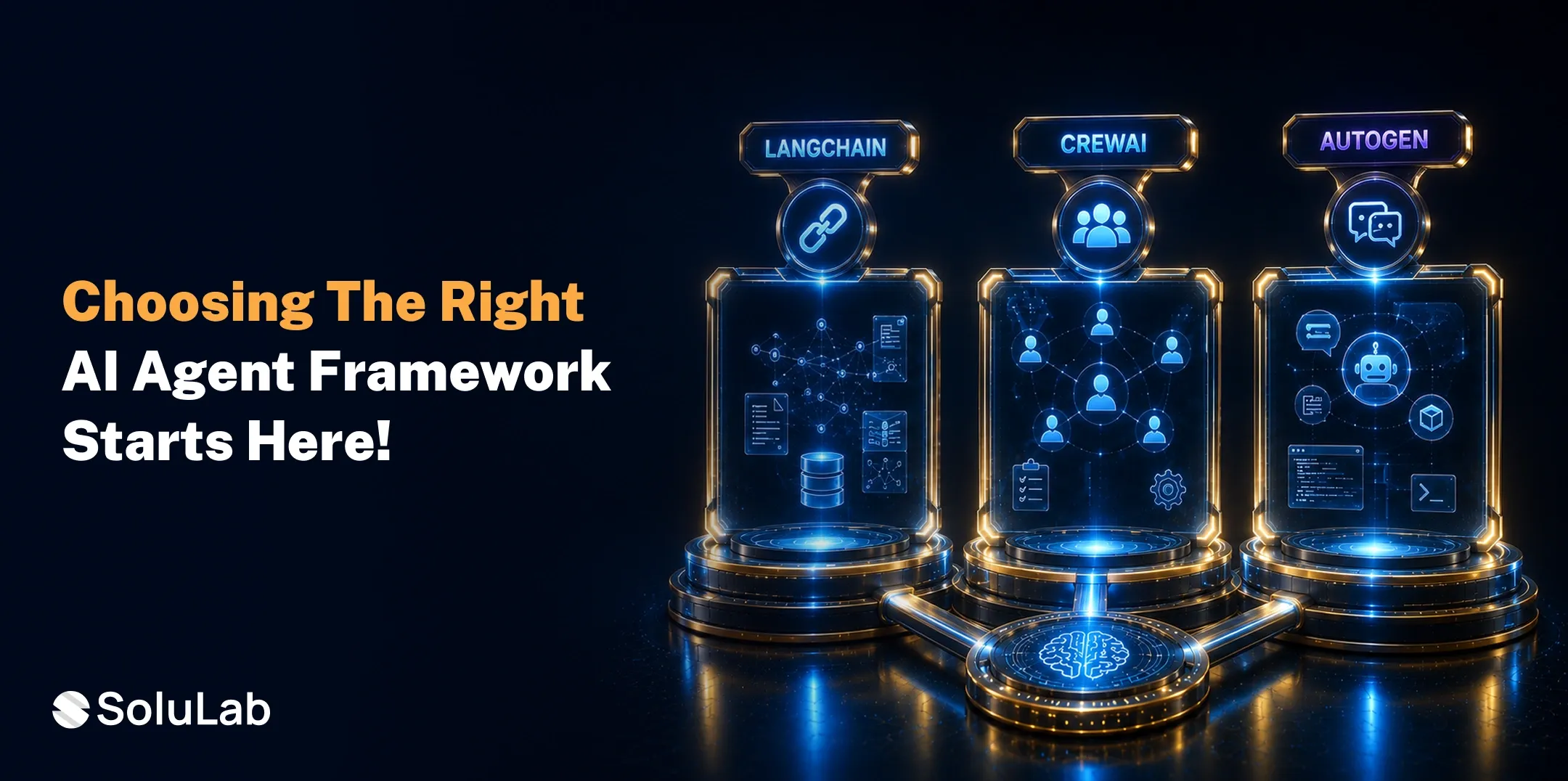
LangChain vs CrewAI vs AutoGen matters when an AI agent has to do more than answer prompts. A support agent must pull tickets, check CRM data, draft replies, and hand off exceptions. A finance agent may read invoices, match rules, and alert teams before errors spread. That is where the right AI agent development changes cost, speed, and control. LangChain fits enterprise apps that need integrations and RAG. CrewAI suits role-based agents that move quickly. AutoGen supports deeper multi-agent collaboration for technical teams.
This guide compares use cases, limits, and AI agent development costs for startups, SMBs, and enterprises.
Key Takeaways
- Choose the right AI agent framework based on workflow complexity, team skills, integrations, budget, and automation goals.
- LangChain fits production-ready AI agents that need RAG, enterprise integrations, observability, and scalable architecture.
- CrewAI helps startups and SMBs build role-based agents quickly for sales, support, marketing, and operations workflows.
- AutoGen supports advanced multi-agent systems for technical teams, research projects, and Microsoft-focused AI environments.
- SoluLab helps businesses move from AI agent ideas to secure, scalable, production-ready automation systems.
Why AI Agent Frameworks Matter for Businesses?
A basic chatbot responds to questions. An AI Agent framework can go further- it can understand a goal and use A basic chatbot to answer questions. An AI agent can plan steps, use tools, pull company data, connect with APIs, and complete work across systems. A sales agent can update CRM records; a support agent can classify tickets; a finance agent can match invoices.
It gives AI Agent Development teams the structure to build reliable automation, not fragile demos, for real operations safely. The benefits include:
Faster AI Agent Development
An AI Agent framework gives developers ready structures for tools, memory, prompts, workflows, and integrations, helping teams build reliable agents faster instead of starting every project from scratch.
Better Workflow Automation
AI agent frameworks help agents follow business steps, use APIs, retrieve data, and complete tasks across systems, making automation more useful than simple chatbot responses or isolated AI tools.
Easier System Integration
Frameworks make it easier to connect AI with CRMs, ERPs, databases, ticketing tools, cloud apps, and internal APIs, so agents can work inside real business operations.
Improved Control and Safety
A strong AI Agent framework helps teams define rules, permissions, memory limits, tool access, and human approvals, reducing the risk of agents making incorrect, unsafe, or unauthorized decisions.
Scalable AI Operations
AI agent frameworks support monitoring, testing, orchestration, and performance tracking, helping businesses move from small AI experiments to scalable automation systems that improve over time.
What is LangChain?
LangChain is a popular AI Agent Development architecture for building applications powered by large language models. For businesses, its biggest value is flexibility. It can support AI agents, retrieval-augmented generation, tool calling, data integrations, workflow orchestration, and production monitoring.
LangChain’s ecosystem also includes LangGraph, which is designed for building more controlled and stateful agent workflows, and LangSmith, which supports tracing, debugging, evaluation, and monitoring of LLM applications.
For mid-level enterprises, SaaS companies, fintech platforms, healthcare technology firms, legal-tech companies, and internal automation teams, LangChain is often a strong choice because it supports deeper customization.
Best business use cases for LangChain
LangChain is suitable for businesses that want to build:
- Custom AI assistants connected to internal data
- RAG-based enterprise search systems
- AI workflow automation tools
- AI copilots for sales, support, finance, legal, or operations
- Agentic software products with long-term scalability
- Multi-step workflows using tools, APIs, and business logic
If your business needs flexibility, integrations, observability, and a more mature development ecosystem, LangChain is usually one of the strongest options.
What is CrewAI?
CrewAI is an AI agent framework focused on building teams of role-based agents. It allows developers to create agents with defined roles, goals, tools, and responsibilities. These agents can work together as a “crew” to complete tasks.
CrewAI works well when the business goal is speed, simplicity, and role-based automation. It is especially useful for startups and SMBs that want to validate AI workflow automation without building a complex enterprise-grade architecture from day one.
Instead of thinking only in technical components, teams can think in roles such as “research agent,” “writer agent,” “reviewer agent,” “sales agent,” or “support agent.”
Best business use cases for CrewAI
CrewAI is suitable for businesses that want to build:
- Sales research agents
- Content marketing automation workflows
- Lead qualification systems
- Market research agents
- Customer support task automation
- Internal productivity agents
- Multi-agent workflows with clear roles
What is AutoGen?
AutoGen is an open-source Microsoft Agent Framework for building multi-agent AI systems. It is an event-driven programming framework for scalable multi-agent AI systems, including deterministic and dynamic workflows, business processes, research collaboration, and distributed multi-agent applications.
AutoGen is useful when a technical team wants to build advanced multi-agent collaboration patterns. It supports scenarios where different agents interact, exchange messages, use tools, and solve complex tasks together.
Best business use cases for AutoGen
AutoGen is suitable for businesses that want to build:
- Complex multi-agent AI systems
- Research-heavy AI workflows
- Developer-focused agent collaboration tools
- Microsoft ecosystem AI solutions
- Advanced workflow orchestration prototypes
- Distributed agent applications
LangChain vs CrewAI vs AutoGen: Quick Comparison
AutoGen is powerful, but it is usually better suited for teams with stronger technical depth. For non-technical SMBs or early-stage startups, CrewAI may feel easier. For production-focused enterprise applications, LangChain or Microsoft Agent Framework may be a stronger long-term fit depending on the AI technology stack.
| Factor | LangChain | CrewAI | AutoGen |
| Best for | Production-grade custom AI agents | Fast role-based multi-agent workflows | Advanced multi-agent systems |
| Ideal users | Mid-level enterprises, SaaS teams, AI product companies | Startups, SMBs, automation teams | Technical teams, R&D teams, Microsoft ecosystem users |
| Learning curve | Moderate | Easier | Moderate to advanced |
| Multi-agent support | Strong with LangGraph | Strong and business-friendly | Strong and flexible |
| Enterprise integrations | Strong | Moderate | Strong for technical teams |
| Observability | Strong with LangSmith | Available in the CrewAI ecosystem | Depends on implementation |
| Speed to prototype | Good | Very good | Good for technical teams |
| Long-term scalability | Strong | Good | Strong, especially for advanced teams |
| Best fit | Custom AI products and enterprise workflows | Business automation and quick deployment | Complex agent collaboration and Microsoft-led architecture |
LangChain vs CrewAI: Which One Should Businesses Choose?
When comparing LangChain vs CrewAI, the right choice depends on whether the business prioritizes flexibility or speed.
- Choose LangChain if your AI agent needs to connect with internal databases, CRMs, ERPs, document repositories, APIs, analytics platforms, and enterprise systems. It is also a better fit when you need production monitoring, advanced RAG, custom workflows, and long-term scalability.
- Choose CrewAI if your goal is to build role-based agents quickly. For example, if you want one agent to research leads, another to write outreach emails, and another to review the final output, CrewAI provides a simple and practical structure.
For startups and SMBs, CrewAI can be a faster starting point. For mid-level enterprises and AI-first products, LangChain usually offers more architectural flexibility.
Read More: Build AI Agents with LangGraph
CrewAI vs AutoGen: Which Is Better for Multi-Agent Systems?
When comparing CrewAI vs AutoGen, CrewAI is usually more business-friendly, while AutoGen is more engineering-heavy.
- CrewAI is easier to map to business roles. A marketing team can understand the idea of a researcher, writer, editor, and strategist working together. A sales team can understand a lead researcher, a CRM updater, and an outreach assistant. This makes CrewAI useful for AI workflow automation where business clarity matters.
- AutoGen is better when developers need more control over agent communication, experimentation, and complex multi-agent behavior. It is a stronger choice for technical R&D, advanced simulations, and sophisticated multi-agent orchestration.
For most SMBs, CrewAI is easier to adopt. For advanced engineering teams, AutoGen may provide more flexibility.

LangChain vs AutoGen: Which Is More Enterprise-Ready?
When comparing LangChain vs AutoGen, LangChain is often more practical for businesses building production applications, while AutoGen is better for complex multi-agent experimentation and Microsoft-oriented environments.
- LangChain has a broader ecosystem for building real-world LLM applications, especially when combined with LangGraph and LangSmith. Its strengths are integrations, workflow design, tool use, observability, and production readiness.
- AutoGen is powerful for multi-agent collaboration, but businesses should evaluate Microsoft’s newer Agent Framework if they are planning a long-term Microsoft-based AI architecture.
For mid-level enterprises that need scalable AI agents across departments, LangChain is often the safer and more flexible choice. For Microsoft-heavy organizations, AutoGen or Microsoft Agent Framework may be more suitable.
Best AI Agent Framework by Business Type
| Business Type | Recommended Framework | Why |
| Early-stage startup | CrewAI | Faster prototyping and simple role-based workflows |
| Growth-stage startup | LangChain or CrewAI | CrewAI for speed, LangChain for scalable product architecture |
| SMB | CrewAI | Easier for sales, support, marketing, and operations automation |
| Mid-level enterprise | LangChain | Better for integrations, governance, monitoring, and customization |
| Microsoft-based enterprise | AutoGen or Microsoft Agent Framework | Better fit for the Microsoft ecosystem and advanced agent workflows |
| AI product company | LangChain | Strong flexibility for building custom AI agent products |
| R&D team | AutoGen | Useful for complex multi-agent experimentation |
Which AI Agent Framework Is Better?
There is no single best AI agent framework for every company. The best AI agent framework depends on your business goal, technical maturity, budget, internal systems, and long-term automation roadmap.
- For most startups and SMBs, CrewAI is a strong starting point because it is practical, fast, and easy to structure around business roles.
- For mid-level enterprises, SaaS companies, and businesses building scalable AI products, LangChain is often the better long-term choice because it supports deeper customization, enterprise integrations, RAG, monitoring, and production-grade architecture.
- For advanced technical teams, research groups, and Microsoft ecosystem companies, AutoGen or Microsoft Agent Framework can be the better option for complex multi-agent systems.
How Do AI Agent Frameworks Work?
AI agent frameworks usually combine several components:
- LLM or model layer- This is the language model that understands instructions, reasons through tasks, and generates responses.
- Tools and API connections- Agents use tools to perform actions such as searching databases, updating CRM records, sending emails, reading files, or triggering workflows.
- Memory and context: Memory helps agents remember useful information during a session or across repeated tasks.
- Workflow orchestration: This controls how tasks move from one step to another and how multiple agents collaborate.
- Guardrails and permissions: These help prevent unsafe actions, incorrect outputs, data leakage, or unauthorized system access.
- Monitoring and evaluation
Observability tools help teams track performance, identify failures, and improve agent behavior over time.
A strong AI Agent Development architecture should include all of these elements, especially when the agent is used in real business operations.
How to Build an AI Agent for Your Business?
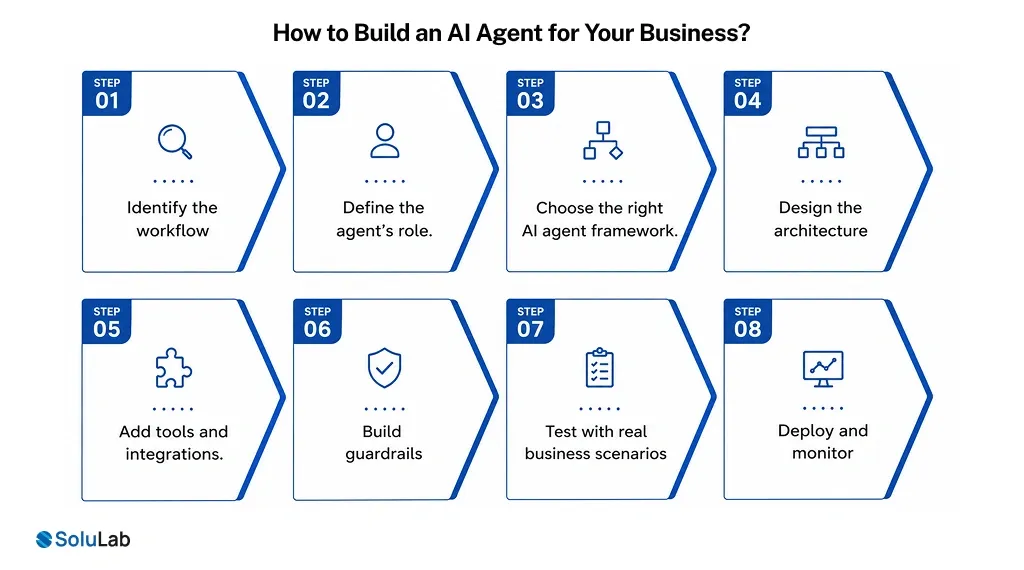
If you are wondering how to build an AI agent, the process should start with business goals, not technology.
Step 1. Identify the workflow
Start by choosing a workflow that is repetitive, time-consuming, and valuable to automate. Examples include customer ticket triage, lead research, invoice processing, report generation, or internal knowledge search.
Step 2. Define the agent’s role.
Decide what the agent should do and what it should not do. A good agent has a clear purpose, defined permissions, and measurable success criteria.
Step 3. Choose the right AI agent framework.
Use CrewAI for fast role-based automation, LangChain for custom production-grade applications, and AutoGen for advanced multi-agent systems.
Step 4. Design the architecture
Plan how the agent will connect with data sources, APIs, business tools, databases, and user interfaces. This is where a strong AI Agent Development company can help avoid costly mistakes.
Step 5. Add tools and integrations.
Connect the agent with business systems such as CRM, ERP, helpdesk software, email, Slack, databases, cloud storage, analytics tools, or custom APIs.
Step 6. Build guardrails
Add access controls, approval steps, output validation, human-in-the-loop review, and safety rules.
Step 7. Test with real business scenarios
Test the agent on actual workflows, edge cases, incomplete data, and high-risk actions before launching.
Step 8. Deploy and monitor
After launch, monitor accuracy, cost, response quality, tool usage, failure points, and user feedback. AI agents need continuous improvement.
What Is The Cost of Building a Custom AI Assistant or Multi-Agent System?
The cost of building a custom AI assistant depends on the number of workflows, integrations, data sources, security requirements, model usage, and deployment complexity. Here is a practical cost range for business planning:
| AI Agent Solution | Estimated Cost Range |
| Basic AI assistant | $15,000–$40,000 |
| Internal workflow automation agent | $30,000–$80,000 |
| Custom AI agent with business integrations | $50,000–$150,000 |
| Multi-agent AI system | $100,000–$300,000+ |
| Enterprise-grade AI agent platform | $250,000–$500,000+ |
Cost can vary based on:
- Number of agents and workflows
- Framework choice
- Data complexity
- API and third-party integrations
- Security and compliance requirements
- Human approval workflows
- Cloud infrastructure
- Ongoing monitoring and maintenance
For startups, it is usually better to start with one high-impact workflow. For mid-level enterprises, it is better to design a scalable architecture from the beginning so future agents can be added without rebuilding the system.
When Should You Hire AI Developers?
You should hire AI developers when your business needs more than a simple chatbot. If your AI agent must connect with business systems, manage sensitive data, automate decisions, use tools, support multiple users, or work across departments, expert development becomes important.
An experienced AI Agent Development company can help with:
- Framework selection
- AI Agent Development Architecture
- LLM integration
- RAG implementation
- Multi-agent system design
- Workflow automation
- API integrations
- Security and guardrails
- Testing and evaluation
- Deployment and monitoring
Working with a Generative AI Development company also helps businesses reduce technical risk. Instead of building a fragile proof of concept, companies can create agents that are reliable, measurable, secure, and ready for real-world usage.
Final Verdict: LangChain vs CrewAI vs AutoGen
For most businesses, the decision can be simplified like this:
- Choose CrewAI if you are a startup or SMB that wants to build role-based AI workflow automation quickly.
- Choose LangChain if you are a mid-level enterprise, SaaS company, or AI product business that needs scalable, customizable, and production-ready AI agents.
- Choose AutoGen if you have a strong technical team, complex multi-agent requirements, or a Microsoft-focused AI development roadmap.
The best AI agent framework is the one that fits your business process, technical maturity, integration needs, and long-term automation strategy.
Build the Right AI Agent with Experts at SoluLab!
Choosing between LangChain, CrewAI, and AutoGen is only the first step. The real value begins when the right framework is matched with the right business workflow, data source, security layer, and deployment plan.
At SoluLab, we help businesses design and build AI agents that do more than look good in demos. Our team focuses on production-ready AI Development that connects with your tools, follows your workflows, and solves real operational problems.
Our team brings the technical depth and delivery experience to build systems that are secure, scalable, and easy for your team to use.
Whether you are a startup validating your first AI workflow, an SMB automating repetitive tasks, or a mid-level enterprise planning a full AI automation roadmap, our team can help you choose the right AI agent framework, build the right architecture, and launch an agent for your business.
FAQs
Shipra Garg is a tech-focused content strategist and copywriter specializing in Web3, blockchain, and artificial intelligence. She has worked with startups and enterprise teams to craft high-conversion content that bridges deep tech with business impact. Her work translates complex innovations into clear, credible, and engaging narratives that drive growth and build trust in emerging tech markets.