Key Takeaways
- AI in drug development spans the full pipeline, from target identification through molecule generation, preclinical prediction, trial design, patient recruitment and regulatory submission.
- The clearest wins are upstream. Target discovery and molecule generation have abundant structured data and a fast computational verification loop.
- Clinical trials are where most of the cost sits, and where AI adoption is newest and least proven.
- Around nine in ten drugs entering clinical trials still never reach approval, and AI has not moved that number yet.
- Validation is the gate, not accuracy. A model that cannot produce a regulator-acceptable audit trail cannot be used in a submission.
- Start where you already have proprietary data. Licensed public datasets give you the same answer as everyone else.
AI in drug development applies machine learning across the pipeline: finding disease targets, generating candidate molecules, predicting toxicity before animal studies, designing trial protocols, matching patients to trials, and assembling regulatory submissions.
Investment reflects that split. Grand View Research values the AI in drug discovery market at roughly $2.9 billion in 2026, projecting about $13.8 billion by 2033 at a compound annual growth rate near 24.8%.
Money is not the constraint here. Evidence is. Discovery has genuinely compressed, while the clinical stages that consume most of the budget have barely moved. This guide walks the pipeline stage by stage, names the companies actually shipping, and reports honestly on what the data does and does not yet show.
What Does AI in Drug Development Actually Do?
AI in drug development replaces exhaustive search with prediction. Instead of physically screening millions of compounds, a model ranks the few thousand worth making. Instead of discovering a toxicity problem in month eighteen, a model flags it in week two.
1. The Core Shift Is Prioritization, Not Automation
Nothing here removes the laboratory. Molecules still get synthesized, animals still get studied, patients still get dosed. What changes is the order of the queue and the size of the shortlist. That distinction matters when you are estimating time saved, because the physical steps set a floor no algorithm gets under.
2. Three Data Types Do Most of the Work
Structural data covering proteins and compounds. Assay and omics data from experiments already run. And text, meaning decades of literature, patents, and trial records. Most production systems combine all three, and the text layer is where a well-built RAG platform earns its place, because the answer to a target question is usually buried in papers nobody has time to read.
3. Where the Verification Loop Is Fast, and Where It Is Not
Docking scores and predicted properties come back in hours. Preclinical results take months. Clinical outcomes take years. That gradient explains almost everything about adoption patterns across the pipeline, including why discovery is crowded, and trial design is not.
Where AI Fits Across the Drug Development Pipeline
Seven stages, running from target to submission. Adoption maturity falls steadily as you move down the list.
1. Target Identification and Validation
Models mine genomic, proteomic, and literature data to propose which biological targets are causally linked to disease. This is where AI in genomics work feeds directly into pipeline decisions. It also has the best ratio of computational effort to downstream value of any stage here.
2. Hit Generation and Lead Optimization
Generative models propose novel molecular structures against a target, then optimize them for potency, selectivity and drug-like properties. Structure prediction tools, including AlphaFold, have changed what is computationally tractable here.
3. Preclinical Prediction of ADMET and Toxicity
Predicting absorption, distribution, metabolism, excretion, and toxicity before synthesis. Killing a bad candidate on a workstation instead of in month fourteen is the cheapest saving available in the whole pipeline.
4. Trial Protocol Design
Models simulate protocol variations against historical trial data to estimate enrolment feasibility, dropout risk, and statistical power. Badly designed protocols cause amendments, and amendments are expensive.
5. Patient Recruitment and Site Selection
Natural language processing reads electronic health records and clinical notes to find eligible patients faster than manual screening. Recruitment delay is the single most common cause of trial overrun.
6. Trial Monitoring and Data Management
Anomaly detection on incoming trial data, risk-based monitoring, and automated query generation. A lot of this work is deterministic enough that robotic process automation handles it without a model at all.
7. Regulatory Writing and Submission
Drafting clinical study reports, assembling submission dossiers and mapping documents to regulatory formats. This is squarely intelligent document processing territory, and it is where several large pharmas have reported their most concrete time savings.
How is AI Changing Drug Discovery?
Discovery is the most mature stage and the most competitive. Structure prediction and generative chemistry have compressed work that used to take years into months, and a number of AI-originated molecules are now in human trials.
1. What the Leading Platforms Are Doing
Insilico Medicine generated both the target and the molecule for its idiopathic pulmonary fibrosis candidate on its own platform, then took it into clinical testing. That remains the most-cited end-to-end example.
Isomorphic Labs, spun out of DeepMind, builds on AlphaFold for structure-based design. Recursion runs automated cell-imaging experiments at enormous scale and trains models on the resulting phenomic data. Schrödinger takes a different route, combining physics-based simulation with machine learning rather than leaning on learned patterns alone.
Large pharma has mostly chosen partnership over building. Merck KGaA, Bayer, Sanofi, and others have run collaborations with AI-native discovery firms, which tells you something about where the specialized capability sits.
2. The Claim That Needs a Caveat
You will see the figure that AI-discovered molecules clear Phase I at 80 to 90%, well above historical averages. Treat it carefully. The sample is small, the molecules are recent, and Phase I tests safety rather than efficacy, which is the easier bar. Phase II is where drugs actually die, and the AI-originated cohort has not yet produced enough Phase II readouts to say anything statistically meaningful.
Some AI-originated candidates have already been discontinued in the clinic. That is normal attrition, not a scandal, but it does argue against reading early success rates as proof of a new paradigm.
3. Where Discovery Work Sits Relative to This Article
Discovery deserves its own treatment and we have given it one. Our deeper breakdown of generative AI in drug discovery covers the model architectures and the chemistry in detail. The rest of this article focuses downstream, where the money and the failures actually concentrate.
How AI Is Changing Clinical Trial Design and Execution
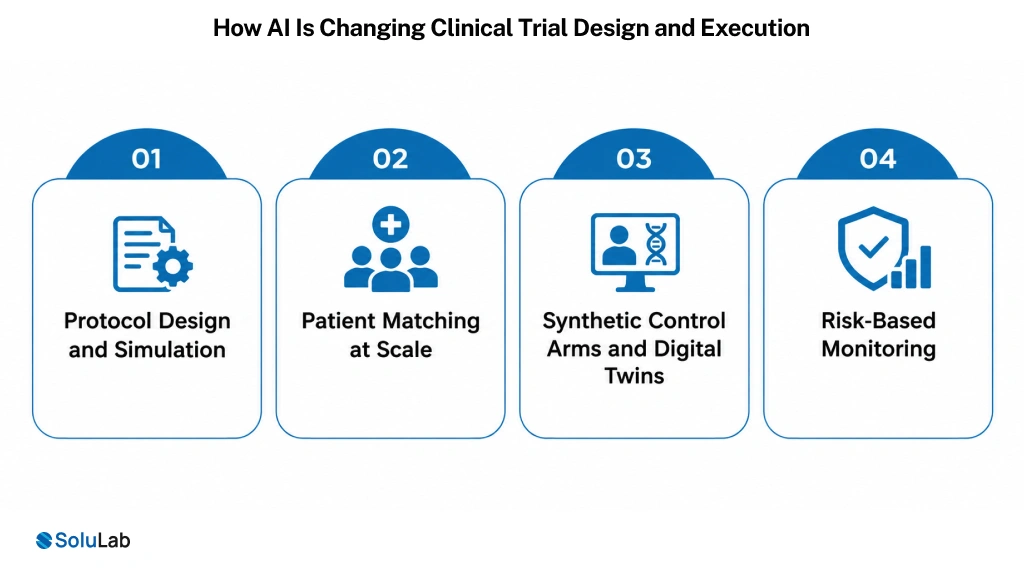
Trials consume the majority of development cost and nearly all of the timeline. They are also where AI adoption is newest, which makes this the highest-upside and highest-uncertainty part of the pipeline.
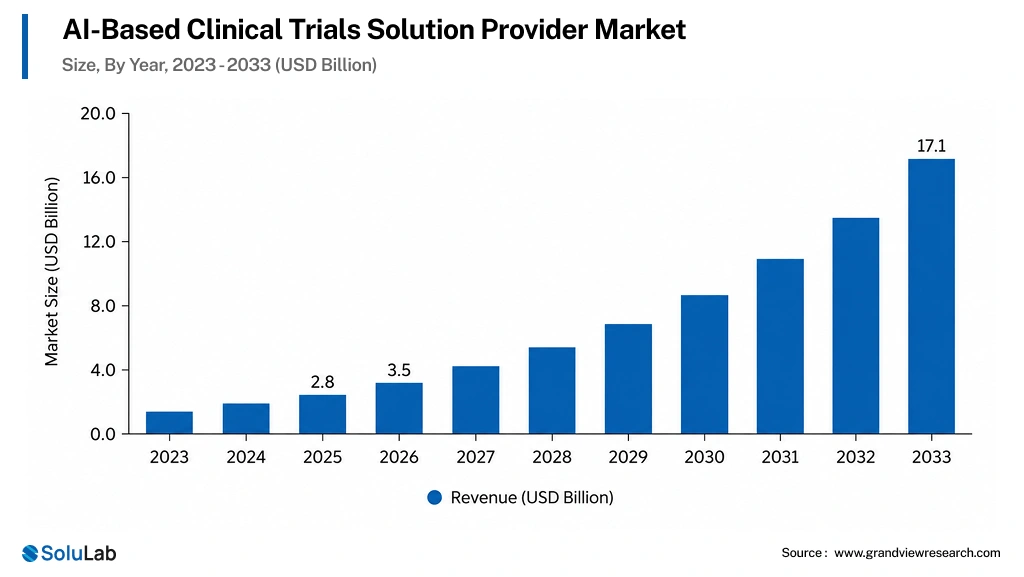
Grand View Research sizes the AI-based clinical trials solution provider market at around $3.5 billion in 2026, projecting $7.8 billion by 2030 at a 22.1% compound annual growth rate. Phase II applications lead, which makes sense. Phase II is where the attrition is.
1. Protocol Design and Simulation
Models trained on historical trial data estimate how a protocol change affects enrolment rate, dropout and required sample size. Run the simulation before the protocol is locked and you avoid amendments later. Each substantive amendment costs money and weeks.
2. Patient Matching at Scale
Eligibility criteria are written in prose. Patient records are unstructured. Matching them manually is slow and misses people. NLP systems including work coming out of the NIH on trial matching read both sides and surface candidates that screening would not have found. Deep 6 AI and similar platforms do this commercially against hospital record systems.
3. Synthetic Control Arms and Digital Twins
This is the most interesting and most contested application. Models built on historical patient data predict how a given patient would have progressed on standard of care. That reduces how many people need randomizing to control. Unlearn.ai is the best-known name here. Regulators have engaged with the concept, cautiously, and acceptance varies considerably by therapeutic area and by agency.
4. Risk-Based Monitoring
Anomaly detection across incoming site data flags protocol deviations, data-entry problems and sites that are drifting before they become findings. This is the least glamorous and most reliably valuable trial application on this list.
Does AI Actually Cut Drug Development Cost and Time?
At programme level, sometimes clearly. At industry level, not yet visibly. Anyone telling you otherwise is selling something, and this gap is the most important thing in this article.
Deloitte’s sixteenth annual analysis of pharmaceutical innovation found projected internal rate of return across the top 20 biopharma companies rose to 7.0% in 2025. That was a third consecutive year of improvement.
Strip out the GLP-1 and GIP obesity assets driving that recovery and average forecast peak sales per asset drops to about $353 million, lower than the year before. Underlying productivity is declining, not improving. R&D cost per asset has meanwhile climbed to roughly $2.23 billion.
Deloitte’s own read on AI is blunt. Despite substantial investment, it has not yet delivered lower R&D costs or faster development across the industry, and it may be contributing to rising cost per asset rather than reducing it. The recommendation is integration across the whole operation rather than isolated pockets.
1. Why Both Things Can Be True
A discovery programme compressing target-to-candidate from four years to eighteen months is a real result. It is also a small fraction of total development cost and time. If the trial phases stay the same length and the failure rate stays the same, the programme-level win barely moves the portfolio number.
2. Around Nine in Ten Trial Entrants Still Fail
That figure has been stable for years, and it is the number that determines pipeline economics. Reducing time to candidate does not help if the candidate fails Phase II for the same biological reasons it always would have. The honest position is that AI has improved the speed of getting to a wrong answer more than it has improved the rate of getting to a right one.
3. What This Means for a Business Case
Do not build your case on portfolio-level cost reduction, because you will not be able to prove it for years. Build it on things you can measure inside a single programme: compounds synthesized per hit, weeks from protocol draft to first patient in, screening hours per enrolled patient, days to assemble a submission dossier. Those are defensible.
Read More: Generative AI in Healthcare Industry
What Does an AI Drug Development Build Cost?
A scoped AI build for a single pipeline stage typically costs between $50,000 and $80,000 and takes 12 to 28 weeks, driven mainly by data readiness, validation burden and how many source systems it touches. Regulated applications sit at the upper end because documentation is a deliverable, not an afterthought.
1. What Drives the Number
| Cost Driver | Effect on Budget | Why |
| Proprietary data readiness | Highest single driver | Assay and trial data are rarely model-ready as stored |
| Regulatory scope | High | GxP validation, audit trails and documentation are engineering work |
| Systems integration count | High | ELN, LIMS, EDC, CTMS and safety databases each add connectors |
| Model type | Moderate | Predictive models are cheaper than generative chemistry platforms |
| Compute requirements | Variable | Structure prediction and simulation carry real infrastructure cost |
| Ongoing validation | Recurring | Models drift, and regulated models need periodic revalidation |
2. Build, Buy or Partner
If you want generative chemistry, partner. The specialized platforms have years of head start and proprietary training data you cannot replicate. Build where your own data is the advantage, which usually means trial operations, internal knowledge retrieval, or prediction models trained on your historical assay results. Buy for commodity workflows like document assembly.
Most engagements start narrower than the client expected, usually as scoped AI integration services work connecting existing systems rather than a new platform.
3. Where Estimates Go Wrong
Data preparation, consistently. Laboratory data lives in formats designed for instruments, not for models. Harmonizing assay results across years, instruments and protocols routinely takes longer than building the model that consumes them. Budget for it explicitly. Otherwise the project slips at exactly that point.
Why Do AI Drug Development Programs Fail?
Mostly on data, validation and scope, rather than on model performance. The pattern repeats across organizations of very different sizes.
1. Training on Public Data Only
If your model learns from the same public datasets everyone else uses, it produces the same answers everyone else gets. Proprietary assay results, failed-compound records and internal trial data are the actual asset. Failed experiments are especially valuable and almost never digitized properly.
2. Treating Validation as a Later Phase
In a regulated environment, a model that works but cannot show its work is unusable. Audit trails, version control, reproducibility, and documented performance characteristics have to be designed in from the first sprint. Retrofitting them is a rebuild. This is standard MLOps discipline applied under a stricter regime.
3. No Bench Scientist in the Loop
Models proposing molecules nobody can synthesize, or targets with no tractable chemistry, are a well-documented failure mode. The teams that get results pair computational and experimental people from day one rather than handing predictions over a wall.
4. Measuring the Wrong Outcome
Model accuracy on a held-out set is not a business result. Compounds synthesized per validated hit is. Patients enrolled per screening hour is. Pick the operational metric before you build, because retrofitting a measurement story to an existing project never convinces anyone.
How to Start Integrating AI Into Your Drug Development Pipeline
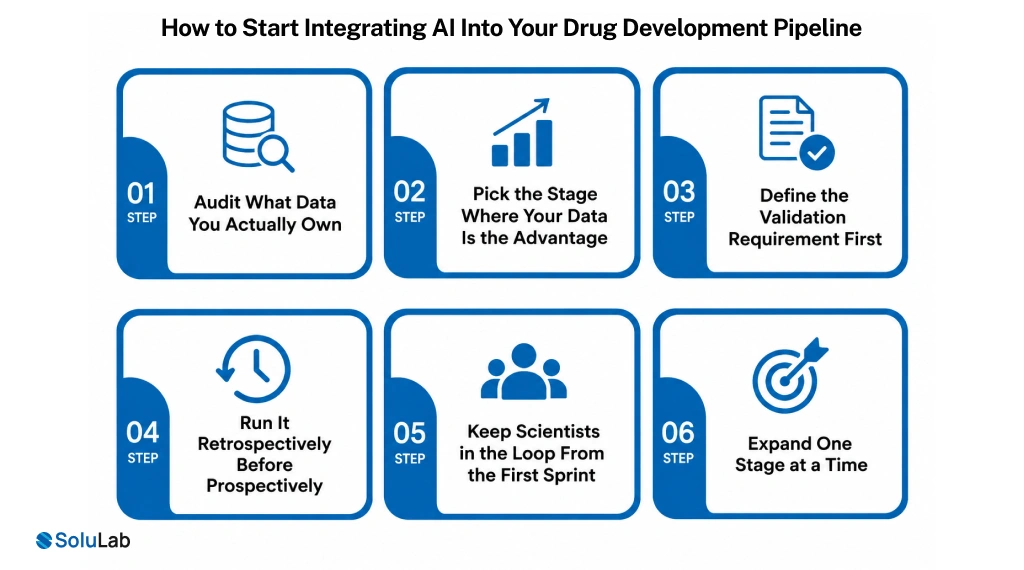
Start where your proprietary data is strongest, not where the technology is most exciting.
1. Audit What Data You Actually Own
Assay results, structure-activity relationships, historical trial data, safety records, and crucially the failures. Score each dataset on volume, consistency and how much cleanup it needs. This audit determines everything downstream.
2. Pick the Stage Where Your Data Is the Advantage
Not the stage with the best vendor demo. If your strength is fifteen years of assay data in one therapeutic area, that is a predictive modelling opportunity nobody else can copy. If it is trial operations, start there instead.
3. Define the Validation Requirement First
Ask early whether the output will inform an internal decision or appear in a regulatory submission. The two have entirely different engineering requirements, and discovering this in month four is expensive.
4. Run It Retrospectively Before Prospectively
Test the model against decisions you already made and outcomes you already know. This gives an honest accuracy baseline without risking a live programme, and it is the fastest way to find out whether your data supports the use case at all.
5. Keep Scientists in the Loop From the First Sprint
Computational and experimental staff reviewing outputs together, weekly. Not a handover at the end. This single practice separates programmes that produce usable candidates from programmes that produce interesting plots.
6. Expand One Stage at a Time
Prove value in one place, then move. Where internal capacity is the constraint it is usually faster to hire AI developers with life sciences validation experience for defined phases, and an AI consulting engagement can run the data audit in step one within a few weeks. Broader context on where the sector is heading sits in our view of the future of AI in healthcare.
Conclusion
The honest summary of AI in drug development is that it is working where verification is fast and evidence is thin where verification is slow. Discovery has compressed. Preclinical prediction is genuinely useful. Trial operations are improving. Whether any of that reaches portfolio-level economics is a different question. The next five years of Phase II readouts will answer it. No vendor can.
If you are deciding where to start, the filter is simple. Find the stage where your own data is better than anyone else’s and begin there. Licensed public datasets and an off-the-shelf model give you the same output your competitors get, which is worth very little.
SoluLab, an AI development company, can help your business audit pipeline data, build models with validation designed in rather than bolted on, and connect them to the laboratory and trial systems you already run.
FAQs
Neha is a curious content writer with a knack for breaking down complex technologies into meaningful, reader-friendly insights. With experience in blockchain, digital assets, and enterprise tech, she focuses on creating content that informs, connects, and supports strategic decision-making.