Key Takeaways
- Gold-backed stablecoins bring physical gold into DeFi and Web3 as programmable, transferable, asset-backed digital value.
- The most promising gold-backed stablecoin use cases include DeFi lending, collateralized borrowing, cross-border settlement, tokenized commodities trading, treasury diversification, and Web3 payments.
- Gold-backed stablecoins in Web3 can power wallets, marketplaces, DAOs, gaming economies, metaverse commerce, and creator payments.
- Businesses need more than token code. They need custody, reserve audits, smart contracts, compliance, liquidity, redemption, and exchange integration.
- SoluLab helps enterprises build asset-backed stablecoin development solutions with strategy, smart contracts, blockchain integration, and real-world deployment support. SoluLab states its stablecoin development services focus on real-world deployment, regulatory alignment, and measurable business outcomes.
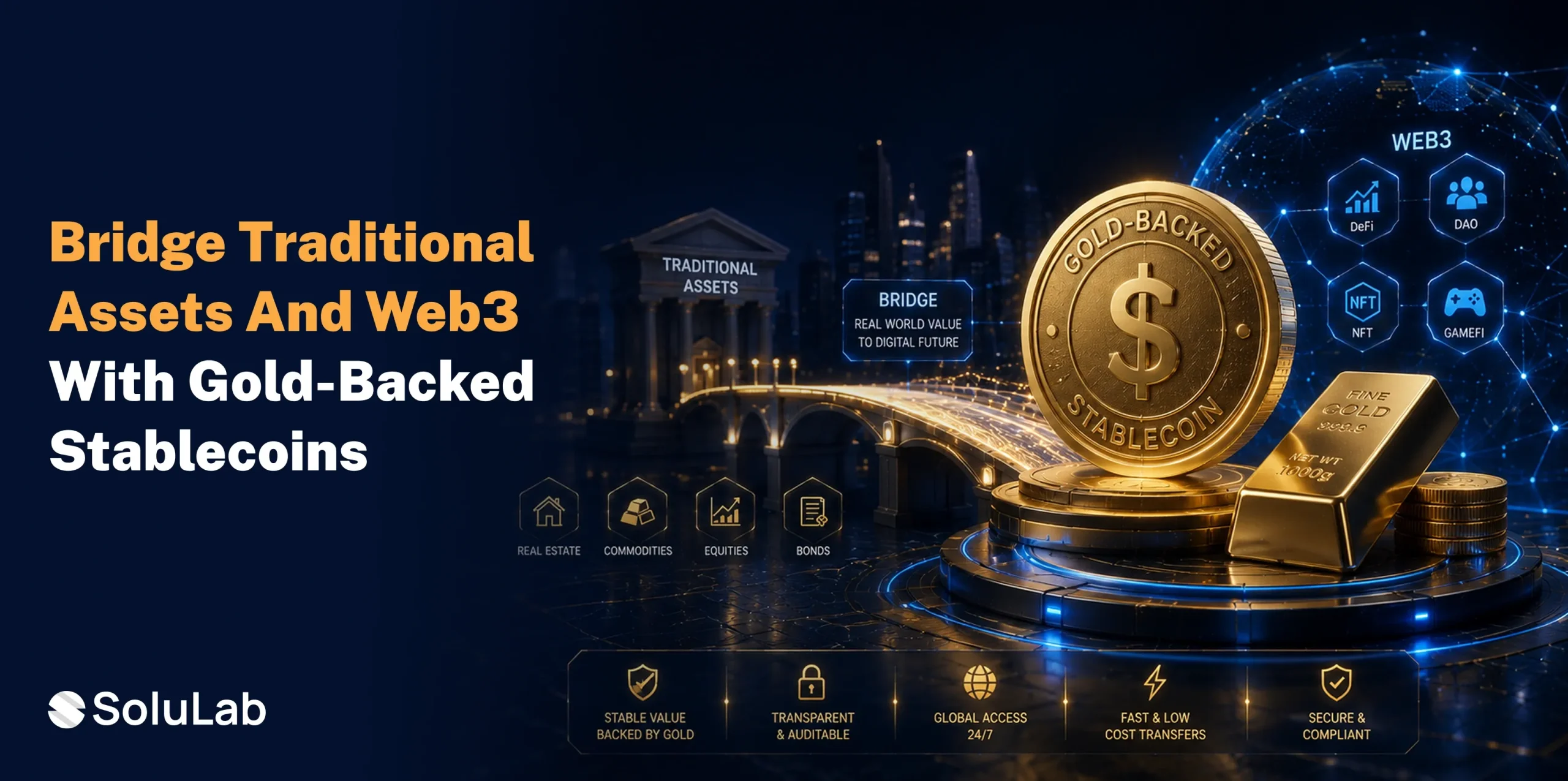
Gold-backed stablecoins are no longer just digital versions of bullion sitting in a vault. They’re becoming genuinely useful financial infrastructure for DeFi protocols, Web3 apps, exchanges, payment platforms, and RWA businesses that need a more trusted on-chain asset to build on. Once gold moves through blockchain rails, it becomes easier to divide, transfer, use as collateral, settle payments with, and plug into automated financial products, something physical gold simply can’t do.
That shift is why businesses are now looking past buying gold-backed tokens and asking how to build their own gold-backed stablecoin platform. A well-built platform can support DeFi liquidity, Web3 payments, remittances, treasury management, tokenized commodity trading, and investor-facing gold products. This guide covers the top 10 practical use cases of gold-backed stablecoins in DeFi and Web3 and what it takes to launch one with a stablecoin development company like SoluLab.
Why Gold-Backed Stablecoins Are Gaining Business Attention?
Businesses want digital assets that aren’t tied only to fiat currencies, and that’s exactly what’s pulling attention toward gold-backed stablecoins. Gold has functioned as a hedge, a reserve asset, and a store of value for centuries. Blockchain gives that same asset a new layer of utility.
A gold-backed token can move across wallets, exchanges, DeFi protocols, payment rails, and Web3 applications in seconds — without anyone physically moving a bar of bullion. That single shift opens real product possibilities for fintech firms, bullion dealers, exchanges, asset managers, wealth platforms, and Web3 startups that want to offer a commodity-backed alternative to dollar-pegged tokens.
The market data backs up the interest. Tokenized gold crossed $5.6 billion in 2026, and two issuers, Tether Gold (XAUT) and Paxos Gold (PAXG), together account for more than 90% of that market.
| Token | Issuer | Approx. Market Cap (2026) | Backing |
| XAUT (Tether Gold) | Tether | ~$2.9B–$3.3B | 1 troy oz gold, Swiss vaults |
| PAXG (Pax Gold) | Paxos Trust Company | ~$2.3B–$2.6B | 1 troy oz gold, LBMA vaults (London) |
| KAU (Kinesis Gold) | Kinesis Money | ~$350M | 1 gram allocated gold |
That concentration isn’t a red flag; it’s proof the model works at scale. But it also leaves a real gap: most businesses can’t just plug into XAUT or PAXG and call it a strategy. Redemption minimums are high, custody and audit structures differ by issuer, and neither token was built around a specific enterprise’s compliance footprint, chain preference, or customer base.
That gap is exactly why more fintechs, bullion dealers, and asset managers are now looking at custom stablecoin development instead of simply integrating an existing gold token, building their own commodity-backed stablecoin with the collateral model, jurisdiction, and blockchain that actually fit their business.
What Makes Gold-Backed Stablecoins in DeFi Different?
Gold-backed stablecoins in DeFi are different from fiat-backed stablecoins because their underlying reserve is gold, not cash, Treasury bills, or bank deposits. This changes the way they are used.
Fiat-backed stablecoins are mainly used for trading, payments, liquidity, and settlement. Gold-backed stablecoins can do those things too, but they also bring commodity exposure into decentralized finance.
| Feature | Fiat-backed stablecoins | Gold-backed stablecoins |
| Reserve asset | Cash, Treasuries, deposits | Physical gold |
| Main value driver | Fiat peg stability | Gold price and reserve trust |
| Common use | Payments, trading, and DeFi liquidity | Collateral, hedging, and tokenized gold investment |
| Investor appeal | Price stability | Gold exposure with blockchain utility |
| Key risk | Banking and reserve risk | Custody, redemption, and gold price volatility |
| Best business use | Payments and settlement | RWA products, gold DeFi, tokenized commodities |
This distinction creates room for gold-backed tokens in DeFi to support a different class of financial products.
Top 10 Use Cases of Gold-Backed Stablecoins in DeFi and Web3
Use Case 1: Gold-Backed Collateral in DeFi Lending
One of the strongest gold-backed stablecoin use cases is collateralized lending. Users can deposit gold-backed tokens into a DeFi lending protocol and borrow stablecoins or other assets against them.
This is useful because many investors do not want to sell gold exposure during market uncertainty. Instead, they may want liquidity while keeping gold-backed holdings. A DeFi platform can support:
- Gold-backed token deposits
- Loan-to-value rules
- Automated collateral monitoring
- Liquidation logic
- Oracle-based gold pricing
- Borrowing in fiat-backed stablecoins
- Institutional lending dashboards
Use Case 2: On-Chain Gold Savings and Wealth Apps
A blockchain gold investment platform can use gold-backed stablecoins to make gold savings more flexible. Instead of buying physical coins or bars, users can buy fractional gold-backed digital assets and track them from a wallet or mobile app.
This model works well for fintechs, neobanks, wealth apps, and retail investment platforms. Users can build recurring gold savings plans, automate purchases, receive alerts, and redeem through platform rules.
Use Case 3: Stablecoins Remittances Backed by Gold Value
Stablecoin remittances are usually discussed around dollar-backed assets. But gold-backed stablecoins can serve a different remittance audience: users who want value transfer linked to gold rather than a fiat currency. This can be useful in regions where families already trust gold as a savings asset. A worker may send value home in a gold-backed token. The receiver may hold it, convert it, spend it, or redeem it through approved partners.
For businesses building Web3 stablecoin solutions, this creates a practical opportunity: combine gold-backed value with wallet-based transfer, local payout partners, and compliant user verification.
Use Case 4: Tokenized Commodity Trading
Gold is only one part of the tokenized commodities market. Once a business builds the infrastructure for gold-backed stablecoins, it can expand into silver, platinum, oil, agricultural commodities, carbon credits, or other real-world assets. Here, the precious metal tokenization becomes a launchpad for broader RWA tokenization. A tokenized commodity platform can include:
| Platform module | Business purpose |
| Commodity onboarding | Verifies the physical asset |
| Custody integration | Connects vaults, warehouses, or custodians |
| Token minting | Issues asset-backed tokens |
| Reserve tracking | Matches supply to reserves |
| Trading engine | Enables buying and selling |
| Redemption module | Supports physical or cash settlement |
| Compliance layer | Manages KYC, AML, and jurisdiction rules |
Use Case 5: DeFi Liquidity Pools With Gold-Backed Assets
Gold-backed stablecoins in DeFi can be used in liquidity pools where users provide gold-backed assets and other tokens to decentralized exchanges. This can help create trading pairs such as PAXG/USDC, XAUt/USDT, gold token/ETH, or gold token/stablecoin pairs. For users, liquidity pools can provide trading access and potential fee income. For businesses, liquidity pools can help bootstrap market depth for a new gold-backed crypto product.
However, platform operators must manage risks carefully. Gold-backed assets are not always flat-pegged like fiat stablecoins. Their value moves with the gold price. This means liquidity pools need proper pricing oracles, risk parameters, and user education.
Use Case 6: DAO Treasury Diversification
DAOs often hold treasuries in volatile crypto assets or dollar-backed stablecoins. Gold-backed digital assets give them another option. A DAO can allocate part of its treasury to tokenized gold stablecoins to diversify reserve exposure. This can reduce dependence on one fiat currency or one volatile crypto asset.
A DAO treasury strategy may use:
- Dollar stablecoins for operating expenses
- ETH or BTC for growth exposure
- Gold-backed stablecoins for reserve diversification
- Tokenized T-bills or money-market RWAs for yield
- Governance rules for allocation limits
Use Case 7: Gold-Backed Trading Pairs on Crypto Exchanges
Crypto exchanges can use gold-backed crypto products to attract investors looking for commodity-backed assets. Instead of offering only BTC, ETH, and fiat stablecoins, exchanges can list gold-backed trading pairs. Useful pairs may include:
- XAUt/USDT
- PAXG/USDC
- Gold token/BTC
- Gold token/ETH
- Gold token/local stablecoin
For exchange operators, this creates more trading volume, better product diversity, and safer options for users seeking gold exposure. For development teams, this creates demand for gold-backed crypto exchange solutions, liquidity systems, custody integrations, and reserve reporting tools.
Use Case 8: Real-World Asset Collateral for Institutional DeFi
Institutional DeFi is moving toward assets that can be verified, priced, audited, and legally structured. Gold-backed digital assets fit this direction when they include clear custody, reserve reporting, redemption terms, and legal ownership rights.
A bank, asset manager, or lending desk may use tokenized gold stablecoins as collateral in private DeFi markets or permissioned lending pools. The platform can enforce participant whitelisting, transaction limits, asset eligibility, and automated reporting.
This is where real-world asset tokenization platform development becomes important. The system must connect physical reserves, legal agreements, smart contracts, investor eligibility, and settlement workflows into one trusted environment.
Use Case 9: Gold-Backed Yield Products
Gold itself does not generate yield like a bond. But gold-backed stablecoins can be used in DeFi strategies that create yield from lending, liquidity provision, structured products, or collateralized borrowing. This is attractive but risky. A platform must clearly separate gold exposure from yield risk. If the yield comes from lending or liquidity pools, users should understand smart contract risk, counterparty risk, liquidation risk, and impermanent loss. A responsible enterprise stablecoin development project should include:
- Yield source disclosure
- Risk ratings
- Automated strategy limits
- Smart contract audits
- Investor suitability checks
- Real-time monitoring
- Emergency pause controls
Use Case 10: Gold-Backed Stablecoin Cards and Wallets
Web3 wallets can integrate gold stablecoin balances alongside fiat-backed stablecoins, NFTs, and crypto assets. A user may hold tokenized gold and spend it by converting at checkout. This creates a modern version of gold-backed spending. The user does not hand over gold. The wallet converts or settles the value digitally. A business building this product needs:
- Wallet infrastructure
- Token support
- Swap routing
- Merchant settlement
- Compliance checks
- Custody options
- Transaction monitoring
- User-friendly UX
For companies offering Web3 stablecoin solutions, this is a strong product direction because it connects gold-backed savings with real digital spending.

Architecture of a Gold-Backed Stablecoin Platform
A strong gold-backed stablecoin platform needs more than ERC-20 token creation. It must connect the physical gold layer with blockchain, compliance, payments, liquidity, and user experience.
| Architecture layer | What it does |
| Gold custody layer | Connects vaults, refiners, custodians, and insurance |
| Reserve management layer | Tracks physical gold against token supply |
| Token smart contract layer | Handles minting, burning, transfers, supply rules, and permissions |
| Compliance layer | Adds KYC, AML, sanctions checks, KYB, and jurisdiction controls |
| Oracle layer | Provides reliable gold price feeds and reserve data |
| Wallet layer | Allows users to hold, transfer, and redeem tokens |
| DeFi integration layer | Connects lending, liquidity pools, staking, and swaps |
| Exchange layer | Supports listings, trading pairs, and liquidity management |
| Admin dashboard | Manages reserves, users, transactions, redemptions, and reports |
| Audit layer | Stores logs, reserve reports, smart contract events, and compliance records |
This architecture is central to asset-backed stablecoin development because the asset must stay matched to the token at every stage.
How to Create Gold-Backed Stablecoin Products?
Businesses that want to create gold-backed stablecoin products should follow a structured process:
- Define the stablecoin model: Decide whether each token represents one gram, one ounce, a fractional interest, or another legally defined claim on gold.
- Secure gold custody: Work with insured vaults, refiners, custodians, or bullion partners.
- Create the legal structure: Define investor rights, redemption rules, issuer obligations, and reserve ownership.
- Build smart contracts: Develop minting, burning, transfer, compliance, pause, and redemption logic.
- Integrate reserve tracking: Match tokens in circulation with verified physical gold reserves.
- Add compliance workflows: Include KYC, AML, KYB, sanctions screening, and jurisdiction controls.
- Build user and admin dashboards: Users need holdings, transactions, price data, and redemption options. Operators need controls and reports.
- Plan liquidity and exchange access: Add internal marketplace features, DEX pairs, CEX listings, or OTC flows.
- Audit the platform: Audit smart contracts, custody records, backend systems, and security controls.
- Launch with transparent reporting: Publish reserve information, fees, redemption terms, and risk disclosures.
Why Businesses Need a Stablecoin Development Company?
A stablecoin development company helps businesses avoid the biggest mistake in this market: launching a token without infrastructure.
Gold-backed stablecoins need custody, compliance, audits, liquidity, reserve reporting, smart contracts, wallet systems, and exchange readiness. If any of these layers are weak, the product loses trust quickly.
SoluLab is relevant here because its stablecoin development services are positioned around strategy, real-world deployment, regulatory alignment, and measurable business outcomes. Its asset-backed stablecoin content also explains that asset-backed coins can be pegged to reserves such as USD, gold, or other commodities.
For enterprises, this matters because gold-backed stablecoins are not only crypto assets. They are regulated financial products, commodity-linked assets, and trust-based platforms.
Revenue Models for Gold-Backed Stablecoin Development
A business can monetize a gold-backed stablecoin ecosystem in several ways.
| Revenue model | How it works |
| Issuance fee | Charge users or institutions when tokens are minted |
| Redemption fee | Charge when users redeem tokens for gold or cash |
| Trading fee | Earn from swaps, exchange activity, or marketplace trades |
| Custody fee | Charge for secure storage and reserve management |
| Spread model | Earn through buy-sell pricing spreads |
| API access | Offer gold-backed stablecoin rails to fintechs and wallets |
| White-label licensing | License the platform to exchanges, bullion dealers, or wealth apps |
| DeFi integration fee | Earn from lending, liquidity, or protocol partnerships |
| Enterprise treasury fee | Offer gold-backed treasury products to businesses |
Risks Businesses Must Control For Stablecoin Development
Gold-backed stablecoin platforms must be built around trust. The main risks include:
- Custody risk: The gold must exist, be insured, and be held by credible custodians.
- Reserve mismatch risk: Token supply must always match gold reserves.
- Redemption risk: Users need clear rules for redeeming gold or cash.
- Smart contract risk: Bugs can affect minting, burning, transfers, or collateral.
- Oracle risk: Bad gold price feeds can harm lending, liquidations, and DeFi integrations.
- Regulatory risk: Stablecoin and commodity token rules vary by jurisdiction.
- Liquidity risk: Users may struggle to exit if markets are shallow.
- Marketing risk: Businesses should not present gold-backed tokens as risk-free products.
Global regulators have repeatedly highlighted stablecoin governance, reserve, redemption, and financial stability risks. The FSB’s recommendations aim to promote consistent regulation and supervision of global stablecoin arrangements.
Future of Gold-Backed Stablecoins in Web3
The future of gold-backed stablecoins in Web3 will be shaped by three forces: RWA adoption, stablecoin regulation, and demand for trusted digital value. In the next phase, gold-backed stablecoins may become part of:
- RWA lending markets
- Tokenized commodities exchanges
- Web3 treasury tools
- Cross-border settlement networks
- Gold-backed payment wallets
- Institutional DeFi platforms
- DAO reserve strategies
- Mobile gold savings apps
- Commodity-backed financial products

Final Thoughts
Gold-backed stablecoins are moving from a niche crypto asset to a serious building block for DeFi, Web3, tokenized commodities, and real-world asset finance. Their value comes from the combination of physical gold backing and blockchain programmability. The strongest gold-backed stablecoin use cases include DeFi lending, tokenized gold savings, remittances, DAO treasuries, exchange trading pairs, Web3 payments, B2B settlement, and institutional RWA collateral.
A well-built gold-backed stablecoin platform can generate revenue through issuance, trading, custody, redemption, APIs, white-label licensing, and DeFi integrations. But the platform must be built with custody, compliance, reserve transparency, smart contract security, and liquidity from day one.
SoluLab’s Role in Stablecoin Development!
SoluLab can support companies that want to build a gold tokenization platform or expand into gold-backed stablecoin development. Its broader blockchain and asset tokenization capabilities include tokenizing real-world assets such as commodities and building platforms designed for security, compliance, and liquidity.
A business can work with SoluLab for:
- Stablecoin architecture
- Smart contract development
- Gold tokenization workflows
- DeFi protocol integration
- Wallet and dashboard development
- KYC/AML integration
- Exchange and liquidity features
- Reserve tracking modules
- Web3 payment systems
- Enterprise-grade deployment
FAQs
Shipra Garg is a tech-focused content strategist and copywriter specializing in Web3, blockchain, and artificial intelligence. She has worked with startups and enterprise teams to craft high-conversion content that bridges deep tech with business impact. Her work translates complex innovations into clear, credible, and engaging narratives that drive growth and build trust in emerging tech markets.