Key Takeaways
- The Problem: Traditional payment rails cost 2.5–6.8% per transaction and settle in 1–5 business days. For global businesses, that’s a direct P&L problem, which is not a tech debate. The World Bank pegs the average global remittance fee at 6.2% as of 2023.
- The Solution: Web3 payment solutions remove intermediaries, execute payment logic through smart contracts, and settle in seconds for fractions of a cent. The result: faster cash flow, lower costs, and full business control over how and when payments move.
- How SoluLab Helps: As a full-stack Web3 development company, SoluLab has built Web3 payment solutions for businesses across fintech, logistics, healthcare, and retail end-to-end, from architecture through compliance to launch.
Most businesses don’t wake up wanting to adopt Web3 payments. They wake up frustrated by failed cross-border settlements, frozen payouts, chargebacks they can’t contest, and payment processors quietly skimming 4–7% off revenue at scale.
If you’re moving money globally, running a marketplace, handling subscriptions, or operating in high-velocity digital commerce, payments stop being a backend feature and start becoming a strategic liability. That’s the moment Web3 payment infrastructure enters the conversation, not as a trend, but as an operational upgrade.
Web3 development solutions are no longer about experimentation or ideology. They are about control: programmable money flows, instant settlement, transparent reconciliation, and payment rails that operate 24/7 without relying on fragmented banking systems.
This guide is written for founders, CFOs, and CXOs who are past the curiosity stage and want clarity on how Web3 payments actually work and what separates a production-grade payment system from a fragile prototype. If payments are central to your business model, this is a decision you don’t get to postpone for long.
Why Web3 Payment Solutions Matter Now for Businesses in 2026?
The World Economic Forum has projected that blockchain could displace up to $3.1 trillion in value held by financial intermediaries by 2030. Visa, JPMorgan, and PayPal are not building Web3 infrastructure out of curiosity, they’re responding to where enterprise money is already moving.
The Web3 payments gateways address the three things business operators actually care about: cost, speed, and control. A standard SWIFT international wire costs 5–7% in fees and takes 3–5 business days to land. A USDC stablecoin transfer on Polygon settles in under 3 seconds for less than $0.01. That’s not an incremental improvement, that’s a different category of infrastructure.
If you are planning to implement Web3 payments, it can also opens up customer segments that traditional banking systems simply don’t serve. Chainalysis’ 2024 Global Crypto Adoption Index shows that crypto adoption has grown fastest in Southeast Asia and Latin America, where populations are largely excluded from conventional banking.
For any business operating across borders, that’s a real addressable market waiting.
Why Businesses Are Implementing Web3 Payment Systems Over Traditional Gateways
Here’s the honest comparison most founders ask for before making a build decision:
| Feature | Traditional Payments | Web3 Payments |
| Settlement Time | 1–5 Business Days | Under 3 Seconds |
| Avg. Transaction Fee | 2.5–6.8% | < 0.1% |
| Chargeback Risk | High | Near Zero |
| Cross-Border Support | Limited / Costly | Native & Free |
| Availability | Business Hours Only | 24/7/365 |
| Custody & Control | Bank-Controlled | Business-Controlled |
Web3 payment gateway vs traditional payment gateway isn’t purely a technology decision; it’s a question of who controls your money, at what cost, and on whose schedule.
A Web3 payment system gives you fully programmable payment logic: release funds on confirmed delivery, split revenue automatically among vendors, and trigger refunds based on on-chain conditions with no manual processes, disputes, or chargebacks.
We believe that the decentralized Web3 ecosystem is the structural foundation that makes trustless, permissionless payment infrastructure possible.
Core Components Required to Integrate Web3 Payments Into Your Business
Before you write a line of code, you need to understand every component of Web3 payments and how Web3 payments work. A production-grade Web3 and crypto payment gateway is built from six distinct layers:
- Smart Contracts: The payment logic engine. Handles payment release, escrow conditions, split payments, and refund rules automatically. No human intervention required or possible.
- Web3 Wallet Layer: Web3 wallet integration for payments connects MetaMask, Coinbase Wallet, and WalletConnect to your platform. This is your checkout experience, and it’s where UX is won or lost.
- Multi-Chain Support: USDC on Ethereum, MATIC on Polygon, USDT on Tron. Enterprise-grade systems need chain-agnostic infrastructure to serve global users at the lowest cost.
- Fiat On/Off Ramps: MoonPay, Transak, or Stripe’s crypto layer. Users who don’t own crypto can still pay through your Web3 gateway with no friction or crypto knowledge required.
- Compliance Stack: KYC, AML, OFAC screening, and Travel Rule compliance. Non-negotiable for any regulated business or anyone operating in the US, EU, or UAE markets.
- Treasury & Reporting Dashboard: Real-time visibility into transaction flows, wallet balances, and settlement status. CFOs need these insights as much as developers do.
Staying current with web3 development trends helps you make better architectural decisions before you commit to a stack that’s hard to change later.
Step-by-Step Guide to Integrating Web3 Payments into Your Business Architecture
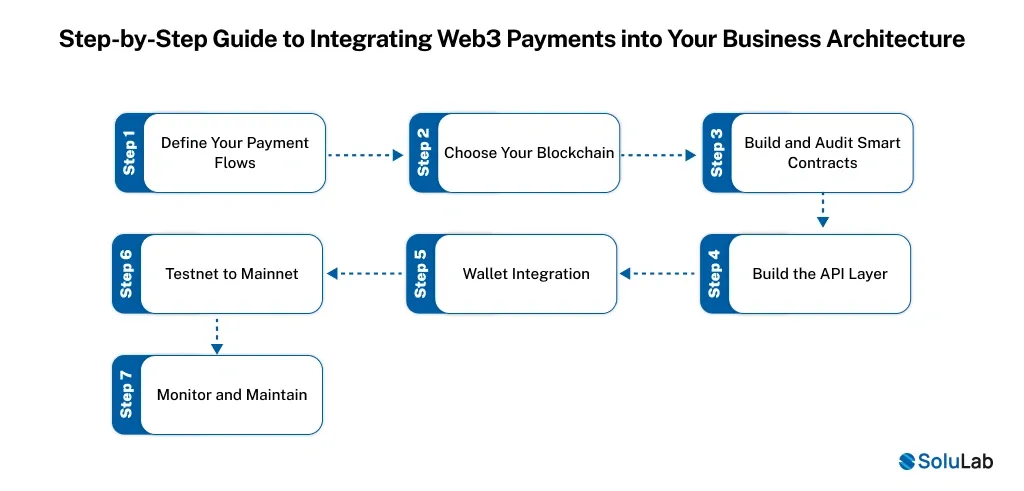
Here’s how experienced teams approach web3 payment gateway development for production. These aren’t theoretical steps; this is what a real build looks like:
Step 1 – Define Your Payment Flows
Map every transaction type your business needs: one-time, recurring, escrow, split payments, and refunds. Each becomes a distinct smart contract module. Do this with finance and product before writing any code, as it saves months of rework down the line.
Step 2 – Choose Your Blockchain
Ethereum for security and DeFi composability. Polygon or Base for low fees and rapid finality. Solana for high-throughput applications. This decision drives your gas economics, UX, and developer tooling across the entire project.
Step 3 – Build and Audit Smart Contracts
Write in Solidity (EVM chains) or Rust (Solana). Audit with CertiK, Halborn, or OpenZeppelin Defender before any mainnet deployment. Skipping audits is how nine-figure exploits happen and no enterprise client will accept unaudited contracts.
Step 4 – Build the API Layer
Build RESTful or GraphQL APIs that abstract blockchain complexity from your frontend and integrations. This is how you integrate Web3 payment gateway into existing applications, ERP systems, or e-commerce platforms without rewriting your entire tech stack.
Step 5 – Wallet Integration
Web3 wallet integration for payments means supporting WalletConnect v2, MetaMask SDK, and Coinbase Wallet SDK as a minimum baseline. For users who don’t have wallets, embedded solutions like Privy or Dynamic handle onboarding seamlessly with no seed phrases, or friction at checkout.
Step 6 – Testnet to Mainnet
Deploy to Polygon Mumbai or Ethereum Sepolia first. Stress test with simulated transaction loads and real-world payment scenarios. Only move to mainnet after full regression testing with live money, which means no second chances.
Step 7 – Monitor and Maintain
Use The Graph or Tenderly for on-chain monitoring. Automate alerts for failed transactions, gas spikes, and contract events. Payments infrastructure is mission-critical, it needs 24/7 visibility and an incident response plan.
If you’re serving US customers, learn how to build a CFTC-Compliant Web3 wallet to stay on the right side of financial regulators from day one.
Security & Compliance for Web3 Payment Solutions in Business
Security and compliance for Web3 payments is where most builds either stall or get shut down post-launch. Here’s what a production-grade Web3 payment system compliance stack actually requires:
- KYC/AML Integration: Real-time identity verification and transaction monitoring via Sumsub, Elliptic, or Chainalysis APIs, which will be integrated at the transaction level, not bolted on afterward.
- OFAC Sanctions Screening: Every wallet address is screened at payment initiation. This is a legal requirement for US-facing businesses, not a best practice you can defer to later.
- Smart Contract Security Audits: Reentrancy attacks, integer overflows, and access control exploits are the most common vectors. Mandatory audit before mainnet, no exceptions.
- GDPR / CCPA Compliance: Off-chain user data must comply with data privacy regulations. Keep on-chain transaction records structurally separated from personally identifiable information.
- FATF Travel Rule: For VASPs processing crypto above regulatory thresholds, compliant messaging via Notabene or Sygna is required in most jurisdictions. Build it in early.
Web3 payment security best practices at the infrastructure level mean multi-signature treasury wallets, hardware security modules (HSMs) for private key storage, and quarterly penetration testing on all deployed smart contracts, not just at launch.
Partnering with a web3 development company in USA ensures regulatory awareness is built into the architecture from day one, not added as an expensive afterthought.
How to Deploy & Integrate a Web3 Payment Gateway in Your Business
The fastest path to production isn’t always a greenfield build. Most enterprise teams integrate Web3 payment gateway capabilities into existing infrastructure through APIs and pre-built modules. Here’s how that looks by channel:
- E-Commerce (Shopify, WooCommerce, Magento): Plugin-based integration. Add crypto checkout alongside your existing payment methods in under a day with no backend rebuilds.
- ERP Systems (SAP, Oracle, NetSuite): API middleware connects your blockchain payment layer to existing finance and accounting systems without disrupting current workflows.
- Mobile (iOS / Android): React Native and Flutter SDKs for WalletConnect make in-app crypto payments feel native to users, with no visible blockchain complexity.
- B2B Invoicing: Smart contract payment links or QR codes tied to escrow conditions. Eliminates manual reconciliation and 30-day payment cycles in one move.
An all-in-one Web3 payment gateway solution handles all of these channels from a single dashboard, which is exactly what CFOs and operations teams need for unified reporting and control across payment types.
Understanding every component of Web3 payments, from the wallet SDK to the compliance API is what separates a clean integration from a painful and expensive rebuild six months after launch. And knowing the top Web3 platforms helps you select the right infrastructure layer for your specific use case and target geographic market.
Use Cases of Web3 Payments in Business
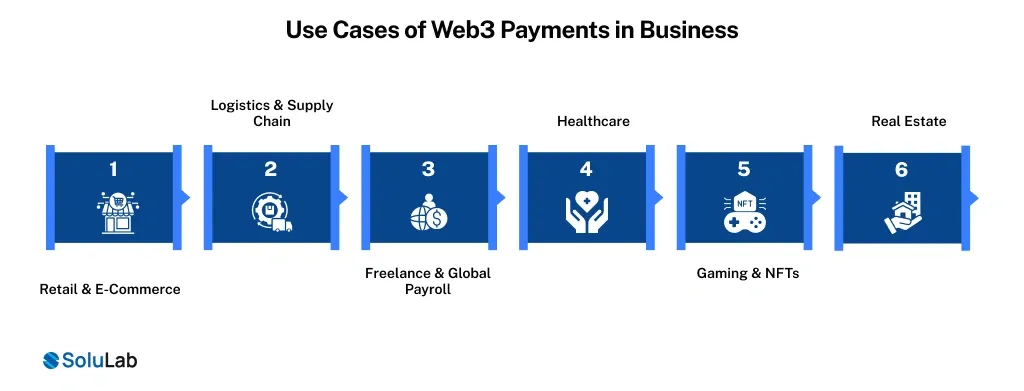
The use cases of web3 payments in businesses extend well beyond crypto-native startups. Here’s where real traction is happening across traditional industries:
- Retail & E-Commerce — Stablecoin checkouts with no chargeback risk. One European fashion retailer cut payment processing costs by 4.2% after switching to USDC settlements.
- Logistics & Supply Chain — Escrow payments released automatically on confirmed delivery confirmation. Eliminates invoice disputes and weeks-long payment delays entirely.
- Freelance & Global Payroll — Stablecoin payroll for cross-border contractors. Companies like Deel and Bitwage process millions monthly this way, with full compliance.
- Healthcare — Cross-border patient billing with a full on-chain audit trail for regulatory compliance without storing protected health information on-chain.
- Gaming & NFTs — In-game purchases, royalty splits, and marketplace settlements running natively with no payment processor middleware required.
- Real Estate — Token-based escrow and fractional ownership settlements with automated distribution logic built directly into smart contracts.
Web3 solutions in payments are no longer a niche story for crypto-native companies. They’re becoming a competitive infrastructure for any business dealing with cross-border payments, chargeback losses, or complex vendor settlement structures.
Our Web3 payments for businesses like yours don’t require your customers to understand blockchain. With fiat on-ramps and embedded wallets, the checkout experience looks exactly like any modern payment flow, but the rails beneath it are fundamentally different.
Once your payment infrastructure is ready, learn how to launch web3 app efficiently to reach users at scale without a painfully slow rollout.
Cost to Develop Web3 Payment Gateway: DIY vs Custom vs All-in-One Solutions
The cost to develop Web3 payment gateway varies dramatically based on how you approach it. Here’s the honest breakdown decision-makers need:
| Approach | Cost Range | Timeline | IP Ownership |
| DIY (Internal Team) | $250K–$500K+ | 12–18 Months | Full |
| SaaS Provider (BitPay / Coinbase) | $0–$500/month | 1–2 Weeks | None |
| Custom Partner (SoluLab) | $40K–$150K | 3–5 Months | Full |
SaaS works for low-volume or early-stage use cases but breaks at enterprise scale, you’re locked into someone else’s logic, pricing model, and product roadmap. DIY makes sense only if payments are your core product and you have the team to build and maintain it. For most growing enterprises, custom development with a proven blockchain development company is the fastest path to a production system you fully own.
Web3 payment gateway vs traditional payment gateway economics become even clearer when you factor in long-term fee savings and chargeback losses eliminated over a 24–36 month period, as the math almost always favors Web3.
Our Web3 payment gateways, built as custom systems, also age significantly better than SaaS solutions. Your payment logic lives in your smart contracts, not locked inside a platform you don’t control.
That’s why we suggest you to hire blockchain developers with domain-specific payment expertise, not just generalist smart contract coders, the difference in project outcome is substantial.
Why Choose SoluLab for Web3 Payment Solution Development?
Web3 solutions require more than developers, as they need architects who’ve shipped real products in regulated environments. Here’s what SoluLab brings to every project:
- 200+ blockchain projects delivered across 18 industries in the US, EU, UAE, and Southeast Asia
- Dedicated payment teams with deep experience in Web3 payment gateway development for fintech, logistics, healthcare, and real estate
- Full-stack capability — smart contracts, APIs, mobile SDKs, compliance integration, analytics dashboards, and post-launch support under one roof
- Regulated market experience — GDPR, CCPA, PCI-DSS awareness, and financial regulatory alignment built into every project scope
- ISO 27001-certified development processes with documented security protocols from day one
When you hire Web3 developers from SoluLab, you’re not bringing on freelancers or generalist coders; you’re engaging a team that has built Web3 payment solutions for business end-to-end, from architecture and smart contract development through compliance and production launch.
When you need an all-in-one Web3 payment gateway solution, SoluLab designs, builds, and maintains the full stack so your team stays focused on the business, not the infrastructure beneath it. Not just that, due to its AI native strategy, you can also streamline your AI in Web3 solutions without any extra hassle.
Conclusion
The shift toward implementing Web3 payments isn’t a future trend you can safely monitor from the sidelines. It’s an active infrastructure decision enterprises are making right now, and the businesses moving first are capturing real, measurable cost savings.
Use cases of Web3 payments in business span every sector, from retail to healthcare to logistics. The technology is mature, the compliance frameworks are defined, and the ROI case is documented across multiple industries and geographies.
Whether you’re just evaluating the cost to develop a Web3 payment gateway, figuring out where to begin, or ready to start your build, the best time to act was last year. The second-best time is now.
So, integrate Web3 payments into your business and stop paying 5–7% to intermediaries who add no real value to your transactions.
FAQs
With over 3 years of experience, I specialize in breaking down complex Web3 and crypto concepts into clear, actionable content. From deep-dive technical explainers to project documentation, I help brands educate and engage their audience through well-researched, developer-friendly writing.