Key Takeaways
- Gold tokenization turns physical gold into blockchain-based digital assets, opening the door to fractional ownership, faster trades, and wider access.
- Building a gold tokenization platform takes secure custody, regulatory compliance, smart contracts, liquidity infrastructure, and an experience investors actually trust.
- Tokenized gold markets are growing fast as investors look for transparent, liquid alternatives backed by a real asset.
- Gold RWA tokenization opens new doors for businesses, financial institutions, and investors stepping into the digital asset economy.
- Picking the right technology and development partner matters if you want a platform that’s secure, scalable, and compliant.
Gold has always held its value, but moving it or trading it has never been simple. Traditional gold investments tend to be illiquid, costly to transfer, and buried in paperwork. Add legal hurdles and blockchain decisions, and the process can overwhelm even experienced founders. Get the strategy right, though, and you can build a gold tokenization platform that’s secure, compliant, and genuinely easy to use.
| According to Yahoo, the overall market cap for tokenized gold has surged to over $5.1 billion, a real jump in investor demand. Trading momentum has broken previous records too, with spot trading volume for gold tokens hitting $90.7 billion in the first quarter alone. |
Physical gold can now become secure, traceable digital tokens. That’s exactly why enterprises are moving toward gold tokenization platform development: it pulls in asset users and boosts liquidity.
How Does Gold Tokenization Work in the 2026 Asset Growth Ecosystem
Gold tokenization converts physical gold into blockchain-based digital tokens. Each token represents ownership of a specific quantity of real gold sitting in secure, audited vaults, so investors can buy, sell, and transfer gold digitally without ever touching the physical asset.
1. Gold Acquisition and Storage
Physical gold gets sourced from verified suppliers and stored in insured vaults. That stored gold is what backs every token the platform issues.
2. Token Issuance
Digital tokens get created on a blockchain through smart contracts. Each token represents a fixed amount of gold, say 1 gram or 1 ounce, so ownership stays transparent.
3. Ownership Verification
Blockchain technology records every transaction on an immutable ledger, giving a transparent, tamper-resistant record of ownership, transfers, and holdings at all times.
What are the Key Benefits of Gold Tokenization in the Modern Market?
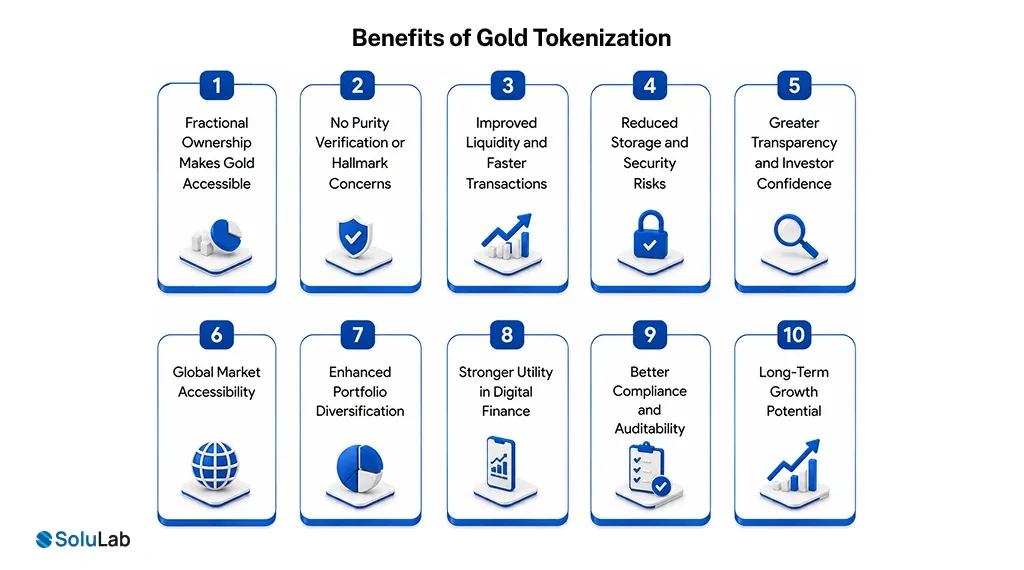
Gold has protected wealth for centuries, but investing in it the traditional way brings real headaches. Buyers worry about purity verification, hallmark authenticity, secure storage, insurance costs, and how hard resale might be. Gold tokenization tackles most of that by pairing physical gold ownership with blockchain technology, and the result is a far more accessible, efficient way to invest.
1. Fractional Ownership Makes Gold Accessible
Investing in gold traditionally meant putting up real capital. Gold bars, or even large quantities of coins, can be out of reach for a lot of retail investors.
- With tokenized gold, investors buy small fractions of a physical gold reserve instead of an entire asset.
- Whether someone wants $10 of exposure or $10,000, tokenization lets them participate without a major upfront commitment.
That accessibility opens gold investing to a much wider audience, while investors still hold a claim on a real underlying asset.
2. No Purity Verification or Hallmark Concerns
Verifying authenticity is one of the biggest headaches in physical gold investing. Is it really 24K, 22K, or 916 hallmarked gold? Investors ask that question constantly.
- Counterfeit products and misleading purity claims are still a real problem across traditional markets worldwide.
- A gold tokenization platform cuts through most of that uncertainty, since every issued token is backed by reserves that were professionally sourced and audited.
Investors don’t need to inspect gold bars, check certifications, or haggle with dealers over quality anymore.
3. Improved Liquidity and Faster Transactions
Selling physical gold usually means finding a buyer, negotiating a price, verifying authenticity, and working through paperwork.
- A gold-backed cryptocurrency trades digitally in minutes, not days.
- Investors reach global markets without shipping an asset anywhere or visiting a physical dealer.
That kind of liquidity lets investors move fast on market opportunities while still holding one of the world’s most trusted stores of value.
4. Reduced Storage and Security Risks
Owning physical gold comes with ongoing responsibility. Secure storage, insurance, vault fees, theft protection: all of it adds up and drives ownership costs higher.
- With digital gold tokenization, the underlying gold stays in professional vaults run by trusted custodians.
- Investors keep the ownership exposure without ever handling storage logistics themselves.
That cuts the operational burden and gives investors real peace of mind about asset security.
5. Greater Transparency and Investor Confidence
Transparency is still a sore spot in a lot of investment markets. Investors want proof the assets exist and are being managed properly.
- Blockchain-based gold tokenization permanently records ownership and transactions on a distributed ledger.
- Every transfer can be verified, which builds a transparent audit trail that’s hard to tamper with.
Pair that with independent reserve audits, and you get a level of trust that most traditional investment structures simply can’t match.
6. Global Market Accessibility
Traditional gold investments often run into limits tied to geography, banking systems, and local markets.
- A tokenized gold investment platform lets investors in different regions access the same asset through the same digital infrastructure.
- Markets can run around the clock, so participation isn’t limited to standard trading hours.
That wider reach drives more trading activity and pulls in a bigger global investor base.
7. Enhanced Portfolio Diversification
Gold has long served as a hedge against inflation, economic uncertainty, and a weakening currency.
With gold asset tokenization, investors can put smaller amounts of capital into precious metals without tying up a large chunk of their portfolio.
That flexibility makes diversification a lot more practical, for retail and institutional investors alike.
8. Stronger Utility in Digital Finance
Unlike traditional gold holdings, tokenized assets can plug directly into modern financial ecosystems.
Through gold RWA tokenization, investors could eventually use tokenized gold as collateral, tap into lending markets, or access other blockchain-based financial products.
Those capabilities push the value well past simple asset ownership.
9. Better Compliance and Auditability
Investor confidence comes down to verification. The gold tokenization process can build in third-party audits, reserve reporting, KYC verification, and automated compliance systems.
These safeguards help make sure every token stays backed by physical reserves, while also supporting regulatory requirements and cutting operational risk.
10. Long-Term Growth Potential
As real-world asset (RWA) tokenization keeps gaining momentum, gold stands out as one of the strongest candidates for going digital. Its reputation, global demand, and intrinsic value make it a natural fit for blockchain adoption.
Organizations putting money into gold tokenization platform development today are building the bridge between traditional precious metal markets and the next generation of digital finance.
How Enterprises Can Build a Successful Gold Tokenization Platform in 2026
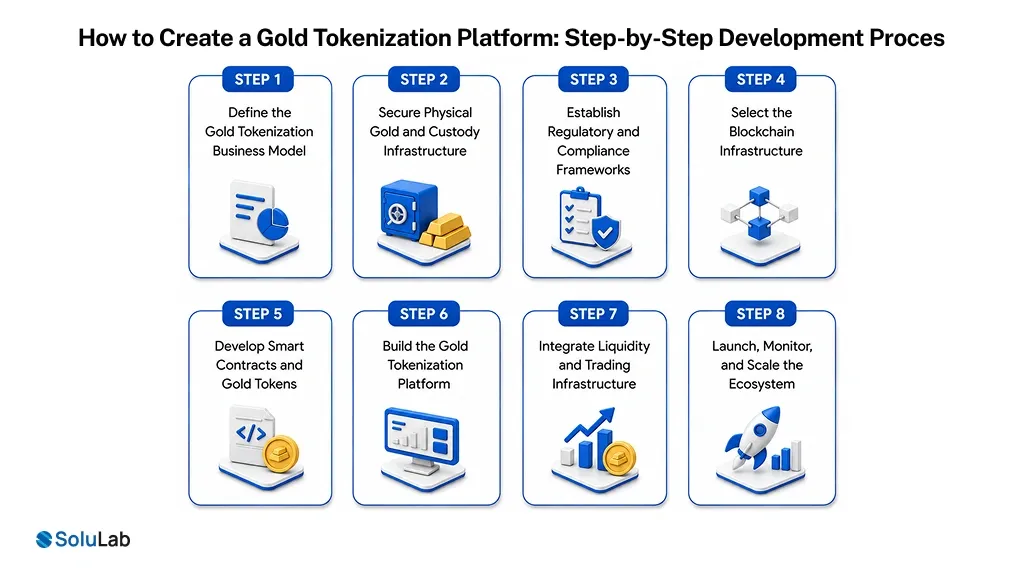
Building a gold tokenization platform takes a lot more than spinning up a blockchain token. A platform that actually works pulls together secure gold custody, regulatory compliance, smart contract infrastructure, investor onboarding, liquidity mechanisms, and transparent asset management into one system.
Whether you’re planning a tokenized gold investment platform for retail investors or an institutional-grade asset-backed tokenization platform, a structured development approach matters either way.
Step 1: Define the Gold Tokenization Business Model
Step one in gold tokenization platform development is deciding how your tokenized gold ecosystem will actually operate.
You need to nail down:
- How much gold each token represents
- Whether investors can redeem physical gold
- Geographic markets you want to serve
- Revenue model and transaction fees
- Compliance requirements in target jurisdictions
A lot of businesses go with a model where one token equals one gram of physical gold in an insured vault. Others build fractional ownership models to put gold-backed digital assets within reach of a much wider audience.
A clear business model is the foundation everything else rests on, shaping the legal, technical, and operational calls you’ll make throughout development.
Step 2: Secure Physical Gold and Custody Infrastructure
Every tokenized gold platform lives or dies by the quality of its underlying asset.
Before any tokens go out, physical gold has to come from certified suppliers and sit with trusted custodians. Investors need real assurance that each token is backed by actual gold reserves.
This stage usually covers:
- Partnering with accredited gold suppliers
- Establishing insured storage facilities
- Working with independent custodians
- Creating reserve verification procedures
- Implementing periodic auditing systems
Custody management has to stay transparent, because investors are buying exposure to actual physical gold, not a purely speculative digital asset.
For staying power, publish regular third-party audits that verify reserves and keep trust in the platform intact.
Step 3: Establish Regulatory and Compliance Frameworks
Regulatory compliance is one of the biggest pieces of gold asset tokenization, full stop.
Tokenized gold sits at the intersection of physical commodities, financial assets, and blockchain technology, so businesses end up navigating several legal frameworks at once.
A professional RWA tokenization development company usually helps put in place:
- KYC (Know Your Customer) verification
- AML (Anti-Money Laundering) procedures
- Investor accreditation requirements
- Data protection compliance
- Cross-border transaction regulations
- Commodity ownership regulations
Compliance can’t be an afterthought here. Build it directly into the platform architecture, or risk real operational and legal trouble after launch.
Step 4: Select the Blockchain Infrastructure
Next comes picking the blockchain network that will actually power your gold tokenization ecosystem.
That blockchain needs to support:
- Smart contract functionality
- High transaction throughput
- Security and decentralization
- Interoperability with wallets and exchanges
- Cost-efficient transactions
Ethereum, Polygon, Avalanche, and a handful of other enterprise blockchain networks are the popular picks.
Whichever blockchain you choose directly shapes transaction costs, scalability, user experience, and what you can build later. For businesses eyeing large-scale gold RWA tokenization, getting this choice right early can save serious money down the road.
Step 5: Develop Smart Contracts and Gold Tokens
This is where actual gold-backed token development starts.
Smart contracts automate creation, transfer, redemption, and management of the tokenized assets.
The development team builds contracts to handle:
- Token issuance
- Token burning
- Ownership transfers
- Reserve tracking
- Redemption requests
- Compliance validation
A secure gold-backed cryptocurrency needs heavy smart contract testing and third-party security audits before it ever goes live.
One vulnerability can wreck investor confidence and the platform’s reputation, which is exactly why smart contract security sits near the top of the priority list during gold token development.
Step 6: Build the Gold Tokenization Platform
Once the token infrastructure is ready, it’s time to build the platform around it.
A modern gold tokenization platform should include:
- Investor onboarding portal
- User dashboards
- Wallet integration
- Gold reserve tracking
- Real-time token pricing
- Transaction history
- Portfolio management tools
- Admin management panels
The goal is an experience simple enough that users can buy, sell, transfer, and track tokenized gold holdings without needing to understand blockchain at all.
This stage takes up the biggest share of gold tokenization services, since it pulls frontend, backend, blockchain, and security work into one unified system.
Step 7: Integrate Liquidity and Trading Infrastructure
Even the most secure platform falls flat without liquidity.
Investors expect to trade tokenized assets easily, which makes exchange integrations a core part of gold-backed token development services.
Liquidity infrastructure can include:
- Cryptocurrency exchange listings
- OTC trading functionality
- Internal marketplace development
- Market maker partnerships
- Stablecoin payment integrations
Strong liquidity is what turns tokenized gold from a static holding into something people actually trade.
That’s a big part of why digital gold tokenization keeps pulling in both traditional investors and crypto-native users.
Step 8: Launch, Monitor, and Scale the Ecosystem
The last stage is deployment, followed by ongoing optimization.
Before launch, run extensive testing across:
- Smart contracts
- User workflows
- Security infrastructure
- Compliance systems
- Transaction processing
- Wallet integrations
After launch, businesses need to keep watching platform performance, security events, user activity, and regulatory changes.
As adoption picks up, more features can come online, including:
- Multi-metal tokenization
- Precious Metals investment products
- Base Metal tokenization solutions
- Commodity tokenization marketplaces
- Natural Resource Tokenization ecosystems
- DeFi integrations
- Institutional investment modules
Over time, a simple gold tokenization platform can grow into a full real-world asset (RWA) tokenization marketplace, supporting multiple asset classes and investors around the world.
The Future of Precious Asset Tokenization
Our project, Digitizing Gold & Silver: A Tokenization Success Story, shows exactly how precious metal investing is moving away from traditional ownership models toward blockchain-powered accessibility. The platform supports fractional ownership, 24/7 trading, and smooth digital asset integration, making gold and silver investments more flexible for investors everywhere.
Market Growth Is Accelerating
The tokenized gold market has now topped $6 billion in market cap, a clear sign of growing confidence in digital ownership models. Trading activity has surged right along with it, with more than $80 billion in tokenized gold volume in a single quarter, showing real investor demand for blockchain-based assets.
Beyond Gold: The Rise of Multi-Asset Tokenization
Gold still leads the pack, but silver is closing the gap fast. That shift is fueling demand for multi-asset tokenization platform solutions built to support multiple precious metals and other real-world assets under one ecosystem.
More Than Just Digital Ownership
Modern gold tokenization for investors is about more than just buying and holding. Tokenized precious metals can support faster settlements, transparent audits, and global trading access, all without the storage headaches that come with owning the physical metal.
As adoption keeps climbing, businesses putting money into gold tokenization platform development and infrastructure are setting themselves up to capture a real share of the next generation of real-world asset markets.
Conclusion
Building a gold tokenization platform that actually works takes a lot more than minting digital tokens. It demands secure custody infrastructure, regulatory compliance, smart contract security, liquidity mechanisms, and an investor experience that doesn’t feel clunky. As demand for tokenized real-world assets keeps growing, businesses need a technology partner they can trust, with proven expertise in blockchain development.
At SoluLab, we’ve delivered precious metals tokenization solutions that support fractional ownership and global trading of digital assets.
Backed by CMMI Level 3 certification, our team runs mature development processes and industry best practices to deliver solutions that are secure, scalable, and compliant.
Whether you need gold tokenization platform development or a full RWA tokenization development company partner, SoluLab can help get your vision to market.
FAQs
Deepika is a content writer who blends storytelling with strategic thinking. She explores topics across digital innovation, emerging tech, and the evolving blockchain industry. She enjoys breaking down complex ideas into simple, engaging narratives in the growing global markets.