Key Takeaways
- ERC-8004 introduces a standardized framework for AI agent identity on blockchain.
- Nearly 98,000 agents are registered across Ethereum, BNB Chain, Base, and other networks.
- The ERC-8004 standard combines identity, reputation, and validation into a unified trust layer.
- Enterprises use ERC-8004 to reduce fraud, strengthen governance, and establish accountability for autonomous systems.
- The blockchain identity standard supports compliance, agent verification, and cross-network interoperability.
- Financial institutions, neobanks, and AI-powered platforms are increasingly adopting decentralized identity protocols.
Artificial intelligence is rapidly progressing from an assistant that answers questions to an autonomous participant capable of negotiating contracts, managing assets, executing payments, and interacting with other software systems.
This raises a difficult question. How does one AI agent determine whether another AI agent is trustworthy?
For decades, identity systems were built for people and organizations. The arrival of autonomous AI agents demands a different framework. Machines need identities. They need accountability. They need reputation histories.
This is where ERC-8004 enters the conversation.
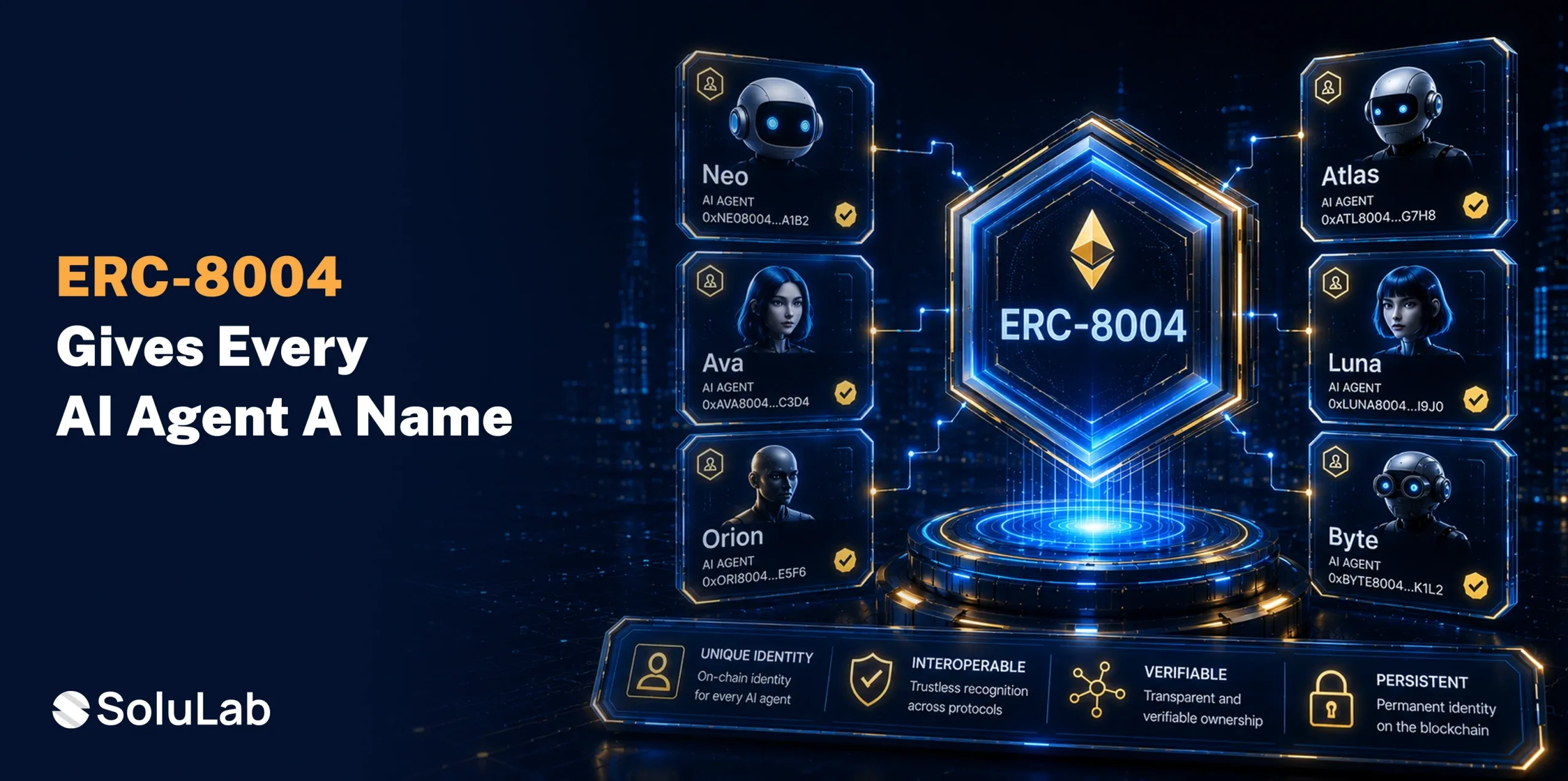
The ERC-8004 token standard introduces a structured framework for on-chain identity and reputation, allowing AI agents to establish verifiable identities, maintain performance histories, and provide cryptographic proof of completed actions.
With approximately 98,000 registered agents spread across more than ten blockchain ecosystems, ERC-8004 is rapidly becoming a foundational component of the emerging machine economy.
Why is the ERC-8004 Token Standard the “Non-Negotiable” Layer for the Autonomous Enterprise System?
Enterprise AI software has always depended on identity. Employees have login credentials.
Applications have access permissions. Servers have certificates. AI agents require the same foundation.
Without a recognized blockchain identity standard, enterprises face significant risks:
- Fake agents impersonating legitimate systems
- Unauthorized financial transactions
- Reputation manipulation
- Untraceable operational failures
- Regulatory compliance challenges
ERC-8004 addresses these concerns by assigning every autonomous agent a persistent digital identity.
Unlike traditional credentials stored in centralized databases, the identity remains verifiable across blockchain networks and organizational boundaries.
For enterprise leaders, this creates a dependable chain of accountability.
Every decision, transaction, and interaction can be traced back to a registered agent identity.
This turns autonomous software from an unknown participant into a verifiable digital entity.
1. What is ERC-8004?
ERC-8004 is an application-layer Ethereum standard designed specifically for AI agent identity on blockchain networks.
Rather than focusing on token transfers, the protocol focuses on trust.
Its purpose is to establish:
- Agent identification
- Reputation scoring
- Validation mechanisms
- Ownership attribution
- Cross-network verification
Think of ERC-8004 as a combination of:
| Function | Purpose |
| Passport | Establishes identity |
| Resume | Records performance history |
| Background Check | Validates claims |
| Compliance Record | Supports governance |
| Trust Score | Assists decision-making |
The result is a complete agent reputation protocol capable of supporting large-scale autonomous ecosystems.
2. How Does ERC-8004 Work?
The ERC-8004 standard operates through three interconnected registries.
Identity Registry: The Agent Passport
The Identity Registry creates a permanent identity for every agent.
This registry utilizes ERC-721 NFT architecture to issue unique identifiers.
Each identity contains references to:
- Agent capabilities
- Communication endpoints
- Ownership information
- Supported protocols
- Service descriptions
This creates a persistent record that can be verified by any participant within the ecosystem.
For organizations implementing agent identity verification, this becomes the foundational layer.
Reputation Registry: The Agent Resume
Identity alone is not enough.
Trust develops through performance.
The Reputation Registry maintains a public history of interactions and outcomes.
It stores information such as:
- Task completion rates
- Success metrics
- Reliability scores
- Historical feedback
- Service quality indicators
Before engaging another autonomous system, agents can query this registry and assess performance records.
This functionality creates an effective on-chain reputation system without relying on centralized review platforms.
Validation Registry: The Background Verification Layer
High-value operations require more than reputation. They require proof.
The Validation Registry verifies whether an agent genuinely performed the actions it claims.
Verification methods may include:
- Zero-knowledge proofs
- Trusted execution environments
- Hardware attestations
- Cryptographic validation records
This provides the technical foundation for blockchain-based identity verification in high-risk environments.
How Does the 98K Agent Milestone Validate the “Machine Economy” in 2026?
Many blockchain standards gain attention but fail to achieve meaningful adoption. ERC-8004 presents a different story.
Current registrations have reached approximately 98,000 agents across multiple blockchain ecosystems.
| Network | Approximate Registrations |
| BNB Chain | 34,000 |
| Base | 16,500 |
| Ethereum Mainnet | 14,000 |
| Polygon, Optimism & Others | 33,500+ |
| Total | 98,000+ |
These figures indicate more than technical curiosity.
They suggest a growing demand for a common digital identity infrastructure that enables machines to interact safely.
A growing number of agent marketplaces now require identity verification before allowing participation.
In practical terms, registration has become a prerequisite for trust.
1. Why is ERC-8004 Important for AI Agents?
Imagine an AI-powered travel planner.
The agent needs assistance from another system specializing in visa processing.
The travel planner must decide:
- Is the visa agent legitimate?
- Has it completed similar tasks successfully?
- Can it be trusted with payment settlement?
- Does it have a verified operational history?
Without a decentralized reputation management framework, these questions remain unanswered.
ERC-8004 enables agents to evaluate one another before collaboration begins.
This creates a safer environment for autonomous interactions.
As agent-to-agent commerce expands, this capability becomes increasingly valuable.
Can Your Enterprise Trust an Unverified Agent to Handle Financial Settlement?
Financial automation introduces a higher level of risk.
An incorrect payment instruction may result in regulatory penalties, operational disruptions, or financial losses.
ERC-8004 introduces two layers of risk management.
1. Reputation-Based Assessment
Organizations can review historical performance before granting access to sensitive workflows.
Questions answered include:
- Has the agent completed similar transactions?
- Does it maintain a positive trust history?
- Have previous interactions produced successful outcomes?
2. Validation-Based Verification
For financial settlements, reputation alone may not be sufficient.
Validation records provide cryptographic proof that specific actions occurred exactly as reported.
This combination significantly strengthens the overall crypto reputation framework used in financial ecosystems.
Which Global Markets are Prioritizing ERC-8004 for Regulatory Compliance?
The demand for ERC-8004 is growing fastest in regions where regulators, financial institutions, and technology providers are placing greater emphasis on accountability, auditability, and trusted automation. As AI agents begin handling transactions, compliance checks, and operational decisions, governments need a reliable framework for on-chain identity and reputation.
1. United States
The United States is emerging as a major adopter due to the rapid growth of AI-powered financial services and decentralized finance platforms.
Why adoption is increasing:
- Financial regulators are paying closer attention to AI-driven transactions and automated decision-making.
- The rise of DeFi, stablecoins, and tokenized assets has increased concerns around fake identities and Sybil attacks.
- Enterprises require clear attribution when autonomous agents execute financial actions.
How ERC-8004 helps:
- Creates verifiable agent identities.
- Provides a permanent audit trail for transactions.
- Supports responsible automation across financial ecosystems.
2. European Union
The European Union’s regulatory environment strongly favors transparent and accountable AI systems.
Why adoption is increasing:
- The EU AI Act introduces strict requirements for high-risk AI applications.
- Organizations must demonstrate traceability and explainability for automated systems.
- Financial institutions require stronger compliance controls for digital operations.
How ERC-8004 helps:
- Maintains immutable identity records.
- Supports audit-ready documentation.
- Enables verifiable agent activity across blockchain networks.
3. Singapore
Singapore continues to position itself as a global hub for fintech and digital finance innovation.
Why adoption is increasing:
- Strong support for blockchain-based financial infrastructure.
- Rapid growth in machine-to-machine payment systems.
- Expansion of digital banking and automated financial services.
How ERC-8004 helps:
- Establishes a trusted AI agent identity on blockchain.
- Improves confidence in autonomous financial interactions.
- Supports regulated digital asset ecosystems.
4. United Arab Emirates (UAE)
The UAE is investing heavily in smart city infrastructure, digital governance, and AI adoption.
Why adoption is increasing:
- Large-scale automation initiatives require secure identity frameworks.
- Government-backed innovation programs encourage blockchain integration.
- Smart infrastructure increasingly relies on autonomous systems.
How ERC-8004 helps:
- Provides trusted agent identity verification.
- Enables secure machine-to-machine coordination.
- Creates accountability across automated public and private services.
5. India and Brazil
Both countries are witnessing rapid expansion in fintech, digital payments, and AI-powered financial services.
Why adoption is increasing:
- Massive transaction volumes create greater fraud prevention requirements.
- Real-time payment networks require stronger verification mechanisms.
- Financial institutions are increasingly deploying AI for risk monitoring and customer services.
How ERC-8004 helps:
- Supports decentralized reputation management.
- Reduces risks associated with anonymous automated actors.
- Establishes trusted digital identity infrastructure for next-generation financial ecosystems.
As AI agents become active participants in banking, payments, logistics, and tokenized asset markets, these regions are recognizing that a robust blockchain identity standard is no longer optional. ERC-8004 provides the accountability layer needed to support compliant, secure, and scalable autonomous economies.
How Does ERC-8004 Integration Bridge the Gap Between AI and Neobanking?
The future of banking increasingly involves software agents acting on behalf of users and institutions.
Banks must know:
- Who controls the agent?
- What permissions exist?
- Can actions be audited?
- Is compliance maintained?
ERC-8004 helps answer these questions.
- AI Layer: The agent performs reasoning and decision-making tasks.
- Identity Layer: ERC-8004 provides verification and accountability.
- Payment Layer: Stablecoins and digital settlement systems handle transactions.
Together, these layers establish a trusted environment for autonomous financial activity.
This explains why many industry observers view ERC-8004 as a key enabler of regulated agentic banking.
1. ERC-8004 specifically targets autonomous entities
Key distinctions include:
- Native support for agent identity verification
- Built-in reputation mechanisms
- Validation registries for proof-based trust
- Multi-network compatibility
- Machine-to-machine interaction support
Rather than functioning as a simple identity database, ERC-8004 acts as a complete trust infrastructure.
One of the most compelling aspects of the ERC-8004 standard is its compatibility across blockchain ecosystems.
Current deployments span:
- Ethereum
- Base
- BNB Chain
- Polygon
- Optimism
- Additional networks
This creates a practical multi-chain identity standard capable of supporting global AI ecosystems.
An agent’s reputation no longer remains confined to a single blockchain.
What is the Commercial Risk of Ignoring the ERC-8004 Tokenization Standard?
Many organizations still rely on internal databases and proprietary identity systems to manage AI-powered operations. While these approaches may work inside a closed environment, they become increasingly ineffective when autonomous agents need to interact with external partners, financial institutions, marketplaces, and decentralized applications.
Ignoring the ERC-8004 standard can create several commercial risks that directly impact growth, compliance, and operational efficiency.
1. Reputation Silos Limit Growth Opportunities
Without a standardized on-chain identity and reputation framework, an agent’s credibility remains locked within a single organization.
Business impact:
- Trust records cannot travel across ecosystems.
- External partners cannot verify historical performance.
- AI agents must repeatedly establish credibility.
- Enterprise onboarding cycles become longer and more expensive.
- Cross-company automation initiatives face greater resistance.
Industry perspective: In a machine economy, reputation functions much like a business credit score. If reputation cannot move across networks, agents lose value outside their home ecosystem.
2. Limited Interoperability Across Ecosystems
Modern enterprises operate across multiple blockchain networks, cloud environments, and AI platforms.
Challenges organizations face:
- Difficulty verifying external autonomous agents.
- Increased integration costs.
- Fragmented identity management processes.
- Reduced collaboration between ecosystems.
- Slower adoption of agent-to-agent transactions.
Without a recognized cross-chain identity protocol, every new partnership requires additional verification layers, creating operational friction.
3. Increased Fraud and Security Exposure
As autonomous systems scale, identity abuse becomes a growing concern.
Potential risks include:
- Sybil attacks using thousands of fake agents.
- Reputation manipulation campaigns.
- Unauthorized access attempts.
- Marketplace abuse and reward exploitation.
- Fake service providers impersonating legitimate agents.
The agent reputation protocol provided by ERC-8004 helps create persistent identities that are significantly harder to duplicate or manipulate.
4. Governance and Compliance Challenges
Regulators increasingly expect organizations to maintain accountability for AI-driven decisions.
Without a recognized blockchain identity standard, enterprises may struggle to answer critical questions:
- Which agent executed the transaction?
- Who owns the agent?
- What permissions were granted?
- Was the action validated?
- Can the decision be independently audited?
The inability to provide these answers creates compliance risks, audit gaps, and governance concerns.
5. Reduced Access to Future AI Economies
The autonomous economy is rapidly evolving toward trust-based participation.
Increasingly, AI marketplaces and financial networks prefer agents that provide:
- Verifiable identities
- Historical reputation scores
- Ownership transparency
- Validation records
- Compliance-ready audit trails
Organizations that fail to adopt AI agent identity on blockchain frameworks may find themselves excluded from high-value autonomous ecosystems.
Enterprise Takeaway
Trust is becoming a foundational infrastructure layer for autonomous commerce. Just as websites require SSL certificates to participate in digital commerce, AI agents will increasingly require verifiable identities to participate in machine-to-machine economies. For enterprises, ignoring ERC-8004 today may create competitive disadvantages tomorrow.
What is the Practical Implementation Roadmap of ERC-8004 Development in 2026?
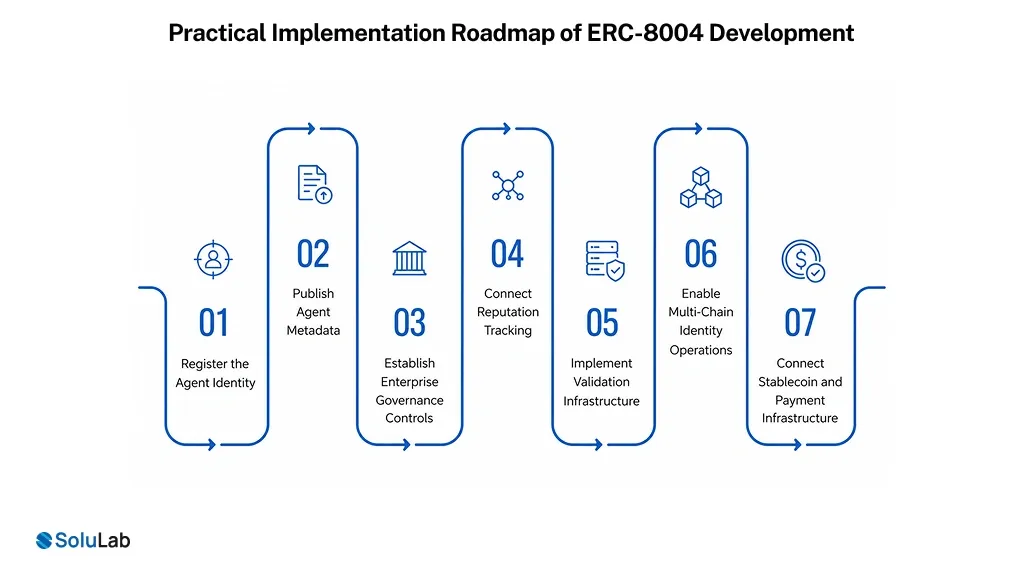
Successful ERC-8004 development goes far beyond minting an identity token. Enterprises must establish a complete trust architecture that combines identity, governance, reputation, validation, and payment infrastructure.
The following roadmap reflects how leading organizations are deploying autonomous agent identity systems in 2026.
Step 1: Register the Agent Identity
The first step is creating a unique ERC-721 NFT within the Identity Registry.
Objectives:
- Assign a permanent blockchain identity.
- Establish ownership attribution.
- Create a verifiable agent passport.
- Enable future reputation tracking.
This identity becomes the foundation of the organization’s digital identity infrastructure.
Step 2: Publish Agent Metadata
Each registered agent should publish detailed metadata describing its role and capabilities.
Metadata typically includes:
- Agent name and purpose.
- Supported services.
- Communication endpoints.
- API integrations.
- Ownership references.
- Security policies.
This information strengthens agent identity verification across decentralized ecosystems.
Step 3: Establish Enterprise Governance Controls
Identity without governance introduces unnecessary risk.
Organizations should secure ownership through:
- Multi-signature wallets.
- Role-based access controls.
- Hardware security modules.
- Enterprise custody solutions.
- Governance approval workflows.
This ensures that no single individual can compromise critical agent identities.
Step 4: Connect Reputation Tracking
The Reputation Registry allows agents to build a verifiable operational history.
Tracked metrics may include:
- Task completion rates.
- Transaction success rates.
- Service quality scores.
- Reliability indicators.
- Historical feedback.
A transparent on-chain reputation system helps enterprises evaluate trust before engaging external agents.
Step 5: Implement Validation Infrastructure
High-value activities require proof, not assumptions.
Organizations should integrate:
- Zero-knowledge proofs (ZKPs).
- Trusted Execution Environments (TEEs).
- Digital attestations.
- Cryptographic verification systems.
- Compliance evidence records.
These mechanisms strengthen the overall decentralized reputation management framework.
Step 6: Enable Multi-Chain Identity Operations
Most enterprises operate across several blockchain ecosystems.
Common deployment targets include:
- Ethereum
- Base
- BNB Chain
- Polygon
- Optimism
- Emerging Layer-2 networks
A multi-chain identity standard ensures reputation and verification records remain portable across ecosystems.
Step 7: Connect Stablecoin and Payment Infrastructure
The final phase links identities to programmable payment systems.
Key integrations include:
- USDC settlement rails.
- EUR-backed stablecoins.
- Agent payroll systems.
- Automated invoice processing.
- Machine-to-machine payments.
- API consumption billing.
This creates a complete environment where autonomous agents can transact while maintaining verifiable trust records.
Supporting Standards and Protocols That Complement ERC-8004
While ERC-8004 provides the core framework for AI agent identity on blockchain, enterprises typically combine it with several supporting standards to create a complete autonomous ecosystem.
Common integrations include:
- ERC-721 for minting unique agent identity NFTs within the Identity Registry.
- MCP (Model Context Protocol) for connecting AI agents to enterprise tools, databases, and business applications.
- A2A (Agent-to-Agent) Protocols for secure communication and task coordination between autonomous agents.
- x402 Payment Protocol for enabling machine-to-machine payments and automated service settlements using stablecoins.
- DID (Decentralized Identifiers) and verifiable credential frameworks for additional identity and compliance verification layers.
For businesses, ERC-8004 should not be viewed as a standalone standard. Its true value emerges when integrated with communication, payment, and verification protocols that allow agents to identify themselves, exchange information, prove outcomes, and settle transactions in a trusted and auditable manner.

Final Enterprise Perspective
Forward-thinking enterprises increasingly view ERC-8004 as the trust layer connecting AI, blockchain, and programmable finance. The combination of identity, reputation, validation, and payments creates a foundation for scalable autonomous operations.
As agent-to-agent commerce expands, organizations that establish this framework early will be better positioned to participate in regulated financial ecosystems, digital asset markets, and the next generation of autonomous business networks. To align all this, you need expert support. SoluLab’s AI developers are here to help you build this trust layer in accordance with local regulations. Contact us today!
FAQs
Deepika is a content writer who blends storytelling with strategic thinking. She explores topics across digital innovation, emerging tech, and the evolving blockchain industry. She enjoys breaking down complex ideas into simple, engaging narratives in the growing global markets.