Key Takeaways
- An AI copilot helps you do a task. An AI agent does the task for you.
- Copilots wait for you to ask. Agents can act on their own, which is why people call them autonomous AI agents.
- Copilots are great for writing, coding, and quick answers. Enterprise AI agents are better for long, multi-step jobs like processing orders or managing supply chains.
- Many companies use both together. A copilot can help a person plan, then hand the job to an agent to finish it.
- Cost depends on how smart and independent the tool needs to be. Simple copilots cost less. Custom AI agent development costs more but can save more time.
- Picking the right one starts with one question: Does a human need to stay in control, or can the task run on its own?
Your team keeps hearing two words this year: Copilot and Agent. They sound similar, so most buyers treat them the same way, and that mix-up gets expensive fast.
Some companies pay for a full AI agent build when a simple AI copilot would have done the job in half the time and at a fraction of the cost. Others plug in a copilot and then wonder why it cannot run a task end-to-end without someone watching every step along the way.
In fact, Gartner indicates that at least 15% of day-to-day work decisions will be made autonomously by agentic AI by 2028.
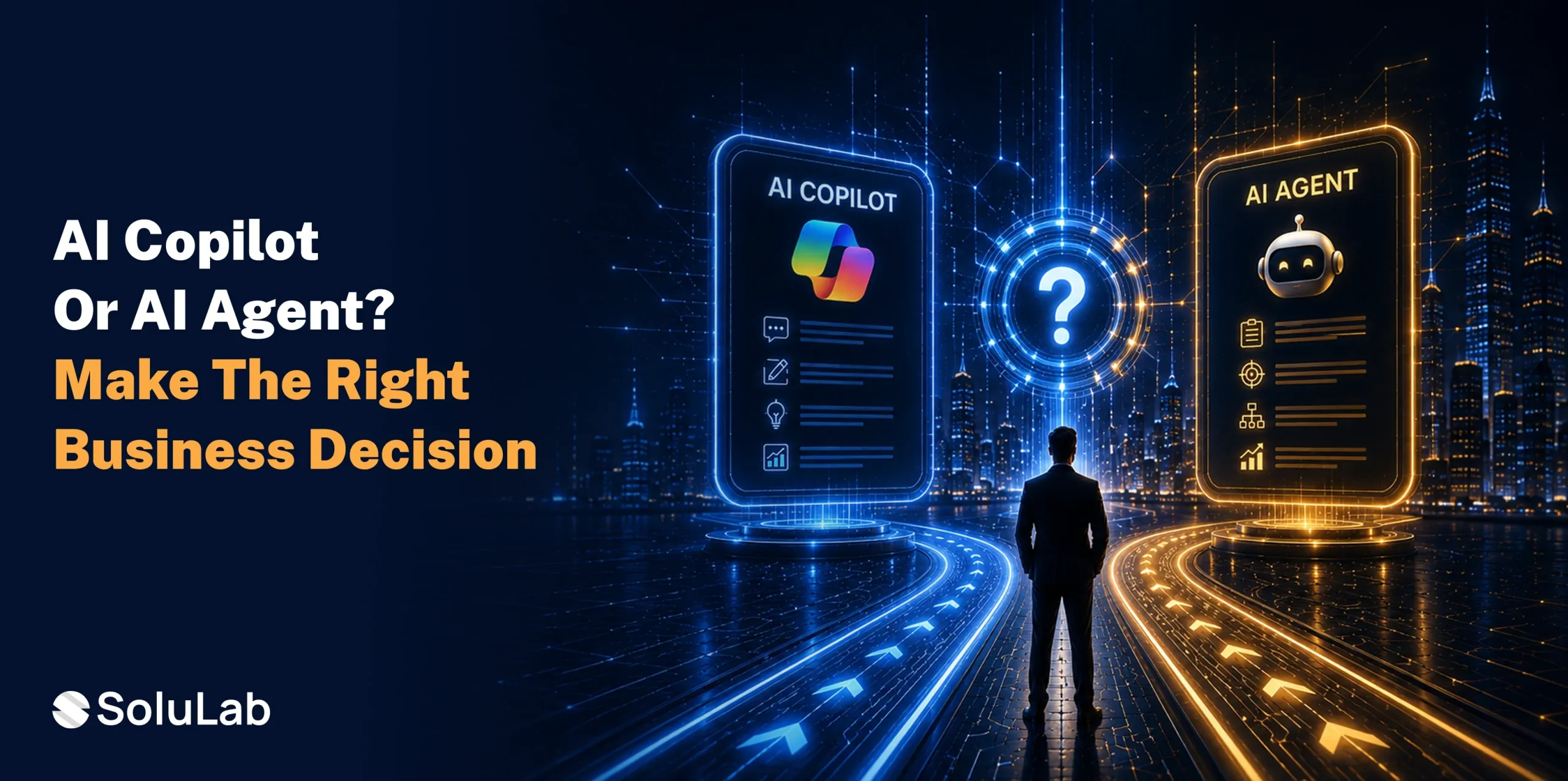
The result is wasted budget, stalled pilots, and teams that stop trusting AI projects altogether. This guide breaks down AI Copilot vs. AI Agent in plain words, so you can pick the right tool the first time.
What is an AI Copilot?
An AI copilot is like a smart helper sitting next to you at your desk. You type a question or a task. It gives you an answer, a draft, or a suggestion. Then you decide what to do next.
Think of GitHub Copilot for coders, or Microsoft 365 Copilot for writing emails. You are still the one driving. The copilot just makes the drive faster. This is close to what people mean by an AI copilot vs AI assistant comparison, too. Both terms describe tools that support a person rather than replace them.
A few things a copilot usually does:
- Copilots suggest text, code, or ideas
- They answer questions inside an app you already use
- They wait for your next command

What is an AI Agent?
An AI agent is different. You give it a goal, not just a question. Then it plans the steps, takes action, and keeps going until the job is done. It does not wait for you to click “next” each time.
Say you want to onboard a new employee. An agent could set up their accounts, send the welcome email, schedule their first meetings, and check that each step actually finished. That is what people mean by autonomous AI agents. This is also where the term agentic AI comes from, since the tool acts with its own kind of agency inside the limits you set.
Some quick facts about agents:
- AI agents can use tools, apps, and data on their own
- They can make small decisions without asking first
- They keep working across many steps, not just one reply
What’s the Difference Between an AI Copilot and an AI Agent?
A copilot answers and suggests, while a person acts. An agent plans, decides, and acts by itself. The table below breaks down AI copilot vs AI agent style differences point by point.
| Feature | AI Copilot | AI Agent |
| Who acts | The human, with help from the tool | The tool itself, with limits set by humans |
| Best for | Writing, coding, quick research | Multi-step business processes |
| Needs approval | Yes, at every step | Only at key checkpoints |
| Memory | Often short, tied to one task | Can remember and track long jobs |
| Speed of setup | Fast, often plug-and-play | Slower, needs planning and testing |
| Risk level | Low, since a person checks the work | Higher, needs guardrails and monitoring |
| Good example | Drafting a report | Running a full customer refund process |
How to Choose the Right AI Model for Your Business?
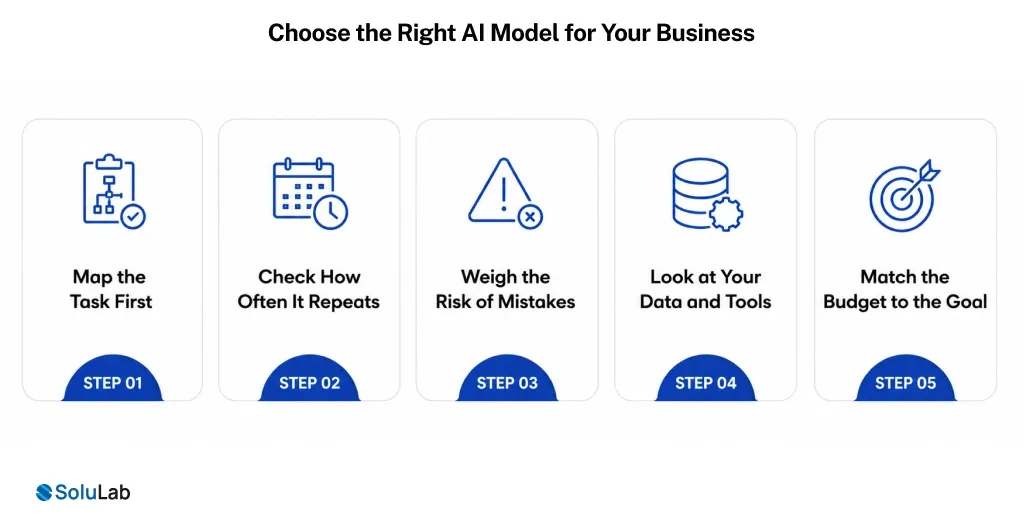
Picking between an AI copilot and an AI agent comes down to how much control you can hand over, how often the task repeats, and how much risk a mistake could cause.
1. Map the Task First
Start by breaking the task into its individual steps, so you know exactly where a human needs to step in.
- Count the total number of steps
- Mark steps that need a decision
- Flag steps that carry real risk
2. Check How Often It Repeats
Some tasks happen once a year. Others happen every single day, and that changes everything.
- Daily tasks suit AI agent development
- One-time tasks suit simple copilots
- Mixed tasks may need both tools
3. Weigh the Risk of Mistakes
A wrong draft is easy to fix. A wrong payment or shipment is not.
- Low-risk tasks work well with copilots
- High-risk tasks need strict guardrails
- Regulated tasks always need human approval
4. Look at Your Data and Tools
Agents need clean, connected data to act safely without a person checking every step.
- Check your data quality first
- Confirm your apps have open APIs
- Plan for proper AI integration services
5. Match the Budget to the Goal
More independence for the tool usually means a bigger build and a bigger budget.
- Copilots cost less to launch
- Agents cost more but scale further
- Pilot small before scaling up fully
Read our blog – How to Select the Right AI Model for Your Project
Can AI Copilots and AI Agents Work Together?
Yes, and most smart companies already run them side by side. A copilot can help a manager write a project plan. Then an AI agent executes the plan, such as updating a project tool, notifying the team, and tracking deadlines.
This pairing is becoming common in enterprise AI agent setups, where copilots handle the thinking with a person, and agents handle the doing without a person. SoluLab’s breakdown of Agentic AI vs Generative AI goes deeper into how these tool types connect and where they overlap.
How Much Does AI Copilot or AI Agent Development Cost?
The cost of developing an AI Copilot or AI Agent depends on complexity, AI integrations, AI models, and automation requirements. Understanding these factors helps businesses plan budgets and maximize long-term ROI.
| Solution | Estimated Cost (USD) | Development Timeline | Best For |
| AI Copilot (Basic) | $15,000–$40,000 | 4–8 weeks | Internal productivity, chat assistants |
| AI Copilot (Advanced) | $40,000–$50,000 | 8–16 weeks | Enterprise knowledge management, CRM, coding assistants |
| AI Agent (Single-Task) | $30,000–$50,000 | 8–12 weeks | Customer support, document processing, workflow automation |
| AI Agent (Multi-Agent System) | $80,000–$20,000+ | 3–6 months | Enterprise automation, autonomous operations, complex workflows |
Where Do Copilots Work Best and Where Do Agents Take Over?
Copilots shine in creative and knowledge work. Writing, coding, research, design ideas, and quick data summaries all benefit from a helper that speaks up but lets you make the final call. Sales teams use Copilot to draft outreach. Support teams use them to suggest replies.
Agents take over once a task becomes a repeatable, rule-based process. Order processing, fraud checks, IT ticket routing, and inventory restocking are strong fits for enterprise AI agents, since the steps rarely change, and speed matters more than a second opinion. As agentic AI matures, more of these handoff points will shift from copilot to agent, especially in operations-heavy departments.
How SoluLab Helps Businesses Build AI Copilots and AI Agents?
SoluLab, an AI native company, works with businesses to figure out which tool actually fits, instead of pushing one product for every problem. The process usually starts with a short discovery phase to map your workflows and data, then moves into a working pilot before any large build begins.
SoluLab builds agents that can plan, act, and check their own work inside the guardrails your team sets. For businesses that need a lighter touch, SoluLab also builds copilots through its AI Chatbot Development services, tuned to your tone, your data, and the questions your customers actually ask.
Full builds often include AI Agent Development for the autonomous pieces, connected through solid AI integration services, so the new tool actually talks to your existing systems instead of sitting apart from them. That connection work is often the difference between a demo that looks good and a tool your team uses every day.

Conclusion
The AI copilot vs AI agent question is not about which one is better. It is about matching the tool to the task. If a person needs to stay in the loop and make the final call, a copilot is the right fit.
If the task repeats often, follows clear rules, and needs speed over judgment, an agent is worth the extra setup. Most businesses will end up using both, often on the same workflow.
The smart move is to start small, test one use case, and expand once you see it actually save time. If you want help figuring out which fits your business first, SoluLab, an AI development company, can walk through your workflows and map out a plan that fits your budget and your risk comfort.
FAQs
Neha is a curious content writer with a knack for breaking down complex technologies into meaningful, reader-friendly insights. With experience in blockchain, digital assets, and enterprise tech, she focuses on creating content that informs, connects, and supports strategic decision-making.