
Key Takeaways
- Only 21% of enterprises report mature governance for autonomous AI agents, even as 74% expect to be using agentic AI within two years (Deloitte, 2026).
- Gartner predicts 40% of enterprises will demote or decommission autonomous agents by 2027 due to governance gaps found only after incidents occur.
- More than a third of organizations admit they couldn’t shut down a rogue AI agent today.
- A real kill-switch is a layered system—session termination, permission revocation, circuit breakers, rollback, and full deactivation—not a single button.
- Governance and kill-switch depth should scale with an agent’s autonomy level, not apply uniformly across every agent in the organization.
- Regulatory frameworks in Singapore and the EU are already treating the ability to intervene in or deactivate an agent as a core requirement, not an optional safeguard.
A kill-switch for an AI agent is a governance control that lets a human immediately halt, isolate, or revoke an autonomous agent’s permissions before it can take further action without needing to shut down the entire system it runs on. Enterprises need this now because agentic AI has quietly crossed a threshold: agents no longer just draft an email or summarize a document; they send it, update the database, or push code to production on their own.
According to Deloitte’s 2026 State of AI in the Enterprise report, only 21% of organizations say they have a mature governance model for these agents, even though 74% expect to be running agentic AI within two years. That gap between capability and control is exactly why “kill-switch” has moved from a science-fiction plot device to a line item on enterprise architecture diagrams.
This article breaks down what a kill-switch actually is, why generic AI governance solutions’ frameworks aren’t built to support one, what the newest Gartner and Deloitte data says about the risk, and how to design agent-level emergency controls that hold up under regulatory scrutiny in 2026.
What Is AI Agent Governance, and Why Does It Need a Kill-Switch?
AI agent governance is the set of policies, technical controls, and human oversight mechanisms that determine what an autonomous agent is allowed to access, what actions it can take without approval, and how its behavior is monitored and corrected. It’s a narrower, harder problem than traditional AI governance, which was largely built around models that generate outputs for a human to review. Agents are different: they plan multi-step tasks, call tools and APIs, write to production systems, and in multi-agent setups, hand work off to other agents without a person in the loop at every step.
A kill-switch is the last line of defense inside that governance model, the mechanism that answers the question “what happens the moment we realize this agent is doing something wrong?” In practice, it’s rarely a single button. It’s a layered set of controls:
- Session or task termination stops the specific agent run in progress.
- Permission revocation pulls the agent’s API keys, OAuth tokens, or role-based access, so it can’t act even if the process keeps running.
- Circuit breakers automate thresholds (error rate, spend, number of actions per minute) that pause an agent without waiting for a human to notice.
- Rollback reverses the specific changes the agent already made, which is only possible if every action was logged with enough detail to undo it.
- Full deactivation removes the agent from production entirely, used when the failure indicates a design flaw rather than a one-off error.
Confusing these layers is a common mistake. A circuit breaker that only pauses new tasks does nothing if the AI agent already committed a bad transaction five minutes ago. A kill-switch strategy has to specify, in advance, which of these responses applies to which type of failure, because during an actual incident is the worst time to be deciding that for the first time.
The 2026 Data: Governance Is Not Keeping Pace With Deployment
The urgency behind agent kill-switches isn’t theoretical. Three independent data points from 2026 point at the same gap.
Deloitte’s 2026 State of AI in the Enterprise report, based on a survey of 3,235 director-to-C-suite leaders conducted across 24 countries, found that 23% of organizations were already using agentic AI at least moderately, a figure Deloitte expects to reach 74% within two years. Against that growth curve, only 21% of respondents reported having a mature governance model for autonomous agents in place. Deloitte’s own framing of the finding was direct: agentic AI usage is rising sharply while oversight is lagging, and only one in five companies has governance mature enough to manage it.
Gartner’s research points to the consequence of that gap rather than just its size. In a May 2026 analysis, Gartner predicted that by 2027, 40% of enterprises will demote or decommission autonomous AI agents because governance gaps are discovered only after a production incident has already occurred, not before. Gartner’s central finding was that the failure isn’t usually a total absence of governance; it’s applying the same governance model to every agent regardless of how much autonomy it actually has.
A third data point, compiled from enterprise AI agent statistics research, adds a more direct answer to the kill-switch question specifically: 35% of organizations admitted they could not shut down a rogue AI agent if one emerged, and 36% had no formal plan for deploying agents at all. In other words, more than a third of enterprises running or planning agentic AI today would not currently be able to answer “can we turn this off?” with confidence.
Regulators and security agencies are responding to the same signal. In April 2026, CISA, the NSA, and allied cybersecurity agencies issued joint guidance urging organizations to assess failure scenarios before deploying agentic AI and to maintain visibility into agent activity once it’s running, explicitly warning against giving agents broad or unrestricted access to sensitive systems. OWASP’s Top 10 for Agentic Applications, published for 2026, frames autonomous planning and action-taking as a distinct security category requiring its own controls, separate from traditional LLM application security.
Why Uniform Governance Fails: Gartner’s Four Autonomy Levels
Gartner’s May 2026 research makes a specific case for why blanket governance policies- the same approval workflow, the same monitoring cadence, the same kill-switch design applied to every agent set enterprises up for one of two failure modes. Either simple, low-risk agents get buried under compliance overhead meant for high-risk systems, or fully autonomous AI agents get the same light-touch review as a low-stakes chatbot until something goes wrong.
Gartner’s framework splits agents into four autonomy tiers, each requiring a different depth of control:
| Autonomy Level | What the Agent Can Do | Governance Focus | Kill-Switch Requirement |
|---|---|---|---|
| Observe | Read-only access to defined data; retrieval, summarization, code explanation | Scoped data access, authentication, usage logging, basic testing | Low—session termination is usually sufficient. |
| Advise | Generates recommendations or drafts; a human executes the final action | Output quality review, bias, and accuracy checks | Low-to-moderate—revoke draft visibility, log overrides |
| Act with approval | Can send communications or write data, but only after explicit human sign-off | Meaningful human review (not rubber-stamp approval), audit trails | Moderate—permission revocation, approval-queue freeze |
| Fully autonomous | Executes within defined guardrails; humans review exceptions, logs, and outcomes rather than each action | Continuous monitoring, rollback mechanisms, circuit breakers, a named human owner | High—full kill-switch stack: circuit breakers, instant permission revocation, rollback, deactivation |
The practical takeaway is that “does this agent have a kill switch?” is the wrong first question. The right first question is, “What autonomy level is this agent operating at, and does its kill-switch design match the damage it could do in the time before a human notices?” A multi-agent system makes this harder still, because a single workflow might chain an Observe-level research agent into an Act-with-approval agent into a Fully Autonomous execution agent, and the kill-switch has to work at whichever point in that chain the failure appears.
Anatomy of an AI Agent Kill-Switch: What It Actually Is
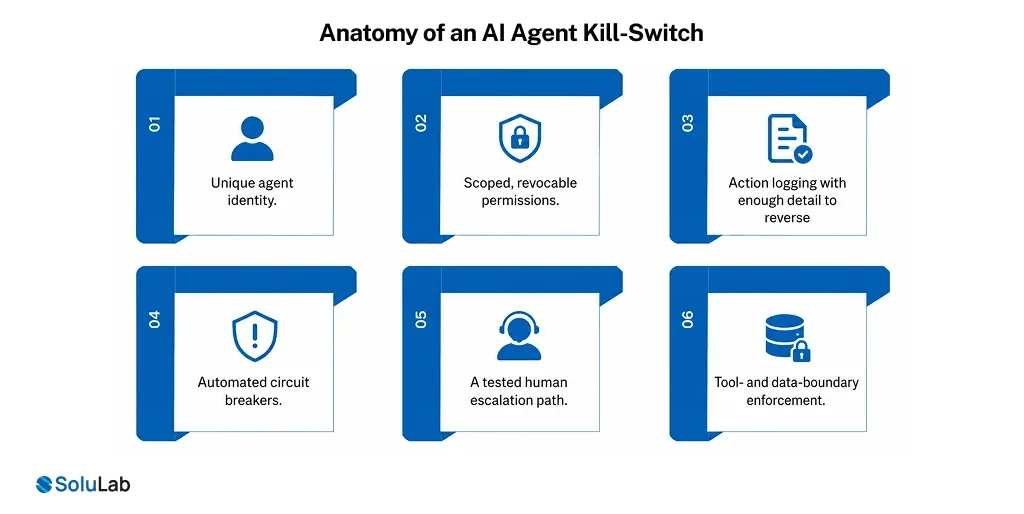
A production-grade kill-switch is not a feature you bolt onto an agent after it’s built; it has to be part of the agent’s architecture from the start, because it depends on things like identity, logging, and tool-scoping that are much harder to retrofit than to design in from day one. The components that make one work reliably:
Unique agent identity. Every agent needs its own identity, distinct from the human or service account that deployed it, so that permission revocation targets exactly one actor and doesn’t collaterally lock out a person or an unrelated system.
Scoped, revocable permissions. An agent’s access to tools, APIs, and data should be granted through short-lived, narrowly scoped credentials rather than broad standing access. Revoking a token should be a single, low-latency operation, not a multi-step process that takes an on-call engineer twenty minutes to execute correctly under pressure.
Action logging with enough detail to reverse. A kill-switch that stops future actions but can’t undo the last one an agent already took is only half a solution. Logs need to capture what changed, not just that something changed, so a rollback is actually possible.
Automated circuit breakers. Thresholds that trigger a pause without waiting for a human’s unusual action volume, repeated errors, requests outside the agent’s defined scope, or anomalous spend. These catch the failures that happen faster than a human can react.
A tested human escalation path. A kill-switch is only as good as the person who knows they’re allowed to use it. Fully autonomous agents need a named human owner with the authority and the practiced habit to pull the switch without waiting for a committee.
Tool- and data-boundary enforcement. This is where the harder governance question that OAuth and MCP alone don’t answer comes in: not just whether an agent is authenticated, but whether it should be allowed to use this specific tool, with this specific data, for this specific task, right now. That distinction is central to how enterprises are approaching AI agent security for cybersecurity operations, where agents increasingly have access to production environments and incident-response tooling.
Regulatory Momentum: Singapore’s Model and the EU AI Act
Kill-switches are no longer just a best-practice recommendation buried in a vendor whitepaper; they’re becoming an explicit regulatory expectation.
In January 2026, Singapore’s Infocomm Media Development Authority (IMDA) released the Model AI Governance Framework for Agentic AI, described as the world’s first governance framework built specifically for agentic systems. It’s structured around four dimensions: assessing and bounding risk upfront, making humans meaningfully accountable, implementing technical controls, and enabling end-user responsibility.
Within the technical controls dimension, the framework explicitly calls for the ability to intervene in or deactivate an agent, along with designing offline mechanisms for handling malfunctions—a direct, regulatory articulation of the kill-switch concept. Though the framework isn’t legally binding, it’s already shaping how enterprises elsewhere are designing their own agentic AI governance programs, and IMDA has continued updating it through mid-2026 based on industry feedback.
The EU AI Act adds a harder compliance deadline into the mix. Obligations for high-risk AI systems — including many agentic use cases in hiring, credit, and critical infrastructure become fully enforceable on August 2, 2026, with penalties that can reach €35 million or 7% of global annual turnover, whichever is higher. For multinational enterprises, that means an agent kill-switch designed only around US or internal-policy expectations may not satisfy the human-oversight and technical-control requirements regulators in Europe are now checking for, a distinction that matters directly for organizations running AI agents in regulated sectors like European banking.
Common Mistakes Enterprises Make With Agent Kill-Switches
Treating “pause” as “stop.” Pausing an agent halts new tasks; it doesn’t undo the last five actions it already completed. Teams that only build pause functionality discover the gap during their first real incident, not before.
No named owner for autonomous agents. Gartner’s guidance is specific here: a fully autonomous agent needs a person whose job it is to watch for exceptions and who has the standing authority to deactivate it. Without that, “someone should probably turn this off” becomes a Slack thread instead of an action.
Applying one governance tier to every agent. As Gartner’s four-level model shows, an Observe-level summarization agent doesn’t need the same approval workflow as an agent that can modify production data, and forcing it through one anyway is what drives the over-restriction failures Gartner warns about.
Kill-switches that aren’t tested. A revocation process that works in a tabletop exercise but takes twenty manual steps in production isn’t a kill-switch; it’s a postmortem waiting to happen. The switch needs to be exercised the same way disaster-recovery failovers are on a schedule, not just in theory.
No visibility into which agents exist. Deloitte’s research and Gartner’s warnings both assume organizations know what agents are running. In practice, a meaningful share of enterprises can’t fully answer that question, which makes “shut down the rogue agent” impossible before you can even identify which one it is. This is one of the reasons governance and risk frameworks like AI TRiSM, Trust, Risk, and Security Management treat inventory and continuous monitoring as a prerequisite to any control, kill-switches included.
How to Design and Implement an Agent Kill-Switch: A Practical Checklist
- Inventory every agent and its autonomy level. You cannot govern, let alone kill-switch, an agent you don’t know exists. Classify each one using a tier model similar to Gartner’s Observe/Advise/Act-with-approval/Fully autonomous framework.
- Assign a named human owner to every Act-with-Approval and Fully Autonomous agent. Document who has the authority to trigger a shutdown, and make sure that authority doesn’t require a multi-person sign-off during an active incident.
- Design revocable, short-lived credentials from the start. Build the agent’s architecture so that pulling access is a single API call, not a manual cleanup across five systems.
- Build circuit breakers around measurable thresholds. Define, in advance, what “too many actions,” “too much spending,” or “too many errors” means for each agent, and automate the pause.
- Log every action with rollback in mind. If a log entry doesn’t contain enough information to reverse the action it describes, it’s not sufficient for incident response.
- Test the kill-switch on a schedule, not just in design review. Run tabletop exercises where the team actually executes a revocation, end-to-end, and times how long it takes.
- Map controls to your regulatory footprint. If you operate in the EU, Singapore, or other jurisdictions actively regulating agentic AI, confirm your technical controls satisfy the specific human-oversight and intervention requirements those frameworks describe, not just a generic internal policy.
- Revisit governance as agents chain together. In multi-agent workflows, a failure in one agent can cascade into others before a human notices. Kill-switch design has to account for stopping a chain, not just a single agent.
Enterprises that don’t have the internal bandwidth to build this from scratch are increasingly working with AI agent development partners who build governance, monitoring, and kill-switch mechanisms into the agent from the design phase rather than adding them after deployment which is consistent with what both the Gartner and Deloitte research point to: the organizations seeing the strongest outcomes from agentic AI are the ones building governance in early and scaling deliberately, not the ones moving fastest.

Conclusion
The gap Deloitte and Gartner are both describing in their 2026 research isn’t a story about AI agents being too risky to use it’s a story about governance maturity failing to keep pace with how fast enterprises are deploying them. A kill-switch doesn’t slow an agent program down; it’s what makes scaling one past the pilot stage defensible to a board, an auditor, or a regulator.
The enterprises that build agent-level identity, revocable permissions, tested rollback, and a named human owner in from the start are the ones Gartner and Deloitte both point to as pulling ahead not because they moved cautiously, but because they built the off switch before they needed to use it.
If your organization is scaling agentic AI without a clear answer to “how fast could we shut this down,” that’s the governance gap to close first. SoluLab’s AI development team builds governance, monitoring, and kill-switch controls into agent architecture from day one — talk to us about assessing where your current agent deployments stand.
FAQs
Tanmay is focused on building brand authority through narrative-driven marketing. With 19+ years in tech branding, he has positioned SoluLab as a thought leader in the Blockchain and AI sectors. He regularly shares insights on AI-driven brand storytelling and content strategy. He is open to connecting with startups and enterprise teams to help them overcome their challenges.