
Over the past two years, enterprises have moved rapidly from AI experimentation to AI deployment. Customer support bots write responses, marketing teams generate content with AI copilots, and decision-support tools increasingly rely on machine learning models. But as AI development solutions spread across business operations, a new question is becoming central: can organizations clearly disclose where AI is being used and how its outputs are generated?
The EU AI Act transparency rules, which become applicable on 2 August 2026, make this question more than a governance exercise – it becomes a legal requirement. Companies must be able to identify when users interact with AI systems, disclose when content is AI-generated or manipulated, and maintain evidence that these disclosures are implemented consistently.
For many enterprises, meeting these obligations will require more than policy updates. It requires a structured EU AI Act transparency audit checklist that maps AI systems, disclosures, and evidence across the organization.
Key Takeaways
- The EU AI Act begins major enforcement milestones in 2026, requiring enterprises deploying AI systems in the EU to meet strict transparency, risk management, and documentation standards.
- Organizations using high-risk AI systems must conduct transparency audits, including dataset documentation, model explainability, and human oversight mechanisms.
- Non-compliance with the EU AI Act can lead to penalties of up to €35 million or 7% of global annual turnover, making early compliance preparation critical for enterprises.
- A structured transparency audit helps businesses identify risks, review training data governance, evaluate model decision logic, and document AI system performance.
- SoluLab helps enterprises build compliant AI systems and governance frameworks, supporting transparency, explainability, and regulatory readiness for evolving global AI regulations.
Why the 2026 EU AI Act Deadline Matters for US Enterprises?
One of the most common misconceptions about the EU AI Act is that it primarily affects companies headquartered in Europe. In reality, the regulation has extra-territorial reach, meaning organizations outside the EU may still fall under its scope.
The rules apply when an AI system is placed on the EU market, used by individuals in the EU, or produces outputs that affect people in the EU. For US technology companies, SaaS providers, and digital platforms, this condition is often already met. Customer-facing AI assistants, automated content generation tools, and AI-powered analytics services can all trigger obligations under the Act when deployed globally.
The 2026 EU AI Act deadline marks the point when transparency requirements become enforceable. By that stage, regulators expect organizations to demonstrate that AI interactions are clearly disclosed, AI-generated content is identifiable, and compliance controls are operational.
For US enterprises expanding AI adoption, transparency will increasingly become a core component of AI governance and risk management.
What ‘Transparency’ Actually Means Under the EU AI Act?
The term transparency appears frequently in discussions about the EU AI Act, but in practice, it refers to a specific set of obligations designed to ensure that people understand when and how AI systems influence the information they see or interact with.
At a high level, the EU AI Act transparency requirements require organizations to clearly inform users when they are interacting with AI systems rather than humans. This applies to common enterprise deployments such as chatbots, virtual assistants, and AI-powered customer support platforms. If a customer interacts with an automated system, the organization must disclose that interaction in a clear and understandable way.
Transparency obligations also apply when AI systems generate or manipulate content. When text, images, audio, or video are produced using AI, organizations must ensure that users can identify that the content was created artificially. Similar expectations apply to synthetic or manipulated media, particularly when they could influence public perception or decision-making.
Importantly, transparency under the EU AI Act is not just a front-end disclosure problem. Behind every disclosure must be supporting documentation, governance processes, and traceable evidence that the organization understands where AI is deployed and how outputs are produced. Without that operational visibility, companies cannot reliably demonstrate compliance.
For many enterprises, achieving EU AI Act transparency compliance will require building internal inventories of AI systems, mapping user-facing interactions, and establishing controls that ensure disclosures remain consistent as systems evolve.

Which Enterprise AI Use Cases Should Be Audited First?
For large organizations, AI adoption rarely happens in a single system. Instead, AI capabilities spread across products, internal tools, and third-party software. As a result, an effective EU AI Act compliance checklist must begin by identifying the AI use cases most likely to trigger transparency obligations.
The first category to prioritize is customer-facing AI interactions. This includes chatbots, virtual assistants, AI copilots, and automated support systems that interact directly with users. These systems must clearly disclose when users are communicating with AI rather than a human representative.
The second priority area involves AI-generated content workflows. Marketing teams increasingly use AI tools to generate articles, product descriptions, and campaign materials, while customer service platforms may automatically draft responses to inquiries. When these outputs reach customers or the public, organizations must ensure the role of AI is clearly identifiable.
A third category includes decision-support systems used in areas such as hiring, lending, insurance underwriting, or fraud detection. While these systems may not always require the same disclosures as conversational AI, they often involve transparency expectations related to how automated systems influence decisions.
Finally, enterprises should examine third-party AI features embedded in existing software platforms. Many SaaS vendors now include AI capabilities by default, and organizations remain responsible for understanding how those features interact with their customers and users.
By prioritizing these high-impact use cases, organizations can focus their AI risk management efforts on the areas where transparency obligations are most likely to apply.
Read More: How to Build an Agentic AI Governance Framework Like Singapore?
8-Step Transparency Audit Checklist: Enterprise EU AI Act Compliance
Preparing for the EU AI Act transparency requirements requires more than a legal interpretation of the regulation. Enterprises must translate regulatory expectations into operational controls that can be tested, monitored, and documented. A structured transparency audit helps organizations identify where AI is used, how users are informed, and whether compliance evidence exists to support those disclosures.
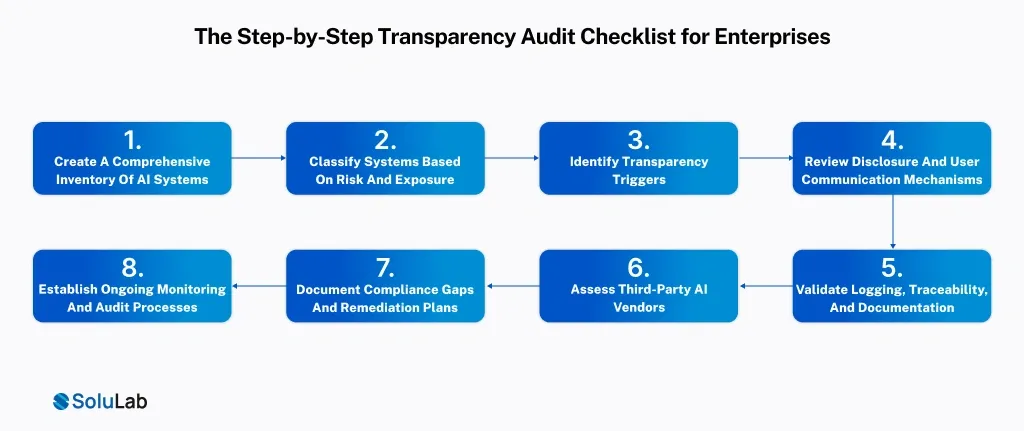
The following EU AI Act transparency audit checklist provides a practical framework for evaluating readiness across enterprise AI deployments.
1. Create a Comprehensive Inventory of AI Systems
The first step is building a complete inventory of AI systems used across the organization. Many enterprises underestimate how widely AI capabilities are embedded within their technology stack.
The inventory should include:
- internally developed AI models
- foundation models accessed through APIs
- AI features embedded in SaaS platforms
- automation tools using machine learning
- generative AI systems producing content or responses
Without a clear system inventory, organizations cannot determine where transparency obligations apply.
2. Classify Systems Based on Risk and Exposure
Once systems are identified, they should be classified according to how they interact with users and where their outputs are used.
Important classification questions include:
- Does the system interact directly with customers or external users?
- Does it generate or modify content?
- Could its outputs influence decisions affecting individuals?
- Are EU users or markets involved?
This classification step helps organizations prioritize the systems most likely to fall within EU AI Act transparency requirements.
3. Identify Transparency Triggers
The next step is mapping where transparency disclosures may be required. Common triggers include:
- users interacting with chatbots or AI assistants
- AI-generated marketing or support content
- synthetic media or AI-modified images, audio, or video
- automated systems influencing user-facing decisions
Each trigger point should be documented along with the specific disclosure mechanism used.
4. Review Disclosure and User Communication Mechanisms
Organizations must verify that disclosure mechanisms are clear, consistent, and accessible to users.
This includes evaluating:
- chatbot introduction messages
- product interface notifications
- content labeling practices
- customer support communication templates
Disclosures should be understandable to users and integrated naturally into the experience rather than hidden in legal notices.
5. Validate Logging, Traceability, and Documentation
Transparency compliance requires supporting technical evidence that AI systems operate as described. Enterprises should review whether systems maintain sufficient logs and documentation.
Key elements include:
- model version tracking
- records of AI-generated outputs
- documentation of training sources or model behavior
- system deployment records
These artifacts provide the traceability required for EU AI Act compliance verification.
6. Assess Third-Party AI Vendors
Many organizations rely heavily on third-party AI providers. Transparency obligations may still apply even when AI capabilities originate from external vendors.
Vendor assessments should examine:
- provider transparency policies
- available documentation about the AI system
- disclosure responsibilities in customer interactions
- contractual compliance obligations
This step ensures organizations understand how vendor systems contribute to their overall AI risk management framework.
7. Document Compliance Gaps and Remediation Plans
After reviewing systems and disclosures, organizations should identify any gaps between current practices and regulatory expectations.
Common remediation areas include:
- inconsistent disclosure messaging
- lack of system documentation
- missing logs for generated outputs
- unclear responsibilities between internal teams and vendors
Each identified gap should include a remediation owner and timeline.

8. Establish Ongoing Monitoring and Audit Processes
Transparency compliance is not a one-time activity. As enterprises deploy new AI systems and update existing models, transparency controls must evolve as well.
Organizations should establish:
- periodic transparency audits
- governance reviews for new AI deployments
- monitoring processes for AI-generated outputs
- internal reporting mechanisms for compliance oversight
By institutionalizing these processes, companies can maintain long-term readiness for EU AI Act compliance.
The Enterprise Operating Model Behind Transparency Compliance
While transparency disclosures often appear in user interfaces, achieving consistent compliance requires coordination across multiple enterprise functions. Organizations that treat transparency as a purely legal requirement frequently struggle to implement it effectively.
In practice, EU AI Act transparency compliance depends on a cross-functional operating model.
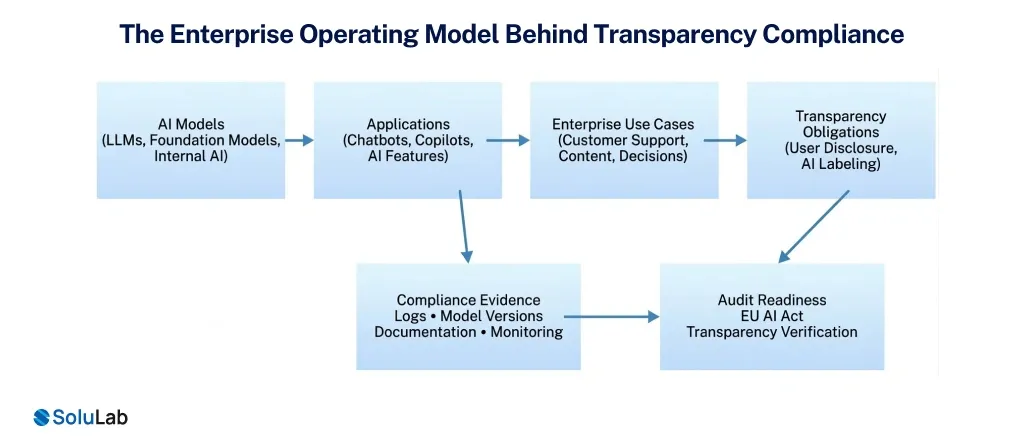
Legal and compliance teams are responsible for interpreting regulatory requirements and defining disclosure policies. They establish the standards that determine when transparency obligations are triggered and what form disclosures should take.
Product teams translate those policies into real user experiences. They design chatbot interactions, interface notifications, and content labeling mechanisms that communicate clearly with users while maintaining a seamless experience.
Engineering and MLOps teams play an equally important role. They implement logging systems, maintain model version records, and ensure that AI outputs can be traced back to the underlying system configuration. These technical controls provide the evidence required to demonstrate compliance.
Finally, risk management and procurement teams oversee third-party AI providers, ensuring that vendor systems meet enterprise governance standards and align with internal transparency policies.
When these functions operate together, transparency becomes part of the organization’s AI governance framework, rather than a compliance afterthought.
Common Transparency Compliance Failures Enterprises Should Fix Before 2026
As organizations begin assessing their readiness for the EU AI Act transparency requirements, several recurring gaps tend to emerge. These issues rarely stem from a lack of intent but rather from the complexity of modern enterprise AI environments.
One of the most common failures is the absence of a centralized inventory of AI systems. AI capabilities often spread across business units through experimentation, vendor integrations, and product innovation. Without a unified inventory, organizations struggle to identify where transparency obligations apply.
Another frequent challenge involves inconsistent disclosure practices. Some teams may implement clear chatbot introductions or AI-generated content labels, while others rely on minimal or unclear disclosures. When transparency mechanisms differ across platforms or customer interactions, organizations risk falling short of regulatory expectations.
Enterprises also often underestimate the importance of technical traceability. Transparency is not limited to the visible disclosure presented to users. Regulators may expect organizations to demonstrate how AI outputs were produced, which model version generated them, and what controls govern the system. Without logging systems, documentation, and deployment records, this evidence can be difficult to produce.
A further challenge arises from third-party AI integrations. Many SaaS platforms now embed generative AI features by default. Organizations sometimes assume that vendors are solely responsible for compliance. In practice, companies deploying these tools remain accountable for how AI-generated outputs are presented to users.
Addressing these gaps early allows enterprises to build a stronger AI governance and risk management framework before the 2026 EU AI Act deadline.
Build Internally or Use Third-Party AI Transparency Verification?
Once enterprises begin implementing transparency controls, a key strategic question emerges: Should transparency compliance be managed entirely internally, or should organizations rely on external verification partners?
For companies with mature AI governance capabilities, building internal compliance programs may be feasible. Dedicated risk teams, internal audit functions, and experienced engineering groups can work together to map AI deployments, implement disclosure controls, and monitor transparency requirements.
However, many organizations are still developing the operational infrastructure required for enterprise AI governance. In these cases, external partners can provide valuable support. Enterprise AI audit firms and compliance specialists often assist with regulatory interpretation, risk assessments, and independent validation of transparency controls.
A hybrid model is becoming increasingly common. Internal teams manage day-to-day governance processes, while external specialists conduct periodic assessments or provide advisory support for complex regulatory requirements.
This approach allows organizations to combine operational familiarity with independent oversight, strengthening the credibility of their EU AI Act compliance efforts.
A 120-Day Enterprise Roadmap for EU AI Act Readiness
With the 2026 EU AI Act deadline approaching, organizations should begin implementing transparency controls well before enforcement begins. A structured readiness roadmap can help enterprises move from initial assessment to operational compliance.
Days 1–30: Establish visibility
The first phase focuses on discovery with AI consulting experts. Organizations should prepare an inventory of all AI systems used across products, internal operations, and vendor platforms. This process often reveals previously undocumented AI capabilities embedded within existing tools.
Days 31–60: Map transparency obligations
Once systems are identified, organizations should classify them based on user interaction and content generation. Teams can then map where transparency disclosures may be required and evaluate whether current communication mechanisms meet regulatory expectations.
Days 61–90: Implement remediation
The third phase involves closing identified gaps. This may include updating chatbot introductions, implementing labeling for AI-generated content, strengthening logging systems, or clarifying vendor responsibilities.
Days 91–120: Conduct a transparency audit
In the final phase, enterprises should perform a structured transparency audit to confirm that systems, disclosures, and documentation align with regulatory expectations. This review helps ensure the organization can demonstrate compliance if regulators request evidence.
By following this roadmap, enterprises can move from fragmented AI deployments toward a consistent EU AI Act compliance framework.

Conclusion
The EU AI Act transparency rules represent a shift in how organizations are expected to manage artificial intelligence. Transparency is no longer simply a matter of ethical AI guidelines – it is becoming a measurable regulatory requirement.
For enterprises deploying AI across products, services, and internal workflows, compliance will depend on their ability to identify where AI is used, clearly communicate that use to customers and users, and maintain evidence supporting those disclosures.
Organizations that begin preparing early can transform transparency from a regulatory burden into a structured component of their AI governance strategy. By building inventories of AI systems, implementing consistent disclosure practices, and maintaining traceable documentation, companies can establish the operational foundation required for long-term compliance.
As the 2026 EU AI Act deadline approaches, enterprises that treat transparency as an integrated governance capability will be best positioned to navigate evolving regulatory expectations.
FAQs
Bhavya is driving growth through data-backed demand generation for AI and Web3 solutions. With 9+ years in digital marketing, he has spearheaded initiatives that led to a 40% increase in qualified inbound leads. Bhavya shares insights on marketing ROI and scaling a digital presence via AI workflows. He is open to connecting with startups and enterprise teams to help them overcome their challenges.