Key Takeaways
- The Problem: Centralized platforms hold your users’ data hostage, moderate content arbitrarily, and keep creators dependent on opaque algorithms. Trust in big social is eroding fast, and probably permanently.
- The Solution: A decentralized social blockchain project returns data ownership to users, makes moderation transparent through on-chain governance, and incentivizes participation through token economics. It’s a fundamentally different product contract.
- How SoluLab Can Help: SoluLab is a full-stack blockchain development company that has shipped products across Web3 social, DeFi, healthcare, and enterprise since 2014. We work like a technical co-founder, not just a vendor who delivers code and disappears.
In 2026, social media is a $100B+ attention economy, and the people creating that value still own nothing, and nearly 5 billion people generate value daily while their identities, reach, and data remain locked inside centralized platforms that can censor, demonetize, or erase them overnight. Every serious founder knows this is broken, and the only question is who moves first.
Furthermore, data sovereignty is now a boardroom-level concern, advertiser trust in centralized platforms has already cracked, and over 65 decentralized social apps are already live, competing for early network effects. The market for such apps is still small, but the window for blockchain development services is closing fast.
This guide is for founders and CTOs making real build decisions, and we will help them do that. We’ll break down architecture, stack choices, incentives, and go-to-market realities so you understand what it truly takes to launch a decentralized social product and when it makes sense to bring in an experienced blockchain team to avoid costly mistakes.
Why Enterprises Are Building Decentralized Social Blockchain Projects?
The honest case for building here isn’t just ideological, it’s commercial.
Centralized platforms are facing regulatory pressure, advertiser flight, and genuine user fatigue. When Meta faced EU data restrictions and Twitter fractured post-acquisition, something shifted in user behavior. People started looking for alternatives, and for the first time in a decade, some of them actually found ones worth using.
Data ownership in blockchain social networks is the real product differentiator.
- On the Farcaster protocol, your posts go live on a public ledger, and no executive can delete them with a Slack message.
- On Lens Protocol, your social graph is yours, and you take your followers if you ever switch platforms.
That’s a promise no centralized company can honestly make.
From a pure business angle, that’s a moat, and the economics are different too. Traditional social platforms sell your attention to advertisers. Decentralized platforms let users own governance tokens, vote on product decisions, and earn from their content.
That changes retention, loyalty, and the entire relationship between platform and community.
For enterprises specifically in healthcare, finance, and legal fields, enterprise blockchain solutions for internal communication and data management are increasingly attractive. GDPR, CCPA, and emerging data frameworks are pushing companies toward architectures where user consent and data residency are provable, not just claimed.
Understanding the Core Architecture to Build a Decentralized Social Network
How to build a decentralized social media platform is a genuinely technical question, and the architectural decisions you make in month one will shape your cost, performance, and flexibility for years.
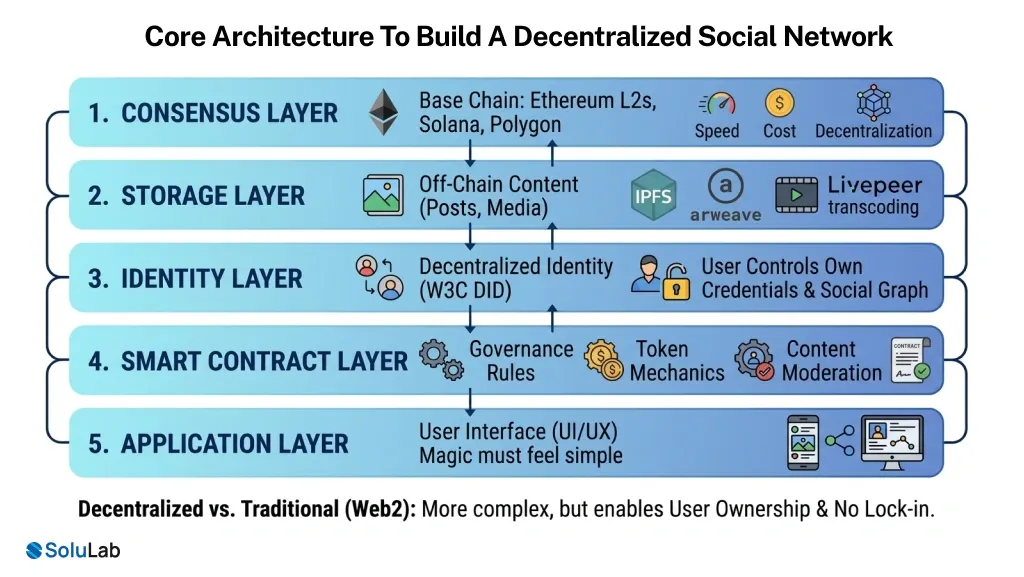
Here’s how the stack layers actually work:
1. Consensus Layer
This is your base chain. Ethereum L2s (Optimism, Base, Arbitrum), Solana, and Polygon are the most common choices today. Each involves tradeoffs between speed, cost, and decentralization.
2. Storage Layer
Posts, media, and user-generated content don’t live on-chain; that would be prohibitively expensive. IPFS and Arweave are the decentralized storage defaults. For video, Livepeer handles decentralized transcoding.
3. Identity Layer
Decentralized identity system in social blockchain project implementation, typically through W3C DID (Decentralized Identifier) standards, means users control their own credentials and social graph. No platform lock-in, or single point of failure.
4. Smart Contract Layer
Governance rules, token mechanics, content moderation logic, and monetization are all encoded here.
5. Application Layer
What users actually touch. This is where the magic needs to feel simple, even if the infrastructure underneath is anything but.
The reality is that this stack is meaningfully more complex than a traditional Web2 product. It requires people who understand both blockchain engineering and product design.
That’s why most serious teams either build with a specialist blockchain development company or bring in dedicated Blockchain consultants early to set the architecture right.

How to Choose the Right Blockchain Tech Stack to Launch Decentralized Social Media?
Stack choice is where many projects spend too long deciding, or worse, decide wrong and spend months undoing it. For a decentralized social blockchain project, the decision comes down to three things: throughput requirements, ecosystem maturity, and cost per transaction.
- Ethereum blockchain + L2 (Optimism, Base, Arbitrum) is the most battle-tested option. Farcaster runs on Optimism. Deep developer ecosystem, proven security, and increasingly affordable gas fees.
- Solana blockchain is worth serious consideration if you need high throughput from day one and are comfortable with a slightly younger tooling ecosystem.
- Lens Protocol’s stack (Polygon) has become a reference architecture specifically for social; it has composable modules for profiles, follows, mirrors, and publications baked in. Building on Lens means inheriting its ecosystem, which is a genuine distribution shortcut.
- IPFS + Filecoin for storage is essentially standard now.
- Arweave is preferred if you want permanent storage guarantees.
For AI-powered blockchain social platform development, the emerging pattern involves off-chain AI inference (via Akash Network or similar) combined with on-chain verification and governance. The top blockchain trends for 2025–2026 are converging on user-owned networks and AI-integrated governance.
This unlocks AI-assisted content moderation and recommendation without handing control back to a centralized party. A good blockchain development services partner won’t recommend a stack before understanding your product.
See our guide on blockchain development use cases for a more complete breakdown by category.
Step-by-Step Project Plan to Launch a Decentralized Social Media Platform
Most projects don’t fail on technology; they fail on sequencing. Here’s a realistic order:
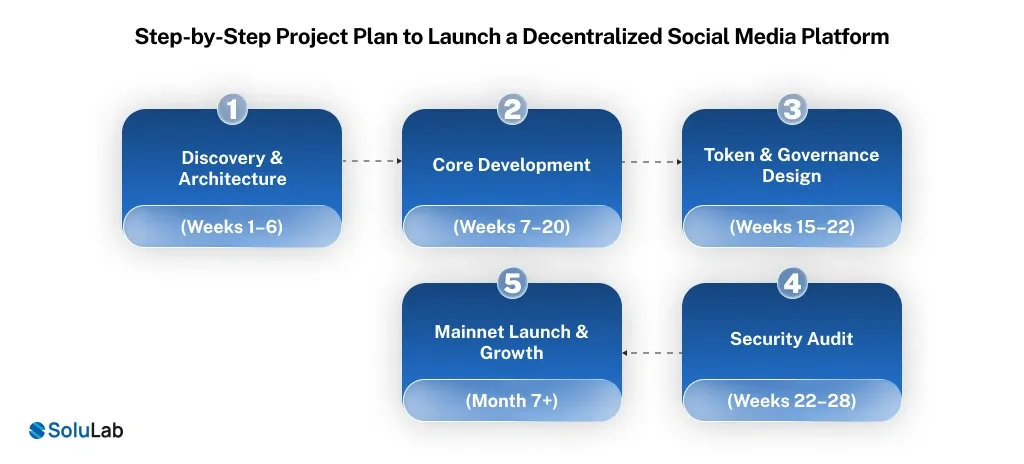
Phase 1 — Discovery & Architecture (Weeks 1–6)
Define the core interaction loop.
- Who’s your user?
- What’s the one thing your platform does that nothing else does?
Run a Blockchain PoC to validate the riskiest technical assumption before any production code is written.
Phase 2 — Core Development (Weeks 7–20)
Smart contracts, identity layer, social graph logic, and basic frontend. This is the phase where you need to hire blockchain developers with specific social and Web3 product experience or engage a blockchain app development services partner who has shipped real products.
Phase 3 — Token & Governance Design (Weeks 15–22)
Tokenomics shouldn’t be designed after the product. It should be designed with it, so build incentive structures into the architecture from the start.
Phase 4 — Security Audit (Weeks 22–28)
Non-negotiable. Smart contract exploits cost the Web3 ecosystem over $3.1 billion in 2023 alone. Every serious project is audited before mainnet, without exception.
Phase 5 — Mainnet Launch & Growth (Month 7+)
Launch decentralized social media with a controlled rollout. Start with your core community, gather real feedback, and iterate. A focused launch beats a big bang almost every time.
According to our analysis, 8–12 months for a production-ready platform. Anyone promising significantly less either hasn’t built one or is leaving out important scope.

Designing Tokenomics, Governance & Incentives for Enterprise-Grade Social Blockchain Platforms
Tokenomics is the economic constitution of your blockchain platform.
- Get it wrong, and you attract mercenary users who drain your treasury and leave when incentives dry up.
- Get it right, and you get a self-reinforcing community that grows without you pushing it.
The key question to consider is: which behaviors would you like to reward? Content creation, curation, governance participation, and referrals each need a corresponding mechanic.
Vague token designs (users earn tokens for engaging) create farming behavior, not community.
Governance models broadly break into two camps: token-weighted voting (simpler, but plutocratic) and reputation-weighted voting (more equitable, harder to implement well). Most projects launch with token voting and evolve governance over time as the community matures.
One critical note to remember is that token design intersects with securities law in most jurisdictions, which is why we say – Legal counsel isn’t optional. This is especially relevant for Enterprise blockchain solution deployments where regulatory exposure is higher and compliance requirements are binding.
User Experience & Onboarding for Decentralized Social Networks with Data Ownership
How blockchain improves social media privacy is a compelling story. But only if your users can actually use the platform without a technical background.
This is still the biggest unsolved problem in Web3 social. Wallet-based login, gas fee management, and key recovery – none of these feel natural to a mainstream user. The platforms that are actually growing have invested heavily in abstracting this complexity.
Account abstraction (ERC-4337) is the most important UX development in this space right now. It lets you offer a familiar email/password experience on the frontend while remaining fully decentralized underneath.
If you’re building in 2026, design with account abstraction from the start.
The rule of thumb: your blockchain layers should be functionally invisible to an average user. If they can feel the blockchain, you’ve already lost them.
Go-to-Market Strategy for Building and Launching a Decentralized Social Network
Building decentralized social network technology is half the job. The other half is getting people to show up and stay.
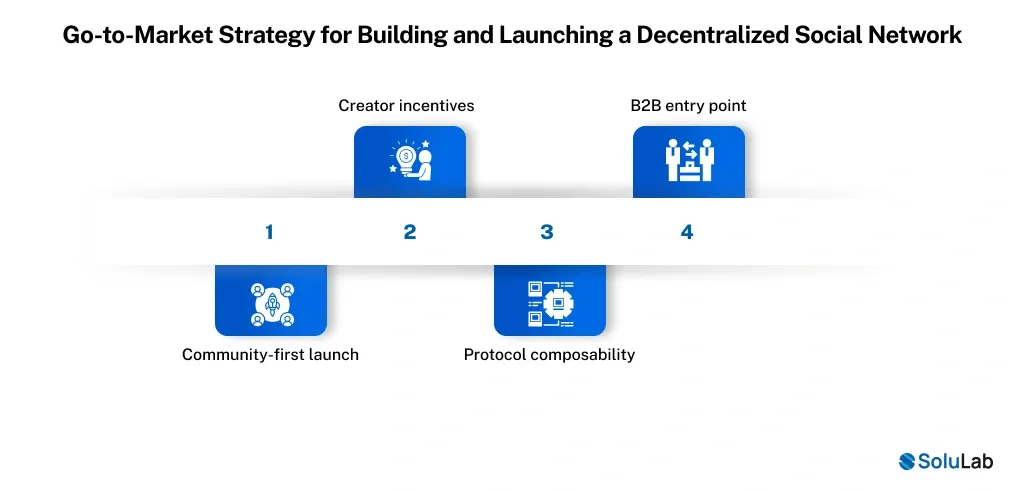
What consistently works:
- Community-first launch. Start small, high-quality. A tight 500-person community with genuine engagement beats 50,000 passive sign-ups.
- Creator incentives. Early creators need a real reason to migrate. Token allocations, revenue share, and exclusive features all work. Vague promises don’t.
- Protocol composability. Building on Lens or Farcaster’s protocol layer means you inherit their user base and developer ecosystem immediately. That’s a distribution shortcut most standalone platforms miss.
- B2B entry point. For enterprise blockchain solutions clients, starting with a permissioned network before opening to the public gives enterprises the compliance controls they need while building toward full decentralization.
The blockchain development services ecosystem is also a distribution channel for developers who build with your protocol to become advocates.
We have found that open-sourcing your protocol layer has accelerated growth for nearly every major Web3 social project.
What Actually Worked in Decentralized Social Blockchain Projects?
- Farcaster – Built on Optimism, and they grew it to 300K+ active users in 2024 by focusing on developer quality over mass growth. The Frames feature drove a 10x spike in engagement in a single week.
- Lens Protocol – it is Polygon-based and pioneered the composable social graph. Over 100+ apps built on the protocol. So, focus on building the protocol layer, not the app layer.
- Bluesky — The AT Protocol (Authenticated Transfer) delivered genuine user portability. And due to that, it grew from 1M to 5M+ users in under a year post-public launch.
- Mastodon— It us a ActivityPub-based federated network and proved his decentralized social network could scale to millions without a central company. The 2022 Twitter exodus helped them drive a 10x user surge.
- Nostr — Cryptographic key-based social protocol. Ultra-minimal, beloved by the Bitcoin community. Data ownership in blockchain social networks is implemented with radical simplicity, no company or servers, just keys.
- Hive— Token-incentivized content platforms. Hive (evolved from Steemit) demonstrated long-term sustainability through content monetization. Minds showed how privacy-first positioning builds a loyal, specific community.
Collectively, they prove that decentralized alternatives exist for nearly every social category and that niche, trust-driven communities can outlast growth-hacked mainstream platforms.
The consistent pattern we noticed:
- Start with protocol design.
- Build incentives from day one.
- Don’t compete with centralized giants on features; compete on trust.
How SoluLab Can Help You Build a Decentralized Social Blockchain Project?
SoluLab has been in the blockchain app development services space since 2014, working across DeFi, NFTs, supply chain, healthcare, and increasingly Web3 social. The team includes blockchain architects, smart contract engineers, tokenomics designers, and full-stack Web3 product developers.
When you bring us a decentralized social blockchain project idea, we start with your business model and product vision, not a technical spec.
- We make the architectural decisions that are expensive to change later.
- We run a Blockchain PoC if there’s a meaningful technical risk.
- We build iteratively and ship real products, not just MVPs that prove nothing.
We also have deep capability in AI-powered blockchain social platform development by combining on-chain governance with AI-assisted moderation, content discovery, and recommendation.
This is where the next generation of Web3 social is heading, and it’s a space we’ve invested in specifically.
The blockchain project development cost varies by scope.
- A focused MVP typically runs $40K–$80K.
- A full-featured platform with token mechanics, governance, and a security audit can range from $150K to $300K+.
We’re transparent about these costs before any engagement starts.
Whether you want to hire blockchain developers to embed in your team or hand us the full project, we work both ways. For enterprises exploring Enterprise risk detection platforms or governance-layer blockchain products, we bring additional depth in regulated industry deployments.

Conclusion
How blockchain improves social media privacy isn’t a theoretical argument anymore. It’s live, funded, and growing. The infrastructure is mature enough, and the developer tooling is better than it’s ever been. And the user appetite for alternatives is real and measurable in millions of sign-ups across Bluesky, Farcaster, and the Fediverse.
What’s still missing, more often than not, is excellent product thinking paired with strong technical execution.
That’s the gap, and it’s where the business opportunity lives.
The cost of building a decentralized social blockchain project today is significantly lower than what it will be once the space becomes saturated. Early movers who adopt the right architecture, protocol choices, and an AI-native approach will benefit from compounding advantages in scalability, user growth, and ecosystem control.
The question isn’t whether to build. It’s when and with whom.
Partnering with an experienced blockchain consulting company like SoluLab ensures you move forward with the right strategy, infrastructure, and execution model—so you don’t just enter the market early, but lead it.
FAQs
Shipra Garg is a tech-focused content strategist and copywriter specializing in Web3, blockchain, and artificial intelligence. She has worked with startups and enterprise teams to craft high-conversion content that bridges deep tech with business impact. Her work translates complex innovations into clear, credible, and engaging narratives that drive growth and build trust in emerging tech markets.