Blockchain identity management solutions are becoming the enterprise’s top demand in 2026b, and the reason is trust and control. In centralized identity systems, all the data is managed by a single authority, responsible for creating and verifying. This data is spread across disconnected system fails to work together, and results into issues like repeated verification, tampered records, and security vulnerabilities.
Decentralized Identity Systems fix that issue. This guide explores how blockchain-based decentralized identity systems helps to overcome the limitations of centralized solutions and how SoluLab contributes to the global-scale implementation of these solutions.
Key Takeaways
Key Takeaways
- The problem: Businesses depends upon the fragmented identity systems having duplicacy, fraudulent transactions, and slow processing.
- The solution: A Blockchain-based Decentralized Identity Management System removes these issues with self-sovereign identity and blockchain identity management solutions. This results in improved privacy, trust reduced duplication, and faster transactions.
- How SoluLab helps: SoluLab is a top-rated Blockchain Consulting Company that develops and launches a practical Blockchain Solution for Decentralized Identity with strong enterprise alignment.
Understanding Blockchain-based Decentralized Identity Management System
A blockchain identity management system enables businesses to interact through digital credentials, decentralized identifiers, and blockchain-backed trust records.
Instead of depending upon one central database, this blockchain-powered model uses a distributed trust layer to support secure identity verification and credential management. In practical terms, it helps businesses verify information more efficiently without making every system responsible for storing the same sensitive data. This structure usually includes three key participants:
- Issuers- These are the trusted organizations that issue credentials such as identity verification, KYC, certificates, licenses, and access .
- Holders- They are the users to whom these credentials belong.
- Verifiers- They are third parties that verify credentials collected.
Decentralized Identity vs Traditional Identity Systems: How They Are Different
The difference between decentralized identity vs traditional identity systems is that trust works. Traditional systems are built to collect and store identity data, while decentralized systems are built to verify what matters with less duplication, better privacy, and stronger trust.
| Factor | Traditional Identity Systems | Decentralized Identity Systems |
|---|---|---|
| Control of identity data | Identity data is usually controlled by a central authority or stored across disconnected enterprise systems. | Identity data is managed through a distributed trust model, giving users and businesses more control over how credentials are shared and verified. |
| Data storage | Businesses often collect and store full identity records multiple times. | Businesses verify trusted claims without storing unnecessary copies of sensitive data. |
| Verification process | Verification is repeated across platforms, which increases time and operational effort. | Verification is faster because trusted credentials can be reused across systems. |
| User experience | Users often need to upload the same documents again for each onboarding or approval process. | Users can present verifiable credentials when needed, reducing repeated data submission. |
| Privacy | Collect more data than required | A blockchain-based self-sovereign identity system supports selective disclosure. Only required details are gathered and shared. |
| Security risk | Centralized storage creates larger attack surfaces and increases breach impact. | No unwanted data concentration and less risk exposure. |
| Interoperability | Systems often operate in silos, causing trust issues, | Support trusted interactions across multiple parties and platforms. |
| Compliance burden | Repeated checks and duplicated records increase compliance overhead. | Reusable credentials can reduce duplication and support more efficient compliance workflows. |
| Trust model | Rely upon Central system or record owner. | Trust reply on verifiable credentials, decentralized identifiers, and blockchain-backed records. |
| Enterprise value | Works for legacy environments but often creates friction, duplication, and cost over time. | Supports modern enterprise SSI solutions focused on privacy, efficiency, and scalable trust. |
How Blockchain Enables Decentralized Identity?
A common enterprise question is: how blockchain enables decentralized identity. Businesses need to understand that not everything is stored on-chain. The sensitive personal data is usually kept off-chain, while blockchain technology is used to anchor trust. Here is how blockchain contributes to it.
- Provides tamper-resistant trust records
Blockchain helps by recording identity-related references that cannot be easily altered. This creates a trustworthy base layer for identity verification. These include:
- Decentralized identifiers
- Issuer registries
- Credential schemas
- Revocation records
- Consent proofs
- Audit logs
- Reduces dependence on a single authority
In centralized systems, one provider or institution often acts as the gatekeeper. In a Blockchain Solution for Decentralized Identity, trust can be distributed across multiple issuers and verifiers.
- Supports traceability and transparency
For regulated industries, enterprises need a record of who issued a credential, when it was updated, whether it was revoked, and how it was verified. Blockchain and distributed ledgers help create this history without making the process overly manual.
So when enterprises ask how blockchain enables decentralized identity, the practical answer is this: it creates a secure, auditable, and shared trust layer that supports identity verification without over-centralizing control.

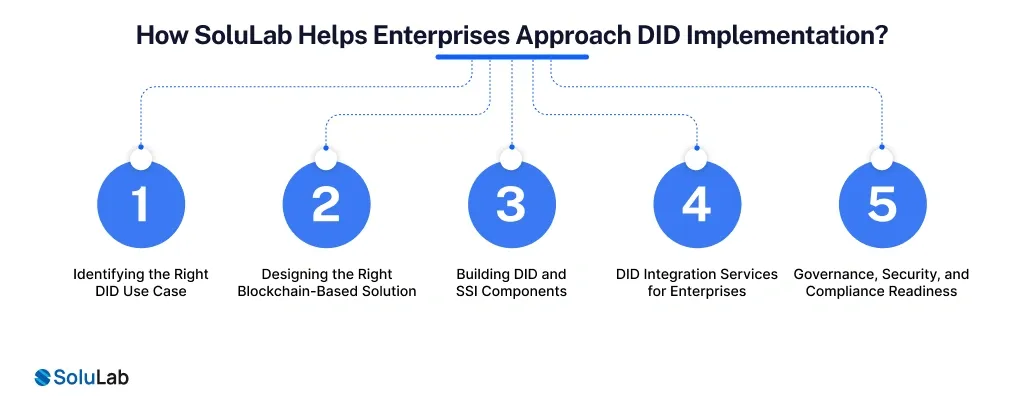
How SoluLab Helps Enterprises Approach DID Implementation?
SoluLab, as a blockchain solution expert, typically fits into this problem as both a strategic and technical partner. Instead of treating DID as only a blockchain build, SoluLab usually frames it as an enterprise transformation project.
Step 1. Identifying the Right DID Use Case
Not every enterprise identity problem needs a decentralized model. SoluLab helps organizations first define where DID adds real value.
Typical blockchain use cases include:
- Customer onboarding and KYC
- Employee identity and access credentials
- Vendor and partner verification
- Digital certificates and academic records
- Healthcare records consent
- Supply chain participant identity
- Digital wallets for regulated transactions
This first stage is important because enterprises often start with a broad ambition and need a practical starting point.
Step 2. Designing the Right Blockchain-Based Solution
Once the use case is clear, the next step is architecture. This includes deciding:
- Which blockchain or ledger model to use
- What data should stay off-chain
- How wallets will work
- How credentials will be issued and verified
- How revocation and updates will be handled
- How privacy and compliance requirements will be met
This is where SoluLab’s role as a Blockchain Consulting Company becomes relevant. Enterprises usually need more than coding support. They need technical architecture aligned with legal, operational, and user experience realities.
Step 3. Building DID and SSI Components
The technical layer of a DID project may include:
Identity wallets
For storing credentials and managing consent.
Issuer portals
For organizations that issue trusted credentials.
Verifier interfaces
For platforms, partners, or internal teams that need to validate claims.
Smart contracts and registries
Smart contract development is needed to manage validation, revocation, credential status, and trust logic.
Admin dashboards
For governance, monitoring, and enterprise controls.
This is where a DID (decentralized identity) development company becomes useful. SoluLab’s blockchain development capabilities allow enterprises to move from concept to working product without treating identity as a generic blockchain experiment.
Step 4. DID Integration Services for Enterprises
The real value of decentralized identity appears only when it connects with existing systems. That is why DID integration services for enterprises are as important as the core platform itself.
A DID system may need to connect with:
- IAM and SSO systems
- CRM platforms
- HR software
- KYC and AML tools
- Customer apps
- Internal portals
- Compliance systems
- Document verification services
Without integration, identity becomes another isolated tool. With blockchain integration, it becomes part of the operating workflow. SoluLab helps enterprises connect decentralized identity layers to business systems so the solution works in practice, not just in demos.
Step 5. Governance, Security, and Compliance Readiness
Many enterprises like the idea of DID but worry about governance. Who can issue credentials? Who can revoke them? How is trust established? What happens when standards evolve?
These are valid concerns.
A strong blockchain-based solution for identity needs governance rules around:
- Issuer trust frameworks
- Credential lifecycle policies
- Revocation processes
- Access controls
- Encryption and key recovery
- Compliance obligations
- User support and dispute handling
This is one reason DID projects must be carefully designed. SoluLab’s enterprise blockchain development services help address these concerns by combining development with operational planning.
The Role of Self-Sovereign Identity (SSI) in Enterprise Use Cases
Self-sovereign identity (SSI) is the idea that individuals or organizations should control their own identity credentials instead of surrendering them to every platform they use.
For enterprises, SSI is useful because it does not remove business control. It improves identity efficiency.
A well-designed blockchain-based SSI management system can help enterprises:
- Issue reusable credentials to customers, employees, and vendors
- Reduce repetitive verification steps
- Improve remote onboarding
- Enable selective disclosure of identity data
- Manage cross-border digital trust more effectively
This makes SSI especially relevant in banking, insurance, healthcare, education, HR, logistics, and government-linked digital services.

SSI Standards in Identity Management
A serious enterprise rollout cannot rely only on custom blockchain solution development. It needs standards. That is why SSI standards in identity management matter.
When SoluLab helps enterprises plan DID systems, standards-based design becomes critical for interoperability and long-term adoption.
Key standards usually involve:
1. Decentralized Identifiers (DIDs)
These are unique identifiers that can be created and controlled without relying on a central registry.
2. Verifiable Credentials (VCs)
These are digital credentials issued by trusted entities and presented by holders when verification is needed.
3. Wallet and presentation protocols
These support issuance, storage, sharing, and blockchain verification across applications and ecosystems.
Without standards, enterprises may build isolated systems that cannot scale or integrate well. With standards, a blockchain identity management platform development project becomes more future-ready.
How to Implement Decentralized Identity Using Blockchain?
Many decision-makers ask: how to implement decentralized identity practically using blockchain solutions.
A useful implementation path usually looks like this:
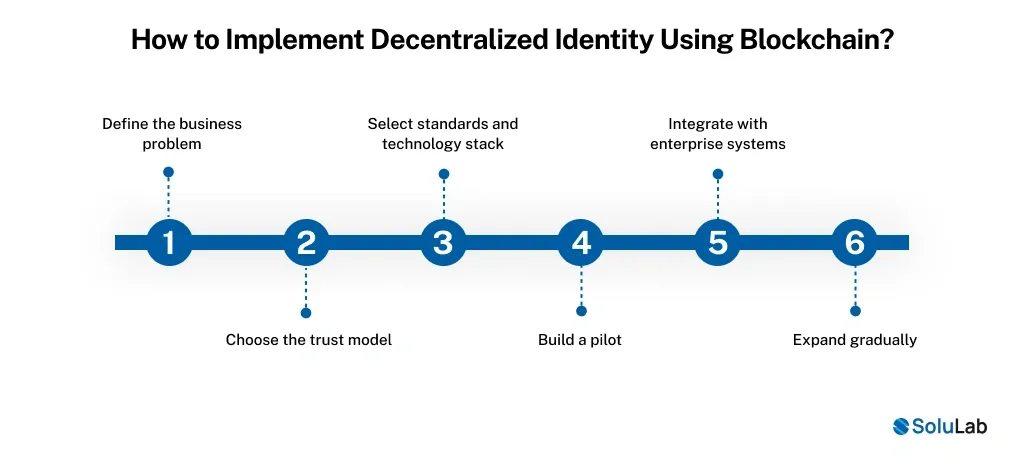
Step 1: Define the business problem
Start with a specific pain point such as repeated KYC, supplier verification delays, or fragmented employee identity systems.
Step 2: Choose the trust model
Identify issuers, holders, verifiers, and governance participants.
Step 3: Select standards and technology stack
Decide the DID method, credential format, crypto wallet structure, blockchain network, and integration model.
Step 4: Build a pilot
Start with a narrow workflow, such as employee credentials or onboarding verification.
Step 5: Integrate with enterprise systems
Connect the DID system with live business tools and compliance processes.
Step 6: Expand gradually
Once the pilot proves useful, extend it to customers, partners, or multi-organization ecosystems.
This phased model is often better than trying to launch a fully scaled identity network from day one.
Blockchain Identity Management Platform Development: What Enterprises Should Expect
A blockchain identity management platform development project is usually more complex than a standard application build because identity touches security, privacy, compliance, and user trust all at once.
Enterprises should expect work across:
- Architecture and consulting
- Wallet design
- Backend credential services
- Verifier workflows
- Smart contracts or trust registries
- API integration
- Dashboard development
- Testing and security validation
- Rollout planning
This is why many businesses prefer working with teams that combine Blockchain app Development Services with consulting and enterprise integration experience.
Cost to Develop Decentralized Identity System
Another important question is the cost to develop decentralized identity system. There is no single price because the final budget depends on the scope. A pilot may be relatively lean, while a full enterprise-grade SSI network can become a major digital infrastructure program.
Main cost drivers include:
- Number of user roles and workflows
- Wallet complexity
- Blockchain network choice
- Smart contract requirements
- Level of standards support
- Integrations with enterprise tools
- Security and compliance requirements
- Analytics, dashboards, and admin controls
- Multi-region or multi-entity rollout needs
So when businesses ask about SSI platform development cost, the realistic answer is that the cost depends on whether the goal is a blockchain proof of concept, a production-ready platform, or a multi-party ecosystem.
When Enterprises Should Hire Blockchain Experts?
Some organizations try to build DID systems with general blockchain development teams only. That can work for limited prototypes, but enterprise identity usually needs deeper specialization.
Enterprises usually benefit when they hire blockchain experts if they need:
- Complex trust architecture
- Smart contract logic
- Credential lifecycle design
- Security-heavy implementation
- Enterprise integration support
- Standards-led DID and SSI development
This is where SoluLab’s role becomes practical rather than purely promotional. As a Blockchain Consulting Company and enterprise blockchain partner, SoluLab helps reduce the gap between concept, compliance, and production delivery.
Conclusion
Enterprises are moving toward decentralized identity because traditional models are expensive, fragmented, and difficult to scale securely. SoluLab helps address this shift by supporting architecture, development, integration, and governance across DID programs.
A successful Blockchain-based Decentralized Identity Management System is not only about blockchain. It is about solving trust, privacy, and verification problems in a way that works for real enterprise operations.