
Key Takeaways
- A private blockchain like R3 Corda is for businesses’ demand for security, control, compliance, and rules to perform transactions.
- R3 Corda vs traditional blockchain architecture are different in data sharing.
- Businesses should choose private blockchain developers with proven experience for blockchain development.
- SoluLab helps enterprises to build R3 Corda private blockchain solutions for enterprises customized to their requirements.
Private blockchain like R3 Corda plays a crucial role for businesses that demand security, privacy, and control over their transactions. Private blockchains work differently from public blockchain networks, where the data is available for all the participants.
Enterprise firms like financial institutions and capital market businesses need secure systems where only relevant and R3 Corda private blockchain development is a strong reference model for such projects. Corda-style architecture focuses on known identities, limited data sharing, automation, and compliance. This guide is for those who want to build a private blockchain development platform with similar principles.
Read more—What Is Blockchain Technology
Why Businesses Need Private Blockchain Development Like R3 Corda?
Businesses require a trusted network to execute their operations, as it involves multiple organizations sharing their records. Private Blockchain, like R3 Corda, helps with that. It allows approved parties to work from shared records while keeping unrelated transaction data private. This creates trust without exposing sensitive business information. A private blockchain for businesses can help to address numerous issues, such as:
- Data mismatch between companies
- Slow manual reconciliation
- Repeated document verification
- Limited visibility across workflows
- High dependency on intermediaries
- Weak audit trails
- Delayed approvals and settlement
- Sensitive data exposure
R3 Corda vs Traditional Blockchain Architecture
The biggest difference in R3 Corda vs traditional blockchain architecture is data sharing. Traditional blockchains usually broadcast transaction data across the network. This works for public crypto ecosystems and is not suitable for the majority of enterprises. A Corda-style model shares transaction data only with involved parties. Participants are known. Access is permissioned. Governance is business-led. Privacy is designed into the architecture.
| Factor | Traditional Blockchain | R3 Corda-Like Private Blockchain |
| Network access | Open or semi-open | Permissioned and controlled |
| Identity | Often wallet-based | Verified legal entities |
| Data visibility | Broad network visibility | Shared only with relevant parties |
| Consensus | Network-wide | Transaction-specific |
| Privacy | Added through extra tools | Built into the design |
| Best fit | DeFi, NFTs, public crypto | Banking, insurance, trade, healthcare, enterprise workflows |
How R3 Corda Private Blockchain Works?
In the R3 Corda private blockchain network, each participant runs a node that interacts directly with the parties involved in a transaction. A Corda-style private blockchain has four core elements:
The key components of the private blockchain development process include:
- Permissioned network- Only approved organizations can join, view records, and perform transactions.
- Digital identity layer- Each participant is verified before accessing the private blockchain network.
- Participant nodes—Each business runs or connects to a node that stores relevant transaction records.
- States- States represent business facts like invoices, assets, documents, claims, or settlement obligations.
- Smart contracts- Smart contracts validate business rules before any transaction is accepted.
- Flows- Flows automate multi-party approvals, communication, document exchange, and transaction finalization.
- Notary service—A notary prevents transaction duplication.
- Governance framework- The governance framework defines the operational rules.
- API layer- APIs connect the blockchain with business processes.
- Security layer- The security layer ensures that data remains safe.
How to Create Your Own Private Blockchain Like R3 Corda?
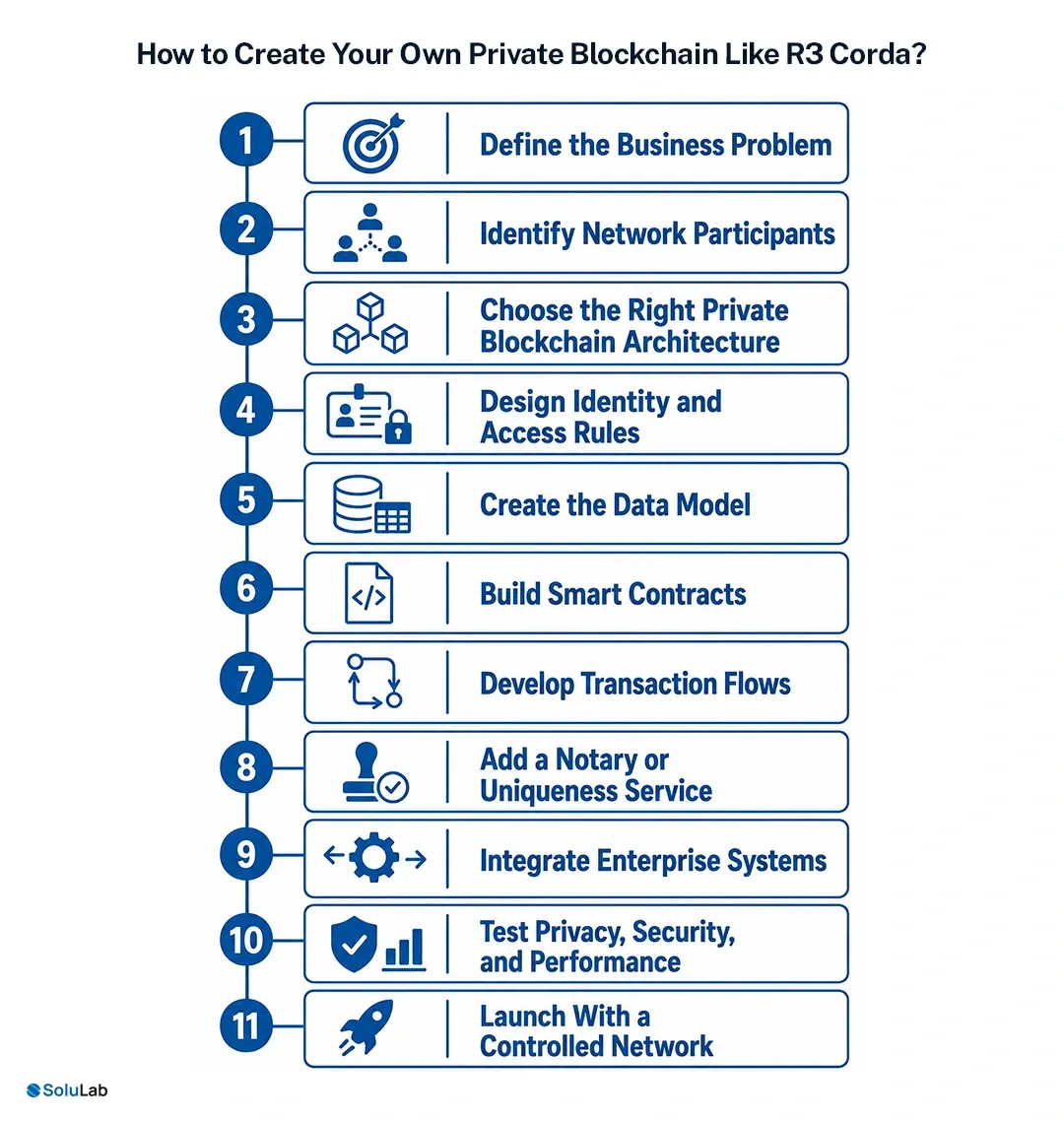
To create your own private blockchain like R3 Corda, businesses should start with the workflow. The blockchain should solve a real operational problem.
1. Define the Business Problem
Start with expert blockchain consulting services and defining the business problem, the requirements to be fulfilled, and the expected outcomes.
2. Identify Network Participants
List every organization supposed to be part of the private blockchain network. Each participant must have a defined role, access, and responsibility.
3. Choose the Right Private Blockchain Architecture
The business must decide whether to use R3 Corda directly, build a Corda-like framework, or choose another permissioned blockchain architecture. The selected architecture should support business operations. This is where experienced private blockchain developers can prevent costly architecture mistakes.
4. Design Identity and Access Rules
A private blockchain cannot allow unknown participants. The system must define how organizations are verified, approved, authenticated, suspended, or removed. This step is especially important for finance, insurance, healthcare, government, and capital market use cases.
5. Create the Data Model
Decide what business facts the ledger will record. These may include invoices, asset records, shipment documents, insurance claims, certificates, approvals, ownership rights, or settlement instructions. The data model should be simple, secure, and privacy-focused.
6. Build Smart Contracts
Smart contracts define the validation logic. This is a key part of Corda R3 blockchain development because enterprise workflows depend on enforceable business rules.
7. Develop Transaction Flows
Flows define how participants interact during a business process. An invoice approval flow may include document upload, buyer review, bank approval, supplier notification, and final settlement. Good flows make the blockchain usable for business teams, not just technical teams.
8. Add a Notary or Uniqueness Service
A private blockchain like R3 Corda needs a mechanism to prevent duplicate claims, double-spending, or conflicting records. In Corda, this role is handled by a notary. In custom private blockchain development, businesses need an equivalent uniqueness service.
9. Integrate Enterprise Systems
Private blockchain applications do not work in isolation. They must connect with ERP software, payment systems, compliance tools, identity providers, cloud platforms, data warehouses, and reporting dashboards. Integration turns blockchain from a ledger into a working business system.
10. Test Privacy, Security, and Performance
Before launch, test access control, smart contract logic, transaction privacy, API reliability, audit logs, key management, failover, scalability, and data recovery.
Security testing is essential when the network handles regulated or sensitive enterprise data.
11. Launch With a Controlled Network
Start with a small group of participants and one high-value workflow. Once the network is stable, expand to more users, processes, and organizations. This reduces risk and helps stakeholders trust the system step by step.
Private Blockchain Applications for Enterprises
The best private blockchain applications involve multiple organizations that need shared trust without full data exposure.
Banking
Interbank settlement, loan servicing, KYC sharing, syndicated lending, and payment reconciliation.
Insurance
Claims automation, policy verification, fraud checks, repair approvals, and reinsurance workflows.
Trade finance
Letters of credit, invoice financing, document verification, buyer-supplier-bank coordination, and settlement approvals.
Supply chain
Product provenance, shipment tracking, supplier verification, inventory records, and compliance certificates.
Healthcare
Patient consent, provider coordination, secure record sharing, insurance claims, and clinical documentation.
Capital markets
Digital securities, asset servicing, settlement workflows, regulatory reporting, and investor record management.
Real estate
Ownership records, escrow workflows, title verification, property tokenization, and transaction settlement.
Energy
Carbon credits, renewable certificates, energy settlement, and multi-party market records.
These use cases show why Private Blockchain Application development works best where privacy, trust, and accountability are equally important.
Practical Examples of R3 Corda Blockchain Development
- A trade finance network- To connect importers, exporters, banks, insurers, and logistics firms. Each party can access the records needed for its role, while unrelated business data remains private.
- An insurance claims network- To connect insurers, hospitals, repair vendors, policyholders, and auditors. Claims can move through one shared workflow with better visibility and fewer disputes.
- A securities platform– To connect issuers, investors, custodians, transfer agents, and regulators. The network can manage ownership, settlement, compliance checks, and reporting.
- A KYC sharing network- To help regulated institutions reuse verified customer checks with permissioned access, reducing repeated onboarding and compliance friction.
These examples show how R3 Corda private blockchain solutions support real business workflows instead of generic blockchain experiments.
Choosing Private Blockchain Platforms and Developers
There are many blockchain platforms, but the right choice depends on the industry, privacy needs, participant roles, transaction volume, governance model, integration requirements, and compliance expectations. When choosing private blockchain developers, businesses should look for experience in:
- Enterprise blockchain architecture
- R3 Corda or Corda-like development
- Smart contract engineering
- Workflow automation
- ‘Identity and access management
- API integration
- Security and key management
- Compliance-focused design
- Cloud and on-premise deployment
- Long-term maintenance and upgrades
An Expert Blockchain Consultant can help businesses choose the right architecture before full development begins. This saves cost, reduces risk, and avoids rebuilding later.
SoluLab’s Private Blockchain Development Services
SoluLab is a trusted blockchain development company that helps enterprises design and build secure, permissioned, and scalable blockchain networks for real business workflows. With our private blockchain development services, businesses can plan the architecture, define participant roles, build smart contracts, automate transaction flows, integrate enterprise systems, test security, and deploy reliable blockchain infrastructure.
Whether the requirement is R3 Corda private blockchain development, a Corda-like permissioned network, or a custom private blockchain development platform, SoluLab helps enterprises move from idea to implementation with the right technical foundation.
Build a secure private blockchain network with enterprise blockchain engineers who understand workflows, privacy, compliance, and system integration.
FAQs
Shipra Garg is a tech-focused content strategist and copywriter specializing in Web3, blockchain, and artificial intelligence. She has worked with startups and enterprise teams to craft high-conversion content that bridges deep tech with business impact. Her work translates complex innovations into clear, credible, and engaging narratives that drive growth and build trust in emerging tech markets.