Key Takeaways
- Blockchain recycling tokenization turns a verified quantity of recycled or recovered material into a digital token that can be tracked, traded and retired.
- A blockchain proves a record was not changed after it was written. It cannot prove the record was true when it was written. Verification at the point of collection is the whole game.
- Tokens must be retired once used for a claim. Without a burn step, the same kilogram of plastic gets counted twice.
- Regulation turned this from a nice idea into a compliance tool. Recycled content targets need proof, not a PDF.
- The strongest real-world platforms pay informal waste collectors directly, which is a social benefit as much as a technical one.
- A dual-token design works well: a fungible token for the credit and a unique certificate for each retirement.
- Most projects fail on physical verification and buyer demand, not on smart contract code.
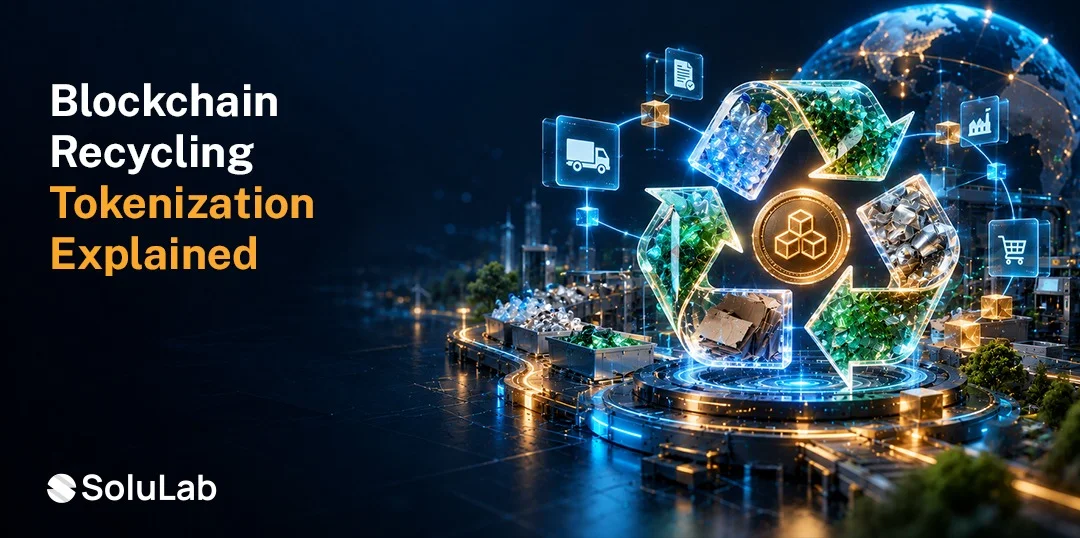
Blockchain recycling tokenization records a verified amount of collected, recovered, or recycled material as a digital token on a shared ledger. Each token carries its evidence trail: who collected it, where, what material, how much, and where it went next. Brands and producers then buy, transfer, or retire those tokens to prove recycling claims and meet regulatory targets.
The underlying market is growing fast. Grand View Research values the global recycled plastics market at $60.76 billion in 2025, projecting $132.33 billion by 2033 at a compound annual growth rate of 10.4%. As recycled material gains value, proving it is genuinely recycled becomes the commercial problem.
This guide covers how tokenized recycling works, why the ledger is the easy part, which real platforms exist, and what it takes to build one.

What Is Blockchain Recycling Tokenization?
Recycling tokenization converts a verified recycling event into a digital asset. One token typically represents a fixed quantity, such as a kilogram or a tonne of recovered plastic, backed by evidence recorded at the moment of collection or processing.
1. What a Token Actually Represents
Not the plastic itself. The token is a claim that a specific, verified quantity of material was collected or recycled by a specific party, at a specific place and time. The material moves through the physical supply chain. The token moves through the digital one, and the two stay linked by the evidence trail.
2. Why Blockchain Fits This Problem
Recycling involves many parties who do not fully trust each other: informal collectors, aggregators, processors, brands, auditors and regulators. A shared ledger gives all of them the same record, which no single party can quietly edit. That property, rather than anything about cryptocurrency, is why blockchain technology keeps appearing in circular economy projects.
3. How It Differs From a Carbon Credit
Related but distinct. A carbon credit represents avoided or removed emissions. A plastic or recycling credit represents a physical quantity of material recovered. Some projects issue both from the same activity, which is useful, and which also creates double-counting risk that has to be designed out. Our guide to building a carbon credit marketplace covers the emissions side.
How Does Recycling Tokenization Work?
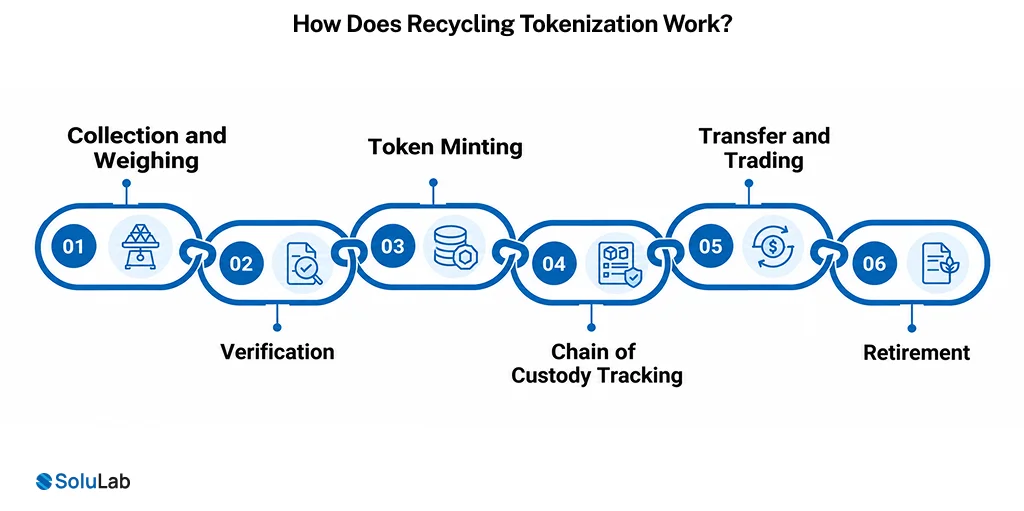
Six stages, from the moment material is collected to the moment a claim is made against it. The first two are physical and they determine whether anything after them can be trusted.
1. Collection and Weighing
A collector brings material to a collection point. It is weighed and sorted by type, such as PET, HDPE, PP or flexible film. The record captures collector identity, material type, weight, GPS location and timestamp.
2. Verification
Evidence is checked before anything is minted. Photos, geolocation, invoice matching, scale readings and periodic on-site audits confirm the event happened as recorded. Credible platforms add automated anomaly checks that flag unusual volumes or patterns for human review.
3. Token Minting
Only verified quantities become tokens. A smart contract mints the corresponding amount and attaches the evidence reference, so every token can be traced back to the event that created it.
4. Chain of Custody Tracking
As material moves from aggregator to processor to recycler, each handover extends the record. This is standard blockchain in supply chain logic applied to waste, and it is what lets a buyer see where the material actually ended up.
5. Transfer and Trading
Brands, producers or intermediaries acquire tokens to support recycling claims, meet producer responsibility obligations or fund collection programmes. Transfers are recorded publicly, so ownership is never ambiguous.
6. Retirement
When a token is used to support a claim, it is burned or retired and cannot be sold or counted again. A retirement certificate is issued to the buyer as proof. Skip this step and the entire system allows double counting.
Why Does Recycling Tokenization Matter Now?
Because regulation now demands verifiable proof, and greenwashing has become a legal exposure rather than a reputational one. Those two shifts arrived together.
1. EU Packaging Rules Now Apply
The EU Packaging and Packaging Waste Regulation, Regulation (EU) 2025/40, entered into force on 11 February 2025 and has applied since 12 August 2026 across all member states, including imported packaging. It requires all packaging to be recyclable by 2030 and sets minimum recycled content for plastic packaging, including 30% for single-use plastic beverage bottles by 2030 rising to 65% by 2040.
Recycled content targets need evidence. A brand claiming 30% recycled content has to prove where that material came from, and a tamper-evident chain of custody is one of the cleanest ways to do it.
2. Producer Responsibility Is Expanding
Extended producer responsibility schemes are tightening across the EU, the UK, India and Latin America, making brands financially responsible for the packaging they put on the market. Reporting against these schemes needs auditable data, which is where tokenized records fit.
3. Most Plastic Still Is Not Recycled
The scale of the gap is the opportunity. The European Commission reports that 40% of plastics used in the EU go into packaging and that roughly half of marine litter comes from packaging. In Grand View Research’s analysis of plastic waste management services, landfill remained the largest segment at 44.7% in 2024. There is far more material to recover than current systems handle.
4. Greenwashing Is Now a Liability
Sustainability claims face growing scrutiny from regulators, investors and procurement teams, who increasingly want auditable data rather than commitments. A claim backed by a retired token with a full evidence trail is far easier to defend than a claim backed by a supplier letter. That reporting need connects directly to AI in ESG work, where the challenge is turning raw data into credible disclosure.
5. Collectors Get Paid Fairly and Traceably
Much of the world’s plastic is collected by informal workers. Tokenized systems can pay them directly, often as a combination of cash and digital bonuses, with every payment on record. That traceability protects collectors and gives brands evidence their programmes actually reached people.
What Can Be Tokenized in the Recycling Value Chain?
Six asset types, each serving a different buyer. Most platforms start with one and add others once verification is proven.
1. Plastic Credits
The most common. Each credit represents a verified tonne or kilogram of plastic collected or recycled. Brands buy them to support plastic neutrality or reduction claims.
2. Recycled Content Certificates
Proof that a specific batch of recycled material went into a specific product. This is what recycled content targets actually need, and it is harder to produce because it requires tracking material through processing rather than just at collection.
3. Recyclable Material Batches
Tokens representing lots of sorted, graded material ready for sale to processors. These support trading between aggregators and recyclers and bring price transparency to a market that often lacks it.
4. Collector Reward Tokens
Loyalty or bonus tokens paid to collectors on top of cash, redeemable for goods, services, or benefits. These drive participation and create a verified payment history for workers who may lack formal banking.
5. Producer Responsibility Compliance Units
Tokens mapped to specific scheme obligations, letting a producer demonstrate its share of collection or recycling for a given market and period.
6. Environmental Co-Benefits
Some recovery activity also avoids emissions. Where the methodology supports it, those benefits can be tokenized separately, in the same way green energy tokenization represents renewable generation. The critical rule is that the same activity is never sold twice under two labels.
Why the Blockchain Is Not the Hard Part
The ledger guarantees a record was not altered after it was written. It says nothing about whether the record was true when it was written. That gap, often called the oracle problem, is where recycling tokenization succeeds or fails.
1. Garbage In, Immutable Garbage Out
If a collection point logs 500 kilograms that were really 300, the blockchain will preserve that error permanently and publicly. Immutability protects honest data and dishonest data equally. Any platform that leads with blockchain as its trust guarantee, without explaining its verification, is making a weaker claim than it appears.
2. Verification Is the Real Engineering
The credible platforms combine several independent signals: calibrated scales, timestamped photos, geolocation, invoice and weighbridge matching, accredited recovery partners, periodic physical audits, and automated anomaly detection. No single check is enough. Together they make fraud expensive and detectable.
3. Double Counting Has Several Forms
The same kilogram can be sold twice as a credit, counted once as a credit and again as recycled content, or claimed by both the collector’s programme and the processor’s. Retirement logic, unique serial numbers and cross-registry checks close these gaps. Well-designed smart contracts in supply chain systems enforce these rules automatically rather than relying on manual reconciliation.
4. Mass Balance Adds Complexity
Recycled and virgin materials are often mixed during processing, so a physical molecule cannot always be traced to a product. Mass balance accounting tracks proportions instead. It is legitimate and widely used, but it needs clear disclosure so buyers understand what a certificate is actually claiming.
5. What This Means for Buyers
Ask any recycling tokenization provider three questions. How is each quantity verified before minting? How are tokens retired to prevent double counting? And who independently audits the process? A provider that cannot answer all three clearly is selling a ledger, not proof.
How Do You Build a Recycling Tokenization Platform?
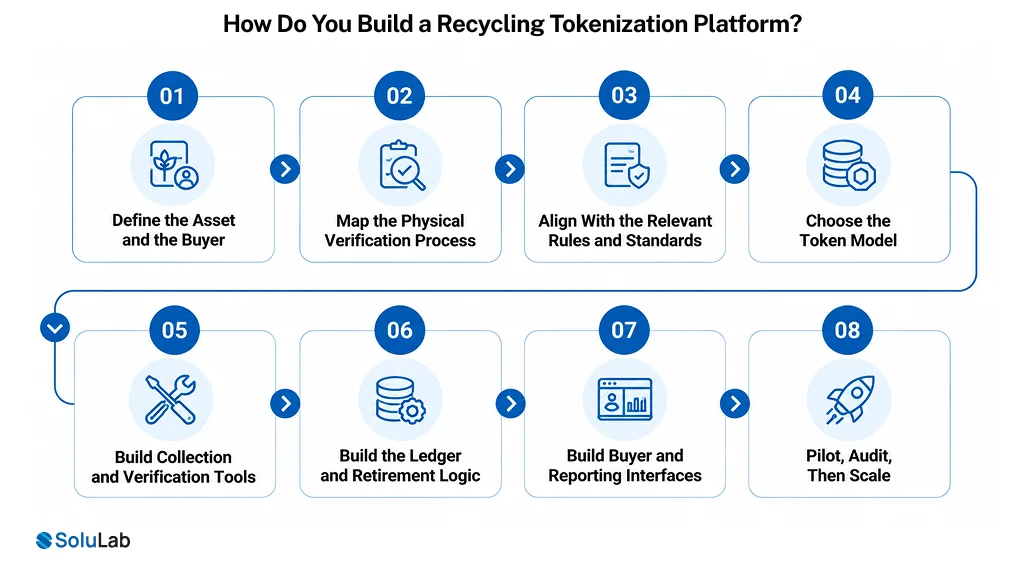
Eight steps, followed by what drives the budget. The first three are about the physical world and the regulatory context, and they matter more than the chain you choose.
1. Define the Asset and the Buyer
Plastic credits for brand claims, recycled content certificates for compliance, or material batches for trading. Each serves a different buyer with different evidence requirements. Decide this before anything technical.
2. Map the Physical Verification Process
Specify exactly how every quantity will be weighed, evidenced, and checked before minting. This is the hardest and most important design work, and it is where most blockchain consulting services engagements should spend their time.
3. Align With the Relevant Rules and Standards
Identify which producer responsibility schemes, recycled content rules, and credit standards your buyers report against. Your token design has to produce evidence those frameworks accept.
4. Choose the Token Model
Fungible tokens for interchangeable credits, unique certificates for retirement proofs, or both. A dual-token model is often the cleanest. This is core asset tokenization design, and it follows the same principles as other forms of RWA tokenization.
5. Build Collection and Verification Tools
Mobile apps for collection points, integration with scales and IoT sensors, photo and GPS capture, and a review dashboard for verifiers. These tools must work offline and on low-cost devices, because many collection points have poor connectivity.
6. Build the Ledger and Retirement Logic
Minting, transfer, and burn contracts, plus registry logic that prevents double counting across programmes. Commission an independent smart contract audit before launch, not after.
7. Build Buyer and Reporting Interfaces
Dashboards, retirement certificates and exports that plug into ESG and compliance reporting. Most buyers do not want to touch a wallet, so custodial accounts and conventional interfaces matter.
8. Pilot, Audit, Then Scale
Launch with one material type, one region, and a small group of collection points. Run an independent audit of the full cycle before expanding. Teams without in-house depth often hire blockchain developers with supply chain experience for defined phases rather than building capability from scratch.
Real Examples of Recycling Tokenization Platforms Exist Today?
Several platforms operate at meaningful scale, and they illustrate the design choices well. The patterns matter more than any single company.
1. Plastic Bank
One of the earliest and largest. Plastic Bank created a digitally tokenized, traceable plastic credit linked to physical collection, with a network of more than 63,000 collectors across the Philippines, Indonesia, Brazil, Egypt and Thailand. Each deposit records collector identity, branch location, distance from the nearest shoreline, weight, material type, timestamp and payment. Collectors use the same platform as a digital wallet, receiving cash plus token bonuses.
The design lesson is that social impact and data integrity reinforce each other. Paying collectors traceably produces the evidence trail brands need.
2. Plastiks
Focused on verification for compliance. Plastiks checks plastic recovery using timestamped photos, geolocation and invoice validation, then issues blockchain-backed certificates that feed producer responsibility and ESG reporting. It positions its methodology against frameworks including EU packaging rules, UK producer responsibility and India’s plastic waste regulations.
The lesson here is that the buyer is often a compliance team, not a sustainability marketing team, and the product has to fit their reporting workflow.
3. KleanLoop
KleanLoop is a decentralized blockchain and AI-powered platform created by Klean Industries to bring transparency, traceability, and digital tokenization to the global waste management, recycling, and circular economy sectors.
Conclusion
Blockchain recycling tokenization matters for one reason: it turns recycling from a claim into a verifiable record that multiple parties can trust at once. With EU packaging rules now applying and producer responsibility expanding across markets, that verifiability has moved from a sustainability nice-to-have into a compliance requirement.
But the blockchain is the easy part. The platforms that succeed invest most of their effort in physical verification, retirement discipline and interfaces that collectors and compliance teams can actually use. Start with one material, one region and one buyer with a real obligation, prove the full cycle, and scale only once an independent audit confirms it holds up.
SoluLab, a blockchain development company, can help your business design the verification process, build the token and retirement logic, and deliver collection and reporting tools that work for collectors, recyclers and compliance teams alike.
FAQs
Neha is a curious content writer with a knack for breaking down complex technologies into meaningful, reader-friendly insights. With experience in blockchain, digital assets, and enterprise tech, she focuses on creating content that informs, connects, and supports strategic decision-making.