Key Takeaways
- In dApp development, the contract is the product. Everything else is replaceable; deployed contract logic often is not.
- Most dApps are partly centralised, and that is fine. What matters is being deliberate about which parts, not pretending otherwise.
- Audit is not a line item you cut. Once value flows through a contract, a bug is a loss, not a bug report.
- Chain choice is a distribution decision. Fees, finality and tooling matter, but where your users already hold assets matters more.
- Upgradeability is a design decision made before launch. Retrofitting it is usually a migration, not a patch.
dApp development is the process of building an application whose core logic runs as smart contracts on a blockchain rather than on a server you control. Users interact through a normal web or mobile interface. But the rules that move value are enforced by code on a public network that nobody can quietly change, including you.
On this page: what makes an app a dApp, how the dApp architecture is layered, choosing a chain, the tech stack, how a build runs, the security work that dominates the budget, what it costs, and where most projects are less decentralised than they claim.
If you are past the research stage and comparing delivery partners, our dApp development services page covers scope and engagement models.
What Is dApp Development and What Makes an App a dApp?
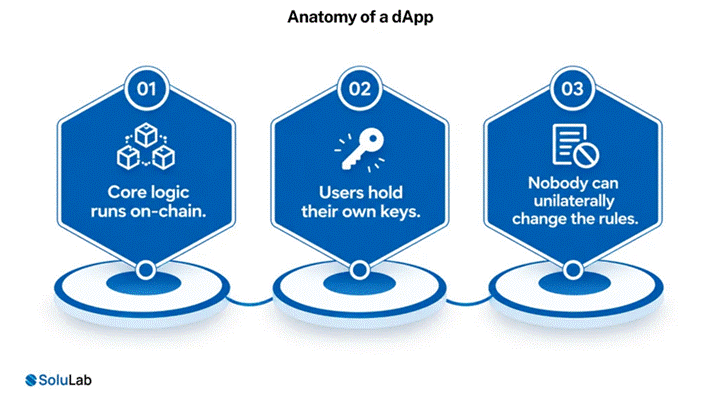
1. Core Logic Runs On-Chain
The rules that move value or determine state live in smart contracts on a public network. Validators execute and verify them, not your backend.
2. Users Hold Their Own Keys
Interaction happens through a wallet the user controls. There is no account you can suspend and no password you can reset, which is why Web3 wallet development is part of the product design rather than an add-on.
3. Nobody Can Unilaterally Change the Rules
If a single team can upgrade a contract without notice or constraint, the application is a normal app with a blockchain database attached.
Around those three sit components that usually aren’t decentralised at all: a front end served from a CDN, an indexer that makes chain data queryable, oracles feeding external prices, and off-chain storage for anything too large or too private for the chain. That’s normal in dApp development. What matters is whether the team knows which parts are centralised and has said so publicly.
How Is dApp Development Different From Traditional Web Development?
| Dimension | Traditional web app | dApp |
| Where core logic runs | Your servers | Smart contracts on a network |
| Who controls the data | You | The network, plus whatever you keep off-chain |
| User accounts | Email and password you manage | Wallet address the user controls |
| Fixing a bug | Deploy a patch | Upgrade path if you built one, migration if not |
| Cost per action | Your infrastructure bill | Gas paid per transaction, by someone |
| Downtime | Your responsibility | Contracts stay live; your front end can still fail |
| Main risk | Data breach | Irreversible loss of funds |
| Iteration speed | Fast | Slow on-chain, fast off-chain |
The two rows to sit with are bug fixing and main risk. In a web app, a bad deploy is embarrassing. In a dApp, a bad deploy can be permanent and expensive.
That single difference is why dApp development front-loads specification, review and testing to a degree that feels excessive to teams arriving from web development.
How Do You Choose a Blockchain for dApp Development?
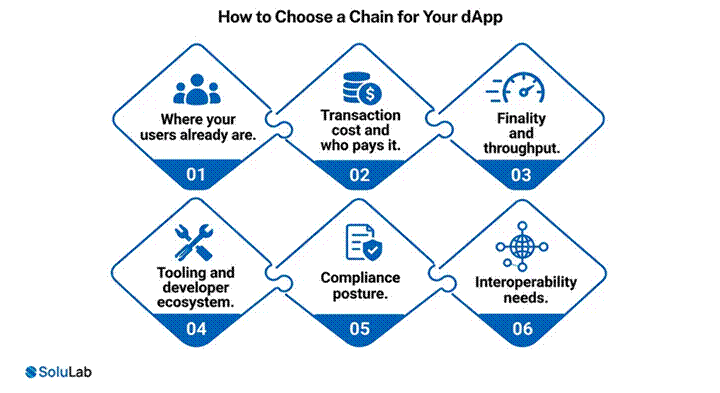
1. Where Your Users Already Are
Liquidity and existing wallet adoption beat technical elegance. A better chain with no users is a worse product.
2. Transaction Cost and Who Pays It
If users pay gas per action, high fees kill any consumer use case. Account abstraction and sponsored transactions change this calculation.
3. Finality and Throughput
Trading and gaming need fast confirmation, so they shape most DeFi development choices. Registries and settlement, by contrast, can tolerate slower blocks.
4. Tooling and Developer Ecosystem
Mature libraries, indexers, testing frameworks and audit firms familiar with the environment save months.
5. Compliance Posture
Some chains and token standards fit regulated use cases better than others. So settle this before writing contracts; our guide to blockchain regulatory compliance for enterprises covers the questions to ask.
6. Interoperability Needs
If assets must move between chains, bridging becomes part of your threat model. Historically, bridges have been among the most exploited components in the space.
EVM-compatible environments remain the default for dApp development because tooling, audit expertise and developer availability are deepest there, which is why so many teams start with Ethereum blockchain development. Alternative environments can be the right answer. The cost is a smaller talent pool and fewer audit firms who know the pitfalls.
For a chain-specific worked example, our guide to building a dApp on Rootstock walks through one non-default choice end to end.
What Does the dApp Development Tech Stack Look Like?
In dApp development, a production app combines on-chain contracts with a surprising amount of conventional infrastructure. Here’s what typically sits at each layer.
| Layer | Common choices | What to watch |
| Smart contracts | Solidity on EVM chains, Rust in several non-EVM environments, built with Foundry or Hardhat | Test far more heavily than typical application code |
| Front end | React or Next.js, plus a wallet connection library for signing and network switching | Make transaction states legible: pending, confirmed, failed and why |
| Indexing | A subgraph or custom indexer that turns contract events into a queryable API | Treat it as production infrastructure, not a convenience |
| Storage | IPFS or Arweave for durable, verifiable content; conventional storage for the rest | Personal data on-chain is usually a compliance problem |
| Oracles | Price, outcome and identity feeds for any contract that needs external data | Feed manipulation remains a common exploit route |
| Node access and monitoring | Managed RPC providers, plus alerts on contract events | Learn about anomalies from your alerts, not from social media |
The contract layer is where specialist skill matters most. If your team is new to it, Solidity development support for the first contracts usually pays for itself in fewer audit findings.
How Does the dApp Development Process Run?
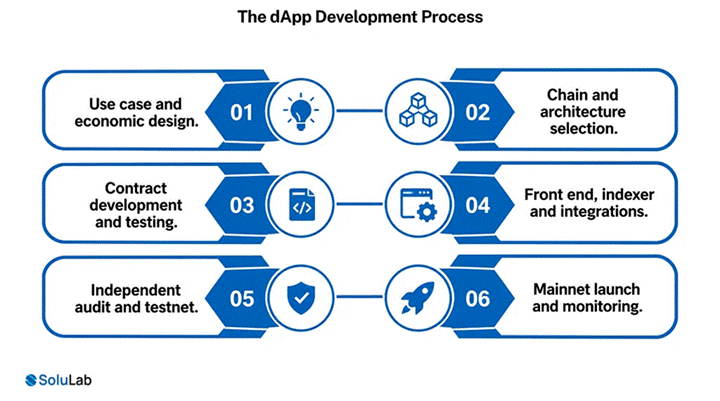
1. Use Case and Economic Design
Decide what genuinely needs to be on-chain. If nothing does, a database is a better product, and good blockchain consulting should tell you so.
2. Chain and Architecture Selection
Settle the chain, the upgradeability approach, admin key handling and the custody model before writing code.
3. Contract Development and Testing
Run unit tests, fork tests against real network state, and invariant and fuzz testing. Coverage figures mean little; adversarial thinking means everything.
4. Front End, Indexer and Integrations
Build wallet flows, transaction status handling, indexing, oracles and any off-chain services.
5. Independent Audit and Testnet
Commission an external audit from a firm familiar with your environment, then run a public testnet period with real users. Fix the findings, then re-review the changed code.
6. Mainnet Launch and Monitoring
Deploy with event monitoring and an incident plan. If contracts are upgradeable, publish who holds the keys and under what constraints.
What Does Security Involve in dApp Development?
The recurring failures are well documented and repetitive: reentrancy, unchecked access control on privileged functions, and oracle manipulation. The largest category by value, though, is compromised admin keys rather than flawed contract logic.
So use a multisig or timelock for privileged operations. A single private key controlling upgrades is the most common serious weakness in otherwise competent projects. Threshold signing is another option, and our explainer on MPC wallets covers how it removes the single point of failure.
For teams building the skill in-house, our guide on becoming a dApp developer covers the learning path. If you need capacity sooner, you can hire Web3 developers who have already shipped audited contracts.
What Does dApp Development Cost?
The cost of dApp development is driven by contract complexity and audit scope more than by front-end work. The main variables are how many contracts you deploy and how much value they handle, whether the design is upgradeable, how many integrations and oracles are involved, the audit firm and number of review rounds, and how much of the product is off-chain.
Two costs teams consistently leave out. Audit is not a one-time fee, because material changes after review require re-review, and most projects go through more than one round. Post-launch monitoring is also permanent: contracts run continuously, so someone needs alerting on anomalous events and a rehearsed response when something looks wrong.
The most reliable dApp development estimate comes from a scoped discovery against your contract surface and target chain.
How Do You Choose a dApp Development Partner?
Before you sign a dApp development partner, run these five checks, in order.
- Have their contracts been externally audited, and can you read the reports? Ask for findings, not a badge.
- Do they have mainnet deployments handling real value? Testnet demos prove very little.
- How do they handle keys and upgrades? If they can’t explain multisig, timelocks and admin key policy clearly, they shouldn’t hold yours.
- Who owns the contracts, the repositories and the deployment keys? Get it in writing before scoping.
- What happens after launch? Monitoring, incident response and chain upgrades are ongoing obligations, not project tasks.
For the surrounding services, our smart contract development, smart contract audit and Web3 app development pages cover the specialisms most dApp projects need alongside the build.
CTA3- Talk to Engineers Who Ship to Mainnet

How SoluLab Approaches dApp Development
We have built software for over eleven years with a team of 250+ engineers. Our Web3 work spans contract development, audit preparation, front end and indexing, and the off-chain infrastructure most dApps actually depend on.
We hold ISO 27001:2022 and SOC 2 certification and are assessed at CMMI Level 3, which matters when contracts handle customer funds.
Most dApp development engagements start with an architecture session on chain choice, upgradeability and custody. Those three decisions constrain everything that follows and are the expensive ones to reverse. You can see the full scope on our decentralised application development page.
dApp Development FAQs
Shipra Garg is a tech-focused content strategist and copywriter specializing in Web3, blockchain, and artificial intelligence. She has worked with startups and enterprise teams to craft high-conversion content that bridges deep tech with business impact. Her work translates complex innovations into clear, credible, and engaging narratives that drive growth and build trust in emerging tech markets.