
Key Takeaways
- Web3 compliance solutions now need to cover token classification, AML/KYC, governance, custody, disclosures, sanctions screening, and audit records.
- The CLARITY Act aims to clarify the SEC vs CFTC in the CLARITY Act by giving the CFTC a central role over digital commodities while preserving SEC authority over certain primary market crypto transactions.
- Startups need a practical Web3 startup compliance checklist before launching tokens, DeFi tools, wallets, payment features, or marketplaces.
- Web3 AML compliance platform adoption will increase as startups face stronger expectations around transaction monitoring and customer risk.
- AI-powered Web3 compliance platform tools can help teams detect suspicious activity, screen wallets, monitor smart contract risk, and reduce manual review.
- SoluLab helps startups build Web3 Solutions, compliance-ready product architecture, and scalable infrastructure through its Web3 Development Services.
A Web3 startup cannot take compliance as paperwork saved for fundraising, exchange listings, or a last-minute legal review anymore. In the U.S., the CLARITY Act has pushed digital asset regulation closer to a market-structure model that separates digital commodities, investment contract assets, and payment stablecoins.
As of May 27, 2026, the bill had passed the House and advanced out of the Senate Banking Committee. It changes how founders should think about product design. Businesses may now need clearer answers on classification, custody, disclosures, user protection, AML controls, and agency oversight.
This shift directly impacts how web3 development teams design and build blockchain products. It requires clearer decisions around asset classification, custody models, disclosures, user protection mechanisms, AML controls, and regulatory oversight readiness.
This guide explores how businesses can build Web3 compliance solutions supporting the Clairty Act.
How Does the CLARITY Act Impact Web3 Startups?
The CLARITY Act affects Web3 startups by making token classification and market activity more important from the beginning.
For years, many startups built first and asked legal questions later. That approach became risky because a token could be viewed differently depending on how it was sold, how the network worked, how much control the founding team retained, and whether buyers expected profit from the team’s efforts.
The US CLARITY Act tries to reduce that uncertainty by creating a market-structure framework. The Congressional Research Service summarized that the bill would give the CFTC a central role in regulating digital commodities and related intermediaries, while preserving certain SEC authority over primary market crypto transactions and creating a limited registration exemption for fundraising.
Read more – US CLARITY Act 2026: Regulatory Clarity for Tokenized RWAs
For Web3 startups, this means three things.
- Token design becomes a compliance decision
A founder cannot decide tokenomics only around growth, liquidity, or community incentives. The team must also consider whether the token may be treated as a digital commodity, an investment contract asset, or another regulated asset type.
- Intermediaries face more scrutiny.
Crypto trading platforms, brokers, custodians, marketplaces, liquidity venues, and related service providers may need stronger registration, customer asset protection, disclosure, and conflict management processes.
- Decentralization claims need evidence.
A project cannot simply say “decentralized” in a whitepaper. It may need governance records, admin-key controls, voting history, validator distribution, treasury oversight, and proof that no small group controls the network.
This is where CLARITY Act compliance consulting becomes valuable. It helps founders turn legal uncertainty into product decisions.
Why Web3 Startups Need a New Compliance Stack?
The old Web3 compliance model was thin. Many startups relied on terms of service, a basic privacy policy, a one-time smart contract audit, and a KYC vendor added only when a centralized feature required it.
A modern compliance stack for Web3 startups should cover the full product lifecycle. It should start before token design. It should continue through development, launch, growth, governance, treasury management, and secondary market activity. The strongest startups now treat compliance like security. They build it early, test it often, and document it properly.
A good stack should answer practical questions:
- Who can use the platform?
- Which users need KYC?
- Which wallets are blocked?
- Who controls admin keys?
- What disclosures are shown before token purchase?
- How does the team monitor suspicious activity?
- What happens if a regulator, exchange, bank, or investor asks for records?
Web3 compliance solutions are not only about avoiding penalties. They help startups win trust.
SEC vs CFTC in the CLARITY Act: What Businesses Should Understand
The CLARITY Act matters because U.S. digital asset regulation has long suffered from overlapping SEC and CFTC claims.
Broadly, the CLARITY framework attempts to separate digital asset oversight based on asset type and market activity. The CFTC would receive a central role over digital commodities and related intermediaries, while the SEC would retain authority over certain securities-related transactions and disclosures. Now, startups need to know what they are building.
A token used in a live decentralized network may create one risk profile. A token sold to fund future development may create another. A marketplace that only provides non-custodial software may sit differently from a platform that takes custody, controls order execution, or pools user assets.
This is why legal classification should happen before development milestones such as token sale design, staking mechanics, DAO governance, liquidity incentives, exchange strategy, and customer onboarding.
A startup that understands the SEC and CFTC compliance solutions it may need can build cleaner systems from the beginning.
The Core Layers of a Modern Web3 Compliance Solutions Stack
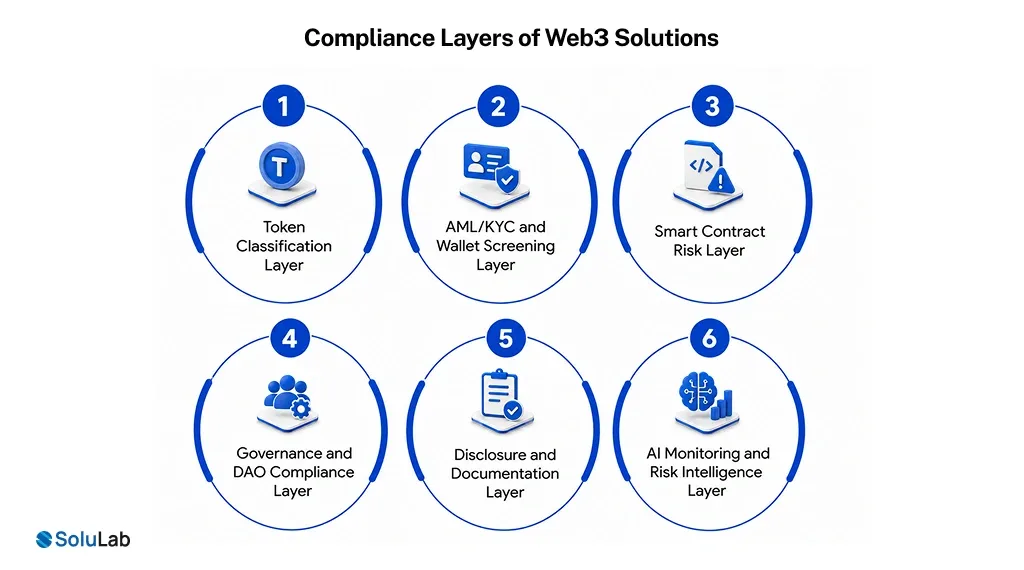
- Token Classification Layer
This layer helps the startup understand how its token, protocol, or digital asset may be viewed under market-structure rules. It should cover token purpose, sale structure, network maturity, decentralization, governance control, economic rights, marketing language, and secondary market expectations.
Without this layer, the startup may build a product that looks exciting to users but risky to crypto exchanges, banks, investors, and regulators.
- AML/KYC and Wallet Screening Layer
A Web3 AML compliance platform helps identify high-risk wallets, sanctioned addresses, mixer exposure, scam-linked funds, fraud behavior, and suspicious transaction patterns. This layer becomes even more important for startups handling payments, custody, fiat ramps, token sales, marketplaces, RWAs, gaming economies, or DeFi access controls.
Web3 KYC AML solutions should support both customer identity and on-chain risk. Traditional KYC alone does not show where crypto funds came from. Wallet analytics alone do not identify the person or business behind a regulated account. Startups often need both.
- Smart Contract Risk Layer
Smart contracts are a compliance infrastructure. A startup should know who can upgrade contracts, pause functions, move treasury funds, blacklist addresses, change fees, or adjust protocol rules. If those powers exist, they should be documented. If they do not exist, the startup should understand the operational trade-off. This layer should include audits, admin-key controls, multisig approvals, timelocks, access-control reviews, bug bounty planning, and incident response.
For teams using blockchain development services, this should be part of the development scope, not a separate afterthought.
- Governance and DAO Compliance Layer
Governance is often where Web3 projects become messy. A DAO may look decentralized on paper, but real control may sit with founders, whales, multisig signers, foundation directors, or protocol contributors. Regulators and investors may look beyond the branding. Web3 governance compliance services help teams document governance rights, voting rules, treasury controls, contributor roles, conflict policies, grant procedures, and admin permissions.
- Disclosure and Documentation Layer
A Web3 startup should document what users, investors, exchanges, and partners need to know. This may include token risks, protocol risks, smart contract dependencies, custody arrangements, fee rules, governance rights, treasury practices, conflicts of interest, and limitations of decentralization.
The CLARITY Act’s market-structure approach increases the value of accurate disclosures. CRS notes that issuers relying on the bill’s exemption would need to file an offering statement, and some issuers tied to non-mature blockchains would face additional reporting requirements.
- AI Monitoring and Risk Intelligence Layer
An AI-powered Web3 compliance platform can help startups move faster without losing visibility. AI can support wallet clustering, suspicious activity detection, adverse media screening, risk scoring, case routing, alert prioritization, and document review. Research on Web3 RegTech shows blockchain-native compliance tools can use transaction graph analysis, real-time risk assessment, cross-chain analytics, and privacy-preserving verification to address risks that traditional systems struggle to handle.
This does not mean AI integration replaces compliance teams. It means AI helps small teams manage large volumes of data, especially when transactions move across chains, bridges, wallets, DEXs, and DeFi protocols.
How to Build a Web3 Compliance Framework?
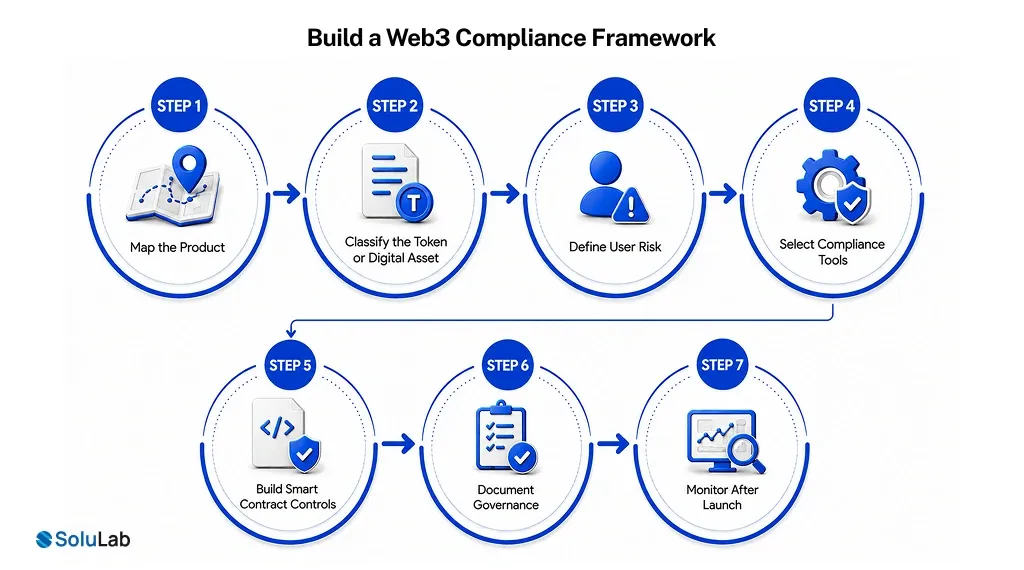
Web3 has different risks. The framework should fit the product.
Step 1: Map the Product
The team should list every core activity: token issuance, custody, trading, staking, governance, lending, payments, NFT marketplace features, wallet services, or data infrastructure.
This helps identify which parts of the product may trigger legal, AML, consumer protection, or cybersecurity obligations.
Step 2: Classify the Token or Digital Asset
The startup should review how the asset is created, sold, distributed, used, governed, and marketed. This step is critical under the CLARITY Act because classification influences whether SEC, CFTC, banking, state, or other rules may apply.
Step 3: Define User Risk
The business should decide who can access the product. Retail users, accredited investors, institutions, liquidity providers, market makers, DAO contributors, validators, and merchants may need different onboarding and risk controls.
This is where AML requirements for Web3 companies become practical. The startup must connect user type, activity, jurisdiction, and transaction behavior.
Step 4: Select Compliance Tools
The startup should choose tools for identity verification, business verification, wallet screening, sanctions monitoring, transaction monitoring, case management, and audit records. The goal is to build the right stack for the product’s actual risk.
Step 5: Build Smart Contract Controls
Smart contract controls should match the legal and operational model. If the protocol needs pausing, freezing, admin upgrades, role permissions, or emergency actions, those controls must be secure and well-documented. If the startup wants a more decentralized model, it should explain how governance, security, and user protection will work without centralized controls.
Step 6: Document Governance
The team should document who controls treasury funds, who signs transactions, who can propose upgrades, who can vote, and how conflicts are handled. Good governance records make the startup easier to review during due diligence, audits, regulatory inquiries, and exchange listing discussions.
Step 7: Monitor After Launch
The startup should monitor wallet activity, user risk, protocol changes, treasury movement, governance votes, suspicious transactions, sanctions updates, and smart contract events. This is where a compliance stack becomes operational, not theoretical.

Web3 Startup Compliance Checklist 2026 For Businesses
| Compliance Area | What Startups Should Do | Why It Matters |
| Token classification | Review whether the token may be treated as a digital commodity, investment contract asset, stablecoin, or another asset type. | Classification affects SEC, CFTC, disclosure, fundraising, trading, and platform obligations. |
| AML/KYC | Use identity checks, wallet screening, sanctions monitoring, and transaction monitoring where relevant. | Helps detect illicit finance risk and supports safer access to regulated partners. |
| Governance | Document voting rights, multisig roles, treasury controls, admin keys, and contributor authority. | Shows whether decentralization claims match real control. |
| Smart contracts | Audit contracts, control admin permissions, add timelocks, and document emergency functions. | Reduces security risk and supports responsible protocol management. |
| Custody | Define whether the startup controls user assets, private keys, settlement flows, or treasury funds. | Custody can trigger higher compliance and operational obligations. |
| Disclosures | Explain token risks, fees, conflicts, governance rights, technology dependencies, and user limitations. | Helps users and partners understand product risk before participation. |
| Reporting | Keep records of transactions, alerts, admin actions, audits, governance decisions, and user reviews. | Makes the startup easier to review by investors, exchanges, banks, and regulators. |
Where AI-Powered Web3 Compliance Platform Tools Fit
AI compliance tools are useful when a startup has too much activity for manual review.
For example, a marketplace may need to monitor wallet patterns. A DeFi startup may need to detect risky bridge flows. A token issuer may need to review suspicious buyers. A payment app may need real-time sanctions and transaction alerts.
An AI-powered Web3 compliance platform can help by ranking alerts, identifying wallet clusters, flagging unusual transaction paths, reading adverse media, and preparing case notes for compliance teams. AI tools are only useful when the startup has clear policies. The team still needs written rules for blocked wallets, high-risk users, escalation, reporting, appeals, and recordkeeping.
What Businesses Should Expect From Web3 Development Services Should Change After the CLARITY Act
The CLARITY Act changes what A business’s should expect from development partners. A complaint Web3 development company in USA or global Web3 partner should not only ask which chain the startup wants to use. It should also ask about token classification, user types, jurisdictions, custody, governance, AML/KYC, disclosures, and admin controls.
A stronger Web3 development scope now includes:
- Product and compliance discovery.
- Smart contract architecture.
- Tokenomics review support.
- Wallet and identity integrations.
- AML/KYC tool integration.
- Governance dashboards.
- Admin-key security.
- Audit support.
- Reporting workflows.
- Post-launch monitoring.
The Role of Governance in the Decentralized Web3 Ecosystem
The decentralized web3 ecosystem depends on trust, but trust does not appear automatically because a project uses blockchain.
Businesses must show how decisions are made. Who upgrades the protocol? Who manages the treasury? Who approves partnerships? Who responds to exploits? Who changes user permissions? Who can shut down a front end?
These questions matter for investors, users, exchanges, and regulators.
Good governance does not always mean full decentralization on day one. Many businesses need staged decentralization. Early control may be necessary for security and product stability. But the team should be honest about it. Here, Web3 legal Consultant can help. The right consultant can connect governance design with legal structure, treasury operations, token mechanics, and technical controls.
Cost of Building a Compliance Stack for Web3 Startups
The cost depends on product risk.
A simple non-custodial tool may need basic terms, smart contract review, wallet screening, and security documentation. A token launch, exchange-like platform, RWA product, custodial wallet, or DeFi lending protocol may need deeper legal review, AML/KYC, transaction monitoring, cybersecurity controls, audits, disclosures, governance documentation, and ongoing reporting.
Startups should not view compliance as a cost center only. A credible compliance stack can help with fundraising, banking, partnerships, exchange discussions, and enterprise sales.
The expensive mistake is rebuilding later. If a startup launches without proper controls, it may need to redesign smart contracts, rework onboarding, rewrite disclosures, restructure governance, or pause product features.
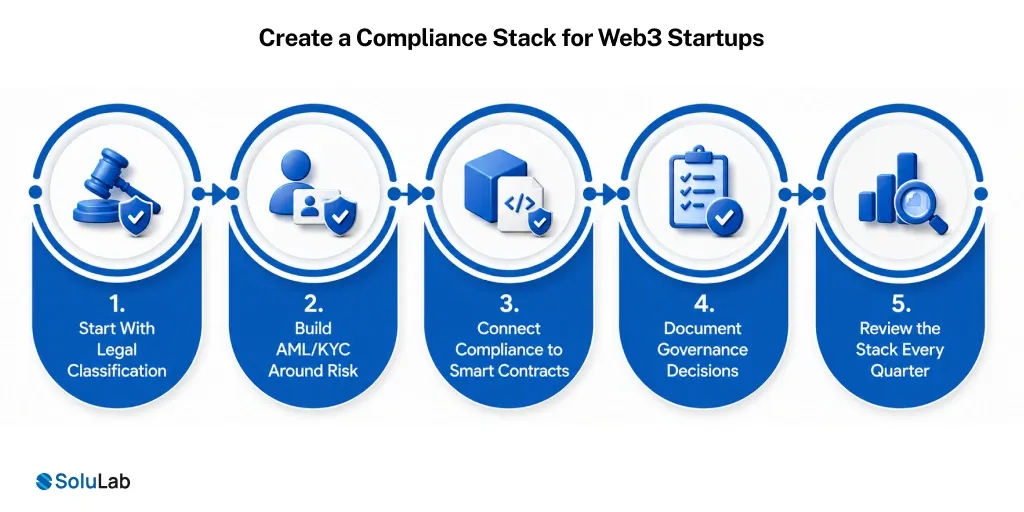
How to Create a Compliance Stack for Web3 Startups Under the CLARITY Act
The practical route is simple, but it needs discipline.
1. Start With Legal Classification
Before writing token contracts, review the asset type, sale model, use case, network maturity, and governance structure. This reduces the chance of building a token that later needs major restructuring.
2. Build AML/KYC Around Risk
Not every Web3 product needs the same level of KYC. A custodial payment product has a different risk than a developer tool. The right approach is risk-based. Use stronger checks where the product touches money movement, regulated users, token sales, fiat access, or suspicious wallet exposure.
3. Connect Compliance to Smart Contracts
Compliance policies should show up in product behavior. This may include transfer restrictions, allowlists, blocklists, pause functions, admin approvals, claim limits, or audit events.
4. Document Governance Decisions
Keep records of admin actions, treasury votes, proposal decisions, contract upgrades, emergency responses, and contributor authority. These records help prove that the startup is not improvising.
5. Review the Stack Every Quarter
Regulation changes. Products change. Users change. A quarterly review helps the startup update controls, vendors, policies, disclosures, and technical systems before small gaps become serious problems.
Build Your Web3 Compliance Stack with SoluLab!
At SoluLab, we help you build Web3 products that are ready for real users, investors, enterprises, and regulatory review. Our team supports you with token architecture, smart contract development, AML/KYC integration, wallet screening, governance workflows, dashboards, and scalable Web3 infrastructure. Whether you need Web3 Development Services, compliance-ready dApps, DeFi platforms, wallets, or enterprise blockchain systems, we help you move from idea to launch with fewer blind spots and stronger execution.
Final Thoughts: Web3 Compliance Solutions Are Now Growth Infrastructure
The CLARITY Act is pushing Web3 startups toward a more mature market.
Even before the final legislative process is complete, the direction is clear. Founders need better token classification, stronger AML/KYC, clearer governance, cleaner disclosures, safer smart contracts, and better records.
That does not mean innovation has to slow down. It means startups need to build with fewer assumptions.
The best Web3 companies will not treat compliance as a burden added after launch. They will treat it as infrastructure. It will help them earn trust, close partnerships, support institutional users, and survive regulatory review.
For startups building in 2026, Web3 compliance solutions are no longer optional. They are part of the product.
SoluLab helps founders build that foundation through Web3 Development Services, smart contract development, AML/KYC integrations, governance tools, and scalable blockchain infrastructure.
FAQs
Shipra Garg is a tech-focused content strategist and copywriter specializing in Web3, blockchain, and artificial intelligence. She has worked with startups and enterprise teams to craft high-conversion content that bridges deep tech with business impact. Her work translates complex innovations into clear, credible, and engaging narratives that drive growth and build trust in emerging tech markets.