In just one year, the CFTC collected $4.3 billion in crypto-related penalties, and that number doesn’t even account for SEC enforcement.
If you’re building a Web3 wallet today, that number is a risk signal embedded directly into your product roadmap. This is because regulators are no longer focused only on exchanges. Wallet infrastructure is now under scrutiny, especially products that are involving U.S. users. What used to be considered just tooling once is increasingly viewed as market infrastructure now.
CFTC compliance for Web3 wallet development used to be a post-launch problem. In 2026, that buffer no longer exists. The message from regulators is clear: if your wallet facilitates commodity-based crypto activity, even indirectly, you may fall within CFTC jurisdiction, regardless of whether you ever registered for it.
This guide breaks down exactly when compliance applies, which wallet features trigger regulatory exposure, and how to architect a wallet that can withstand regulatory, enterprise, and investor due diligence before those questions turn into enforcement actions.
Key Takeaways
- The Problem: Most wallet builders assume Web3 wallet compliance is the exchange’s job. That assumption has already cost companies hundreds of millions. Gaps don’t show up at launch as they show up when enforcement arrives or when an enterprise client runs a due diligence review and walks away.
- The Solution: A proactive, architecture-level compliance program built in from day one that covers CFTC registration thresholds, transaction monitoring, AML/KYC flows, and alignment across SEC, FinCEN, and OFAC requirements simultaneously.
- How SoluLab Can Help: SoluLab has designed compliance for enterprise-grade Web3 wallets across DeFi, institutional finance, and regulated asset platforms. We bring both the engineering and the compliance architecture together, so your product is solid technically and defensible legally.
Why Every Crypto Wallet Must Address CFTC Compliance Earlier?
Most founders assume compliance sits with exchanges or custodians. In reality, CFTC compliance for the best crypto wallets directly impacts wallet architecture and functionality.
The CFTC regulates platforms that enable commodity derivatives trading. Since Bitcoin and Ether are classified as commodities under U.S. law, any wallet offering swaps, leverage, yield, or cross-chain features enters a regulated zone, whether registered or not.
The challenge grows with the CFTC vs SEC crypto regulation overlap. A token can fall under both frameworks at once, meaning most wallets operate within dual compliance requirements. “Lack of awareness” is not a valid defense.
Why this matters for builders:
- Compliance risk is embedded in the product, not just marketing
- Enterprises demand proof of compliance before integration
- Enforcement actions can damage long-term partnerships
- Investors now prioritize regulatory readiness in Web3 wallet development
The reality is simple: CFTC-compliant crypto wallet development is a core product decision. Delaying it increases cost, complexity, and regulatory risk later.
When Does a Web3 Wallet Trigger CFTC Compliance Requirements?
This is the question most teams get wrong because the answer isn’t simply when you add trading features. There are specific triggers that put your product inside CFTC jurisdiction, and knowing them early is the difference between building right and rebuilding expensively.
Your wallet likely triggers CFTC compliance for wallet providers’ requirements when it:
- Facilitates futures, options, or swaps on crypto assets, even if routed through a third-party DEX or integrated protocol
- Enables leveraged or margin-based activity in any form, including through embedded DeFi connections
- Operates as an intermediary for commodity transactions, even without holding custody
- Routes transactions for US persons involving crypto derivatives, regardless of where your company or servers are based
- Connects buyers and sellers of derivative instruments, effectively acting as a swap execution facility
The US person rule is where international teams consistently get caught. Serving even a small percentage of US users can be enough to trigger crypto wallet legal requirements in the USA obligations in full. The CFTC has been explicit about this in enforcement actions and written guidance, and geographic disclaimers in Terms of Service haven’t been a successful defense.
If your wallet is a pure non-custodial tool with zero derivatives exposure and zero US users, you have more room. But the moment you add yield aggregation, swaps, leverage, or any regulated asset class, you need a top Web3 Crypto Wallets assessment, not a general article.
A product-level legal and technical review is the starting point, and skipping it is how the large enforcement cases began. This is also where blockchain development company compliance decisions get made, not in the legal team’s review cycle, but in the architecture phase, when it’s still cheap to get it right.
Real-World Enforcement Cases Highlighting CFTC Compliance Risks for Web3 Wallets
Theory is one thing. Here’s what actually happened to companies that got this wrong.
1. Binance – $4.3B in combined penalties
The CFTC’s specific case against Binance cited failure to implement proper AML systems and the knowing facilitation of transactions for US persons on CFTC-regulated exchanges without proper registration. Binance’s CEO entered a guilty plea.
This wasn’t a gray area or an ambiguous product question; it was a sustained, documented failure over years.
2. BitMEX -$100M settlement
CFTC and FinCEN jointly penalized BitMEX for operating as an unregistered futures exchange and for the complete absence of KYC AML for Web3 wallets and related compliance infrastructure. Founders were personally charged, not just the company.
3. Ooki DAO
The CFTC pursued a decentralized protocol and successfully argued that DAO token holders could be held collectively liable as an unincorporated association. This permanently changed the risk picture for DeFi-adjacent wallet products and is increasingly cited as a precedent in new enforcement actions.
The pattern across all three is consistent: compliance wasn’t built into the architecture. It was either absent entirely or bolted on too late. The blockchain development use cases across fintech and asset management have shown that regulatory-first architecture pays off; what these cases demonstrate is the alternative.
The Compliance Framework for Building CFTC-Compliant Web3 Wallets
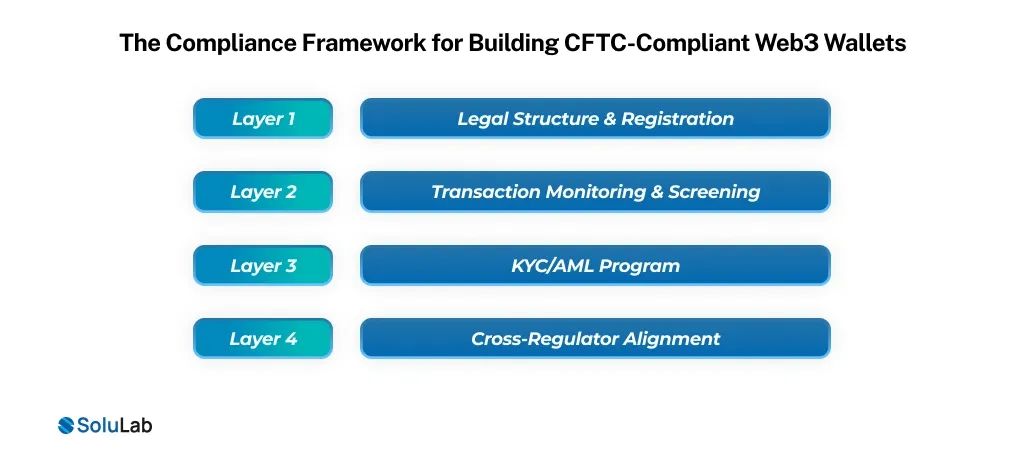
If you’re figuring out how to build a Web3 wallet infrastructure from scratch, the framework has four distinct layers, and they have to be built to work together, not independently.
Layer 1: Legal Structure & Registration
Determine whether your product requires CFTC registration as a Commodity Pool Operator (CPO), Commodity Trading Advisor (CTA), or Swap Dealer based on actual functionality, not intended use.
Layer 2: Transaction Monitoring & Screening
Every transaction through a Web3 cryptocurrency wallet app with compliance obligations needs real-time screening against OFAC sanctions lists, PEP databases, and counterparty risk profiles. This isn’t a manual process, it’s an automated infrastructure tied to your transaction flow.
Layer 3 — KYC/AML Program
A documented, auditable KYC AML for Web3 wallets program requires identity verification at onboarding, tiered due diligence, ongoing transaction monitoring, suspicious activity reporting (SARs), and a designated compliance officer. All of this has to be demonstrable to regulators and enterprise clients alike.
Layer 4 — Cross-Regulator Alignment
Given the real complexity of CFTC vs SEC crypto regulation, your compliance program has to account for both agencies, plus FinCEN’s Bank Secrecy Act requirements, OFAC sanctions screening, and state-level money transmitter licensing where it applies.
This is the difference between MPC crypto wallet development solutions built to scale and products that hit a hard wall the moment a regulated client asks for compliance documentation.
Blockchain development services that don’t include compliance design at the architecture stage are missing the layer that ultimately determines whether the product can operate in institutional markets.
Technical Architecture Controls Required for Web3 Wallet Compliance
The compliance program has to live in the code, not just in a policy document. The features of a CFTC-Compliant Web3 Wallet at the infrastructure level include the following:
- On-chain transaction tracing via integration with Chainalysis, Elliptic, or TRM Labs for real-time address-level risk scoring
- Role-based access controls with full audit trails on all internal access to user data and transaction records
- Geofencing and jurisdictional controls — IP-based and wallet-address-based blocking for OFAC-sanctioned jurisdictions
- Immutable audit logs stored in an append-only format, available for production during regulatory examinations
- Smart contract governance with documented review processes and change logs maintainable for regulatory access
For teams deploying white-label crypto wallet solutions, these controls need to be in the base product, not left for end clients to configure independently. Enterprise buyers of white-label infrastructure will run their own technical audits, and the absence of these controls is a disqualifying factor in the procurement process.
This is increasingly one of the top blockchain trends shaping enterprise adoption: compliance-by-design over compliance-as-afterthought. The application of blockchain technology in regulated industries depends entirely on this architectural shift being made early.
AML/KYC & Cross-Regulator Best Practices for Building a Compliant Web3 Wallet
What separates a mature, compliant Web3 wallet for enterprises from an early-stage build is the depth of AML/KYC implementation. Collecting an ID at signup is the baseline; regulators and enterprise clients want to see the full picture:
- Risk-based customer due diligence (CDD) — tiered KYC that scales with transaction volume and user risk profile, not a one-size approach
- Enhanced due diligence (EDD) for high-risk users, politically exposed persons (PEPs), and cross-border transaction patterns
- Ongoing transaction monitoring with automated alerts for structuring, layering, and high-velocity behavior
- SAR filing infrastructure — the ability to file Suspicious Activity Reports with FinCEN within required windows
- Travel Rule compliance — for transactions above $3,000 (FinCEN) or $1,000 (FATF), counterparty information must travel with the transaction
For any company evaluating enterprise blockchain solutions or building on third-party infrastructure, one thing worth checking: whether your vendors’ AML controls are actually compatible with your own compliance obligations.
Because in a regulatory examination, you inherit the risk from what you integrated, not just what you built.
Testing, Audits & Regulatory Monitoring for CFTC Compliance in Web3 Wallets
Building the controls is step one. Proving they work and keeping them current is step two, and it’s the step most teams skip until something forces the issue.
A mature program covering crypto wallet legal requirements USA includes:
- Pre-launch compliance audit by a qualified independent third party, not just an internal review
- Penetration testing of the compliance controls themselves — not just the security stack
- Annual AML program review by an independent auditor as required by FinCEN guidance
- Regulatory change monitoring with assigned ownership for tracking CFTC guidance updates, no-action letters, and enforcement trends
- Incident response plan — documented procedures for the scenario where a sanctioned address transacts through your wallet
This is where the decision to hire blockchain compliance experts makes straightforward financial sense. Building this internal capacity from scratch is expensive and slow. Bringing in a team with established methodology and tooling compresses the timeline significantly, and the cost difference between proactive compliance and reactive enforcement response is not a close comparison. The top blockchain companies that operate at scale in regulated markets have learned this the hard way or the smart way.
How SoluLab Can Help You Build CFTC-Compliant Wallets?
SoluLab has been working at the intersection of blockchain engineering and regulatory compliance through multiple enforcement cycles. We’re not a law firm, but we work alongside legal counsel to make sure the technical architecture supports what the compliance program actually requires not just what looks good in a document.
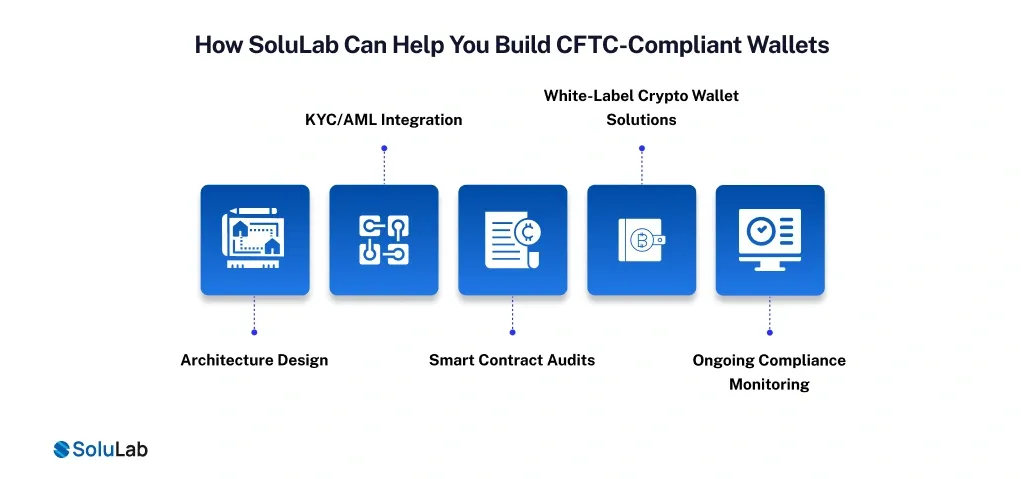
Our Web3 development services for wallet compliance cover the full stack:
- Architecture design that builds compliance controls into the product from day one — not as a retrofit
- KYC/AML integration with leading vendors, including Jumio, Onfido, Chainalysis, and TRM Labs
- Smart contract audits aligned with both security and regulatory requirements
- White-label crypto wallet solutions with compliance infrastructure built in as a core component, not an add-on, for teams deploying to enterprise markets
- Ongoing compliance monitoring and regulatory change management support
We’ve worked with enterprise blockchain solutions clients in fintech, digital asset management, and regulated DeFi, and we understand what institutional buyers need to see before they sign off on a wallet platform.
Our blockchain consulting services team can map your specific product against CFTC, SEC, FinCEN, and state-level requirements, so you know exactly where you stand before launch.
Conclusion
The regulatory environment for crypto wallets has fundamentally shifted, and it won’t shift back. CFTC compliance for wallet providers is an ongoing operational function that needs to live inside how you develop, deploy, and maintain your product over time.
The companies that get this right didn’t hire a compliance lawyer after an enforcement action. They treated CFTC Compliance for Crypto Wallets as a technical requirement from the start, the same way they treated security and scalability. Because in practice, it’s the same category of problem.
If you’re building a Web3 cryptocurrency wallet app for enterprises, for regulated markets, or for users in the US, the question isn’t whether to build compliance in. The question is how quickly you can get it built correctly. We’re only a few blockchain solution providers in USA that bring both the engineering depth and the compliance architecture expertise together in one engagement.
FAQs
With over 3 years of experience, I specialize in breaking down complex Web3 and crypto concepts into clear, actionable content. From deep-dive technical explainers to project documentation, I help brands educate and engage their audience through well-researched, developer-friendly writing.