Web3 rewrote the rules for decentralized and blockchain-based programs (dApps). Security, openness, who actually owns the account: all three shift. Web2 puts a company’s servers in the middle of everything. Web3 puts a blockchain there instead, and that single swap is what gives users real ownership and something closer to verifiable trust.
An idea alone will not get you a Web3 app. You have to pick a chain, ship smart contracts, and then do the hard part: make the interface feel like software a normal person can use. Solidity on Ethereum, Rust on Solana, Web3.js gluing the browser to the chain. The tooling has come a long way.
Money matters too. Tokens, NFTs, transaction fees, an actual community, and a compliance story you can defend. The global Web3 market sat at $3.17 billion in 2024 and is projected to reach $99.75 billion by 2034, at a compound annual growth rate (CAGR) of 41.18%. As blockchain adoption widens, Web3 app development follows it.
This blog walks the whole path, from first commit to launch-day marketing, so your Web3 application actually ships.
What Is a Web3 App, and How Does It Work?
Web3 applications, also known as decentralized applications (dApps), run on decentralized networks like blockchains. No central authority sits above them.
You can build one on any of several blockchain networks. The shape is usually the same: a front-end interface that users touch, and a decentralized backend behind it, reached through smart contracts or other blockchain-based protocols. Here is what that looks like in the wild.
1. Supply Chain Management Systems: These apps let enterprises use blockchain technology to track how goods move through the role of web3 in the supply chain.
2. DeFi Applications: Lend, borrow, swap Bitcoin. Same financial primitives you already know, minus the intermediary, settled on a blockchain network.
3. Decentralized Social Networks: Social platforms running on a blockchain network, where the user keeps a much firmer grip on their own data and content.
4. NFT marketplaces: Places to buy and sell NFT marketplaces in 2025, meaning one-of-a-kind digital goods: artwork, collectibles, whatever someone will pay for.
Types of Web3 Apps
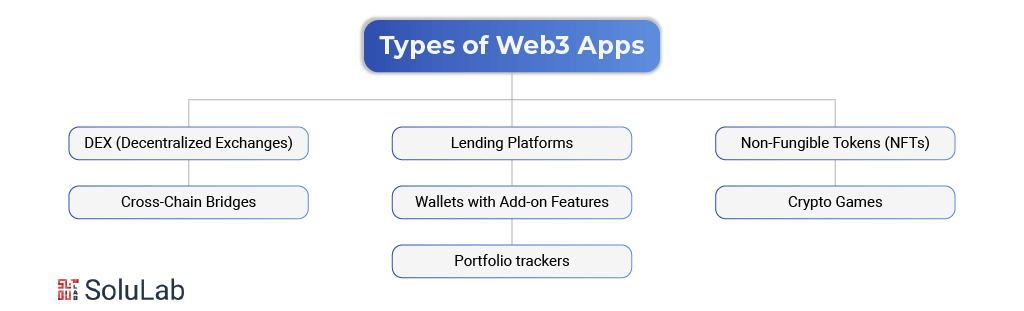
The category is wide. It stretches from non-fungible token (NFT) marketplaces all the way out to decentralized finance (DeFi) networks. Different industries, different users, one shared ambition: open, secure, user-first experiences built on blockchain technology. These are the categories you will run into most often:
- DEXs (Decentralized Exchanges): Trade crypto without routing through a traditional centralized exchange. These are what people mean by DEXs (Decentralized Exchanges).
- Lending Platforms: Smart contracts run the loan book, so borrowing and lending digital assets stops being a paperwork problem. Staking and restaking sit alongside this: lock up tokens, earn rewards, and prop up the network’s security while you are at it.
- Non-Fungible Tokens (NFTs): Non-fungible Tokens (NFTs) are individual digital assets that prove ownership or authenticity. The marketplaces around them are where creators and collectors buy, sell, and trade.
- Cross-Chain Bridges: Plumbing. They move data and assets between blockchain networks that otherwise ignore each other.
- Wallets with Add-on Features: Storage is the baseline. The interesting ones also swap tokens and talk directly to DApps from inside the wallet.
- Crypto Games: Blockchain games where playing earns you Bitcoin and your in-game items, often NFTs, are genuinely yours.
- Portfolio trackers: Software that pulls an investor’s digital assets together across a pile of platforms into one view.

How to Develop A Web3 Application?
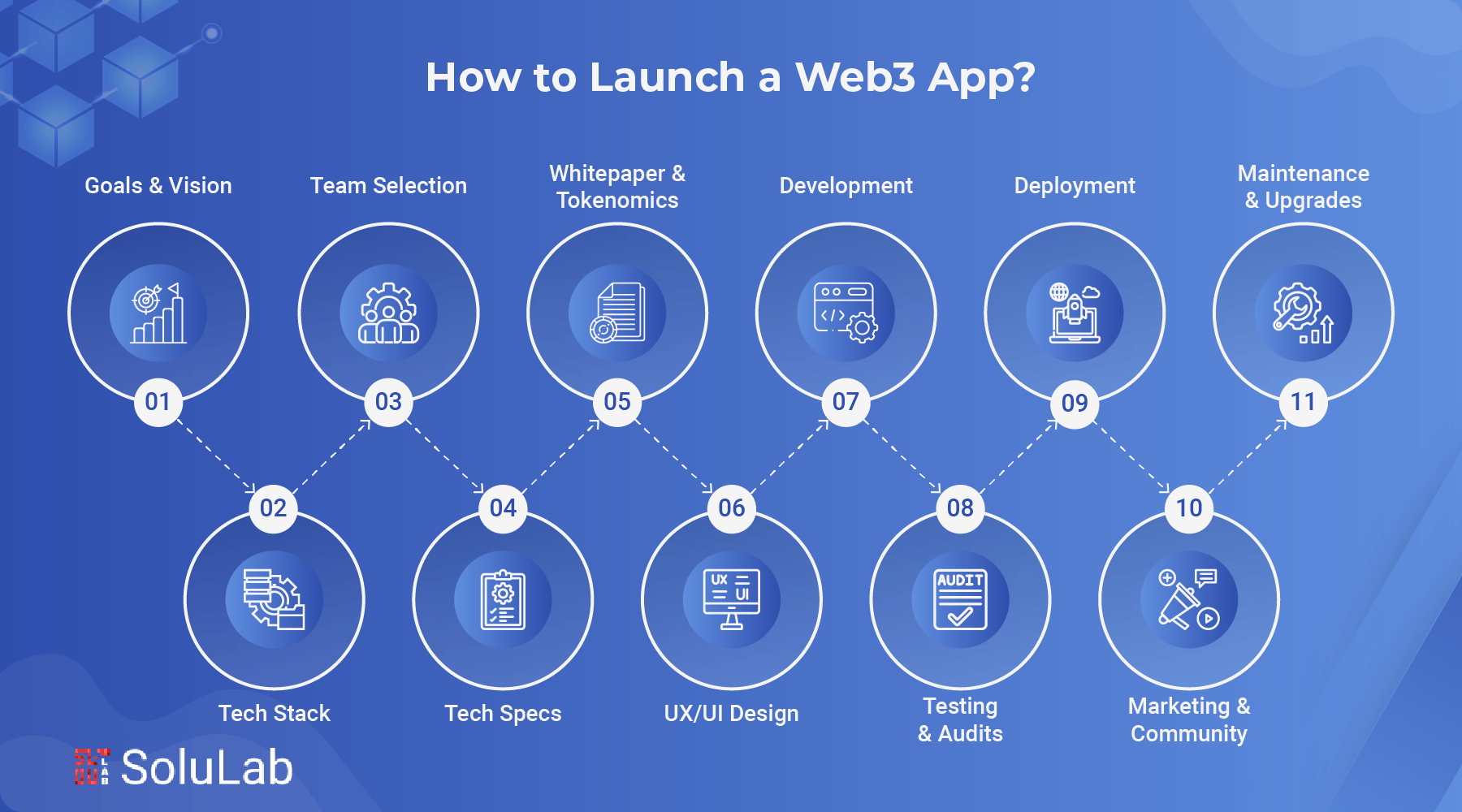
Here is the short, practical roadmap, broken into phases you can actually assign to someone on Monday.
1. Specify Your Project’s Objectives And Vision.
Start with why. Every Web3 app development process begins with knowing what you are chasing. Are you trying to reshape DeFi? Ship a Web3 game that catches fire? Build an NFT marketplace where the experience does not feel like filing taxes? Pick one. Without a sharp goal, the most advanced stack in the world produces nothing anyone remembers.
Ask what your app gives people that they cannot get elsewhere. That answer drives everything downstream, from the blockchain network you commit to right down to the button copy. Building in Web3 is half engineering, half imagination, and teams that treat it as only the first half tend to stall.
2. Select Your Tech Stack and Blockchain
Weigh scalability, security, pricing, and transaction speed against each other. Then choose the tools, frameworks, and languages that fit the chain you picked, not the ones your team happens to like.
If your Web3 app development project is aiming at millions of users, the network has to carry that load. Polygon and the other Layer 2 approaches give you room to scale without rewriting the thing.
3. Select the Development Group
The old argument: build the team in-house, or hire someone who already has one? In-house gives you control and people who live inside the project. It also costs a lot and takes months you may not have. Outsourcing hands you Web3 specialists who have shipped this before and can start next week.
For a startup, outsourcing usually buys back both time and cash. Look for partners with real Web3 apps behind them and a habit of telling you bad news early.
4. Development of Tech Specs
Write the technical specification down: architecture, features, data structures, integrations. Your developers will work from that document every day. Web3 app development punishes vague planning more than most software does, because a deployed contract is hard to take back.
5. Whitepaper Development and Tokenomics
Tokenomics is the foundation. Design the token economy well and people have a reason to show up and stay; design it badly and no amount of marketing fixes it. The whitepaper does the other job, laying out your vision, your technology, and your roadmap for investors and users.
Your whitepaper should name a real problem your Web3 app development solves. Your tokenomics should be readable by someone who is not an economist. Cut the jargon.
6. Design of UX/UI
Build an interface people understand on the first try. What happens under the hood of a Web3 app can be genuinely complicated; none of that complexity belongs on screen. Put user-centric design first. A clumsy UI will drive away even the crypto-native users who came in wanting to like you.
7. Phase of Development
Three pieces come together here. Smart contracts do the automated work: paying out, distributing rewards, handling crypto assets (tokens, NFTs), and encoding the business logic that matters, whether that is trading rules or game mechanics. Smart contract development is the floor the whole decentralized app stands on, because it defines how the system behaves on chain.
Decentralization is the point, and you will still want a backend. Plenty of work has no business running on chain: storing large datasets (push those to off-chain storage such as IPFS), running heavy calculations, handling user authentication in the cases where that applies, and feeding dynamic content to the frontend. The frontend, meanwhile, is the surface where users meet the blockchain underneath.
In Web3 app development, the front end shows data pulled from the backend API or straight off the chain, and it connects to user wallets like MetaMask so people can read state and fire transactions against your smart contracts.
8. Auditing and Testing
Blockchain is an unforgiving place to ship a bug. Test everything. Functional tests first, then an external security audit, and do not skip the second one because the first one passed.
9. Installation and Start-Up
Deploy the contracts to mainnet, then open the doors. Your deployment plan needs an onboarding path for new users and a scaling plan for the day traffic spikes.
10. Marketing and Community Development
Community is not a side quest in Web3 app development. It is the product’s distribution. Build one around the project through forums, social platforms, and wherever your users already argue about this stuff. Marketing is what turns a working app into a used app.
11. Upgrading, Maintaining, and Supporting
Budget for maintenance, support, and upgrades from day one. Web3 apps are never really finished; they get iterated on, patched, and improved for as long as anyone uses them.
Latest Tech Stacks Required to Develop A Web3 Application
Web3 app development pulls from a mix of technologies and tools. And more of that mix is AI-assisted now. On top of choosing a blockchain, wiring up wallet integrations, and picking smart contract frameworks, teams lean on AI-powered development platforms such as rocket.new to prototype faster, generate application scaffolding, and cut the grind out of frontend and backend work.
Startups get to test an idea before it eats a quarter, and developers keep their attention where it belongs: blockchain logic, security, and the user’s experience.
Here are the stacks you will keep reaching for when you build web3 mobile apps.
1. Blockchain Technology
Nothing happens without a blockchain platform underneath it. For Web3 applications, the most-used blockchain technology platform is still Ethereum.
2. Programming Languages for Smart Contracts
A blockchain smart contract is code that runs itself on a blockchain platform. Solidity is where most people write it.
3. Web3.js
Web3.js is the JavaScript package that talks to the Ethereum blockchain. You use it to write client-side programs. It also handles data queries and moves transactions between your web3 application and the chain.
4. Wallets
MetaMask dominates on Ethereum-based Web3 applications. Without a wallet, your app has no way to speak to the blockchain at all.
5. Tools for Testing
Smart contracts have to be secure and predictable, which makes testing non-optional in Web3 development. Truffle and Ganache let you exercise contracts in a local development environment before anything touches real money.
6. Frameworks for Development
Frameworks like Embark and DappHub shorten the distance between writing code and deploying it. Add it all up and a Web3 app needs blockchain technology, a smart contract language, JavaScript libraries, decentralized storage, wallets, testing tools, and development frameworks working together.
Read Also: What is GameFi?
Features Required to Develop A Web3 Application
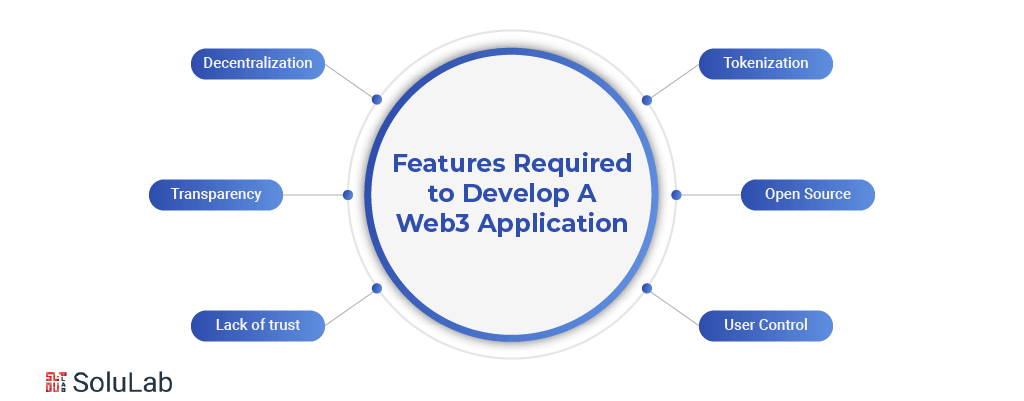
Web3 apps, or dApps if you prefer, part ways with conventional centralized apps on several fronts. These are the traits that define Web3 mobile app development:
- Decentralization: No single organization or authority runs the software. It lives on a spread-out network of nodes, which is exactly why censoring it or attacking it is so much harder.
- Transparency: Blockchain data is public and readable, so anyone can check that a transaction happened and happened correctly.
- Lack of trust: Web3 apps are designed so you do not have to trust anyone. Smart contracts do that work. They are self-executing programs that hold both sides to the agreement while running on the blockchain.
- Tokenization: Tokens like asset tokenization development or digital assets stand in for something of value, whether that is money, shares, or rewards. Most Web3 apps use them somewhere.
- Open Source: Most of these apps ship as open source, so anyone who wants to improve the code can.
- User Control: Identity, access, privacy: the user holds all three. Their data and their digital assets stay theirs.
What is the Cost to Develop A Web3 Application?
What does a Web3 application cost? It depends, and here is what it depends on:
1. Type of Blockchain
Your chain choice moves the budget more than most founders expect. Ethereum is the most widely used blockchain for Web3 apps, so if you are torn, it is a defensible default. Talk to an Ethereum development firm before you commit to a number.
2. Complexity of Smart Contracts
How complicated is the code? A smart contract in Defi with layered logic takes longer to write and far longer to test than a simple one. Plan the contract work against your budget, not the other way around.
3. Design of User Interfaces and User Experiences
Interface and experience design shows up on the invoice. It also shows up in retention. A thoughtful, easy interface costs more hours upfront and keeps users around long enough to pay for itself.
4. Aspects of Security
Security is where you should not economize. Writing hardened smart contracts and locking down the connection between app and blockchain adds to development cost. It costs a great deal less than an exploit.
5. Experience of the Development Team
Experienced developers bill higher rates and often finish sooner, which makes the headline rate a bad way to compare bids.
So the honest range is wide: a few thousand dollars at the small end, several hundred thousand or more once the application gets ambitious and the factors above stack up. Either way, hire web3 developers or a partner who can deliver the best web3 development services inside the budget you actually have, and be blunt with them about what that number is.
Examples of Transformative Web3 Applications
Three that are worth studying:
Polkadot
Polkadot is a decentralized web3 blockchain initiative chasing a multichain vision of the web. What separates it from other third-generation blockchains is a specific list: real interoperability, parachains, parathreads, strong energy efficiency, and governance the users actually steer. Its ecosystem makes it simpler to build inventive dApps that serve a wide spread of web3 use cases.
Axie Infinity
Axie Infinity is the web3 gaming platform that made play-to-earn a household phrase. Players play, earn, and trade NFT-based game assets: collectibles, vehicles, skins, weapons. Getting in takes a few steps, including creating an Axie Infinity account and connecting your wallet.
Uniswap
Uniswap is a web3 DeFi exchange protocol built on an open, decentralized network so that ownership sits with users instead of one company. Developers, traders, and liquidity providers all show up in the same open financial marketplace.
Conclusion
Shipping a Web3 app means holding four things together at once: blockchain technology, smart contracts, decentralized storage, and an experience people tolerate. Choosing the network. Writing contracts that are both secure and cheap to run. Skip a step and it shows up later, usually at the worst moment.
Security and scalability deserve the most attention, because transactions here are immutable and the environment is decentralized. Test hard, get audited, and keep your regulatory position clean; that combination is what earns user trust. Two practical levers left: a wallet flow that does not confuse first-timers, and gas fees kept low enough that people finish what they started.
OBORTECH Smart Hub took on the blockchain integration problems that stall most projects: multi-cloud interoperability, accessibility for ordinary users, and scale. It shipped a staking platform, a crypto payment gateway, and smart contracts built for security and transparency. The result was blockchain that people in supply chain, healthcare, and finance could actually work with. SoluLab is a Web3 app development company with people who have launched web3 apps before. Contact us today to talk it through and hire a web3 developer!
FAQs
Shipra Garg is a tech-focused content strategist and copywriter specializing in Web3, blockchain, and artificial intelligence. She has worked with startups and enterprise teams to craft high-conversion content that bridges deep tech with business impact. Her work translates complex innovations into clear, credible, and engaging narratives that drive growth and build trust in emerging tech markets.