Key Takeaways
- We’ve seen dozens of mid‑market AI pilots stall at the same point: no owned AI strategy timeline that connects one use case to revenue, margin, or efficiency. Drawing on our client work across SaaS, fintech, logistics, and other sectors, we share what actually happens on the ground when AI meets messy data and real teams.
- This guide distills SoluLab’s five‑phase AI implementation roadmap, discovery, data readiness, pilot, scale, and governance, shaped by projects where we’ve taken mid‑market companies from “interesting demo” to production‑grade AI systems that are monitored, owned, and embedded in everyday workflows.
- We show how one flagship AI use case can move from pilot to production in 6–12 months, including who should own each phase, where most companies get stuck, and how our AI development, consulting, and integration teams help clients avoid common failure points and reuse patterns across multiple AI initiatives. Tokenizing Luxury Hotels in the Maldives at an institutional level.
If you’re running a mid‑market company right now, there’s a good chance you’ve already “done something with AI.” Maybe there’s a chatbot on your site. Maybe a vendor delivered a churn model. Maybe your product team shipped a small “AI‑powered” feature.
Starting isn’t the problem.
The real problem is that after all of this, the P&L often looks more or less the same. The board keeps hearing about AI in every update, but there’s no clean story of “we did this, and here’s what changed.” That gap is exactly where a clear, realistic AI strategy timeline makes the difference.
At SoluLab, we step into this situation a lot. There is data. There are pilots. There is pressure. What’s missing is a shared path from “interesting demo” to “this is now part of how we run the business.” We’ve seen that journey across SaaS, fintech, logistics, healthcare, and traditional industries, acting as an enterprise AI development company and deployment partner. Some companies break through. Others stall. The difference is rarely the model itself. It’s the sequence, the ownership, and the timeline.
This playbook is what we wish every mid‑market leadership team had before approving the next AI project.
Why AI Pilots Aren’t Moving the Needle?
When a client brings us in, the first line usually sounds like:
“We’ve run a few AI pilots. They look good in slides, but the business hasn’t really changed.”
In one B2B SaaS company, the setup looked like this:
- A churn‑prediction model from an external vendor
- A support deflection bot on the website
- A product analytics initiative promising “AI insights”
Each initiative had its own deck, metrics, and owner. But when we asked a basic question — “If all three go dark tomorrow, what actually happens to revenue or costs?” The honest answer was: “Probably not much.”
The effort was there. What was missing was a coherent AI implementation roadmap:
- No single, flagship AI use case tied directly to a P&L line
- No shared phases or milestones across business, product, and engineering
- No end‑to‑end timeline from pilot to scale with clear owners
So instead of pitching another pilot, we stopped and asked the leadership team to choose: which one problem really matters, and are they willing to back it all the way to production? Only after that decision did we design the AI strategy timeline.
That is where progress started.
Strategy, Roadmap, Timeline: What Mid‑Market Leaders Actually Need
From a mid‑market leader’s perspective, the questions are simple:
- Where should AI show up so it actually moves the numbers?
- In what order should we do things so operations don’t break?
- How soon can we see real proof that this direction is working?
We usually frame the answer in three layers:
- Strategy – Why use AI at all, and which types of problems will it focus on (churn, support, operations, risk, etc.)?
- Roadmap – Which specific AI use cases will be pursued, on which platforms, with which teams, and in what sequence?
- AI strategy timeline – When each phase happens, how long it can realistically take, and what must be true before moving forward.
For example, in a mid‑market SaaS client, the strategy might be: “Use AI to reduce churn and support costs in the self‑serve segment.” The roadmap then spells out a sequence: first churn prediction and CSM workflows, then support triage, then in‑app guidance.
The timeline turns this into a commitment: “Over the next 12 months, we’ll take the churn use case through five phases: discovery, data, pilot, scale, and governance, and we won’t dilute focus with unrelated AI experiments until that’s stable.”
That is how AI powered solutions move from being a slide in the all‑hands to being a reliable capability in the operating model.
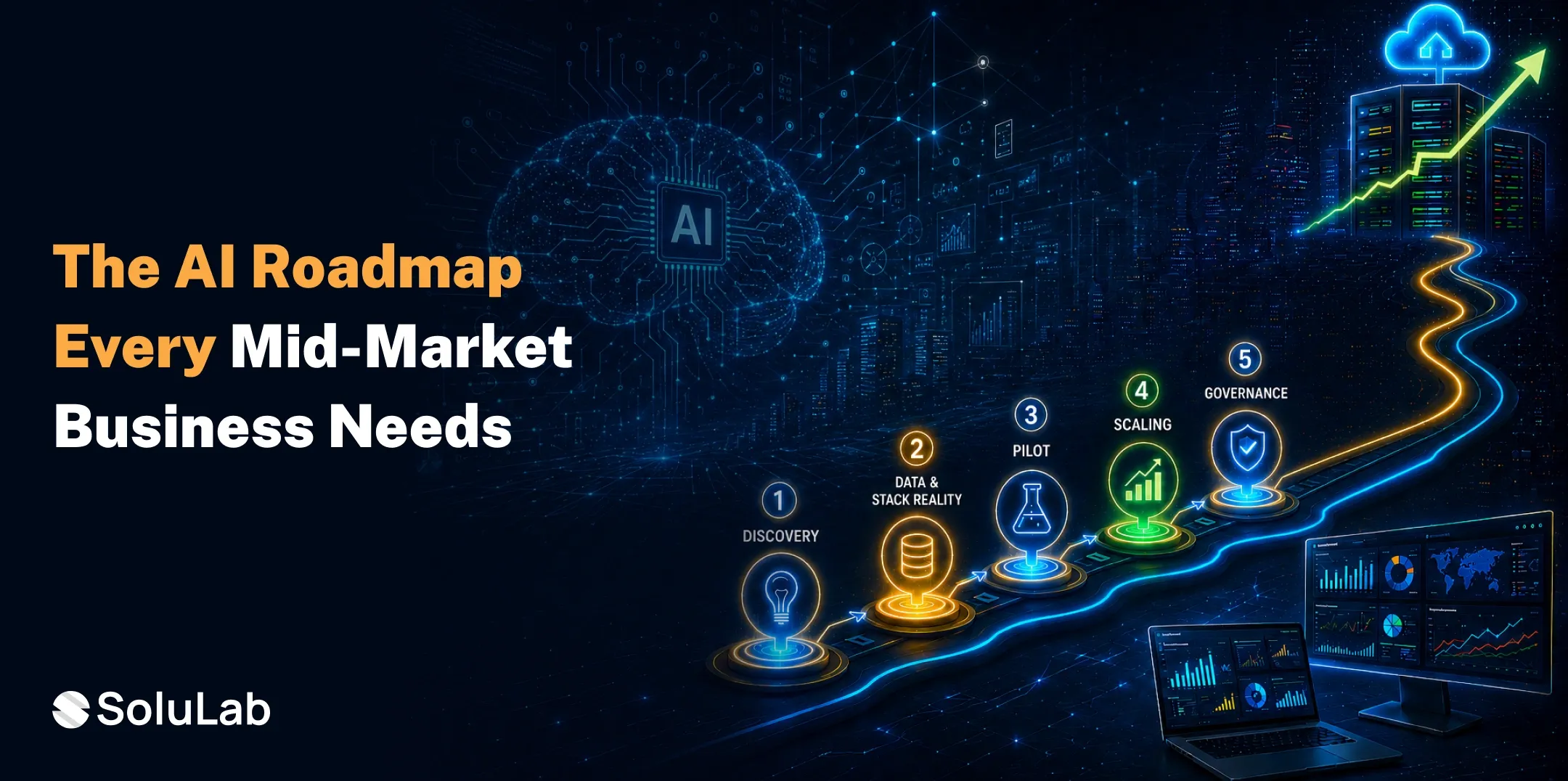
The 5‑Phase AI Strategy Timeline We Use With Mid‑Market Clients
Across different industries and tech stacks, we’ve seen one structure work consistently well for mid‑market companies:
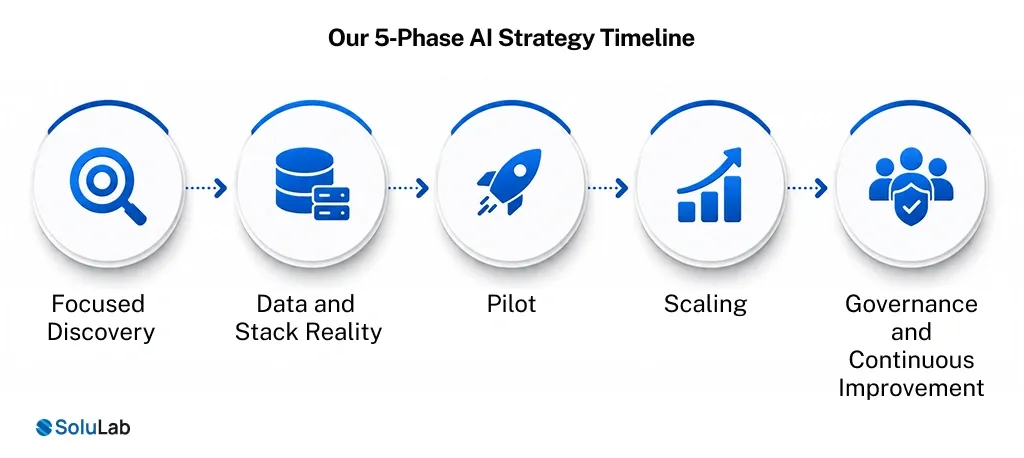
- Focused discovery and use‑case selection
- Data and stack readiness
- Pilot as a real‑world test
- Scaling and company‑wide integration
- Governance and continuous improvement
The details vary; the logic stays the same.
Phase 1: Focused Discovery
In mid‑market companies, capacity is limited. There isn’t room for ten AI programs running in parallel. That’s not a weakness; it’s an advantage if used well.
So discovery has to be sharp.
We usually bring founders/CEO/COO, product, operations, and tech/data together and ask three direct questions:
- Where are we clearly losing money or efficiency churn, support volume, forecasting errors, manual back‑office work, risk, something else?
- For which of those pain points do we already have enough data to do something useful in the next 90 days?
- Which single problem are we willing to actually change processes for if the AI solution works?
For a mid‑market payments company, the initial list was long: fraud, chargebacks, KYC, support load, merchant churn. Once we overlaid data readiness and realistic time‑to‑value, one use case stood out: reducing churn in a specific merchant segment with relatively clean data and well‑tagged support reasons.
By the end of Phase 1, we had:
- A clearly defined flagship AI use case
- A primary metric (for example, churn rate in that segment)
- A named business owner and a named technical owner
- A short written agreement inside the leadership team that this would be the AI priority for the coming months
If the underlying stack is unclear or obviously messy, this is also the right moment to run something like an AI-first enterprise tech stack readiness assessment so everyone sees the baseline clearly before making promises.
Phase 2: Data and Stack Reality
This is where a lot of AI projects quietly sabotage themselves by rushing.
Here, we slow down just enough to answer a few unglamorous but critical questions:
- Where exactly is the data for this use case stored CRM, billing, product analytics, helpdesk, spreadsheets?
- Do those systems agree on core definitions (like what a “customer” or “account” is)?
- How bad is the noise: missing values, inconsistent tracking, duplicate records?
- Can we put stable pipelines in place, or are we depending on manual exports and scripts?
In one SaaS implementation, the same “customer” existed as three different entities: one in billing, one in the CRM, and one in the product database. Before touching any models, we worked with the team to define a single customer view, standardize event tracking, and set up a repeatable way to generate a clean dataset for churn analysis. Only after that did modeling make sense.
In a more traditional client, data turned out to be spread across on‑prem systems, custom tools, and Excel. For them, the honest answer was: “We need a bit of modernization first.” We aligned their AI roadmap with a modernization approach similar to AI-first legacy modernization so the foundation and the AI strategy timeline supported each other instead of clashing.
It’s not glamorous, but this is where the difference between “one memorable pilot” and “a system that quietly runs for years” is created.
Phase 3: Pilot
Once the data groundwork is in place, it’s tempting to treat the pilot as the “fun part.” We see it differently.
Every pilot we run has one main purpose:
Give a clear answer on whether this use case is worth scaling, and show exactly what needs to change to make scaling work.
Take the churn example again.
We:
- Trained a model using historical product usage, billing data, and support interactions
- Integrated daily risk scores into the CRM, but only for one region and one well‑defined segment
- Gave CSMs a ranked list of at‑risk accounts with a few plain‑English reasons behind each score
Then we got out of the way and observed for 8–12 weeks:
- How often CSMs actually used the list
- Whether intervention on flagged accounts correlated with better retention
- Where the experience was frustrating : too many false alarms, poor timing, confusing explanations
By the end of the pilot, we knew:
- In that segment, the AI‑assisted workflow did improve retention in a measurable way.
- CSMs wanted clearer explanations and tighter thresholds before trusting it at scale.
- Integrations with the support tool would be needed to make the workflow feel seamless.
That’s the kind of answer a good pilot should give. It turns “this is a cool model” into “this is, or isn’t, a scalable part of our AI strategy timeline.”
For teams that don’t have the bandwidth or experience to build pilots like this, working with an AI software development company that offers end‑to‑end AI-led development services is often the fastest and safest way to move forward.
Phase 4: Scaling
Once a pilot has earned the right to be scaled, the work shifts again. Now it’s not just a data or R&D project. It’s a product, operations, and change‑management project.
Scaling typically involves:
- Rolling the solution out to additional regions, segments, or product lines
- Embedding it deeply into the tools people already live in CRM, helpdesk, internal dashboards, etc.
- Deciding where full automation is appropriate and where humans must stay in the loop
- Building monitoring and feedback systems so the capability doesn’t silently degrade
For a mid‑market logistics client, route optimization began as a single‑region experiment. Scaling required:
- Integrations with different fleet and telematics systems in other regions
- Training dispatch teams who had their own established routines and scepticism
- Redesigning the UI so suggestions were easy to read, question, and override
- Setting up a monthly session where operations and tech reviewed how the system was performing and what needed tuning
This is where our role as AI integration services partner is just as important as our modeling work. A model on its own rarely changes anything. The change lives in the integrations, the user experience, and the ongoing ownership.
At the same time, we formalize patterns: shared pipelines, deployment standards, logging, and monitoring. That’s how the second and third AI projects become cheaper and faster than the first.
Phase 5: Governance and Continuous Improvement
“Governance” can sound like a big‑company word, but once a mid‑market business has two or three AI‑driven systems live, the choice becomes clear: some structure now, or growing risk later.
We generally start small:
- A simple approval path for new AI use cases: who signs off, what questions they must answer
- Lightweight documentation for each AI system: what it does, what data it uses, what its limits are, and who owns it
- Regular check‑ins on performance and drift, with both technical and business metrics
- A clear map of ownership: each AI capability has a responsible team, not just “the AI guys”
When companies go further into internal copilots, domain‑specific LLMs, or multi‑agent setups, all of this becomes essential. At that point, we often rely on a more structured AI-native solution development strategy, so multiple AI capabilities can coexist without stepping on each other.
The end goal is simple: AI should feel like a normal, managed part of the stack, not a collection of mystery boxes everyone is quietly worried about.
A Realistic AI Implementation Timeline for Mid‑Market Companies
Every organization has its own constraints, but if we average across our mid‑market work, a realistic AI implementation timeline for one flagship use case tends to look like:
- 0–1 month – Focused discovery, choose the flagship use case, write a simple implementation plan
- 1–3 months – Data and stack readiness for that specific use case
- 3–6 months – Pilot build, limited rollout, evaluation, and a clear go/no‑go decision
- 6–12 months – Scaling the successful pilot and embedding it into core workflows
You don’t wait a full year to see value. The pilot window alone usually tells you whether you’re on the right track. But expecting a serious AI capability to go from idea to fully integrated in just a few weeks is how teams set themselves up for frustration.
A 6–12 month horizon for one meaningful AI capability is aggressive enough to stay interesting and realistic enough to succeed.
When It Makes Sense to Bring in a Professional AI Consulting Partner?
An expert AI consulting partner isn’t mandatory for every step, but there are clear signals it’s worth it:
- The internal tech team is strong but has never taken AI beyond prototypes.
- Data is too fragmented to be wrangled quickly without focused help.
- The leadership team effectively has one chance to prove that AI can move a real metric before patience runs out.
In those situations, working with an AI development company that also offers AI consulting services, AI integration services, and custom AI development tends to be the most pragmatic move. The benefits usually look like:
- Better choice of the first use case
- A practical, phase‑based AI adoption roadmap for your organization
- Hands‑on engineering to deliver the pilot
- Support turning that pilot into a stable, owned, monitored capability
From there, each new AI project feels less like a gamble and more like building on an existing platform.

What You Can Do Next: One Use Case, One Timeline
If there’s one idea to take away from this, it’s this:
Pause before launching the next AI idea and write down, in plain English, the full timeline for a single high‑impact use case from discovery all the way to governance.
That short document should answer:
- What business outcome we’re trying to change
- Which phases we’ll go through (discovery, data, pilot, scale, governance)
- Who owns each phase, by name and function
- What we’ll change, stop, or double down on if this works
Once that’s on paper, AI conversations become much clearer. Every new suggestion can be checked against it: “Does this support our current AI strategy timeline, or distract from it?”
Ready to Turn Pilots Into Real Products with SoluLab?
Most mid‑market companies don’t have a shortage of AI ideas. They have a shortage of clear, owned timelines that connect those ideas to real business outcomes. If your team is already running pilots but struggling to point to hard numbers, you’re not alone, and you don’t have to solve it by trial and error.
At SoluLab, a leading AI consulting services provider, we specialize in exactly this gap: taking mid‑market and growth‑stage companies from scattered experiments to a focused AI strategy timeline that survives contact with messy data, legacy systems, and real‑world teams. Our work spans end‑to‑end AI development services, AI consulting, integration for small and mid‑sized companies, and enterprise‑grade deployments, so you don’t have to stitch five different vendors together to make one initiative work.
If you’re looking at your own AI pilots and thinking “these should be doing more for the business by now,” that’s the right moment to step back and design the next 6–12 months with intent. Share a bit about your industry, your biggest bottleneck, and where your data stands today and we’ll help you turn one high‑impact use case into a concrete AI strategy timeline you can execute with confidence, not hope.
FAQs
Shipra Garg is a tech-focused content strategist and copywriter specializing in Web3, blockchain, and artificial intelligence. She has worked with startups and enterprise teams to craft high-conversion content that bridges deep tech with business impact. Her work translates complex innovations into clear, credible, and engaging narratives that drive growth and build trust in emerging tech markets.