Key Takeaways
- AI-powered acne detection uses machine learning, deep learning (CNNs), and computer vision to automatically identify, classify, and grade acne lesions from facial photographs, replacing manual visual assessment with a repeatable, quantifiable process.
- The technology typically detects four core lesion types—comedones, papules, pustules, and nodules—and aggregates them into a standardized severity score aligned with clinical scales like GEA, GAGS, or IGA.
- AI acne detection is already deployed commercially; examples include The INKEY List’s Breakout Analyser Pro, La Roche-Posay’s SpotScan, Legit. Health’s clinical scoring platform, and FPT Software’s Deepclinics diagnostic tool.
- AI acne detection is best used as a triage and monitoring tool, not a replacement for a dermatologist’s diagnosis.
- Building a production-ready system requires four core components: a dermatologist-annotated dataset, a suitable model architecture (CNN/YOLO), an explainability layer for clinical trust, and mobile-first deployment built for smartphone selfies rather than clinical imaging.
- SoluLab’s AI development team brings hands-on experience across healthcare AI builds, making it well-positioned to help brands and health-tech companies take an acne detection model from a validated dataset to a scalable, clinically credible product.
Acne affects a significant share of the global population at some point in their lives, yet the way it gets diagnosed has barely changed in decades: a dermatologist looks at a patient’s face and assigns a severity grade based on visual judgment. That process is useful, but it is also subjective, inconsistent across clinicians, and largely inaccessible to the billions of people who don’t live near a dermatologist.
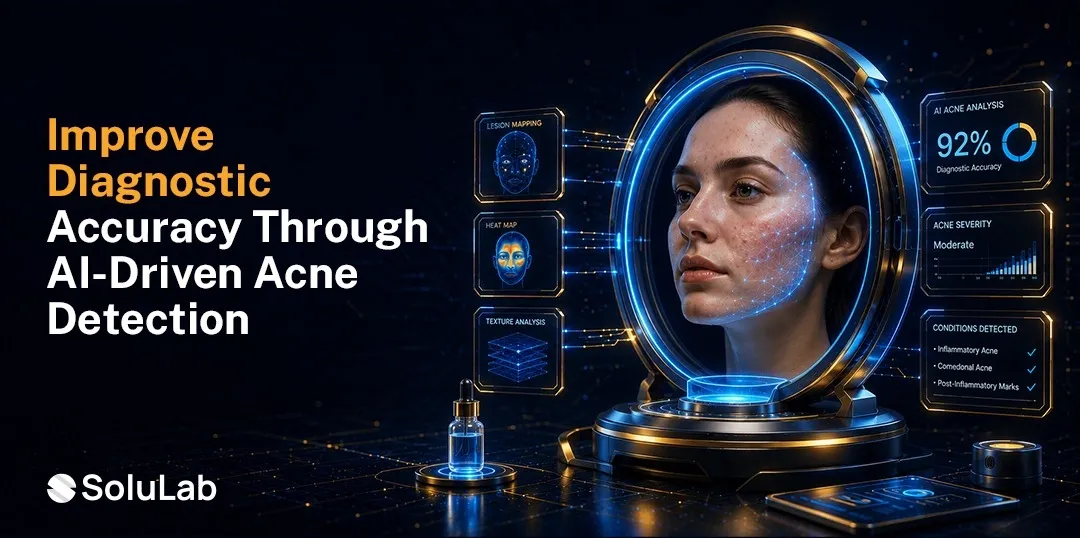
Artificial intelligence is changing that. AI-powered acne detection uses machine learning (ML), deep learning (DL), and computer vision to analyze facial images, identify individual lesions like comedones, papules, pustules, and nodules, and generate a standardized severity score in seconds. Skincare brands, teledermatology platforms, and hospitals are already deploying these systems, and dermatology researchers are actively validating how close AI models get to expert-level accuracy.
In this article, we’ll break down what AI-powered acne detection actually is, how the underlying technology works, where it’s already being used, what its real limitations are, and what it takes to build a solution like this from the ground up.
What Is AI-Powered Acne Detection?
AI-powered acne detection is the use of computer vision and machine learning models to automatically identify, classify, and grade acne lesions from a facial photograph. Instead of a dermatologist manually counting comedones and inflammatory lesions, a trained neural network scans the image, draws bounding boxes or segmentation maps around each lesion, classifies its type, and calculates an overall severity score.
Three underlying technologies typically work together in these systems:
- Machine Learning (ML): Statistical models that learn patterns from labeled data, for example, learning which pixel patterns correlate with an inflammatory lesion versus a blackhead.
- Deep Learning (DL): A subset of ML using multi-layered neural networks, particularly Convolutional Neural Networks (CNNs), which are especially effective at recognizing visual patterns in images.
- Computer Vision (CV): The broader discipline of enabling machines to interpret visual data, covering image preprocessing, object detection, and segmentation.
Most production acne detection systems are built on object-detection architectures like YOLO (You Only Look Once) or CNN-based classifiers such as EfficientNet, trained on large sets of dermatologist-annotated facial images.
Why Traditional Acne Diagnosis Falls Short?
Acne severity has historically been assessed using scales like the Global Acne Severity (GEA) scale, the Global Acne Grading System (GAGS), or the Investigator’s Global Assessment (IGA). These frameworks work well in controlled clinical trials, but they run into three practical problems in everyday care:
- Subjectivity and inter-observer variability. Two dermatologists looking at the same face can assign different severity grades, since scoring depends on visual judgment rather than a fixed, countable metric.
- Limited access to specialists. Many patients, especially in rural or underserved regions, don’t have regular access to a dermatologist, so acne often goes unmanaged until it scars.
- No easy way to track progress over time. Manually comparing “how much better does this look than last month” is difficult to standardize, which makes it hard to measure whether a treatment is actually working.
AI-based grading systems were built specifically to close these gaps, offering a repeatable, quantifiable alternative that doesn’t depend on which specific clinician is doing the assessment.
How AI Acne Detection Works: Step by Step
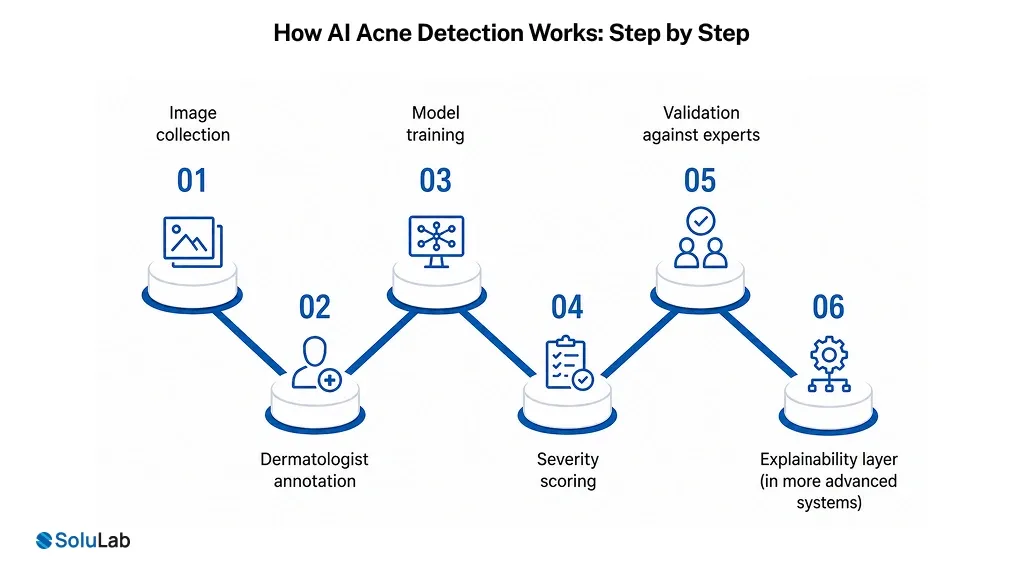
Building a reliable acne detection model follows a fairly consistent pipeline across the research and commercial systems currently in use:
- Image collection. Standardized facial photographs are collected, often using controlled imaging systems (like VISIA) or smartphone cameras, covering frontal and profile angles.
- Dermatologist annotation. Board-certified dermatologists label each image, marking lesion type (comedone, papule, pustule, nodule), location, and an overall severity grade. In several published studies, multiple dermatologists score the same images so researchers can measure and correct for human disagreement before training the model.
- Model training. A CNN or object-detection network (such as YOLO) is trained on the annotated dataset to recognize and localize each lesion type.
- Severity scoring. The model aggregates the detected lesions– their type, count, and distribution- into a standardized severity grade, mirroring scales like GEA, so the output is clinically interpretable.
- Validation against experts. The model’s grading is compared against dermatologist assessments on a held-out test set to measure accuracy, sensitivity, and specificity before deployment.
- Explainability layer (in more advanced systems). Some newer frameworks incorporate explainable AI (XAI) tools like LIME, which highlight why the model flagged a particular region, giving clinicians a way to verify the model’s reasoning rather than trusting it as a black box.
ML vs. DL vs. Computer Vision: Who Does What
| Technology | Role in Acne Detection | Example Use |
| Machine Learning | Learns statistical relationships between image features and lesion labels | Predicting severity grade from extracted image features |
| Deep Learning (CNNs) | Automatically learns visual features directly from raw pixels, without manual feature engineering | Classifying lesion type (comedone vs. papule vs. nodule) |
| Computer Vision | Handles image preprocessing, object detection, and segmentation | Drawing bounding boxes around individual lesions on a face |
In practice, these aren’t competing technologies; a production-grade acne detection system typically layers all three, using computer vision for detection and localization, deep learning for classification accuracy, and broader machine learning techniques for the final severity-scoring logic.

Real-World Examples of AI-Powered Acne Detection
AI-driven skin analysis has moved well beyond research labs and into consumer products and clinical tools:
- Consumer skincare scanners: Brands like The INKEY List (Breakout Analyser Pro) and La Roche-Posay (SpotScan) have built AI-powered skin scanners that let consumers photograph their face and receive a breakout-activity assessment paired with personalized product recommendations, positioning AI analysis as a bridge between skincare retail and dermatological guidance.
- Clinical-grade scoring platforms: Legit.Health has developed an acne scoring methodology designed to standardize severity assessment for clinical and research use, aiming to reduce the subjectivity inherent in manual grading.
- Healthcare case studies: FPT Software built an AI-powered acne diagnosis tool as part of its Deepclinics platform, developed with dermatologists to support remote skin examination and reduce the risks of patients self-treating acne without professional guidance.
- Peer-reviewed validation studies: Research published in journals including Frontiers in Medicine and the International Journal of Dermatology has tested AI grading systems that integrate lesion identification with severity scoring, generally finding that AI systems can grade acne within the performance range of experienced dermatologists while also noting that ensemble models (combining multiple algorithms) tend to outperform single-model approaches.
Benefits of AI-Powered Acne Detection
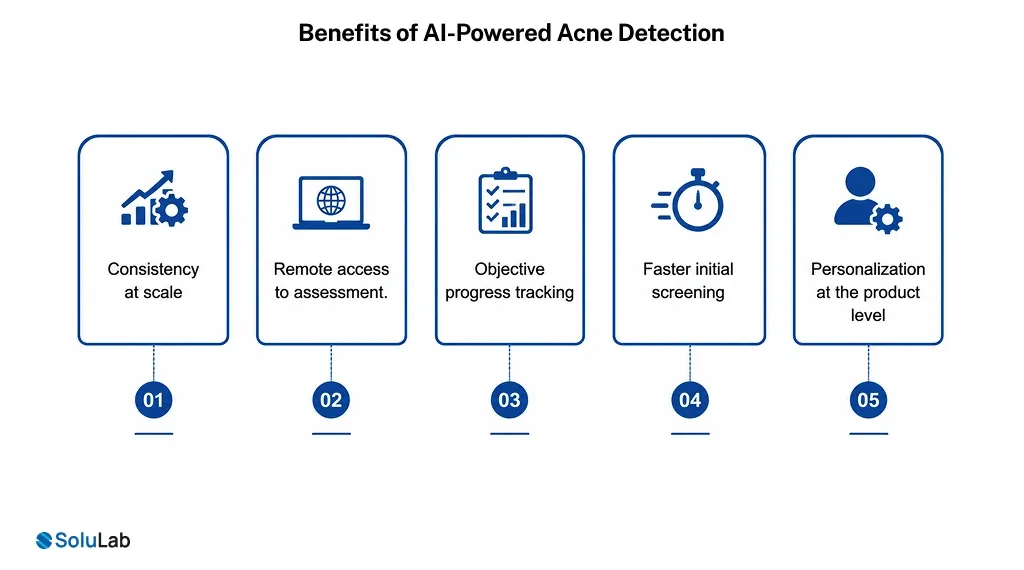
- Consistency at scale. An AI-powered solution applies the same grading logic to every image, removing the clinician-to-clinician variability that makes manual grading hard to standardize.
- Remote access to assessment. Patients without easy access to a dermatologist can get an initial severity read from a smartphone photo, supporting triage and teledermatology workflows.
- Objective progress tracking. Because the scoring is quantifiable, patients and clinicians can track treatment response over time using a consistent metric rather than subjective before/after impressions.
- Faster initial screening. AI can pre-screen and flag severity levels in seconds, letting dermatologists focus their time on complex or ambiguous cases rather than routine grading.
- Personalization at the product level. For skincare brands, acne detection feeds directly into personalized product or routine recommendations, turning a diagnostic tool into a commercial engine as well.
Challenges and Limitations to Understand
AI acne detection is promising, but it isn’t a replacement for dermatological expertise, and the research is candid about where it still falls short:
- Confusion with similar conditions. Studies have found that AI models can struggle to distinguish acne from visually similar conditions like rosacea, eczema, or pigmentation disorders, since these share overlapping visual features.
- Image quality dependency. Selfie-based analysis introduces variables such as poor lighting, low resolution, and distance from the camera, which aren’t factors in an in-person clinical exam, and several published studies specifically flagged unusable images as a limitation.
- Data diversity and representation. Because model accuracy depends entirely on the training data, systems trained on non-diverse datasets risk underperforming across different skin tones, and researchers have specifically called for more diverse training data to support equitable outcomes.
- Not a full diagnostic replacement. Dermatology researchers have been explicit that current AI systems are narrow in focus and are not yet capable of matching a dermatologist’s full clinical assessment, which considers medical history, other symptoms, and conditions beyond what’s visible in a single image.
The practical takeaway: AI acne detection is best positioned as a decision-support and triage tool, not a stand-alone diagnostic authority.

What It Takes to Build an AI-Powered Acne Detection Solution?
Organizations exploring this space, whether a skincare brand, a teledermatology startup, or a hospital system, typically need to plan around a few core building blocks:
- A clinically annotated dataset. This is the single biggest determinant of model quality. It requires partnering with dermatologists to label lesion type, severity, and location across a large and demographically diverse set of images.
- The right model architecture. Object-detection frameworks (like YOLO variants) tend to perform well for lesion localization, while CNN-based classifiers handle severity grading, often combined in an ensemble for better accuracy.
- Explainability and compliance. Especially in clinical contexts, models need to produce outputs a dermatologist can verify and trust, and the system needs to account for healthcare data privacy regulations relevant to the markets it serves.
- Mobile-first deployment. Since most real-world usage happens through smartphone selfies rather than clinical imaging systems, the model needs to be robust to variable lighting, angles, and camera quality.
- Continuous validation. Acne detection models should be regularly benchmarked against dermatologist assessments to catch drift and confirm the system still performs reliably as it scales to new users and populations.
This is exactly the kind of build where working with an experienced AI development company makes a measurable difference. SoluLab has worked across healthcare AI use cases from generative AI-powered clinical workflows to AI-driven diagnostic support and understands how to take a project from a validated dataset through to a scalable, compliant, production-ready application. Whether the goal is a consumer-facing skin-scanning app, a teledermatology triage tool, or a research-grade grading system, the development approach needs to balance clinical accuracy with real-world usability from day one.
The Future of AI in Dermatology
Acne detection is likely just the starting point. The same underlying computer vision and deep learning techniques are already being extended to other dermatological conditions, such as eczema, rosacea, melasma, and psoriasis, among them and researchers are increasingly focused on ensemble models that combine multiple algorithms for higher accuracy, along with explainable AI layers that let clinicians see why a model reached a particular conclusion.
As datasets grow more diverse and imaging technology in smartphones keeps improving, the accuracy gap between AI-assisted grading and expert dermatologist assessment is expected to keep narrowing, though closing it completely, especially for complex or overlapping skin conditions, remains an open research challenge.
Conclusion
AI-powered acne detection represents a genuine shift in how skin conditions get assessed—moving from a subjective, in-person judgment call to a standardized, repeatable, and remotely accessible process. The technology isn’t positioned to replace dermatologists, but it is already proving valuable as a triage tool, a progress-tracking mechanism, and a foundation for personalized skincare recommendations. As datasets grow more diverse and models improve at distinguishing acne from visually similar conditions, AI-assisted dermatology is likely to become a standard part of both consumer skincare and clinical workflows.
If you’re building a healthcare or skincare product that needs reliable AI-powered image analysis, whether that’s acne detection, broader dermatological diagnostics, or a personalized skincare recommendation engine, SoluLab’s AI development team can help you go from concept to a scalable, clinically credible product. Contact SoluLab today to discuss your AI-powered dermatology project.
FAQs
Shipra Garg is a tech-focused content strategist and copywriter specializing in Web3, blockchain, and artificial intelligence. She has worked with startups and enterprise teams to craft high-conversion content that bridges deep tech with business impact. Her work translates complex innovations into clear, credible, and engaging narratives that drive growth and build trust in emerging tech markets.