Key Takeaways
- AI-native SaaS companies grow roughly 4x faster and keep 21% more customers than products that just slap AI on top, according to Emergence Capital’s Beyond Benchmarks report.
- 92% of SaaS companies have already shipped AI features, or they’re actively planning to. Sitting this one out isn’t really an option anymore.
- Retention gains only show up when AI actually gets woven into the workflow. A chatbot bolted onto the nav bar doesn’t move the needle much.
- The smartest starting point usually isn’t the flashiest feature. It’s whatever workflow already eats the most support tickets or manual hours.
- Transformation works best as a sequence: pick a use case, prove it out, then expand. Not one big sweeping AI relaunch.
In the last couple of years, something shifted, and it happened fast. Ask around during any software buying decision now, and you’ll hear the same question pop up early: “Does this thing have AI?”
Say no, and you’re already losing ground, sometimes even to a product whose AI feature honestly isn’t that impressive yet. Weird, but true. And this isn’t cooling off anytime soon. If anything, it’s speeding up.
For a lot of SaaS teams, the hard part was never deciding whether to integrate AI solutions. It’s figuring out where to actually start without breaking what already works, or shipping some bolted-on chatbot nobody touches twice.
This guide gets into what an AI-powered SaaS platform actually looks like, why the shift is happening now, how to tell if your product is ready, the steps that get you there, and where things are heading next.
What Is an AI-Powered SaaS Platform?
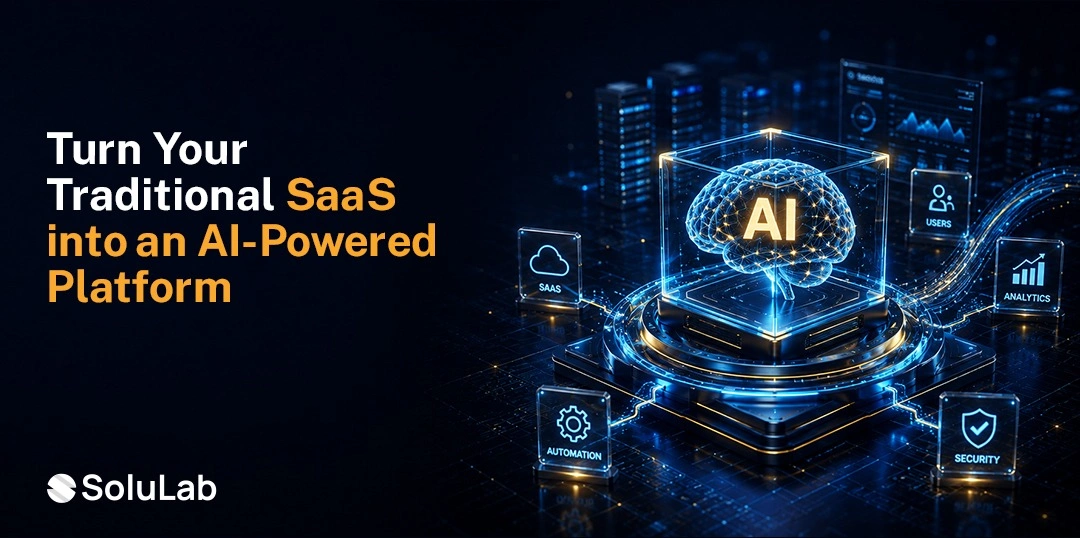
An AI-powered SaaS platform is software that uses machine learning, natural language processing, or generative AI to actively improve how the product works, not just how it gets marketed. Think automated insights instead of static dashboards.
A copilot that drafts the next step instead of an empty search bar. Predictions that show up before a user even has to ask. The real difference between “has an AI feature” and “AI-powered” usually comes down to one thing: is the intelligence baked into the core workflow, or just sitting off to the side looking nice?
Why Are SaaS Companies Adding AI?
Gartner expects 40% of enterprise apps to carry task-specific AI agents by the end of 2026.
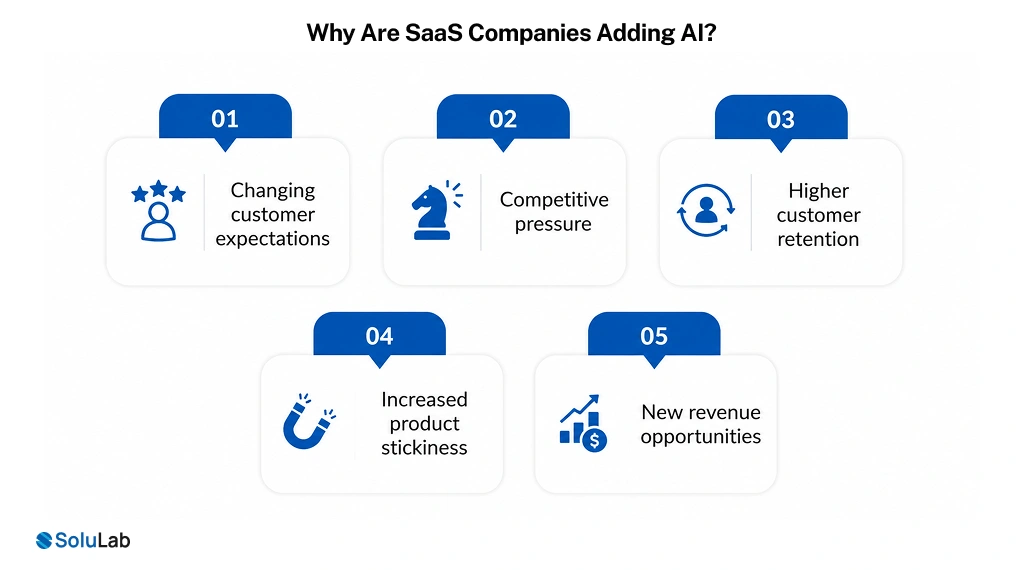
Here’s why SaaS companies use AI solutions in their products or platforms:
- Changing customer expectations. Users increasingly expect software to see what they need coming, not just sit there waiting for instructions.
- Competitive pressure. A rival ships one AI feature that saves customers real time, and suddenly standing still starts to look a lot like falling behind.
- Higher customer retention. Emergence Capital found that AI-native SaaS products hold onto 21% more customers than products without deep AI baked in.
- Increased product stickiness. The more a product learns from someone’s data over time, the more painful it gets to switch to a competitor.
- New revenue opportunities. Usage-based AI tiers, premium copilot features, and pricing options that just didn’t exist under the old flat-rate model.
Signs Your SaaS Product Is Ready for AI
Not every product actually benefits from an AI overhaul, and forcing it in where it doesn’t fit tends to backfire fast. A few signals usually point the other way, toward “yeah, this is genuinely worth building.”
- Large volumes of customer data that mostly sit unused beyond basic reporting.
- Repetitive user workflows, the kind that follow the exact same steps every single time.
- High customer support volume, especially clustered around a handful of recurring questions.
- Manual reporting that eats up hours somebody could be spending on actual analysis instead.
- Search-heavy applications where users keep struggling to find what they’re after.
- Knowledge management is scattered across docs, wikis, and old support tickets.
- Frequent decision-making tasks that would honestly benefit from a confident recommendation.
Step-by-Step Guide to Transforming Your SaaS into an AI Platform
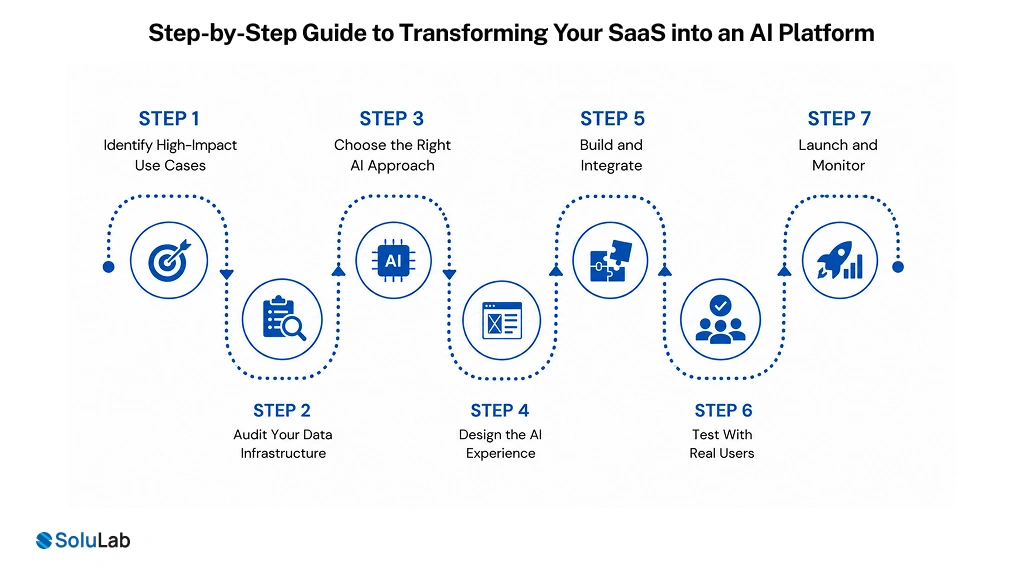
Turning a traditional product into an AI-powered solution isn’t one big launch. It’s a sequence, and skipping ahead usually ends up costing more time than it saves.
1. Identify High-Impact Use Cases
Start with whatever workflow is causing the most pain, not the feature that would look best in a demo.
- Rank workflows by user friction
- Tie each option to a metric
- Pick one to start with
2. Audit Your Data Infrastructure
AI is only as good as what it can actually see, and this step usually decides the real timeline more than anything else on this list.
- Check data quality and access
- Identify gaps before building
- Plan cleanup where needed
3. Choose the Right AI Approach
Decide between a foundation model, a fine-tuned model, or a fully custom build, depending on what the use case actually calls for.
- Compare build vs API options
- Match complexity to the task
- Factor in ongoing costs
4. Design the AI Experience
The interface matters just as much as the model underneath it. A brilliant feature buried in a confusing UI just won’t get used.
- Design for trust and clarity
- Show reasoning where it helps
- Keep a human override option
5. Build and Integrate
AI development happens against the real product architecture, not some standalone prototype floating off on its own.
- Integrate with existing systems
- Keep latency within acceptable limits
- Maintain existing security standards
6. Test With Real Users
Internal testing catches the obvious bugs. Real users catch the weird edge cases nobody thought to test for.
- Run a limited beta first
- Collect direct usage feedback
- Fix issues before wider rollout
7. Launch and Monitor
Shipping isn’t really the finish line, especially with AI features that keep learning and shifting after launch day.
- Roll out in phases
- Track adoption and accuracy
- Iterate based on real usage
Real-World Examples of AI-Powered SaaS Products
Here are a few examples of AI-powered SaaS platforms:
1. Salesforce
Einstein embeds predictive scoring and generative content drafting right into the CRM workflow, so reps get recommendations without ever leaving the record they’re already working in.
2. HubSpot
AI-powered content assistants and predictive lead scoring are built into the marketing and sales hubs directly, not bolted on as a separate add-on tool.
3. Zendesk
AI-driven ticket routing and suggested replies cut resolution time by handling the repetitive first pass before a human agent ever steps in.
4. Notion
Notion AI writes, summarizes, and searches across a workspace’s existing content, turning static docs into something a lot closer to a queryable knowledge base.
Future Trends in AI-Powered SaaS Platform
Here are some future trends you’ll see in the next few years:
1. Autonomous AI Agents
Agents that complete multi-step tasks on their own are moving well past the single-response chatbot model most products still ship today.
2. Multi-Agent Systems
Specialized agents increasingly hand tasks off to each other, each one covering a narrow slice of a bigger workflow.
3. Voice Interfaces
Voice is turning into a real input method for SaaS products now, not just a novelty tacked onto some mobile app.
4. Hyper-Personalization
Interfaces and recommendations adjust per user in real time now, based on actual behavior instead of a static onboarding survey from day one.
5. AI-Native SaaS
New products are getting architected around AI from day one, instead of retrofitting it onto a structure that was built for something else entirely.
6. Vertical AI Platforms
Industry-specific SaaS tools with domain knowledge baked in are increasingly beating out horizontal, one-size-fits-all platforms.
7. Embedded Copilots
AI Copilots that live inside the actual workflow, not some separate chat window off to the side, are becoming the expected default rather than a differentiator.
8. Agentic Workflows
End-to-end processes are starting to run with barely any human intervention, with people setting direction instead of executing every single step themselves.
Why Choose SoluLab as Your AI-Powered SaaS Product Development Partner
Turning a traditional SaaS product into an AI-powered one takes more than plugging in an API. It takes a team that’s actually done this integration work before, more than once.
SoluLab’s AI consulting practice starts with a real audit of where AI can move a metric that matters, not just where it can generate a headline for the pitch deck.
From there, SoluLab’s AI agent development and large language model development teams build the actual copilots, automation, and predictive features into your existing product architecture, backed by custom software development work that keeps everything secure and stable as it scales.
Conclusion
The SaaS products winning right now aren’t necessarily the ones with the longest AI feature list. They’re the ones where AI is woven deeply enough into the core workflow that pulling it out would mean pulling out real value, not just some nice-to-have widget. Getting there means starting with the workflow causing the most friction, proving it works, then expanding on purpose.
With AI-native products already growing roughly four times faster than the rest of the market, the cost of waiting keeps climbing every quarter a product sits on the sidelines.
SoluLab, an AI development company, can help your business turn an existing SaaS product into a genuinely AI-powered platform without a disruptive rebuild.
FAQs
Neha is a curious content writer with a knack for breaking down complex technologies into meaningful, reader-friendly insights. With experience in blockchain, digital assets, and enterprise tech, she focuses on creating content that informs, connects, and supports strategic decision-making.