Key Takeaways
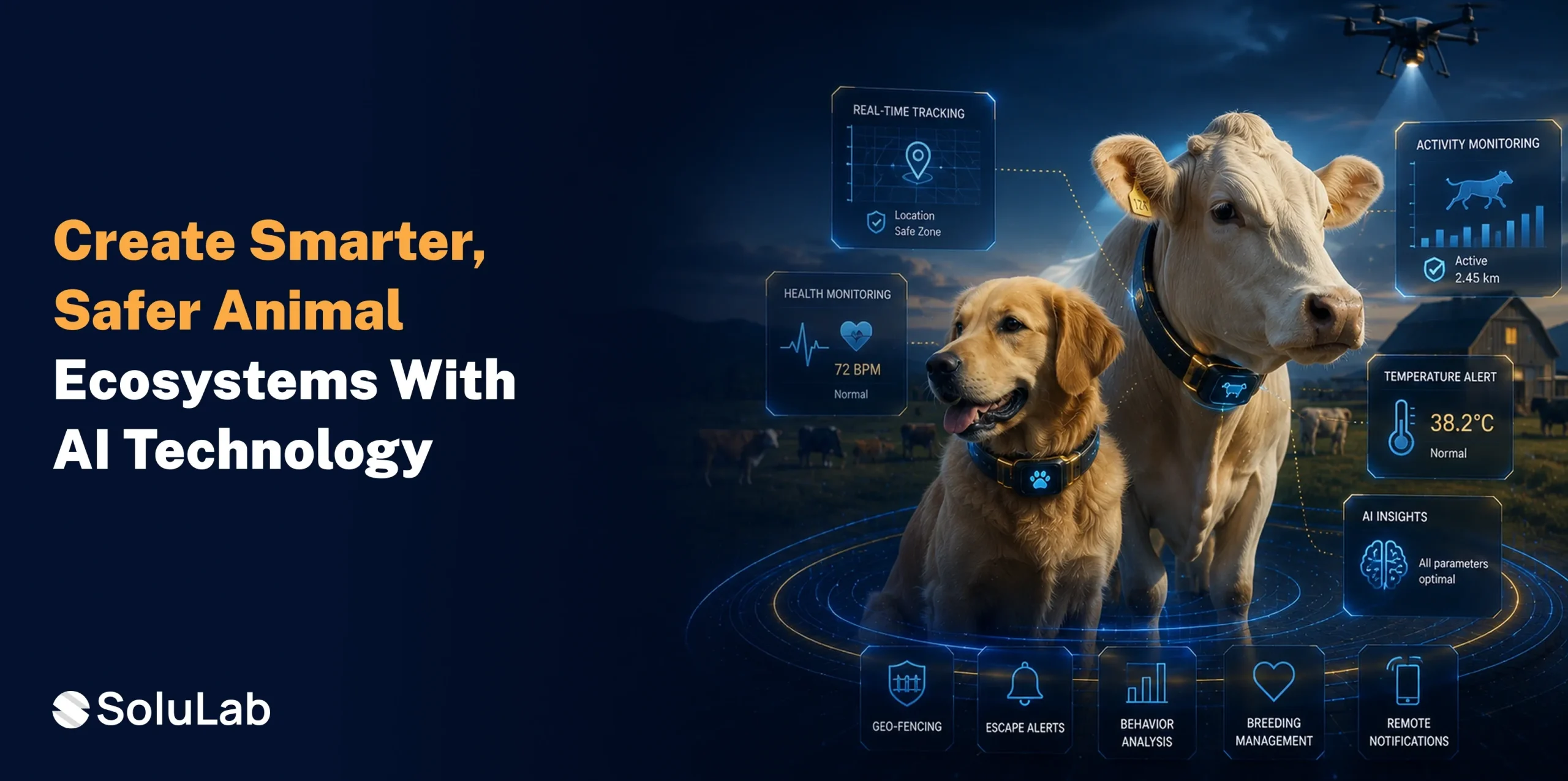
- AI-powered smart collars use sensors, GPS, and AI models to watch an animal’s health all day, not just at the vet.
- The pet wearable market is growing fast. Grand View Research says it will hit $11.4 billion by 2033, growing 16.8% a year.
- The livestock monitoring market is growing too. Grand View Research puts it at $5.73 billion in 2025, heading to $14.82 billion by 2033.
- Smart collars help farms fight rising vet bills, worker shortages, and animal disease outbreaks before they spread.
- In Brazil, a company called Cowmed used AI collar data to turn ten dairy cows into loan collateral on a stock exchange. That is real AI pet health monitoring meeting real money.
- Building a smart collar takes ten clear steps, from picking sensors to training AI models to testing on real animals.
- SoluLab builds the full stack, from hardware firmware to cloud dashboards, for pet and farm health monitoring for pets and livestock alike.
A dog cannot tell you its stomach hurts. A cow cannot tell you she is getting sick before her milk drops. AI smart collars solve exactly that: small devices that sit on an animal’s neck, read its body all day, and send the data straight to an app.
Pet owners use smart collars for pets to catch health problems early. Farmers use smart collars for livestock to watch hundreds of animals at once without walking every field. In some places, this smart collar technology is now doing something bigger, turning cows into digital assets that banks will actually lend money against.
This guide covers what AI-powered smart collars are, why they matter now, how the underlying AI animal health monitoring system works, and how a company approaches AI smart collar development, including where a full-stack AI development company like SoluLab fits in.
What Are AI-Powered Smart Collars?
An AI smart collar is a wearable device, worn like a normal collar, that is packed with tiny sensors. It reads things like heart rate, body temperature, movement, and location. Then it sends that data to the cloud, where an AI model looks for patterns a human eye would miss.
Think of it like a Fitbit, but for a dog, a cat, a cow, or a sheep. The collar does not just count steps. It learns what “normal” looks like for that one animal, then flags anything that breaks the pattern, like a fever starting or a limp getting worse.
Most smart collar technology today includes a few standard parts:
- GPS chip for real-time location
- Accelerometer for movement and activity
- Heart rate or temperature sensor
- Battery, often solar or rechargeable
- Wireless chip to send data to the cloud
The pet wearable market shows how fast this space is moving. Grand View Research expects it to grow at 16.8% a year through 2033, reaching $11.4 billion. At CES 2026, a company called SATELLAI even launched a collar that mixes live GPS tracking with health and activity monitoring in one small pet health monitoring device.

Why Are AI Smart Collars Becoming Essential?
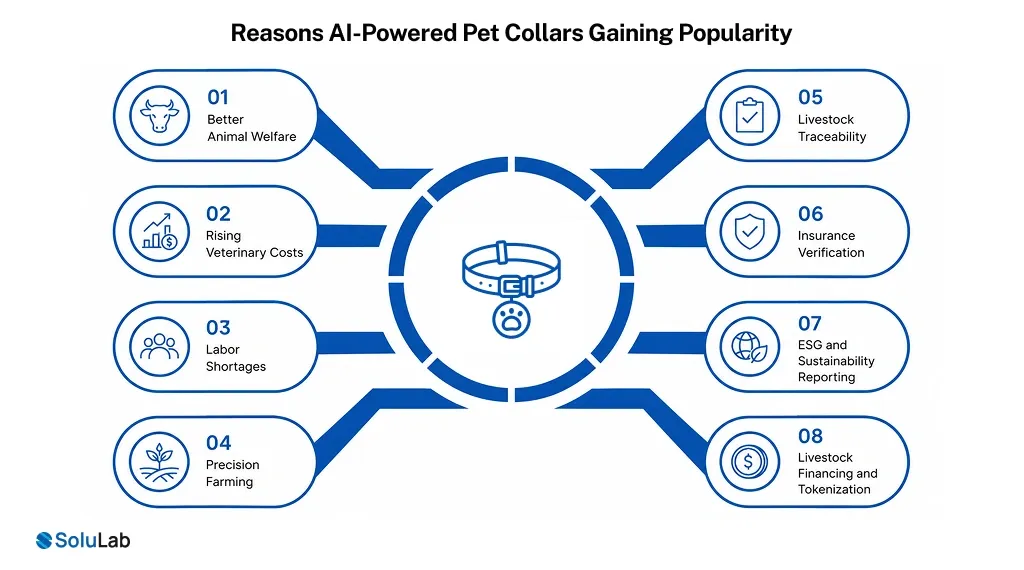
A collar is not just a gadget anymore. For a lot of pet owners and farmers, it has become a real tool for saving money, time, and animals. Here is why demand keeps climbing.
1. Better Animal Welfare
A sick animal often hides pain until it gets bad. A collar catches small changes, like less movement or a higher temperature, days before a human would notice anything wrong.
2. Rising Veterinary Costs
Vet visits are not cheap, and they keep getting pricier. Catching a problem early, through steady AI animal health monitoring system data, often means a smaller bill instead of an emergency one.
3. Labor Shortages
Farms everywhere are short on workers. A collar can watch a thousand animals at once, something no single farmhand could ever do by walking the fields.
4. Precision Farming
Instead of treating every animal the same, farmers can now feed, medicate, and manage each one based on its own data. That is precision farming, and it saves money on feed and medicine.
5. Livestock Traceability
Governments and buyers want to know where an animal has been and what it has eaten. Collar data builds that record automatically, with no extra paperwork.
6. Insurance Verification
Insurers want proof that an animal is healthy and alive before they pay a claim or set a premium. Collar data gives them exactly that, on demand.
7. ESG and Sustainability Reporting
Big food companies now have to report on animal welfare and farm sustainability. Collar data turns that from guesswork into a real, health monitoring for livestock report they can hand to auditors.
8. Livestock Financing and Tokenization
This one is newer, and it is a big deal. Collars can now turn a live animal into trusted collateral for a loan, something we will dig into in a minute.
How Do AI-Powered Smart Collars Work?
It’s a simple loop, repeated thousands of times a day. Sensors on the collar collect raw data, heart rate, body temperature, steps, and location. That raw data gets sent, usually over LTE-M, Bluetooth, or LoRaWAN networks, up to the cloud.
- Once the data lands in the cloud, an AI-powered pet monitoring system goes to work. Machine learning models compare the fresh data against the animal’s own history and against patterns learned from thousands of other animals, the same predictive analytics approach used across other health-monitoring device categories.
- If something looks off, like a heart rate spike or a sudden drop in movement, the system sends an alert straight to an app.
- Farmers and pet owners see this as a simple dashboard: green means fine, yellow means watch it, red means call the vet. Behind that simple screen sits a full smart livestock monitoring system doing constant math that no human could do by hand. Building that pipeline usually calls for the same IoT development expertise used in other connected-device and remote-monitoring products.
How to Build an AI-Powered Smart Collar: 10 Steps
Building a collar that actually works on a live animal, not just on a bench, means moving through hardware, data, AI, and app layers in the right order. This is the core of any serious AI smart collar development project, whether the end goal is a consumer smart pet collar or an enterprise-grade AI-powered pet monitoring system for a farm network. Here’s the process, step by step.
| Step | What Happens | Why It Matters |
| 1. Define the use case and species | Decide upfront whether the collar targets pets, livestock, or both, and which health signals matter most for that animal type. | A cat collar and a cattle collar need very different battery life, GPS range, and sensor accuracy, so scope shapes every later decision. |
| 2. Select sensors | Choose GPS, accelerometer, heart-rate, and temperature sensors based on accuracy needs, size limits, and power draw. | Sensor choice drives cost, battery life, and how reliable the health readings will be. |
| 3. Design the hardware and battery system | Build a lightweight, weatherproof collar housing with solar or rechargeable power that survives outdoor conditions. | Animals move constantly and live outdoors, so durability and comfort directly affect adoption and data quality. |
| 4. Build the firmware | Write the embedded software that manages sensor sampling, power use, and data buffering on the device itself. | Efficient firmware extends battery life and keeps the device working even with patchy connectivity. |
| 5. Choose the connectivity layer | Pick LTE-M, Bluetooth, LoRaWAN, or satellite connectivity depending on how far animals roam from a base station. | The wrong network choice leads to data gaps exactly when an alert matters most. |
| 6. Build the cloud data pipeline | Set up secure ingestion, storage, and processing so sensor readings flow reliably from thousands of collars into one system. | This is the backbone that makes real-time alerts and historical trend analysis possible at scale. |
| 7. Train the AI and ML models | Train anomaly-detection and predictive health models on historical and cross-animal data to learn what “normal” looks like. | This is what turns raw sensor noise into an early warning system instead of just a data logger. |
| 8. Build the app and dashboard | Create simple mobile and web interfaces for pet owners, vets, and farm managers with clear, color-coded alerts. | Even the best AI model is useless if the end user can’t act on what it finds quickly. |
| 9. Test on real animals | Run field pilots across different breeds, climates, and behaviors before a wider release. | Lab testing never fully replicates how animals actually move, chew, scratch, or roll in mud. |
| 10. Add compliance, security, and (optional) digital identity | Layer in encryption, access controls, and — for financing or traceability use cases — tamper-resistant digital IDs. | This step is what makes collar data trustworthy enough for regulators, insurers, or lenders to rely on. |
Can AI Smart Collars Enable Livestock Tokenization?
Here is where things get genuinely new, and it is a space most articles on this topic skip entirely.
What Is Livestock Tokenization?
Tokenization means turning a real-world asset, in this case, a live cow, into a digital record that can be used as collateral for a loan or even traded. Instead of a bank sending someone out to physically check on a cow, the animal’s digital record does the talking. This follows the same principle behind broader real-world asset tokenization, just applied to livestock instead of real estate or commodities.
Why Trust Is the Biggest Challenge
Banks have always been nervous about lending against livestock. A cow can get sick, get stolen, or simply die, and there was never an easy way to check any of that from a bank office. Because of this, banks often discount a cow’s value by as much as 60% when they use it as collateral. A cow worth $2,380 on paper might only count as $1,600 for loan purposes.
How AI Collars Solve It?
This is exactly the gap Brazilian agtech company Cowmed stepped into. Farmers in Paraná, Brazil, fitted ten dairy cows with AI-powered collars and used the resulting data to register the first tokenized livestock collateral on Brazil’s B3 stock exchange, getting close to $20,000 in credit.
Cowmed already tracks around 100,000 dairy cows this way, with a combined herd value topping $395 million, and expects up to 20% of its monitored network to eventually use this model.
Here is what makes it work, piece by piece:
- Continuous monitoring: The collar checks health, behavior, and location all day, not once a season.
- Immutable health records: Every reading gets logged in a way that cannot be quietly edited later.
- Ownership verification: Each animal gets its own digital ID, so it cannot be pledged as collateral twice.
- Location validation: Real-time GPS proves the animal is actually where the farmer says it is.
- Fraud prevention: Built-in rules catch swapped, missing, or double-pledged animals fast.
- Digital identity: All this data gets hashed into one tamper-resistant ID tied to the loan contract itself.
Real-World Examples: AI Smart Collars
Talk is cheap. These are collars already working today, on real animals, solving real problems.
- Cowmed (Brazil): As covered above, Cowmed’s AI collars gave ten dairy cows a digital identity solid enough for Brazil’s B3 stock exchange to accept them as loan collateral, a genuine first for tokenized livestock health monitoring technology.
- Pet monitoring platforms: Consumer brands like Fi and Tractive combine GPS tracking with activity and health monitoring in one collar, giving pet owners real-time alerts if their dog wanders off or slows down in a worrying way.
- Virtual fencing solutions: New Zealand’s Halter puts solar-powered, GPS-enabled collars on cattle that guide the herd using sound and vibration instead of physical fences. Ranchers using it have laid out more than 11,000 miles of virtual fence lines in the U.S. alone.
- Dairy health monitoring systems: Established players like Allflex and DeLaval have long used collar and ear-tag sensors to track rumination, heat cycles, and feeding, helping dairy farms catch disease and boost milk output.
Future of AI Smart Collars
None of this stands still. Here is where the technology is heading next.
- AI agents for herd management: Instead of just alerts, future systems may make small decisions on their own, like adjusting a feeding schedule automatically.
- Edge AI: Running AI models directly on the collar chip, so it can flag a problem even without an internet connection.
- Satellite connectivity: Coverage for animals grazing far from any cell tower or farm building.
- Predictive veterinary care: Spotting disease risk weeks before any visible symptom shows up.
- Blockchain-backed livestock records: Making the Cowmed model a normal financing tool rather than a one-off pilot.
- Digital animal passports: A single lifelong health and ownership record that travels with the animal, even across borders.
- Autonomous farms: Collars working alongside drones, cameras, and robots to run entire operations with far less manual labor.
Why Choose SoluLab for AI Smart Collar Development?
Building a smart collar means juggling hardware, AI, cloud systems, and sometimes blockchain, all at once. Very few teams are set up to handle every layer of that, from firmware to the data science and predictive modeling that turns sensor noise into a real AI animal health monitoring system.
SoluLab is one of the few that does, offering AI-led development services alongside hardware, cloud, and blockchain expertise under one roof, making it a full AI smart collar development company, not just a single-layer vendor.
| SoluLab Capability | What It Covers |
| AI and ML models | Custom models for anomaly detection and predictive health scoring |
| IoT integration | Connecting collar hardware to secure, real-time data pipelines |
| Embedded software | Firmware that manages sensors and battery life on the collar itself |
| Mobile and web apps | Simple dashboards for pet owners, vets, and farm managers |
| Cloud platforms | Scalable infrastructure built to handle thousands of connected collars |
| Predictive analytics | Turning raw sensor data into early health warnings |
| Blockchain integration | Digital IDs and tamper-resistant records for tokenized livestock, when needed |
If you’re still scoping the business case before committing to a full build, SoluLab’s AI consulting services can help validate the use case, sensor strategy, and rollout plan first.

Conclusion
AI smart collars started as a simple way to track a dog on a walk. They have grown into something far bigger: a tool that catches disease early, cuts vet and labor costs, proves an animal’s welfare to regulators, and now, in Brazil at least, even helps a farmer get a loan.
The technology behind it, sensors, AI models, cloud dashboards, and sometimes blockchain, is not simple to build. But the payoff, for pet owners and farmers alike, is an animal that finally has a voice.
If you are exploring a smart collar build, whether for pets, livestock, or both, working with a team that has already handled hardware, AI, and cloud together saves months of trial and error. That is the exact gap SoluLab, an AI development company in the USA, fills for AI smart collar development company partners entering this space.
FAQs
Neha is a curious content writer with a knack for breaking down complex technologies into meaningful, reader-friendly insights. With experience in blockchain, digital assets, and enterprise tech, she focuses on creating content that informs, connects, and supports strategic decision-making.