Key Takeaways
- Start with the task, not the model. Reasoning, coding, summarization, classification, image analysis, and voice all favor different models. Define the task before you compare vendors.
- The “best” model is rarely one model. Gartner’s 2026 research points to domain-specific language models and multi-agent orchestration as leading trends, not a single winning general-purpose model.
- Data residency now shapes model choice. Deloitte’s 2026 enterprise survey found 77% of companies now factor a model’s country of origin into vendor selection, and 58% build their AI stack primarily with local vendors.
- Trust and governance matter as much as benchmarks. KPMG’s research shows a majority of leaders plan to deploy AI agents from vendors they already trust over chasing the highest leaderboard score.
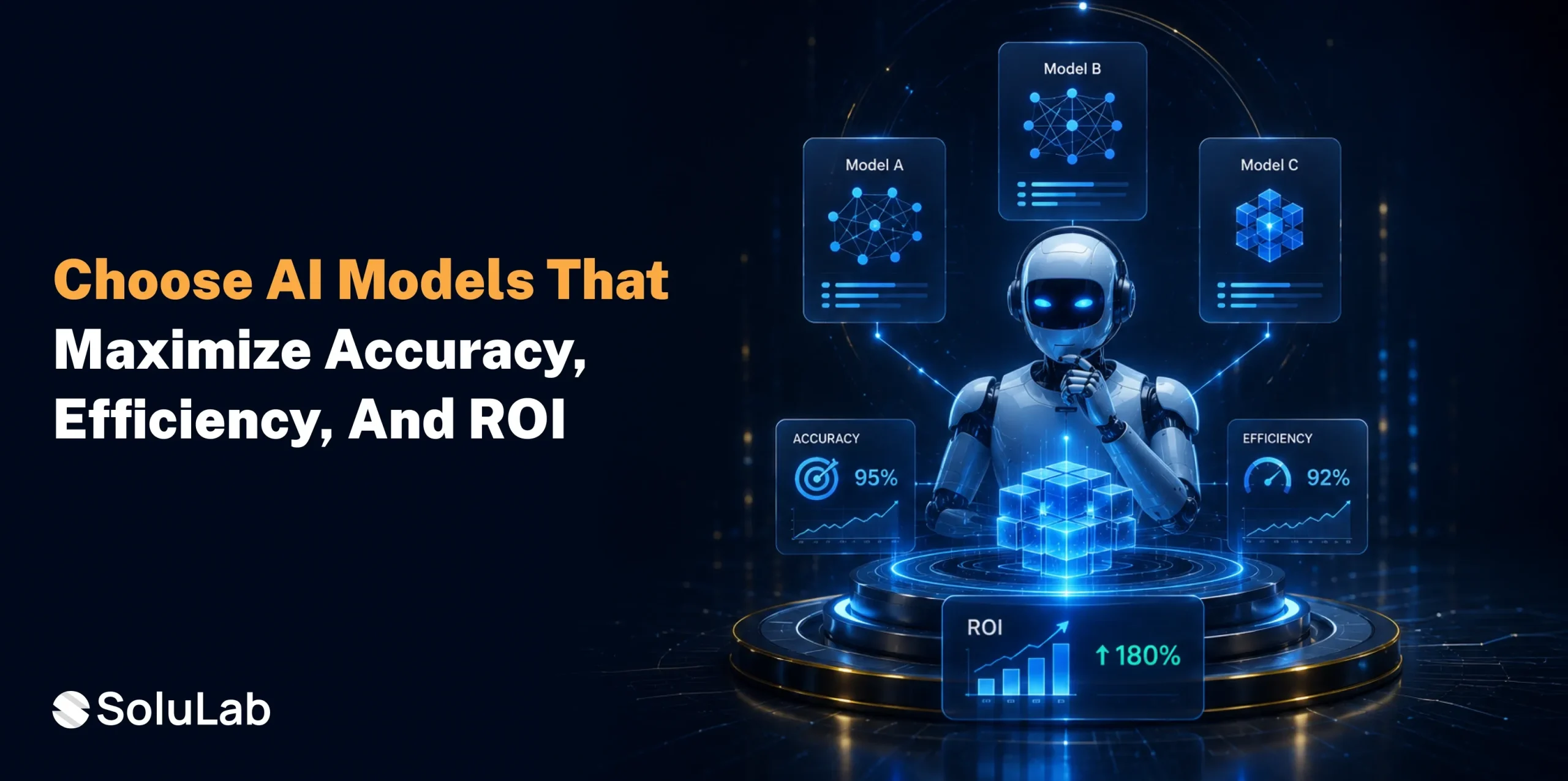
Choosing the right AI model comes down to five questions: what task does it need to perform, how much accuracy versus speed does that task require, what will it cost at your real usage volume, what are your data privacy and compliance obligations, and does it need to work alone or alongside other models. Get those five answers first, then evaluate models against them, not the other way around.
Most teams do this backward. They pick a well-known model (usually the one that’s trending) and then try to make their use case fit it. That approach works fine for a weekend project. It becomes expensive, brittle, or non-compliant the moment the project has real users, real data, or real regulatory exposure. This guide walks through a practical framework for selecting an AI model development, what’s actually different between the major providers, when to run more than one model, and how 2026 research from Gartner, Deloitte, and KPMG shows this decision getting both more important and more complicated for enterprises.
Start With the Task, Not the Model
An AI model is only as good as its fit to the job you’re asking it to do. Before comparing any vendor names, answer these questions about your actual AI use case:
- What is the primary task? Coding, long-document analysis, customer-facing chat, structured data extraction, image or video understanding, and voice each have different model strengths behind them.
- How much does accuracy matter versus speed? A customer support triage bot can tolerate more error than a model drafting a compliance filing.
- How much context does the task require? Summarizing a single email needs almost none. Analyzing a 300-page contract needs a large context window that keeps the original text addressable rather than compressed.
- What’s your realistic request volume? A model that’s affordable at 500 requests a month can become a five-figure monthly line item at 500,000 requests.
- What data will the model see? Customer PII, health records, financial data, or proprietary source code each carry different privacy and compliance weight.
Only once these are answered does it make sense to start comparing specific models against each other.

The Core Decision Framework
Use this as a working best AI model for your project checklist when evaluating any model, general-purpose or specialized:
- Task alignment. Match the model family to the task type. General-purpose large language models handle language tasks (writing, reasoning, coding, chat). Convolutional and vision models handle image classification and object detection. Domain-specific models outperform general models on narrow, high-stakes tasks within their trained domain.
- Cost per unit of output. Price is usually quoted per million tokens, but the number that matters is cost per completed task at your real volume, not the sticker price per call.
- Latency requirements. A real-time voice assistant has a very different latency tolerance than an overnight batch summarization job.
- Context window. Bigger context windows reduce the need to chunk and re-stitch information, which matters more as document or codebase size grows.
- Data privacy and deployment model. Some models are cloud-API only. Others support private hosting, on-premises deployment, or fine-tuning on your own infrastructure, which matters if your data can’t leave your environment.
- Governance and evaluation. Can you audit the model’s outputs, log its decisions, and catch drift before it reaches a user? A model with no evaluation harness around it is a liability regardless of how good its benchmark scores are.
- Vendor stability and lock-in risk. What happens to your product if the vendor changes pricing, deprecates the model version, or shifts terms of service?
Proprietary, Open-Source, or Domain-Specific: Picking the Right Category
Before choosing a specific model, decide which category actually fits your constraints:
| Category | Best for | Trade-off |
|---|---|---|
| Proprietary (GPT, Claude, Gemini) | Fast time to market, state-of-the-art general reasoning, managed infrastructure | Recurring API cost, less control over data handling, dependent on vendor roadmap |
| Open-source (Llama, Mistral) | Data sensitivity, on-premises deployment, long-term cost control at scale | Requires in-house ML expertise to host, fine-tune, and maintain |
| Domain-specific (fine-tuned or purpose-built) | Regulated industries, narrow high-accuracy tasks, compliance-heavy workflows | Higher upfront investment in fine-tuning and data preparation |
There is no universal winner here. A HIPAA compliance healthcare tool and a marketing copy generator have almost nothing in common in terms of what “the right model” looks like, even if both are technically large language models.
OpenAI vs Claude vs Gemini: The Comparison Most Teams Start With
This is usually the first real fork in the road, since GPT, Claude, and Gemini are the three most widely deployed proprietary models in production. In broad strokes: OpenAI’s models tend to lead on ecosystem maturity, with more plugins and documented integrations. Claude tends to lead on instruction-following and coding reliability for complex, multi-step prompts and long documents. Gemini tends to win when an organization already runs on Google Cloud or Workspace, where native integration reduces friction significantly.
None of these are permanent rankings. All three providers release new model versions throughout the year, and the “best” one for a given task shifts accordingly. SoluLab’s OpenAI vs Claude vs Gemini comparison breaks this down further by performance, safety, multimodal capability, and cost, and is worth reading in full if this is the specific decision in front of you.
Should You Use One Model or Several?
Most enterprises don’t deliberately choose a single-model strategy. It happens by accident: one team standardizes on GPT, another builds on Claude, a data science group fine-tunes a Llama variant for one narrow task, and eighteen months later there are three vendors, four APIs, and no coherent policy connecting them.
A deliberate multi-model strategy routes different tasks to different models based on quality, cost, and risk, for example sending nuanced writing to one model, code generation to another, and high-volume, low-stakes tasks to a smaller, cheaper model. This adds architectural complexity up front but reduces both vendor lock-in and total cost at scale. A single-model strategy is simpler to govern and monitor but leaves cost and performance on the table if your workload spans genuinely different task types.
The right answer depends on your organization’s maturity. A single-product MVP validating one hypothesis rarely needs a multi-model architecture. An enterprise running AI across customer service, engineering, and compliance almost always benefits from one. SoluLab’s LLM development services are built to be model-agnostic for exactly this reason, evaluating your workload against multiple model families before recommending an architecture rather than starting from a single preferred vendor.
Why 2026 Model Selection Is Getting More Complicated, Not Less
Three major 2026 research programs help explain why “just pick a model” is no longer good enough advice for any organization operating at real scale.
Gartner’s Top Strategic Technology Trends for 2026 names domain-specific language models as one of the year’s defining shifts. Generic large language models often fall short on specialized, high-stakes tasks, and Gartner predicts that by 2028, more than half of the generative AI models enterprises use will be domain-specific rather than general-purpose. The same report highlights multi-agent systems, collections of coordinated, specialized AI agents, as a parallel trend, reinforcing that the winning approach isn’t one perfect model but the right combination of models working together under proper orchestration.
Deloitte’s State of AI in the Enterprise 2026 report introduces a factor most model-selection guides still ignore: sovereignty. The survey found that 83% of enterprises now view data residency and compute location as at least moderately important to strategic planning, and 77% factor a model’s country of origin into vendor selection decisions. Nearly three in five companies, 58%, now build their AI stack primarily with local vendors. That means the “best” model on a benchmark leaderboard may not be a viable choice at all once data residency and vendor jurisdiction enter the decision.
KPMG’s Global AI Pulse survey adds the trust dimension. The survey found 72% of leaders plan to deploy AI agents built by vendors they already trust, ahead of chasing whichever model tops a benchmark that quarter. Combined with growing concern about data security and governance across KPMG’s research, the pattern is consistent: enterprises are increasingly selecting models and vendors based on demonstrated reliability and governance maturity, not raw capability scores alone.
Put together, these three findings describe the same shift from three different angles. Model selection in 2026 is no longer a single technical decision made once by an engineering team. It’s a recurring strategic one that has to account for task fit, sovereignty, governance, and vendor trust at the same time.
Common Mistakes in AI Model Selection
- Choosing the model everyone is talking about instead of the one that fits the task. Trending isn’t the same as suited to your workload.
- Ignoring the total cost at real volume. A model that looks cheap in a demo can become the largest line item in your AI budget once usage scales past the pilot.
- Skipping the data residency and compliance check until late. Retrofitting a compliant model into an architecture built around a non-compliant one is far more expensive than checking this up front.
- Treating model selection as a one-time decision. Providers release new versions throughout the year. A model that was the right choice six months ago may no longer be the best fit today.
- Locking into a single vendor before proving it’s the right one. Committing to one model family before testing it against your actual workload increases switching costs later.
- Skipping evaluation infrastructure. A model that looks accurate in a demo and drifts or hallucinates in production isn’t a validated choice; it’s an unmanaged risk.
How to Actually Test a Model Before You Commit?
- Run a structured evaluation, not a vibe check. Test the model against real examples from your own workflow, not generic benchmark prompts.
- Score on the dimensions that matter to your task, whether that’s factual accuracy, code correctness, tone consistency, or latency, not just an overall quality impression.
- Test at the volume and context length you’ll actually use in production, since performance and cost both shift as inputs scale up.
- Check the model’s behavior on your edge cases, not just its average performance on typical inputs.
- Confirm the deployment and data-handling terms in writing before any real customer or proprietary data touches the model.

Conclusion
Choosing the right AI model is rarely a one-time decision you get to walk away from. It’s an ongoing evaluation that shifts as your data, your compliance obligations, and the models themselves keep changing. If you’re trying to figure out which model, or combination of models, actually fits your project, SoluLab’s AI team can walk you through a structured evaluation on a free strategy call.
As an AI-native product development partner with over a decade of experience across OpenAI, Claude, Gemini, and open-source model deployments, SoluLab will help you match the model to the task rather than the task to whatever model is trending this month.
Let’s get started!
FAQs
Tanmay is focused on building brand authority through narrative-driven marketing. With 19+ years in tech branding, he has positioned SoluLab as a thought leader in the Blockchain and AI sectors. He regularly shares insights on AI-driven brand storytelling and content strategy. He is open to connecting with startups and enterprise teams to help them overcome their challenges.