Key Takeaways
- AI in asset management is now mostly an operating-model question rather than a modelling question. The firms getting value are fixing data infrastructure first and buying models second.
- Adoption is wide but shallow. Most buy-side firms use AI somewhere in the front office, yet only a small minority have integrated it across the business, and those are almost all the largest managers.
- The highest-return applications sit away from alpha generation: research summarisation, risk surveillance, compliance reporting, client servicing, and middle-office reconciliation.
- Data readiness, not model choice, decides outcomes. Unstructured research archives, inconsistent security masters, and siloed client records kill more projects than poor algorithms do.
- Regulated use needs an audit trail from day one. If you cannot explain how a model contributed to a decision, you cannot defend it to a client, a consultant, or a regulator.
Asset managers have stopped asking whether AI works and started asking why it has not scaled. SimCorp’s 2026 InvestOps Report, run by WBR Insights across 200 senior executives at firms each overseeing at least $10 billion, found 70% of investment managers actively using AI in the front office, up from roughly 10% a year earlier.
Yet a separate 2026 survey of 80 senior asset management figures by Acuity Analytics found only 5% describe AI as fully integrated, and those sit almost entirely above $100 billion in assets. Wide adoption, shallow integration.
That gap, not model capability, is the real story. This guide covers where AI in asset management pays back across research, risk, compliance, and operations, why most firms stall between pilot and production, and how to pick a first workflow you can defend at budget time.
This article is for asset management operations, technology, and investment leadership. It is general information, not investment advice, and nothing here recommends a security, strategy, or allocation.

What Is AI in Asset Management?
AI in asset management is the use of machine learning and language models across an asset manager’s operating model: summarising research, scoring risk, detecting compliance breaches, generating client reporting, reconciling trades, and supporting portfolio decisions. Most production systems assist a human decision-maker rather than making allocation calls autonomously.
The phrase gets stretched to cover two very different things, and conflating them is why budgets get misallocated.
The first is alpha generation: models that aim to improve returns through signal discovery, factor research, or execution timing. This is the application everyone talks about and the hardest to prove, because markets adapt and backtests flatter.
The second is operating leverage: using AI to do the same work with fewer people, fewer errors, and less elapsed time. Research summarisation, RFP drafting, reconciliation breaks, regulatory reporting, and client query handling all sit here. Less exciting. Far easier to measure, and where most of the realised value has landed.
For the wider view of how these patterns run across financial services, our guide to AI in finance covers the same split across banking, insurance, and capital markets.
1. It Is an Operating Model Change, Not a Tool Purchase
Buying a model is the small part. Making its output trustworthy enough to act on means fixing data lineage, defining who reviews what, and logging every decision. Firms that skip this end up with impressive pilots that never reach production.
2. Data Readiness Decides the Outcome
Modernising data architecture now sits near the top of most buy-side technology agendas, and rightly so. A language model running over a fragmented security master produces confident nonsense.
3. Most Production Use Is Assistive
The model drafts, flags, or ranks. A portfolio manager, risk officer, or compliance analyst confirms. That is not timidity; it is what the audit trail requires in a regulated business.
Where AI Works Inside an Asset Management Firm
Eight applications with real production deployments behind them, ordered by how reliably they pay back.
1. Research Summarisation and Idea Triage
Analysts drown in sell-side notes, filings, transcripts, and news. Language models summarise, tag by thesis, and surface what contradicts an existing position, which is the output analysts actually value. This is the most common first deployment and the easiest to measure, because you can count hours.
2. Risk Surveillance and Exposure Monitoring
Models detect concentration drift, factor exposure changes, and correlation breakdowns faster than a scheduled report cycle. The point is earlier warning rather than better prediction. Our work on AI in risk management covers how the same surveillance patterns apply outside the buy side.
3. Compliance Monitoring and Regulatory Reporting
Mandate breach detection, personal account dealing surveillance, marketing material review, and regulatory filing preparation. Compliance is a strong first use case precisely because the work is rules-based and the cost of error is already quantified. See generative AI for compliance for the control design involved.
4. Client Reporting and Commentary Generation
Quarterly letters, factsheets, and bespoke institutional reporting consume analyst time and arrive late. Models draft commentary from performance and attribution data, with a portfolio manager editing rather than writing. Firms typically cut reporting cycles substantially here, and the quality floor rises because every report follows the same structure.
5. RFP and Due Diligence Questionnaire Automation
Institutional distribution runs on DDQs and RFPs that repeat most of their content from one submission to the next. Retrieval over an approved answer library drafts responses and flags anything needing fresh approval. Unglamorous, and one of the fastest payback projects in the firm.
6. Portfolio Construction Support
Models assist with rebalancing, tax-aware trading, and scenario testing. This is where AI portfolio optimization sits, and it deserves its own treatment rather than a paragraph, which is why we cover it separately in AI in portfolio management.
7. Client Servicing and Advisor Support
Query handling, next-best-action prompts, and meeting preparation briefs assembled from CRM and portfolio data. The advisor-facing side of this overlaps heavily with AI in wealth management, where the client relationship rather than the mandate is the unit of work.
8. Middle and Back Office Reconciliation
Trade break classification, failed settlement prediction, and corporate action processing. Boring, high volume, rules-adjacent, and consistently the application with the clearest cost case in AI in fund management programmes.
The Adoption Gap: Why 70% Use AI but Only 5% Have Integrated It
This is the single most useful number pair in the 2026 data, and it explains more than any market forecast.
Seven in ten buy-side firms run AI somewhere in the front office. Five percent call it fully integrated, and those are concentrated above $100 billion in assets. In between sit 37% at moderate adoption, 24% still exploratory, 15% at initial stage, and 19% not using AI at all. The pattern is not reluctance. It is a stall between pilot and production, and it has four causes.
1. The Data Layer Was Never Fixed
A pilot runs on a curated extract. Production needs the real security master, the real client records, and the real document archive. That gap is months of unglamorous work nobody scoped, which is why 54% of firms list data infrastructure modernisation as a priority rather than a completed task.
2. There Was No Owner After the Pilot
Pilots get run by innovation teams. Production needs a business owner with a budget line and a metric. Without one, the tool survives as long as its champion does.
3. Nobody Defined What Good Looks Like
Accuracy on what test set, against which baseline, reviewed by whom. Gartner expects more than 40% of agentic AI projects to be cancelled by the end of 2027, largely for unclear business value and inadequate risk controls. Asset management projects die the same way.
4. Vendor Risk Was Underweighted
57% of InvestOps respondents rank vendor stability as the most important criterion when evaluating third-party AI, above capability. In a business where mandates run for years, that is rational. A model provider who changes pricing or deprecates an endpoint can break a client-facing process.
The firms that crossed the gap did something specific: they picked one workflow with a countable baseline, fixed the data for that workflow only, and gave it a business owner. Scope discipline beat ambition.
Key Benefits of AI in Asset Management
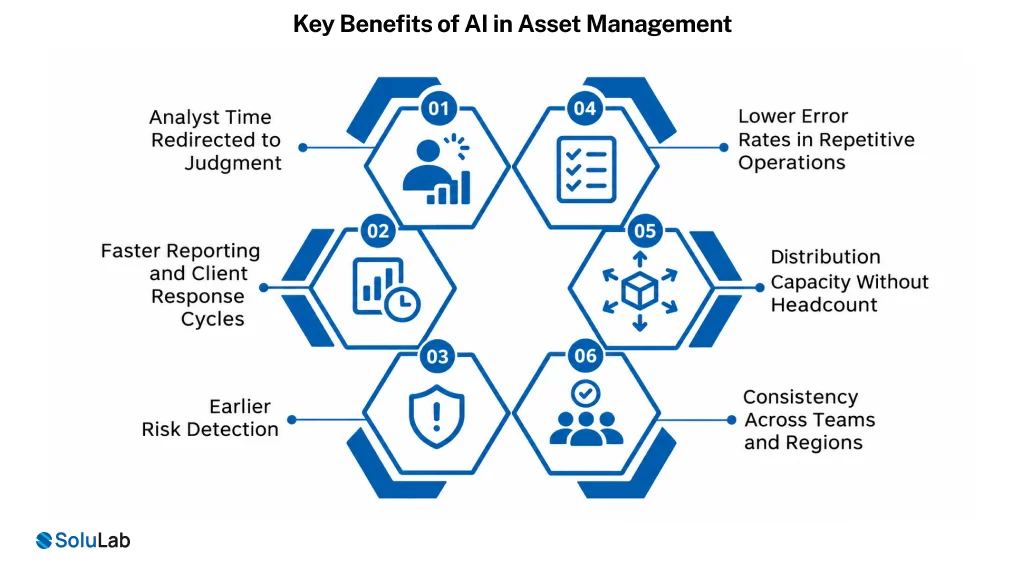
Here are some benefits of AI in asset management:
1. Analyst Time Redirected to Judgment
Summarisation and drafting remove the mechanical half of research work. The benefit is not fewer analysts, it is analysts spending their week on the part a model cannot do.
2. Faster Reporting and Client Response Cycles
Commentary drafting and query handling compress elapsed time more than headcount cost. For institutional clients and consultants, response speed is a retention factor in its own right.
3. Earlier Risk Detection
Continuous surveillance replaces periodic review. Catching exposure drift mid-quarter rather than at quarter-end changes what you can do about it.
4. Lower Error Rates in Repetitive Operations
Reconciliation, corporate actions, and settlement exception handling benefit from consistency rather than intelligence. Fewer breaks, fewer manual touches, fewer write-offs.
5. Distribution Capacity Without Headcount
RFP and DDQ automation lets a small institutional sales team pursue more mandates. This is one of the few applications with a direct revenue argument rather than a cost one.
6. Consistency Across Teams and Regions
A shared retrieval layer over approved content means a London analyst and a Singapore analyst answer the same client question the same way. Compliance notices this before anyone else does.
How to Implement AI in an Asset Management Firm
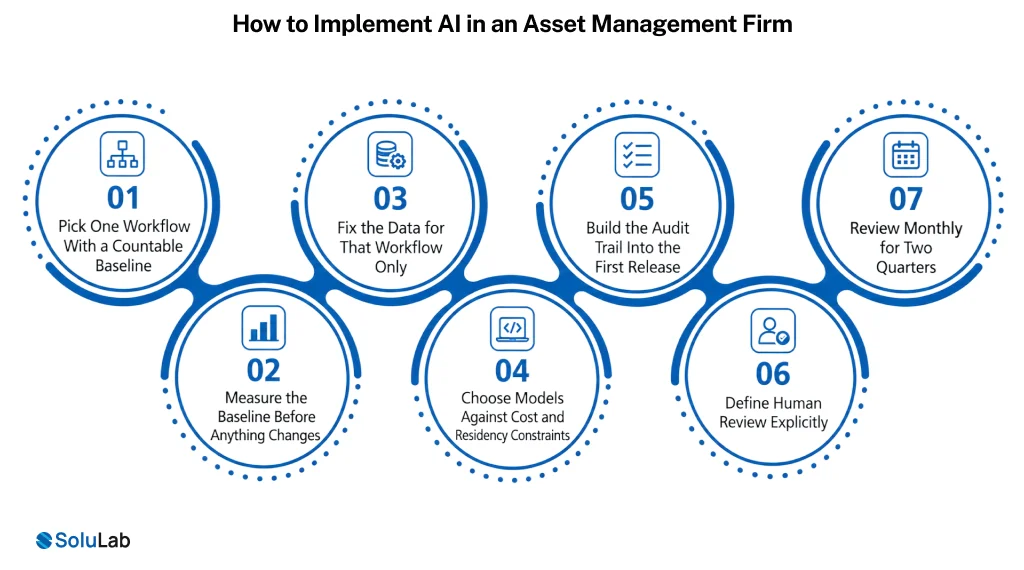
1. Pick One Workflow With a Countable Baseline
Reporting cycle days, DDQ turnaround, reconciliation breaks per month, research hours per analyst. If you cannot count it today, you cannot prove improvement later.
2. Measure the Baseline Before Anything Changes
Four to six weeks of current performance. Skipping this is the most common reason a successful project cannot be defended at budget time.
3. Fix the Data for That Workflow Only
Resist the enterprise data programme. Clean the documents, records, and identifiers that one workflow touches, prove the value, then widen. Boiling the ocean first is how three-year programmes get cancelled in year two.
4. Choose Models Against Cost and Residency Constraints
Hosted and open-weight options are both viable. The deciding factors are usually where data may be processed and what cost per document looks like at full volume, not benchmark scores.
5. Build the Audit Trail Into the First Release
Inputs, outputs, model version, reviewer, and timestamp, logged from day one. Retrofitting this into a live regulated process costs several times more than building it in.
6. Define Human Review Explicitly
Write down what a human confirms, what they can override, and what the system may never do unreviewed. Vague review policies fail audits even when the technology works.
7. Review Monthly for Two Quarters
Track accuracy, override rates, and the original baseline metric. Rising override rates usually signal a data problem rather than a model problem, and they signal it early.
Teams building rather than buying will recognise this sequence from our generative AI in banking and finance work, where validation consistently outweighs model development in effort.
Risks and Limits Worth Naming
1. Confident Summaries of the Wrong Document
Retrieval errors produce fluent, plausible, incorrect output. Citation on every claim and a reviewer who checks the source are the controls. Accuracy figures mean nothing without them.
2. Backtest Overfitting in Alpha Applications
A model that explains history is not a model that predicts. This risk is well understood in quantitative teams and routinely underestimated everywhere else in the firm.
3. Explainability Obligations You Cannot Meet Later
If a model contributed to a decision affecting a client, you may need to explain how. Architectures chosen for performance alone can make that impossible, and the obligation does not disappear because the technology is new.
4. Vendor Concentration and Model Deprecation
Client-facing processes built on a single provider’s endpoint inherit that provider’s roadmap. Portability is a commercial control, not a technical nicety.
5. Information Barrier Leakage
A retrieval system that ignores entitlements can surface research across a wall that exists for a reason. This is a serious compliance failure and an easy one to build by accident.
6. Projects That Die From Weak Scoping
The cancellation rates forecast across agentic AI generally are the aggregate symptom. In asset management the specific causes are consistent: an unfixed data layer, no business owner after the pilot, and no agreed definition of success.
Emerging Trends in AI Powered Investment Management
1. Agentic Workflows in the Middle Office
Multi-step agents that complete a reconciliation or a DDQ response and escalate exceptions, rather than single-purpose models. The architecture mirrors what we describe in AI agents for finance, and the control design matters more than the autonomy.
2. Private Markets and Alternatives Catching Up
51% of InvestOps respondents named private markets and alternatives as the greatest technological opportunity, up 24 percentage points from 27% a year earlier. Document-heavy, data-poor, and manual, which is exactly where language models help most.
3. Firm-Specific Models Over General Ones
Fine-tuned and retrieval-grounded models over a firm’s own research archive, house view, and approved language. The output starts sounding like the firm rather than like a model, which is what makes it publishable.
4. Evaluation as a Procurement Requirement
Consultants and institutional clients are starting to ask how AI-assisted processes are validated. Expect evaluation evidence to move from a technical artefact to a due diligence item.
5. Platform Consolidation
58% of firms cite vendor consolidation as a top initiative. The appetite for ten point solutions is fading in favour of fewer platforms with deeper integration, which changes how AI asset management platforms get bought.
6. On-Premise and Private Deployment Holding Up
On-premises still held roughly 60% of the AI in asset management market in 2025, against a general enterprise trend toward cloud. Data residency and client mandate restrictions explain most of it, and that constraint is not loosening quickly.
For market scale, GM Insights puts the AI in asset management market at about USD 3.8 billion in 2025, growing toward USD 21.7 billion by 2035 at roughly 27.7% CAGR, with North America at 38.54% of 2025 revenue. Machine learning accounted for USD 2.44 billion of the 2025 base, which tells you how much of this spend is still predictive rather than generative.
How SoluLab Can Help in AI in Asset Management
We build and validate AI systems for asset managers, wealth platforms, and fund administrators. Engagements usually take one of these shapes.
1. One-Workflow Proof of Concept
We pick the workflow with the clearest baseline, fix the data it touches, build it, and measure against that baseline. You get a result you can take to an investment committee rather than a demo.
2. Research and Reporting Automation Builds
Retrieval over your research archive with citation on every output, commentary generation from performance and attribution data, and DDQ and RFP drafting against an approved answer library.
3. Risk and Compliance Surveillance Systems
Mandate breach detection, exposure monitoring, and surveillance tooling built with the audit trail and entitlement model in place from the first release, not added afterward.
4. Platform Engineering for Fintech and WealthTech Vendors
For firms building the products asset managers buy, we handle retrieval architecture, model orchestration, audit logging, and compliant infrastructure. Teams usually reach us once a prototype works and the scale and regulatory questions arrive together. Our AI in fintech work covers the adjacent patterns.
If you want to hire AI asset management developers for a defined build, or need an AI asset management development company to take a concept through validation, start with a discovery call. We will say plainly if buying an existing platform beats building, because for several of these workflows it does.
Conclusion
The interesting question in AI in asset management is no longer capability. Models summarise research, flag mandate breaches, and draft client commentary well enough to use today, and most firms have already proved that somewhere in the front office. The question is why so few have got past proving it.
The evidence points at the same three things every time: a data layer nobody fixed, no business owner after the pilot, and no agreed definition of success. None of those are technology problems, which is both the frustrating part and the encouraging one, because they are all fixable with scope discipline rather than better models.
If you are deciding where to start, whether to build or buy, or how to get a pilot into production, SoluLab, an AI development company, can help your business scope it properly. Book a discovery call, and we will work through the first workflow with you.
FAQs
Neha is a curious content writer with a knack for breaking down complex technologies into meaningful, reader-friendly insights. With experience in blockchain, digital assets, and enterprise tech, she focuses on creating content that informs, connects, and supports strategic decision-making.