
Key Takeaways
- AI in the pharmaceutical industry now spans the whole value chain, not just discovery. The fastest returns are showing up in clinical operations, manufacturing deviation handling, quality documentation and supply planning.
- Adoption is near-universal in intent and rare in measured outcome. Most executives call AI a major growth lever; very few can point to a return they have actually quantified.
- Validation is the gating factor, not accuracy. Anything touching a regulated process needs GxP-aligned qualification, data integrity controls and an audit trail before it can run in production.
- Discovery gets the headlines while operations get the savings. Deviation investigations, batch record review, protocol drafting and safety case triage are duller and far easier to measure.
- Build the audit trail into release one. Retrofitting traceability into a live validated system costs several times what designing it in would have.
Pharma has no shortage of AI ambition, and a conspicuous shortage of proven returns. Deloitte’s 2026 Life Sciences Executive Outlook, which surveyed 280 C-suite executives across pharma and medtech in the US, EU and Asia, found 78% describing AI as a cost and growth lever that will drive major change. Only 9% reported significant ROI on their AI investments. Around a quarter claimed to run AI at scale, a figure Deloitte’s own presenter said he found hard to believe.
That spread between conviction and evidence is the honest state of AI in pharmaceutical industry programmes in 2026, and it is largely a validation and scoping problem rather than a modelling one. The models mostly work. The programmes around them often do not. This guide covers which parts of the value chain pay back today, what regulators expect, and how to pick a first workflow.
This article is written for pharma R&D, manufacturing, quality and technology leaders. It is general information, not medical, clinical or regulatory advice, and nothing here substitutes for your own qualification and compliance assessment.
What Is AI in the Pharmaceutical Industry?
AI in the pharmaceutical industry is the use of machine learning and language models across drug development and operations: identifying targets, designing molecules, planning and running trials, drafting regulatory documents, controlling manufacturing processes, and managing quality, supply and drug safety. In regulated steps, the model assists a qualified human who remains accountable for the decision.
Two things get conflated under this heading, and the confusion misdirects a lot of budget.
The first is scientific AI: models that predict protein structure, generate candidate molecules, or find patterns in omics data. Genuinely transformative, long-horizon, and hard to tie to a return inside one fiscal year.
The second is operational AI: models that draft a clinical study report, classify a manufacturing deviation, triage an adverse event, or forecast demand for a cold-chain product. Far less exciting. Measurable in a quarter, and where most realised savings have actually landed.
1. The Regulated Context Changes Everything
A model inside a GxP process is part of a validated system. That means qualification evidence, change control, data integrity under ALCOA principles, and an audit trail a regulator can follow.
2. Assistive by Design, Not by Caution
In regulated steps a qualified person signs. The model narrows options, drafts text or flags anomalies, and the human decision is what enters the record.
3. Data Fragmentation Is the Real Bottleneck
Modernising legacy R&D workflows and analysis sits near the top of most barrier lists, and for good reason. Models cannot fix a broken data lineage.
4. Discovery and Operations Need Different Business Cases
Scientific AI is an option on future pipeline value. Operational AI is a cost and cycle-time case. Funding them from the same template is why both stall.
For how these patterns run across the wider sector, see our overview of generative AI in the healthcare industry.
Where AI Works Across the Pharmaceutical Value Chain
Eight areas with real production deployments, ordered roughly by how reliably they pay back today.
1. Clinical Trial Operations and Protocol Design
Protocol drafting against precedent, site selection from historical enrolment performance, patient prescreening from records, and automated narrative generation for study reports. This is the single largest concentration of measurable value, because every week removed from a trial timeline has a known cost.
2. Regulatory Writing and Submission Preparation
Language models draft CSRs, investigator brochures, module summaries and responses to agency questions, grounded in your own source documents with citation. Regulatory complexity and data submission requirements top most pharma barrier lists, so this is where the pain already sits. Adjacent control design appears in generative AI for compliance.
3. Manufacturing Process Control and Deviation Handling
Anomaly detection on batch data, root cause suggestion for deviations, and predictive maintenance on fill-finish lines. AI in pharma manufacturing usually starts with deviation investigations, because the current process is slow, manual and already measured. Broader patterns sit in generative AI in manufacturing.
4. Quality Documentation and Batch Record Review
Electronic batch record review, SOP and change control drafting, and CAPA documentation. Models flag the records needing human attention instead of reviewing every page at the same depth, which is how review-by-exception becomes practical.
5. Pharmacovigilance and Safety Case Processing
Adverse event intake from unstructured sources, case triage by seriousness, duplicate detection, and literature screening. High volume, rules-adjacent, and under constant regulatory timeline pressure, which makes the business case straightforward.
6. Supply Chain and Demand Planning
Demand forecasting, cold-chain excursion prediction, serialisation data reconciliation and shortage early warning. AI in pharma supply chain work tends to pay back fast because inventory and expiry write-offs are already tracked. See generative AI in supply chain for the cross-industry view.
7. Target Identification and Molecular Design
Protein structure prediction, generative molecule design, and candidate prioritisation. We cover this depth separately in generative AI in drug discovery, and the genomics side in AI in genomics.
8. Medical Affairs and Field Enablement
MSL briefing documents, medical information response drafting, publication planning support, and literature monitoring, all constrained to approved language and promotional compliance rules.
The ROI Gap: Why 78% Call AI a Growth Lever but Only 9% See Returns
This pair of numbers from Deloitte’s 2026 outlook explains more about pharma AI than any market forecast does.
Across 280 pharma and medtech executives, 78% named AI as a cost and growth lever that would drive major change. Nine percent reported significant ROI. Meanwhile 48% cited accelerated digital transformation as having significant strategic impact, up from 36% a year earlier, and 30% expected agentic AI to matter significantly. Ambition is rising faster than evidence. Four things explain the gap.
1. Validation Was Treated as a Final Step
A pilot runs outside the quality system. Moving it inside means qualification protocols, traceability and change control, which is months of work nobody scoped. Teams that treated validation as a design input rather than a gate got to production; the others are still piloting.
2. The Business Case Was Built on Discovery Timelines
Scientific AI pays off across years and across a portfolio. Judging it on an annual ROI review guarantees it looks like a failure. Deloitte put late-stage pipeline internal rate of return in the low single digits, rising from 4.3% to 5.9% largely on obesity and GLP-1 drugs, which tells you how slowly that number moves regardless of technology.
3. Nobody Owned the Workflow After the Pilot
Pilots belong to innovation functions. Production needs a process owner inside R&D, manufacturing or quality with a budget line and a metric. Without one, the tool lives exactly as long as its sponsor’s attention.
4. Success Was Never Defined in Measurable Terms
Gartner expects more than 40% of agentic AI projects to be cancelled by the end of 2027, mostly for unclear business value and inadequate risk controls. Pharma programmes fail the same way, with the added weight that an unvalidated system cannot go live at all.
The organisations that crossed the gap did something unglamorous: they picked one workflow with a counted baseline, scoped validation on day one, and gave it an owner inside the regulated function rather than beside it.
Key Benefits of AI in Pharmaceutical Research and Operations
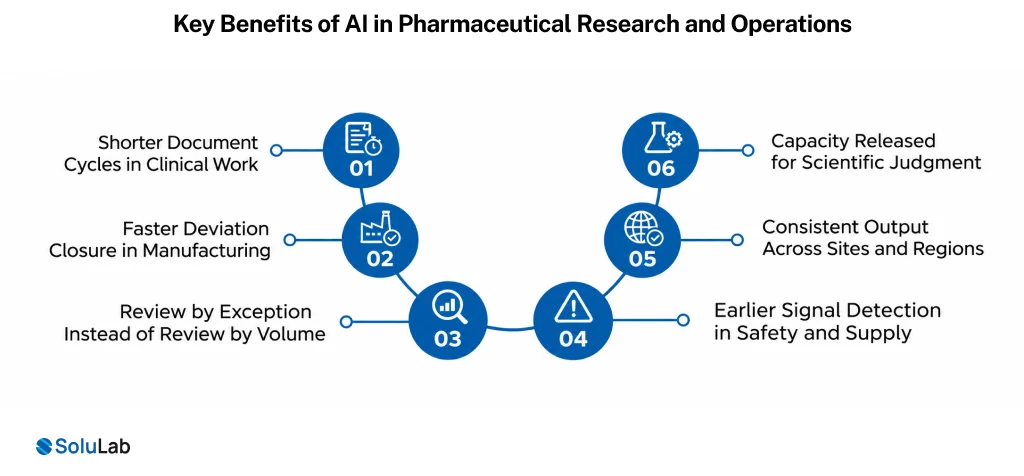
1. Shorter Document Cycles in Clinical Work
Drafting CSRs, protocols and submission summaries from source data compresses elapsed time more than headcount cost. On a filing timeline, elapsed time is the expensive variable.
2. Faster Deviation Closure in Manufacturing
Root cause suggestion and similar-case retrieval shorten investigations that currently sit open for weeks, which directly reduces batch disposition delay.
3. Review by Exception Instead of Review by Volume
Flagging the records that need scrutiny lets quality teams spend their attention where risk actually is, rather than applying uniform depth to every page.
4. Earlier Signal Detection in Safety and Supply
Continuous monitoring replaces periodic review. Catching a safety signal or a cold-chain risk earlier changes what you can still do about it.
5. Consistent Output Across Sites and Regions
A shared retrieval layer over approved content means a document drafted in Basel and one drafted in Hyderabad follow the same structure and cite the same sources.
6. Capacity Released for Scientific Judgment
AI in pharmaceutical research benefits most where the mechanical half of the work disappears: literature screening, data wrangling and first drafts, leaving scientists on interpretation.
How to Implement AI in a Pharmaceutical Organisation
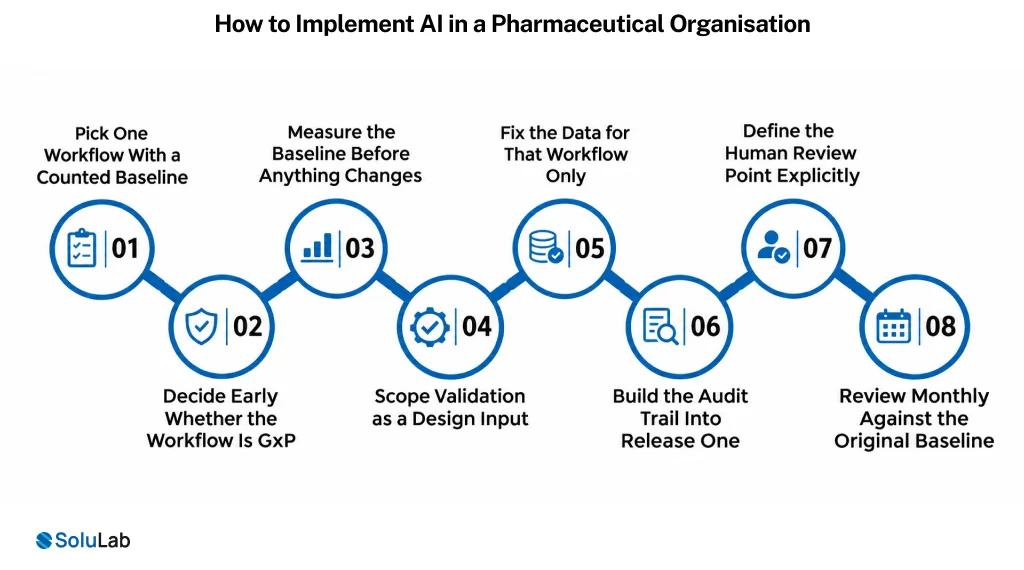
Here’s a step-by-step guide on implementing AI in a pharmaceutical organisation:
1. Pick One Workflow With a Counted Baseline
Deviation closure days, CSR drafting weeks, safety case triage throughput, forecast error. If it is not measured today, improvement cannot be proven later.
2. Decide Early Whether the Workflow Is GxP
This single question determines validation load, documentation, timeline, and cost. Getting it wrong late is the most expensive mistake in pharma AI projects.
3. Measure the Baseline Before Anything Changes
Four to eight weeks of current performance. Without it you will be arguing about impressions at the next budget review.
4. Scope Validation as a Design Input
Risk assessment, qualification approach and traceability decided alongside architecture. Validation designed in costs a fraction of validation retrofitted.
5. Fix the Data for That Workflow Only
Clean the documents, identifiers and systems this one workflow touches. Enterprise data programmes are how three-year initiatives get cancelled in year two.
6. Build the Audit Trail Into Release One
Inputs, outputs, model version, reviewer and timestamp logged from the first deployment, because this is what evidences a decision during an inspection.
7. Define the Human Review Point Explicitly
Write down what a qualified person confirms, what they may override, and what the system must never do unreviewed. Vague review policies fail audits even when the technology works.
8. Review Monthly Against the Original Baseline
Track accuracy, override rates and the metric you started with. Rising override rates usually indicate a data problem rather than a model problem, and they show it early.
Teams building rather than buying will recognise this shape from our AI agents in healthcare work, where validation effort consistently exceeds model effort.
Risks, Limits and What Regulators Expect
Here are some risks and limits you should consider:
1. Unvalidated Systems Cannot Go Live
A model inside a GxP process without qualification evidence is not a technical shortfall, it is a finding waiting to happen. This is the hard constraint that distinguishes pharma from every other sector.
2. Confident Drafts of the Wrong Source
Retrieval errors produce fluent, plausible, incorrect regulatory text. Citation on every claim plus a reviewer who checks the source is the control, and accuracy figures mean little without it.
3. Data Integrity Under ALCOA Principles
Records must be attributable, legible, contemporaneous, original and accurate. An AI step that obscures who did what, when, breaks that regardless of output quality.
4. Model Change Control
Hosted models change without notice. Inside a validated system that is a change requiring assessment, which is a strong argument for version pinning or self-hosted deployment.
5. Explainability Obligations You Cannot Meet Later
If a model contributed to a decision affecting product quality or patient safety, you may need to explain how. Architectures chosen purely for performance can make that impossible.
6. Bias in Clinical and Real-World Data
Models trained on historically narrow trial populations can carry those gaps into site selection or prescreening. This is a scientific and an ethical problem, and it needs testing rather than assurance.
Emerging Trends in AI-Powered Pharma Solutions
Here are some trends you will see in the future:
1. Agentic Workflows Inside Quality and Safety
Multi-step agents that complete a deviation write-up or a safety case intake and escalate exceptions, rather than single-purpose models. Deloitte found 30% of executives expecting agentic AI to have significant impact, and the control design matters far more than the autonomy.
2. Validation Tooling as a Product Category
Vendors are starting to ship qualification documentation, traceability and change-control evidence as part of the product. Expect this to become a procurement requirement rather than a differentiator.
3. Self-Hosted and Private Deployment Holding Firm
Residency rules and model change control push pharma toward open-weight models in private environments, against the general enterprise drift to hosted APIs.
4. Multimodal Models in Manufacturing and Pathology
Combining images, sensor streams and text for visual inspection, particle detection and digital pathology, with evaluation run per modality rather than one blended score.
5. Document Intelligence Across the Submission Lifecycle
Structured extraction and generation across the whole document chain rather than one artefact at a time. Our work on AI-powered intelligent document processing covers the underlying mechanics.
6. Process Automation Converging With AI
Rules-based automation and models working together, with robotic process automation handling deterministic steps and models handling judgment-adjacent ones.
How SoluLab Can Help
We build and validate AI systems for pharma, biotech and medtech organisations. Engagements usually take one of these shapes.
1. One-Workflow Proof of Concept With a Validation Path
We pick the workflow with the clearest baseline, determine its GxP status, build it, and deliver qualification-ready documentation alongside the system rather than after it.
2. Regulatory and Clinical Document Automation
Retrieval over your study data and source documents with citation on every claim, drafting CSRs, protocol sections, module summaries and agency responses for qualified review.
3. Manufacturing and Quality Intelligence
Deviation classification and root cause support, electronic batch record review by exception, CAPA drafting, and anomaly detection on process data with full traceability.
4. Safety and Supply Systems
Adverse event intake and triage, literature screening, duplicate detection, demand forecasting and cold-chain risk prediction, integrated into the systems you already run.
5. Platform Engineering for Life Sciences Software Vendors
For companies building what pharma buys, we handle retrieval architecture, model orchestration, audit logging and validation-ready infrastructure. These AI pharma solutions services engagements usually start once a prototype works and the compliance questions arrive together.
If you want to hire AI pharma developers for a defined build, or need an AI pharmaceutical software development company to take a concept through validation, start with a discovery call. We will tell you plainly when buying a validated product beats building one, because in regulated workflows it frequently does.
Conclusion
The interesting questions in pharma AI are no longer about capability. Models draft regulatory documents, classify deviations and triage safety cases well enough to use today, and most large organisations have proved that somewhere.
It is scoping, ownership and sequencing, which is simultaneously the frustrating part and the encouraging one, because all three are fixable without waiting for better models.
If you are deciding where to start, whether to build or buy, or how to move a pilot into a validated environment, SoluLab, an AI development company, can help your business scope it properly. Book a discovery call and we will work through the first workflow with you.
FAQs
Neha is a curious content writer with a knack for breaking down complex technologies into meaningful, reader-friendly insights. With experience in blockchain, digital assets, and enterprise tech, she focuses on creating content that informs, connects, and supports strategic decision-making.