AI Summary
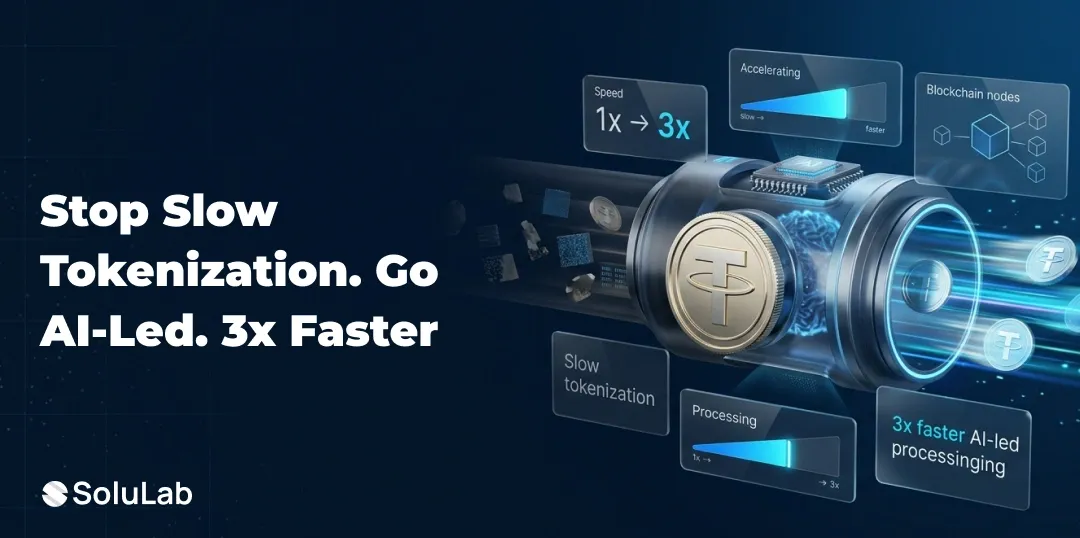
AI-led tokenization platform development is changing how organizations launch tokenized asset platforms. Instead of handling asset onboarding, compliance checks, smart contract workflows, and investor operations manually, teams can now use AI to speed up execution, reduce bottlenecks, and improve platform performance. For companies planning modern tokenization platform development, this approach creates a faster and more scalable path to market.
Businesses are moving towards AI-led RWA tokenization to build platforms that can support business operations, regulated investor access, and long-term digital asset growth. This is creating demand for smarter infrastructure. Standard tokenization systems can manage issuance and transfer, but modern organizations need more than basic minting. They need automation, compliance support, better asset workflows, and cleaner investor experiences.
This guide explores the process for tokenization platform development using AI and how it can add value to your business in generating higher ROI.
Manual tokenization V/S AI-Led Execution
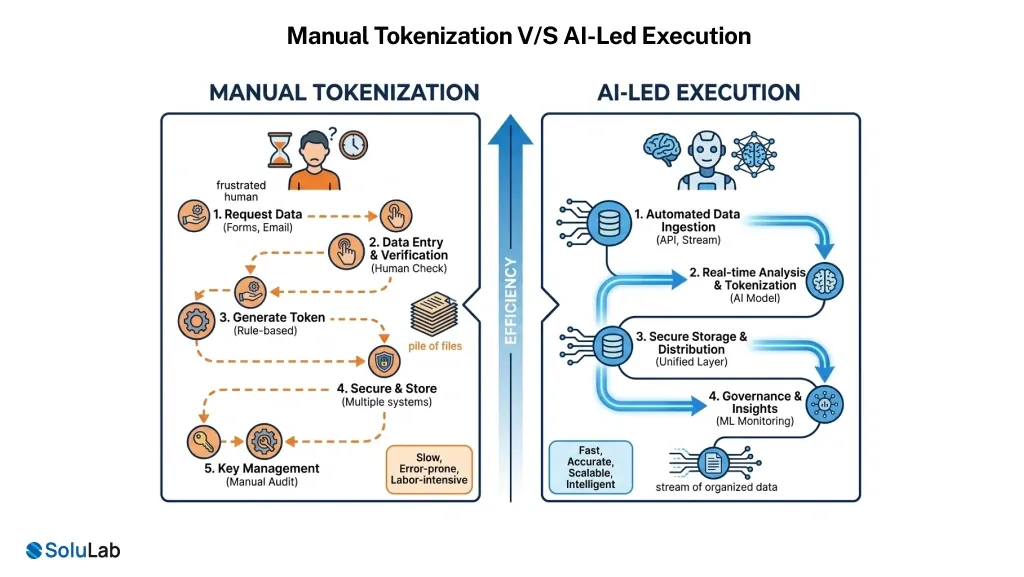
Traditional tokenization projects often depend on fragmented tools and manual reviews. Asset data may reside in one system, investor records in another, and compliance checks in a separate system. That slows delivery and creates friction across teams.
With AI-led development, more of this workflow becomes connected. AI can support document handling, data classification, onboarding flows, transaction monitoring, reporting, and internal decision support. The result is not just a faster build. It is a better operating model.
Why Are Companies Choosing AI Tokenization Platforms?
The interest in AI tokenization platforms is growing because speed alone is no longer enough. Businesses also want consistency, scalability, and better control. A platform should help teams manage the full lifecycle of tokenized assets, not just issue them.
This matters even more for organizations working with real estate, private funds, commodities, or other real-world assets. These projects often include legal reviews, compliance rules, ownership records, investor permissions, and ongoing servicing. AI helps reduce the operational load across each of these areas.
What AI-Led Tokenization Platform Development Means In Practice?
At a practical level, AI-led tokenization platform development means building a tokenization system where AI supports both product delivery and platform operations. The blockchain layer still manages the token, the ledger, and ownership logic. AI improves the layers around it.
That includes asset onboarding, investor verification, fraud detection, workflow automation, analytics, and compliance monitoring. In short, AI-led tokenization helps the platform think faster, organize better, and respond more efficiently.
Important- AI Is Not Replacing The Blockchain
Blockchain technology still provides the trust layer. It records ownership, enables transparent transfers, and supports smart contract execution. AI does a different job. It helps the platform process information and automate routine actions.
This combination is what makes AI-driven tokenization platform development attractive. Blockchain handles the asset logic. AI helps the business run the platform more smoothly.
How AI Tokenization Platforms Are Faster Than Traditional Model?
Speed in RWA tokenization usually breaks down at the process level. Teams lose time collecting documents, reviewing data, checking compliance, and coordinating between departments. Development gets delayed because too many inputs are still manual.
With AI tokenization development, those slow points can be reduced. AI can tag and structure asset documents, flag missing data, help review onboarding submissions, detect anomalies, and generate operational insights quickly. This shortens the journey from planning to launch.
- Faster onboarding
Investor onboarding is often one of the slowest parts of a tokenization program. Every user needs identity verification, eligibility checks, and record management. When those steps are done manually, the process becomes hard to scale.
An AI-enabled tokenization platform can improve this flow by sorting documents, identifying incomplete submissions, supporting KYC and AML reviews, and helping teams move applications faster.
- Quicker asset preparation
Asset tokenization is not only about coding smart contracts. It starts with preparing the asset model, ownership structure, supply logic, documentation, and permissions. AI can assist by organizing and validating this information early. This helps companies move from planning to issuance without wasting time in avoidable review cycles.
- Improved internal decisions
Leadership teams also need faster visibility. They want to know what stage the platform is in, where delays are happening, and what risks need attention. AI-powered dashboards and alerts support this layer too. That makes AI-based asset tokenization solutions useful for both operations teams and decision-makers.
Read More: AI model tokenization platform development
AI Tokenization Platforms: Business Case
Many firms first look at cost savings. That is a valid starting point, but the business case is broader than lower manual effort. The real value comes from building a tokenization platform that can handle scale without creating more complexity.
A well-designed AI tokenization development platform can improve launch speed, support compliance-heavy workflows, reduce routine operational work, and create a cleaner path for future asset expansion.
- Better workflow control
When asset data, compliance logic, investor records, and transaction monitoring work together in one system, teams gain better control. They do not need to chase information across disconnected tools. This improves operational clarity, which matters when the business plans to expand into more asset classes later.
- Improved investor experience
Investors expect digital onboarding, clear dashboards, transparent transaction history, and quick access to information. If the backend is slow or fragmented, the front-end experience suffers too. AI tokenization platforms help improve this by making onboarding smoother, reporting easier to manage, and support flows more responsive.
- Better long-term scalability
A tokenization launch may begin with one asset class, but growth often brings new complexity. Teams may later add more investors, more jurisdictions, more compliance rules, or new forms of tokenized assets. A platform built through custom AI tokenization platform development can handle this growth more effectively than a rigid template.
AI Tokenization Platform Architecture: What Businesses Need
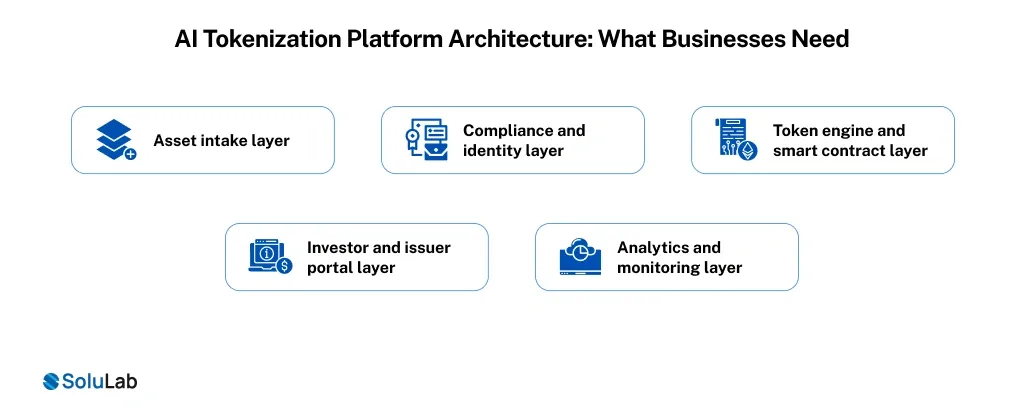
A good platform architecture should support both issuance and post-launch operations. Many projects focus too much on token creation and not enough on the system around it. That leads to weak execution later. A stronger AI tokenization platform architecture connects the key layers from day one.
- Asset intake layer
This is where the platform captures asset details, ownership information, legal structure, supply rules, and required files. Artificial intelligence can help sort and validate inputs before the tokenization flow begins.
This stage matters because weak asset data creates delays later in compliance, issuance, and investor communication.
2. Compliance and identity layer
This layer manages KYC, AML, eligibility rules, jurisdiction filters, and approval workflows. It is one of the most important parts of AI in RWA Tokenization.
Without a strong compliance layer, the platform becomes difficult to trust and difficult to scale. AI improves this layer by supporting document review, flagging inconsistencies, and helping teams monitor risk signals faster.
3. Token engine and smart contract layer
This is the core blockchain layer. It handles issuance, transfer logic, permissions, supply management, ownership rules, and automated actions tied to the asset.
For AI tokenization platform development company selection, this layer is not enough on its own. The build partner should also understand how the token engine connects to the rest of the platform.
4. Investor and issuer portal layer
A strong portal gives investors and operators a clear interface for onboarding, wallet activity, asset access, transaction records, and account actions. This layer turns technical infrastructure into a usable product.
For many companies, this is where the platform starts to feel real. Without a clean portal, even a strong backend can feel incomplete.
5. Analytics and monitoring layer
This is where AI integration solutions become especially useful. The platform should help teams monitor investor activity, transaction behavior, liquidity patterns, onboarding progress, and operational bottlenecks.
An AI tokenization development platform with built-in analytics helps operators make faster decisions and keep the platform running with more confidence.
AI in RWA Tokenization: Where It Creates Most Value
The impact of AI in RWA Tokenization becomes clearer when looking at real business use cases. It is most useful where workflows are complex, document-heavy, and tied to regulated operations.
- Real estate tokenization
Real estate tokenization projects often involve title documents, valuation records, legal approvals, investor onboarding, and ownership structuring. These steps can delay launch when handled through manual workflows alone.
AI can help classify property documents, support due diligence workflows, assist onboarding teams, and improve reporting after issuance. This makes AI Tokenization Solutions highly relevant for real estate platforms.
2. Private funds and investment products
Fund tokenization includes investor permissions, class-level rules, disclosures, and ongoing reporting. These products need tighter control than many standard digital asset models.
An AI-enabled tokenization platform can support fund operations by helping teams manage onboarding, permissions, reporting, and internal workflow routing more efficiently.
3. Commodities and alternative assets
Commodities, carbon assets, IP, collectibles, and revenue-linked assets may all require different metadata structures and operating rules. Generic platforms often struggle to handle this well.
Here, custom AI tokenization platform development becomes more important because the platform needs to match the asset logic closely.
Why Custom AI Tokenization Platform Development Matters?
Many companies begin by looking for ready-made solutions. That can work for simple projects, but it often falls short once the platform needs deeper integration or more specific controls.
A custom build creates room for better architecture, stronger workflows, and more control over future growth.
- Customization supports real business models
Not every asset fits inside a standard template. Some businesses need custom onboarding paths, role-based permissions, white-label portals, multi-chain support, or marketplace features from the start.
In these cases, custom AI tokenization platform development helps the company build around the product instead of adjusting the product around the software.
2. Customization supports enterprise systems
Many organizations already use internal CRMs, compliance tools, accounting systems, or reporting platforms. A good tokenization system should connect with these tools instead of forcing teams to work around them.
This is one of the clearest reasons to choose a partner that offers a full tokenization platform development instead of only token creation.
What to look for in an AI Tokenization Platform Development company?
Choosing the right partner affects the quality of the platform and the speed of execution. A team may know blockchain well and still miss what matters in operational delivery.
A capable AI tokenization platform development company should understand more than smart contracts.
- Product understanding matters
The team should understand asset structure, platform workflows, user roles, investor operations, and compliance-driven design. Tokenization is a product challenge as much as a technical one.
2. AI and blockchain need to work together
Some vendors can build blockchain systems. Others can build AI tools. Fewer can combine both cleanly in one delivery model. For AI-driven tokenization platform development, that combination matters.
3. Post-launch support matters too
A tokenization platform does not end at deployment. It needs monitoring, updates, workflow improvements, and room for new modules later. The right tokenization platform development company should be ready for that ongoing work.
AI Tokenization Platform Development with SoluLab
With AI tokenization platform development with SoluLab, you get more than code delivery. You get a team that can help shape your product architecture, define the right workflow, build the blockchain layer, and connect AI into the platform where it adds practical value. You are not limited to token creation alone. You can build a full system around asset onboarding, compliance support, investor access, transaction tracking, and platform analytics.
What you can build with SoluLab?
With SoluLab, you can launch AI Tokenization Solutions for real estate, private funds, commodities, and other real-world assets. You can also build white-label platforms, investor dashboards, smart contract layers, compliance workflows, and modular systems designed for future expansion. This makes SoluLab a strong fit for companies looking for AI-led tokenization, AI-based asset tokenization solutions, and full-scale tokenization platform development under one roof.
Why SoluLab fits this space?
With SoluLab, you can combine blockchain expertise, AI workflow automation, and product-led development in one engagement. That gives your team a cleaner path from idea to launch. You also get room for customization. If your platform needs unique permissions, deeper integrations, or a more flexible operating model, SoluLab can shape the solution around your business instead of pushing a fixed template.
TakeAway
The future of tokenization will belong to platforms that can manage data, compliance, onboarding, transactions, and scale with less friction. That is the real value behind AI-Led Tokenization Platform Development. For companies exploring AI tokenization platforms, the goal should be simple. Build a platform that moves faster, operates better, and stays flexible as the market grows. With SoluLab’s AI native approach, you can take that step with a partner that helps you design, build, and launch an AI-powered tokenization ecosystem built around your business goals.
FAQs
Shipra Garg is a tech-focused content strategist and copywriter specializing in Web3, blockchain, and artificial intelligence. She has worked with startups and enterprise teams to craft high-conversion content that bridges deep tech with business impact. Her work translates complex innovations into clear, credible, and engaging narratives that drive growth and build trust in emerging tech markets.