A traditional smart contract does exactly what the code says. Nothing more, nothing clever. That was fine when business rules sat still for years, and it is a problem now, because pricing, risk and supply conditions can shift inside a single quarter. So teams are bolting AI onto the contract layer: logic that reads live data, forecasts, and acts without waiting for a developer to ship a patch.
Put blockchain and artificial intelligence in the same system and the agreement starts doing its own thinking. It watches live inputs, learns from what it sees, and decides. You get speed, fewer manual corrections, and a contract that stops being a museum piece the day after deployment.
82% of businesses using AI-powered automation report operational cost reductions of at least 25% inside a year.
If you run a growing business and your systems already creak under manual review queues, AI-based smart contract automation is worth a serious look. Let’s get into it.
What Are AI Smart Contracts?
Start with the plain version. A smart contract is a digital agreement that runs itself on a blockchain. Rules go in, and when the conditions are met it acts, releasing a payment for instance, with nobody at a keyboard.
An AI smart contract is that same agreement with algorithms wired into it. It reads data, picks up on patterns, and reaches a judgment the way a person would, only quicker and without the slip that comes from reviewing the two hundredth document that day.
The difference is adaptability. A basic contract only knows what you told it before launch. An AI-powered one takes in live data, reads the shift in conditions, and responds on its own.
Example: Citi ran AI-powered smart contracts in 2023 to automate trade finance with Maersk and the Panama Canal Authority. Payments fired off as shipping milestones were hit. Less paperwork, and hundreds of thousands saved in fees.
How Are Traditional Smart Contracts Different from AI Smart Contracts?
Most companies are still on traditional smart contracts, which are rule-based programs sitting on a blockchain. They follow the instructions somebody wrote, full stop. Once deployed, nothing changes until a human rewrites and redeploys the code. Dependable? Very. Flexible? Not at all.
AI smart contracts sit at the other end. Machine learning, natural language processing (NLP), and real-time analytics let the contract learn from what it processes, predict what comes next, and tune its own behaviour on fresh input. The table below lays the two side by side:
| Feature | Traditional Smart Contracts | AI Smart Contracts |
| Logic Type | Predefined, rule-based | Dynamic, learning-based |
| Ability to Adapt | No | Yes (automated decision-making) |
| Use of Real-Time Data | No | Yes |
| Intelligence Level | Basic, fixed | Advanced (can interpret & learn) |
| Example Use Case | Fixed rental payments | Dynamic pricing or insurance claim automation |
What you end up with is automation that thinks. The contract reads the data, notices how behaviour is trending, and acts on it. Hours come back to your team, error rates drop, throughput climbs.
Adding that intelligence to a live blockchain system is not a weekend project, so pick a partner who has done it before. An experienced AI development company will know both AI and blockchain infrastructure.
How Does AI Improve Blockchain Smart Contracts?
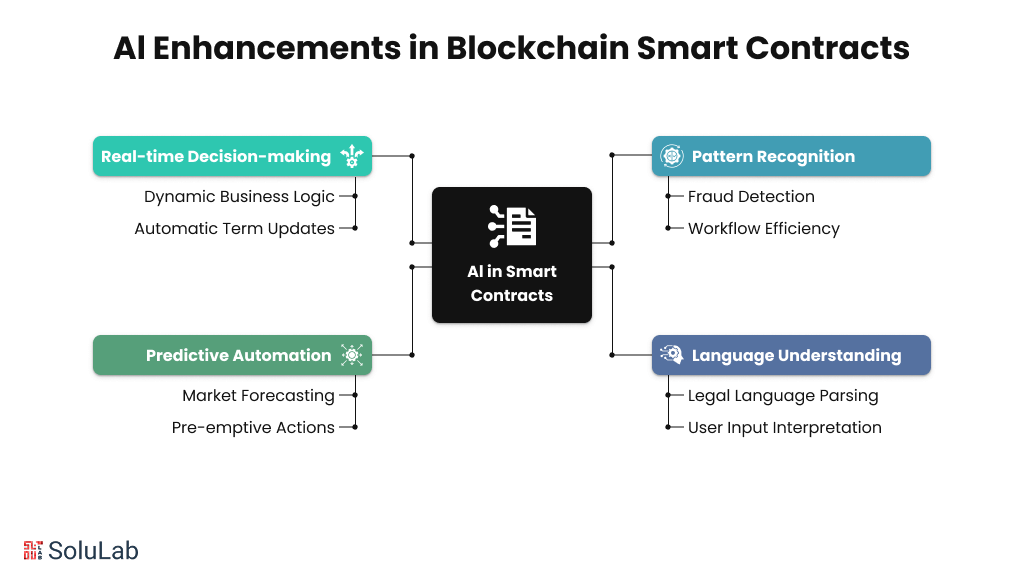
This is not a trend piece. AI changes what a contract can actually do on the job. Here is how AI smart contract development services sharpen blockchain solutions:
1. Real-time decision-making:
- Reacts the moment the data moves
- Updates contract terms without a redeploy
- Makes dynamic business logic possible
2. Pattern recognition:
- Catches fraud and suspicious activity
- Spots where a workflow is wasting time
- Flags transaction trends that look off
3. Language understanding:
- Parses dense legal language
- Reads user input without misfiring on phrasing
- Supports automated contract review
4. Predictive automation:
- Forecasts where the market is heading
- Acts before the condition hits, not after
- Cuts how often a human has to step in
The pairing pays off hardest in AI in DeFi smart contract management, where prices move faster than any fixed rule can track. And if the question on your mind is how to integrate AI with contracts you already have running, that is the part our AI smart contract development company walks clients through step by step.
Why Should Your Business Invest In AI Smart Contract Development?
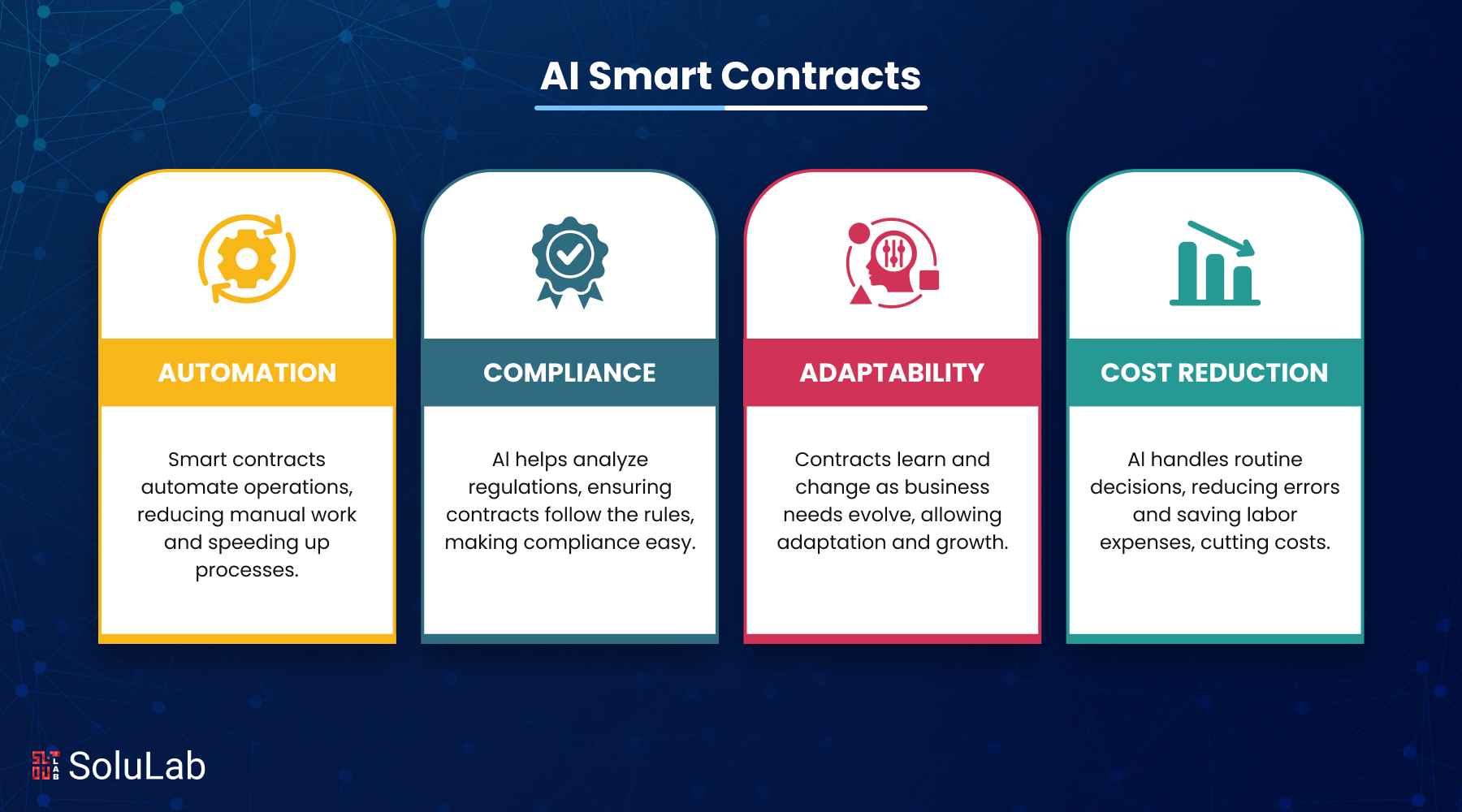
Because you stop paying the rewrite tax. With AI smart contracts you keep control, make better calls, and automate more of the routine, without a developer touching the code every time the business shifts. The returns show up in four places:
- Operations run themselves, so manual work shrinks and processes finish faster.
- Costs drop once AI takes the routine decisions, which also trims errors and labour spend.
- Compliance gets easier, because the AI reads the regulations and checks your contracts against them.
- Growth stops hurting, since the contract learns and shifts as the business does.
That is the gap between you and a competitor still editing contract code by hand.
Read Also: Top 10 Smart Contract Development Companies in 2026
Which Industries Are Already Using AI Smart Contracts?
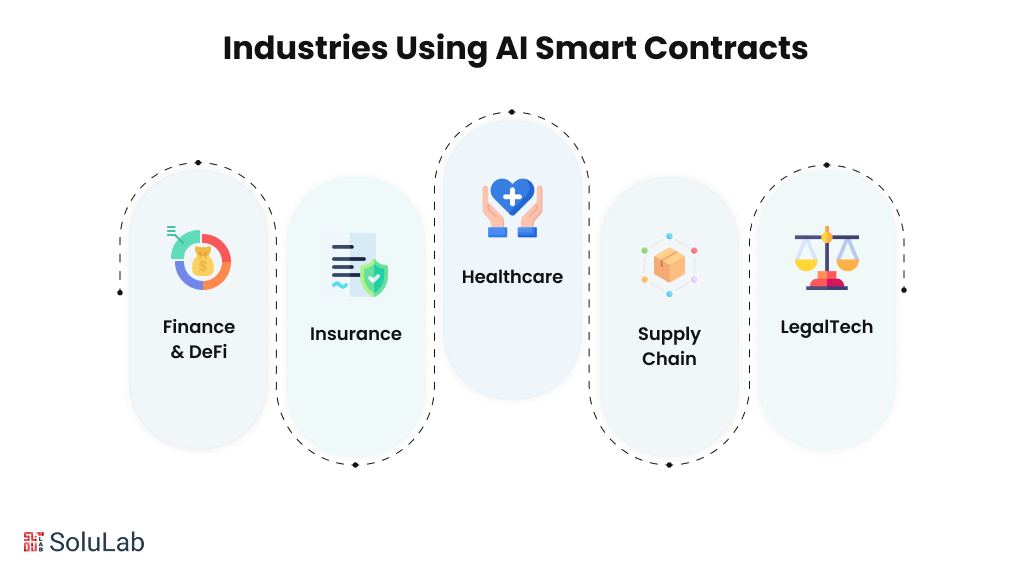
Plenty of them, and not quietly. Whole sectors are moving to AI smart contracts to strip out busywork, cut cost, and get accuracy up. Five examples where the difference is already visible:
1. Finance & DeFi
In finance, and especially in DeFi smart contract management, the work goes to loan approvals, credit scoring, and fraud detection. All three are judgment calls made at volume, which is exactly what AI is good at.
Example: Celsius Network pairs AI with smart contracts to price loans per borrower and run the loan lifecycle itself. Risk goes down, settlement speeds up.
2. Insurance
Claims are where insurers lose weeks. AI-based smart contract automation verifies the documents, and once they check out the contract approves and pays without a queue.
Example: Etherisc runs AI-powered blockchain smart contracts to push claims through fast, with less manual handling and fewer mistakes along the way.
3. Healthcare
Here the prize is consent. Providers use blockchain smart contracts with AI to track who agreed to what, gate access to records, and keep the whole thing inside privacy law.
Example: Medicalchain combines AI and smart contracts so patients decide who reads their medical records. Better security, and a clear trail of who looked.
4. Supply Chain
Routing and demand forecasting are the two jobs AI smart contracts take on here. Deliveries arrive sooner and less stock goes to waste.
Example: IBM Food Trust uses AI and blockchain smart contracts to follow food shipments in real time, so safety and quality are checked in transit rather than argued about later.
5. LegalTech
Legal tech firms use AI smart contract automation to build agreements that adjust themselves when the underlying data changes, and to make dense contracts readable in the first place.
Example: Hyperstart ships AI-powered smart contract templates that update on their own, which shortens contract cycles and keeps errors out of the final document.
Read More: What Problems Do HTLC Smart Contracts Solve in Crypto Payments?
Why Your Business Needs AI Smart Contracts?
Markets move. Your contracts should too. AI smart contracts let you:
- Respond to market shifts and new business needs without a code change
- Earn trust through processes anyone can inspect
- Keep operations viable years out, because the automation bends instead of breaking
The partner matters as much as the tech. Build with an AI smart contract development company USA and you get contracts that are secure and scalable, not just clever. Then run a proper AI smart contract audit, and keep running one as the system grows. In practice, this is where teams get caught out: the model that behaved perfectly in testing meets real data and starts making calls nobody reviewed.
Conclusion
AI stopped being the future of blockchain technology a while ago. It is what is shipping now. Companies running AI-powered smart contract solutions automate more, decide better, and move at a pace their competitors cannot match on manual process. If that is the position you want, our AI in Web3 Development team can start this week.
SoluLab is a leading smart contract development company in USA, and AI integration is the work we do most. We have built it into operations across a lot of different businesses. Digital Quest is one: a travel company that came to us for an AI-powered chatbot to handle engagement and recommend trips.
The shift is already underway in your industry. The only real question is whether you are setting the pace or catching up to it. Contact us now!
FAQs
Shipra Garg is a tech-focused content strategist and copywriter specializing in Web3, blockchain, and artificial intelligence. She has worked with startups and enterprise teams to craft high-conversion content that bridges deep tech with business impact. Her work translates complex innovations into clear, credible, and engaging narratives that drive growth and build trust in emerging tech markets.