Banking automation stopped being optional a while back. Today’s customers don’t just want a place to park their money. They want a partner that recognizes them across every channel, on their terms. So here’s the real question: are banks actually pulling that off?
The World Retail Banking Report turned up some telling numbers. 52% of customers say banking, honestly, isn’t enjoyable. Another 48% feel their bank relationships don’t fit into their daily lives at all. Plenty also said their banks are behind on modern technology, frictionless experiences, and the personal touch they’ve come to expect elsewhere. Read between the lines and it’s a wake-up call: use automation, and use it well.
Now flip that around. The banks getting automation right aren’t just meeting requirements, they’re building real loyalty, turning customers into advocates who talk about them unprompted. And on the inside, automation frees staff from repetitive grind so they can spend time on work that actually needs a human.
What’s driving all this? Two things, mostly: artificial intelligence (AI) and AI chatbots. Call them the MVPs of the shift.
In this piece, we’ll look closer at AI in the BFSI market and how it’s become a core piece of the banking industry, sharpening client experience, cutting costs, tightening operational precision, and taking pressure off staff management. Let’s get into it.
What Does Banking Automation Involve?
Banking automation is the quiet workhorse behind the scenes of the financial industry. At its core: smart software and modern technology doing the busywork that used to eat entire days. Picture less manual labor, period. No more tedious data entry, no more account-opening processes that drag on for a week, no more transaction headaches. The payoff is real money saved, plus better accuracy along the way.
Once these processes get automated, things click into place. Lower costs. Fewer errors. Better service. Everybody wins, really, banks and customers both. And when interactions run smoother and more reliably, client satisfaction follows almost automatically.
What Does the BFSI Sector Demonstrate?
The banking, financial services, and insurance industry (BFSI, for short) underpins a huge share of the global economy by keeping essential financial services running and stable. That covers asset management, banking, investing, and insurance, a wide net meant to serve individuals, companies, and governments alike. Three things hold it together: a solid regulatory framework that keeps things consistent and protects customers, a steady stream of fintech-driven innovation, and constant attention to risk management so financial uncertainty stays contained.
On top of that, the industry keeps adopting newer technology, blockchain, AI, data analytics, to tighten security, sharpen operations, and improve the customer side of things. BFSI never really sits still. It shapes economic policy, keeps financial risk in check, and pushes sustainable growth forward.
How is AI Transforming the BFSI Sector?
These systems learn from data, sort it, interpret it, and turn out predictions. That’s made AI a defining piece of technological innovation in BFSI, changing how products and services actually reach people.
Identification of Fraud
Spotting fraud is where AI earns its keep, for a few reasons:
- AI generates synthetic data and compares it against real transaction data, surfacing patterns that hint at fraud. From there, institutions can build fraud detection models that actually catch more.
- For Example, JP Morgan Chase, for instance, uses generative AI to flag irregularities in transaction data before fraud spreads. The result: lower costs and more consumer trust.
Client Support
Personalized customer service is a heavy lift for BFSI firms. Here’s one way AI carries some of that weight:
- Recommendation engines: AI builds product and service recommendations off a customer’s financial history and preferences. It’s a simple approach, and it works, satisfaction climbs.
- HSBC’s AI-powered virtual assistant, for example, hands out tailored investing advice, and client engagement has followed.
Assessment of Risks
Risk assessment sits at the center of BFSI operations, and AI sharpens risk prediction by:
Running scenario simulations and generating synthetic data off historical records. That lets teams weigh the odds of different outcomes and make calls with more confidence.
Optimization of Portfolios
Optimizing investment portfolios is non-negotiable for financial organizations, and AI helps here too:
Scenario modeling simulates a range of investment outcomes using synthetic data. Spot the diversification opportunities early, and the resulting investment plans tend to hold up better.
Why are BFSI Institutions in Search of Automation?
Ever wonder why banks and financial firms keep circling back to automation? It’s not a fad, it’s a calculated bet. Technologies like machine learning, natural language processing (NLP), conversational AI, generative AI, and a handful of others let BFSI institutions automate genuinely complex operations, pick up on emotional tone in human language, and respond to changes as they happen.
Let’s break down why that trend exists, and how AI in the BFSI market helps banks handle complicated work, parse human language, and even pick up on emotion.
A Customized Experience for the Customer
Personalization isn’t a nice extra anymore, it’s the baseline. It’s the one thing that turns a casual browser into a loyal customer, and a loyal customer into someone who recommends you unprompted. AI chatbots have become the quiet architects of that personalized banking experience. Their job isn’t just answering questions, it’s understanding you. They learn from every input you give them, track your preferences, and start anticipating what you’ll need next. That’s more than convenience. It gives banks a much clearer, data-backed picture of each client, and decisions get made around that picture instead of around guesswork.
Markedly Increased Effectiveness
Inside the financial industry right now, efficiency isn’t a nice-to-have, it’s the baseline for staying in business. That’s exactly why innovations like conversational AI and AI chatbots are moving the needle. They speed up customer service, sure, but they also free human staff to handle harder problems, which lifts overall productivity.
AI in BFSI lets banks make fast, well-informed calls by chewing through massive datasets in a fraction of the time it’d take a person. Chatbots sit at the center of that high-efficiency model modern banking now runs on, from customer interaction all the way down to internal process work.
Adaptability
Unlike hiring more staff, scaling up AI chatbot services doesn’t mean paying proportionally more for the same output. Once they’re live, chatbots give banking unmatched scalability, organizations can handle shifting client demand without matching that with new headcount. And because they adapt easily to different languages, markets, and regulatory quirks, they’re a natural fit for banks expanding across borders.
On top of that, these chatbots keep sharpening their own effectiveness through machine learning, which makes them a natural complement to a banking industry that never stops shifting.

Lower Running Expenses
AI chatbots simply handle concurrent queries better than people can, there’s no real contest. That translates into lower operating costs on high transaction volumes, and better service quality at the same time.
And as more interactions move to digital channels, the need for physical infrastructure, call centers, service branches, keeps shrinking. Less real estate, less utilities, less maintenance. The savings show up fast.
Improved Worldwide Presence, Diversity, and Accessibility
Artificial intelligence chatbots are reshaping banking by knocking down language barriers and opening financial services up to more people, period. A diverse customer base is the norm now, not some edge case. AI chatbots in BFSI answer that challenge by working across a wide range of languages and dialects.
That multilingual range isn’t a perk, it’s the door to genuinely inclusive banking. And what’s actually impressive is how these bots pick up on linguistic nuance, so a customer feels understood no matter how fluent they are.
Banking Beyond the Box
Modern banks used to be transaction hubs, full stop. Now they’ve grown into something closer to financial educators. Financial well-being programs, economic literacy initiatives, guidance beyond the basic account, all of it runs through the power of AI chatbots.
Retirement planning, budgeting help, all of it sitting on one accessible platform. That’s the real shift here: banks paying attention to the whole financial picture of a client’s life, not just the transaction in front of them.
Key AI Applications in BFSI
AI has fundamentally changed the equation for Banking, Financial Services, and Insurance (BFSI) sector. It’s brought applications that tighten up processes, harden security, and deliver service that actually feels personal. Here’s a closer look at where AI shows up in BFSI:
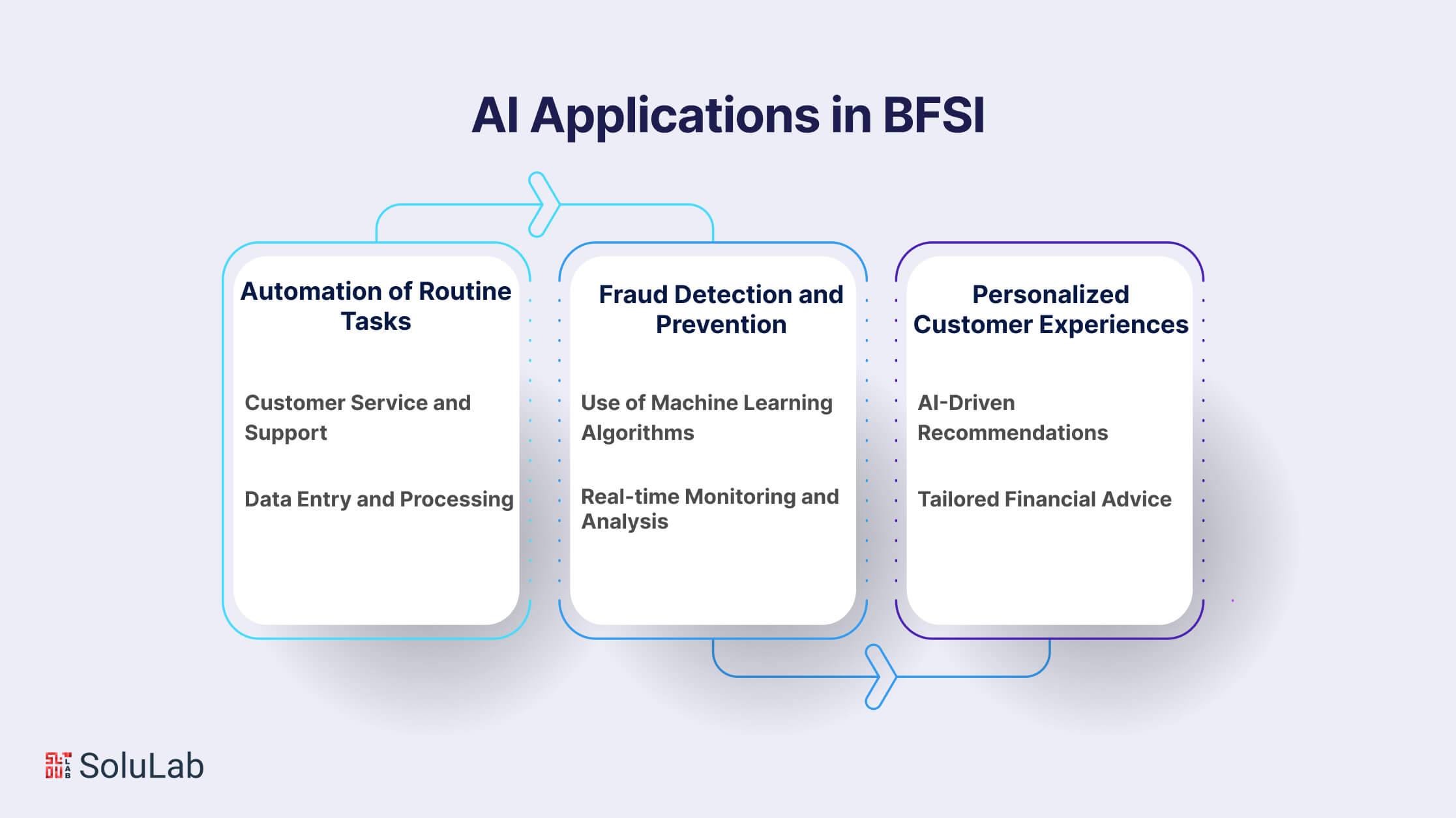
A. Automation of Routine Tasks
Customer Service and Support:
- Introduction of Chatbots and Virtual Assistants: AI-powered chatbots have changed customer interactions completely, real-time answers to queries, account information on demand, transactions handled without a hold queue.
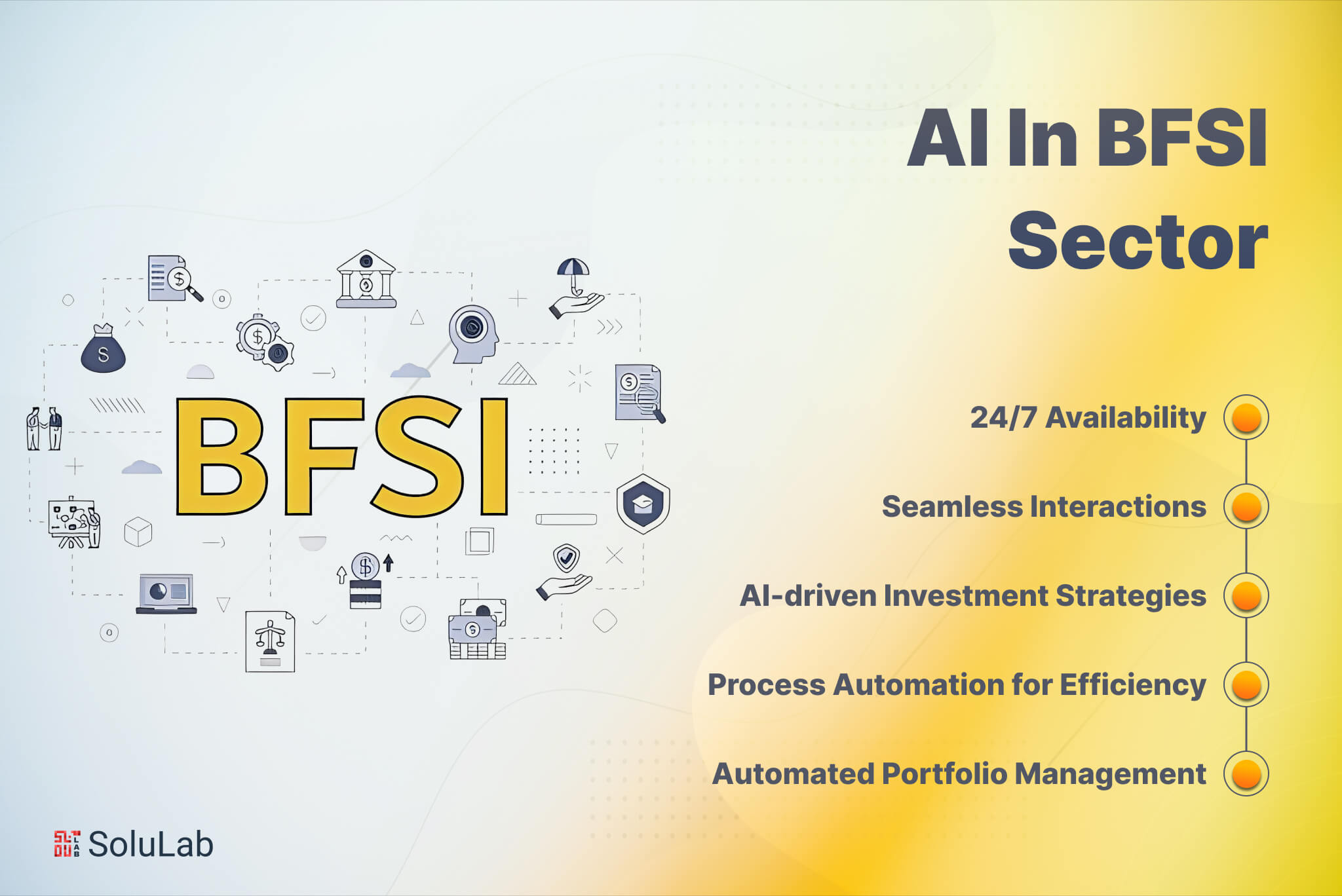
- 24/7 Availability: Automated support runs around the clock, which matters a lot once you have clients spread across time zones.
- Issue Resolution: Chatbots take the routine tickets off the queue, leaving human agents free for the problems that actually need judgment. Overall service gets faster as a result.
Data Entry and Processing:
- Reducing Manual Work: AI takes over data entry, cutting reliance on manual input and shrinking the room for error.
- Operational Efficiency: Automation speeds up data processing tasks and tightens accuracy at the same time. Back-office efficiency climbs as a direct result.
B. Fraud Detection and Prevention
Use of Machine Learning Algorithms:
- Pattern Recognition: AI runs machine learning algorithms against historical data to surface patterns tied to fraud, catching it earlier than a manual review ever could.
- Adaptive Models: These models keep learning as new data comes in, picking up novel fraud patterns as fraud tactics themselves keep shifting.
Real-time Monitoring and Analysis:
- Immediate Identification: Real-time monitoring watches transactions as they happen, flagging anomalies and suspicious behavior the moment they surface.
- Proactive Prevention: Because the system intervenes live, fraudulent transactions get stopped before they escalate, which means smaller losses and safer customer assets.
C. Personalized Customer Experiences
AI-Driven Recommendations:
- Behavioral Analysis: AI algorithms study customer behavior, transaction history, and stated preferences to generate recommendations that actually fit the customer.
- Enhanced Cross-selling: Tailored suggestions open up cross-selling opportunities too, boosting revenue by putting relevant products in front of the right customer at the right time.
Tailored Financial Advice:
- Robo-Advisors: Robo-advisors handle financial planning and investment advice through algorithms, tuned to each customer’s goals and risk tolerance.
- Continuous Monitoring: They also watch portfolios continuously, adjusting positions as market trends shift or a customer’s financial situation changes.
Put together, these applications show AI doing more than automating processes, it’s reshaping customer interaction, sharpening fraud detection, and making financial services genuinely personal. Adopting integration of AI technologies keeps BFSI institutions competitive as the digital environment keeps shifting under them. Next, we’ll look at what AI means for data security, risk management, and the real challenges that come with adopting it in BFSI.
Enhanced Data Security and Privacy
Data security isn’t negotiable in BFSI. Sensitive financial information demands top-tier protection, no exceptions. AI has become a genuine ally here, strengthening data security and protecting customer privacy across the sector.
A. Importance of Data Security in BFSI
Protecting Financial Assets:
- Customer Trust: Trust is the currency BFSI institutions run on. Strong data security measures build and hold that trust by proving financial information is handled carefully.
- Regulatory Compliance: Strict regulations, GDPR among them, along with plenty of industry-specific standards, require secure handling of customer data. Get it wrong, and the consequences include real fines.
Preventing Fraud and Cyber Threats:
- Fraud Prevention: Data security and fraud prevention are basically two sides of the same coin. A secure system cuts down unauthorized access and fraud risk, protecting the institution and the customer at once.
- Cyber Threats: Cyber threats keep getting more sophisticated, and a data breach can wreck both the balance sheet and the reputation. Strong security measures are what stand between an institution and that outcome.
B. AI-Driven Cybersecurity Measures
Behavioral Analysis:
- Anomaly Detection: AI uses behavioral analysis to catch unusual patterns, deviations from a user’s normal behavior. Catching it early is the whole point.
- Continuous Monitoring: These systems watch user activity nonstop, separating legitimate action from something that looks off. That real-time view is what keeps response times fast when a breach attempt shows up.
Biometric Authentication:
- Enhanced Identity Verification: Facial recognition, fingerprint scans, voice recognition, these AI-driven biometric methods verify identity more reliably than a password ever could.
- Reducing Unauthorized Access: Biometric authentication cuts unauthorized access risk too. Replicating someone’s fingerprint is a lot harder than cracking a password or a PIN.
These measures do more than protect data, they raise the entire security posture of a BFSI institution. Using behavioral analysis and biometric authentication together lets institutions stay ahead of threats that keep evolving, and keeps customer data both confidential and intact. Next up: AI’s part in risk management, and where adoption in the sector is headed.
AI-driven Customer Experiences in the BFSI Ecosystem
AI has changed how BFSI institutions interact with and serve customers, full stop. This section walks through the different dimensions of that shift, the advancements driving it and what they actually change.
A. Personalized Recommendations and Products
Understanding Customer Behavior with Machine Learning
BFSI generates enormous amounts of data, and machine learning algorithms sift through it to decode patterns in customer behavior. Transaction histories, spending habits, stated financial goals, run all of that through the model and institutions come away with genuinely useful insight into what an individual customer actually wants.
Tailored Financial Solutions
With those insights in hand, AI helps financial institutions build genuinely tailor-made products, personalized investment portfolios, custom loan offerings, built around what a specific customer actually needs rather than a generic template.
Cross-selling and Upselling Opportunities
Because the algorithms already know a customer’s preferences and habits, they can spot the right moment for cross-selling or upselling. Target the right product to the right person, and marketing spend goes further while engagement climbs.
B. Enhanced Customer Service Through Chatbots
24/7 Availability and Instant Responses
Bringing AI-powered chatbots into the mix has moved customer service well past the old model. These assistants run around the clock, answering inquiries and resolving issues the moment they come in. Support that’s always there tends to raise satisfaction almost by default.
Natural Language Processing for Seamless Interactions
Natural Language Processing lets chatbots understand queries and respond in something close to normal human conversation. That fluency means customers talk to the system the way they’d talk to a person, no need to learn a new communication style just to get help.
Process Automation for Efficiency
Balance checks, transaction history requests, the routine stuff, AI chatbots handle it now. Offload that volume to virtual assistants, and human reps get to spend their time on the complicated cases where they’re actually needed. Service quality goes up across the board.
C. Virtual Financial Advisors and Wealth Management
AI-driven Investment Strategies
Virtual financial advisors run AI algorithms to analyze market trends, assess risk, and build investment strategies specific to the person. As market conditions shift, the recommendations shift too, staying aligned with individual goals and risk tolerance.
Automated Portfolio Management
AI keeps investment portfolios under real-time watch. Automated systems, guided by that AI insight, keep portfolios aligned with the strategy that was set from the start. Part of this approach to portfolio management is automatic rebalancing when the market moves, which in turn optimizes overall performance.
Educational Insights and Financial Planning
Virtual advisors do more than process transactions, they teach too. Informative content, interactive tools, customers walk away more financially literate than when they started. And planning tools tailored to the individual help people set, and actually hit, long-term financial goals.
In short, AI has pushed BFSI into a genuinely customer-first era. Nuanced personalization on one end, smooth interactions through chatbots in the middle, sophisticated virtual advisors on the other, together they don’t just improve the customer experience. They put financial institutions ahead on the innovation curve, and staying there matters.
Challenges and Concerns
As BFSI keeps adopting AI to innovate and tighten up operations, a set of real challenges comes along for the ride, everything from ethics to regulatory compliance.
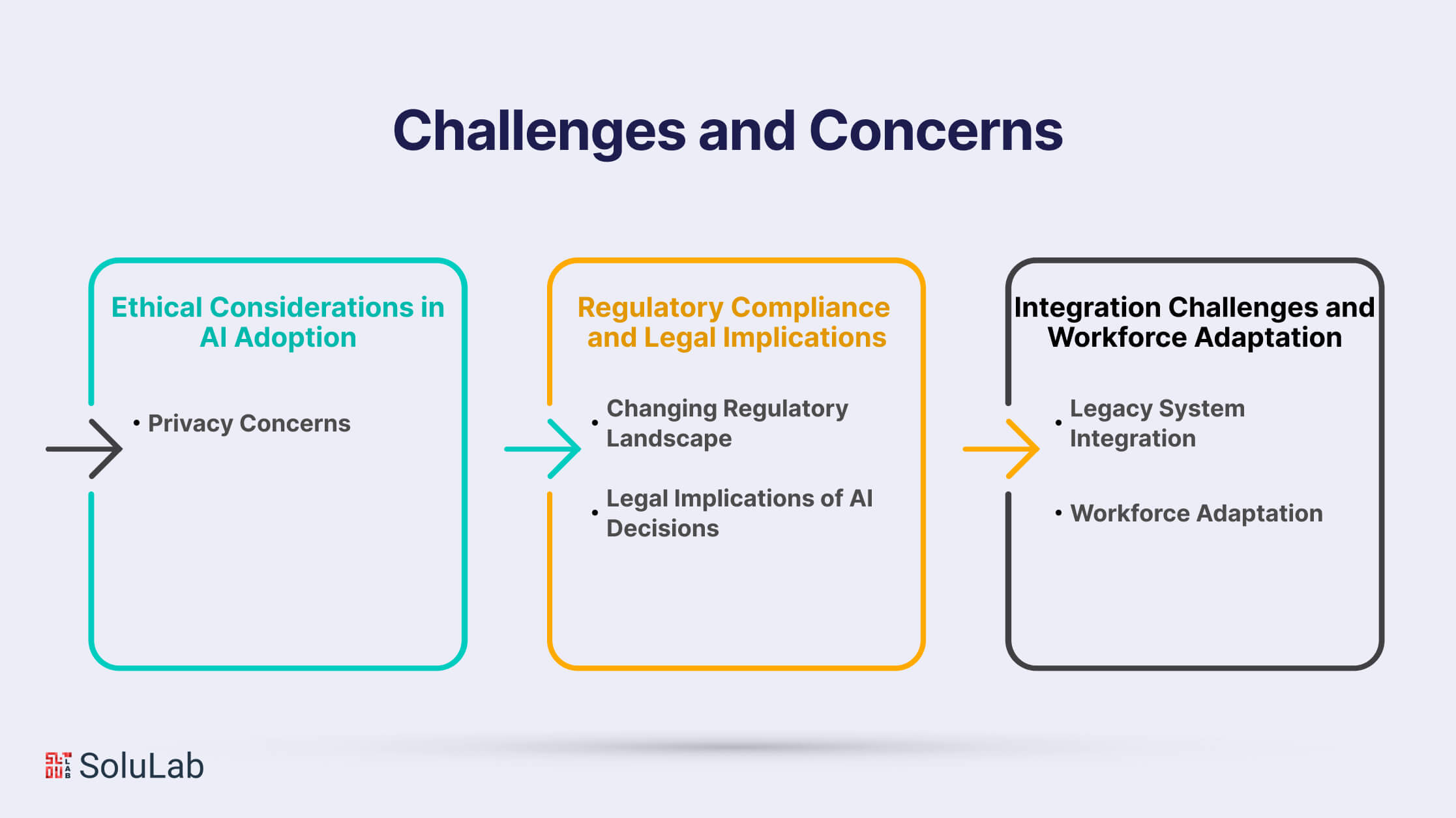
A. Ethical Considerations in AI Adoption
- Algorithmic Bias: AI algorithms can end up repeating biases baked into historical data, which leads straight to discriminatory outcomes. Making decision-making fair in practice is one of the harder ethical problems here.
- Transparency: Some AI algorithms are opaque enough that users can’t really follow how a decision got made, and that’s a problem especially in sensitive territory like credit scoring or loan approvals.
Privacy Concerns:
- Data Usage and Consent: Heavy use of customer data raises privacy questions on its own. Institutions have to balance using that data for personalization against actually respecting consent and privacy rights.
- Data Security: Every data breach risk, every unauthorized access point, raises a real question about how seriously BFSI institutions take their duty to protect customer information.
B. Regulatory Compliance and Legal Implications
Changing Regulatory Landscape:
- Adapting to Evolving Regulations: BFSI already answers to a long list of regulations, and AI is evolving faster than most compliance frameworks can track. Keeping AI systems aligned with regulatory requirements, current and future both, is a genuinely hard problem.
- Cross-Border Regulations: Operate across multiple jurisdictions and the compliance picture gets a lot more complicated, institutions end up working through a patchwork of legal frameworks that rarely agree with each other.
Legal Implications of AI Decisions:
- Explainability: Some generative AI models are simply opaque, and that raises real questions about explainability. In a loan approval decision, being able to explain the reasoning behind an AI call matters both for legal compliance and for keeping customer trust.
- Liability: Figuring out who’s liable when AI gets it wrong isn’t simple either. Pinning accountability on a decision that caused financial loss, or some other bad outcome, is a genuinely complicated legal question.
C. Integration Challenges and Workforce Adaptation
Legacy System Integration:
- Compatibility Issues: Bolting AI onto legacy systems is rarely clean. Compatibility issues show up, and operations can take a hit while things get sorted.
- Cost of Integration: And integration isn’t cheap. That upfront cost weighs especially heavy on smaller BFSI players working with tighter budgets.
Workforce Adaptation:
- Skill Gaps: AI adoption is moving faster than workforce skills can keep up in a lot of organizations. Closing that gap, getting employees genuinely comfortable working alongside AI systems, is one of the harder problems on this list.
- Employee Resistance: People resist change, that’s just human nature, and AI adoption is no exception. Fear of job displacement, distrust of AI-driven processes, it all points to the same fix: real change management, not just a memo announcing the rollout.
None of this gets solved with a single policy document. It takes ethical guidelines, active regulatory awareness, and real workforce planning, all working together. As BFSI keeps leaning into AI, institutions have to work through these challenges deliberately if they want implementation that’s both responsible and effective.
Future Trends in AI for BFSI
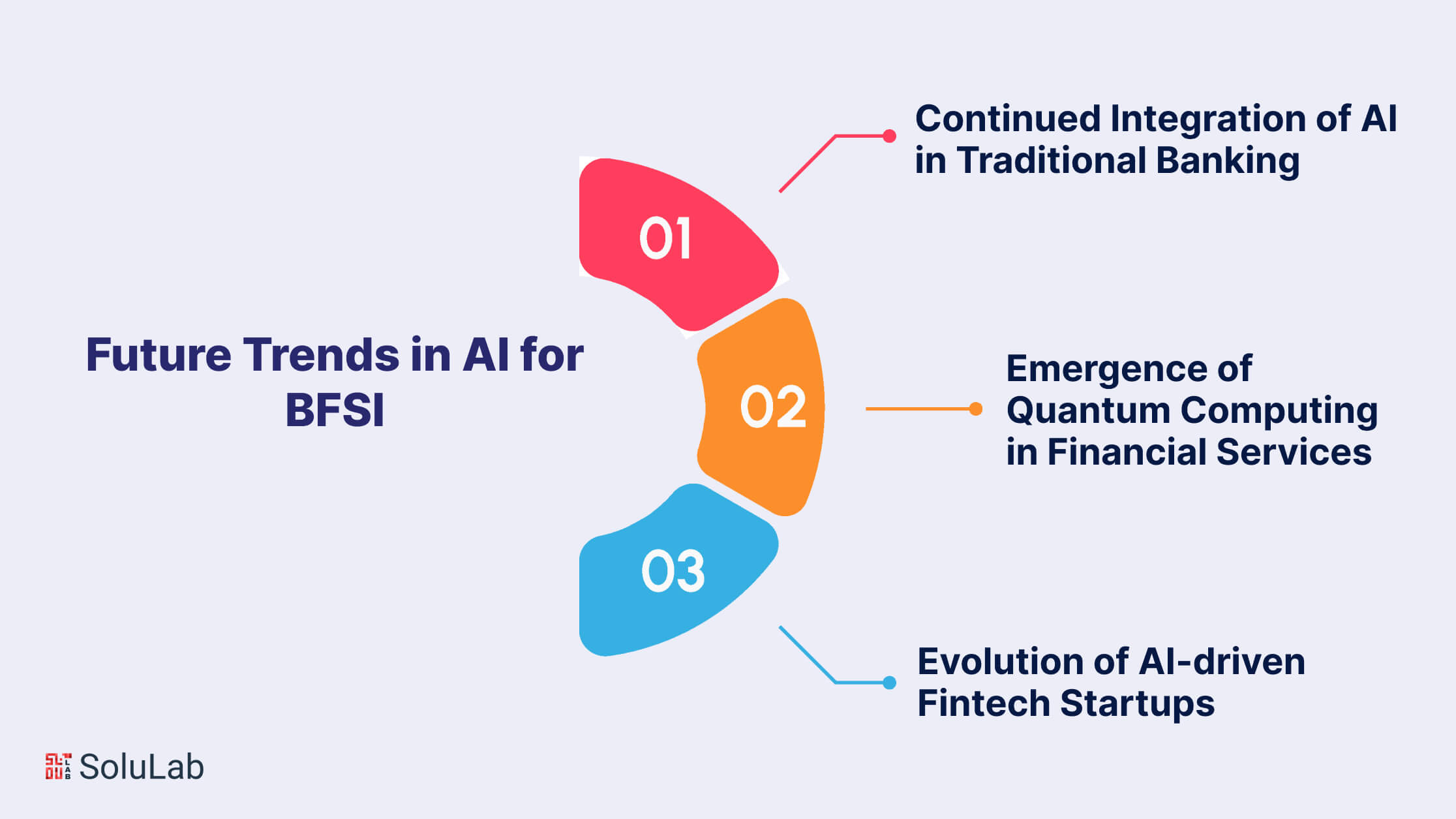
AI’s future in BFSI looks genuinely exciting, and it’s set to redefine practices that have stayed the same for decades. Here’s a look at the trends shaping where AI in the BFSI market goes next.
A. Continued Integration of AI in Traditional Banking
Enhanced Customer Engagement and Personalization
As the technology keeps maturing, traditional banks are turning to AI more and more to deepen customer engagement. Expect hyper-personalized services, tools that anticipate what a customer needs before they ask for it.
Risk Management and Fraud Prevention
Folding AI into traditional banking systems will strengthen risk management across the board. Machine learning models will deliver real-time risk assessments, catching fraud earlier and keeping financial transactions more secure overall.
Operational Efficiency and Cost Reduction
AI’s reach in traditional banking will extend into operational processes too. Automating routine tasks through robotic process automation (RPA) and AI-driven algorithms will tighten up workflows, and the payoff shows up as both efficiency gains and real cost savings.
B. Emergence of Quantum Computing in Financial Services
Unprecedented Computational Power
Quantum computing is set to shake up BFSI in a big way, mostly through raw computational power nothing classical can match. These machines could solve complex financial calculations and run simulations at speeds that sound almost implausible today.
Advanced Cryptography for Enhanced Security
Quantum computing cuts both ways for cybersecurity. It threatens traditional encryption, yes, but it also opens the door to quantum-resistant cryptography. BFSI will need to move to quantum-safe encryption if it wants financial transactions to stay secure once that shift happens.
Optimization of Portfolio Management
Processing massive datasets in real time is where quantum computing will really move the needle on portfolio optimization. Financial institutions could use quantum algorithms to fine-tune strategies, manage risk more effectively, and push algorithmic trading into territory that isn’t really possible yet.

C. Evolution of AI-driven Fintech Startups
Innovative Product Offerings
Fintech startups are leading the charge on AI innovation in BFSI. Small, fast-moving, they use AI to build financial products that challenge the old models entirely, built for consumers who expect more from their apps than their bank ever offered.
Data-driven Decision Making
AI-driven fintech startups put big data and machine learning to work making decisions, not gut calls. That means sharper creditworthiness assessments, customized products, and business models flexible enough to shift when the market does.
Partnerships and Collaborations
As AI becomes more central to BFSI overall, traditional institutions are seeing real value in partnering with fintech startups instead of competing with them. These partnerships bring cutting-edge AI into established banking systems, and it works both ways, startups get scale, incumbents get innovation.
Put it all together and the trends point one direction: continued AI integration in traditional banking, a possible quantum computing shake-up, and fintech startups pushing the pace even faster. Different threads, same conclusion, AI is genuinely reshaping financial services, not just tweaking around the edges.
SoluLab Transforms Banking and Finance with Gen AI
Challenge
The banking industry is stretched across a few fronts at once: rising customer expectations, manual processes that need automating, risk management, regulations that keep shifting, and cyber threats that keep growing.
Solution
SoluLab brought generative AI to bear on all of it at once, automating tasks, personalizing customer experience, tightening cybersecurity, so banks could run leaner without cutting corners.
Impact
- 3x increase in customer satisfaction with personalized services.
- 70% faster processes, cutting operational costs.
- 98% fewer cyber threats, ensuring data safety.
Conclusion
AI has pushed BFSI into a genuinely new phase of innovation and efficiency, that much is clear at this point. Personalized recommendations, chatbots, virtual advisors, they’ve lifted customer satisfaction while quietly making internal operations run better too. And looking ahead: deeper AI integration in traditional banking, a possible quantum computing shift, and fast-evolving AI-driven startups all point toward a BFSI sector with real room to grow, more secure and more collaborative than it is today.
As the BFSI sector keeps working through what AI actually changes, partnering with people who’ve already done this matters more than most institutions expect going in. SoluLab, an AI consulting company, puts that expertise directly to work for BFSI institutions through its AI development services. From personalized customer engagement platforms to state-of-the-art security implementations, the integration runs end to end, no gaps, no guesswork. SoluLab backs that with a real commitment to innovation and to client outcomes, and it’s positioned to keep shaping where AI in BFSI goes next. Ready for the next step? Contact SoluLab today for AI solutions built around your organization, not a generic template, and get ahead in banking and finance instead of catching up to it.
FAQs
Shipra Garg is a tech-focused content strategist and copywriter specializing in Web3, blockchain, and artificial intelligence. She has worked with startups and enterprise teams to craft high-conversion content that bridges deep tech with business impact. Her work translates complex innovations into clear, credible, and engaging narratives that drive growth and build trust in emerging tech markets.