![AI Infrastructure as a Service [AIaaS]_ Build, Scale, Deploy](https://www.solulab.com/wp-content/uploads/2026/03/AI-Infrastructure-as-a-Service-AIaaS_-Build-Scale-Deploy.webp)
AI is no longer a future investment for enterprises; it is a present-day necessity. However, building and managing the infrastructure required to support AI workloads can be complex, expensive, and time-consuming.
This is where AI Infrastructure as a Service is used by businesses to adopt and scale AI. By offering on-demand access to high-performance computing, data pipelines, and deployment environments, AIaaS removes traditional barriers to entry.
According to Gartner, worldwide spending on AI is expected to total $2.52 trillion in 2026, a 44% increase year-over-year.
Enterprises can now experiment, build, and deploy AI solutions faster without heavy upfront investments. This guide explores what AI Infrastructure as a Service is, how it works, its key benefits, and how organizations can leverage it to drive innovation, efficiency, and long-term growth.
Key Takeaways
- The issue: AI implementation is already gaining widespread use in enterprises, yet the process of expansion is still complicated and costly. Getting GPUs, data pipelines, and deployment costly.
- The Solution: AI Infrastructure as a Service makes this easier by providing cloud-based, on-demand, and scalable infrastructure. AI models allow businesses to speed up the deployment, training, and creation of AI models without the management of backend systems, and with fewer costs, more flexibility, and speed.
- The role of SoluLab: SoluLab is an AI native company that applies AI in its own processes to provide solutions that are more efficient and cost-effective. We plan, implement, and scale AI infrastructure on enterprise requirements, and make sure it is scalable and provides performance and long-term value.
What Is AI Infrastructure-as-a-Service (AIaaS)?
AI Infrastructure-as-a-Service (AIaaS) is a cloud-based model that provides the computing power, tools, and environment needed to build, train, and deploy AI models—without requiring companies to set up and manage their own AI software development infrastructure.
In simple terms, it lets enterprises access AI-ready infrastructure on demand, just like they would use cloud storage or servers.
Why AI Infrastructure-as-a-Service Matters for Businesses?
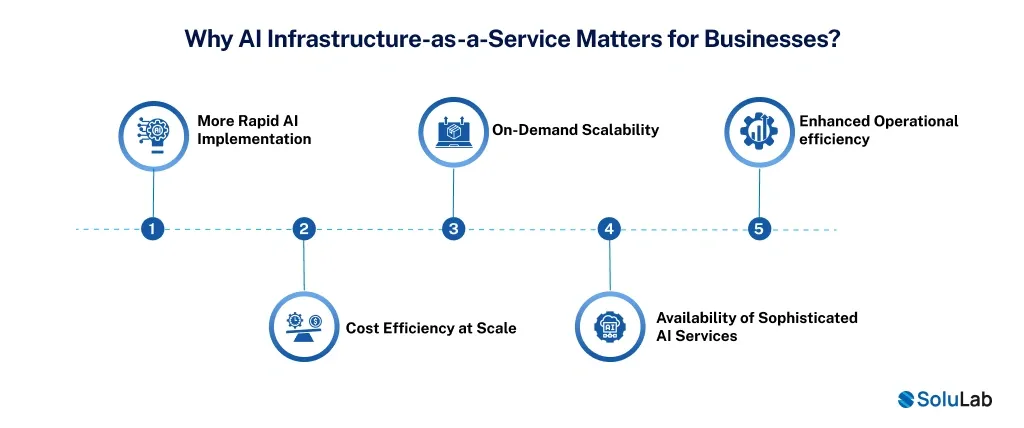
Businesses do not need AI as an experimental tool anymore, but scaling it effectively is a problem. It is there that AI Infrastructure-as-a-Service gains importance in regard to speed, cost optimization, and long-term innovation.
- More Rapid AI Implementation: Pre-built environment and compute allow businesses to get to production in a short time, breathe life into AI-driven products and services faster, and decrease time-to-market.
- Cost Efficiency at Scale: There is no need to spend a fortune on hardware when companies can harness AI infrastructure-as-a-service providers to pay only on what they consume to reduce significantly on the start-up and ongoing infrastructure costs.
- On-Demand Scalability: Using AI integration solutions, companies can automatically expand or contract resources in real-time depending on demand with performance without overprovisioning or wastage.
- Availability of Sophisticated AI Services: Businesses are able to utilize GPUs, ML systems, and new tools without necessarily developing internal expertise, allowing staff to experiment, innovate, and roll out higher-level applications of AI resources more quickly.
- Enhanced Operational efficiency: Monitoring, model management, and infrastructure optimization minimise manual work, leading to teams working on business results rather than maintaining complicated backend systems.
Building Enterprise AI Infrastructure: Key Architectural Components
AI Infrastructure-as-a-Service consists of a combination of various elements that allow enterprises to develop, implement, and expand AI effectively. These fundamental aspects can assist companies in creating trustworthy, high-quality AI systems.
- High-Performance Compute (GPU/TPU): AI programs demand enormous processing capabilities. GPUs and TPUs enhance model training and inference, allowing enterprises to compute complicated algorithms in a much faster manner and efficiently process large-scale AI models.
- Data Storage and Data Pipelines: An intelligent storage system and automated data pipelines provide a smooth data collection, processing, and conversion. This allows a good-quality of datasets, which is the key to accurate and reliable performance of the AI models.
- AI/ML Development Frameworks: Pre-built frameworks such as TensorFlow and PyTorch give AI developers base frameworks that allow them to build, train, and test models in less time, which has simplified the development process and brought innovation in much shorter timeframes with AI-based applications.
- Model Deployment: MLOps consultation and tools facilitate model deployment, versioning, and lifecycle management. They assist in the smooth transition of models between development and production without compromising the performance, scalability, and reliability of the models.
- Monitoring, Security, and Governance: Continuous monitoring tracks model performance and system health, while robust security and governance frameworks ensure compliance, data protection, and responsible AI usage across enterprise environments.

Benefits of AI Infrastructure-as-a-Service for Enterprises
The implementation of AI at scale does not only need models; it should include the appropriate infrastructure. AI Infrastructure-as-a-Service assists organizations in streamlining operations, expediting innovation, and developing scalable and high-performance AI ecosystems.
- Less Operational Complexity: Under AI infrastructure as a service (IaaS), the enterprise does not need to manually manage hardware, software, and updates. 88% of companies report AI has increased revenue, with many seeing measurable business impact across operations.
- Introduction to Faster Innovation: Ready-made environments and on-demand resources can facilitate faster experimentation and creation, as well as deployment, to ensure that businesses can bring AI-driven solutions to the market more quickly and stay ahead of their competitors.
- Improved Multidisciplinary work: Data scientists, engineers, and business teams can work together more easily and enhance productivity and project results across departments due to centralized platforms and shared environments.
- Better Model Performance and Scalability: With AI infrastructure in enterprise use, companies are able to get access to high-performance computing and scalable resources where models will execute effectively on large datasets and achieve stable performance as workloads continue to increase.
Best Practices for Implementing AI Infrastructure-as-a-Service
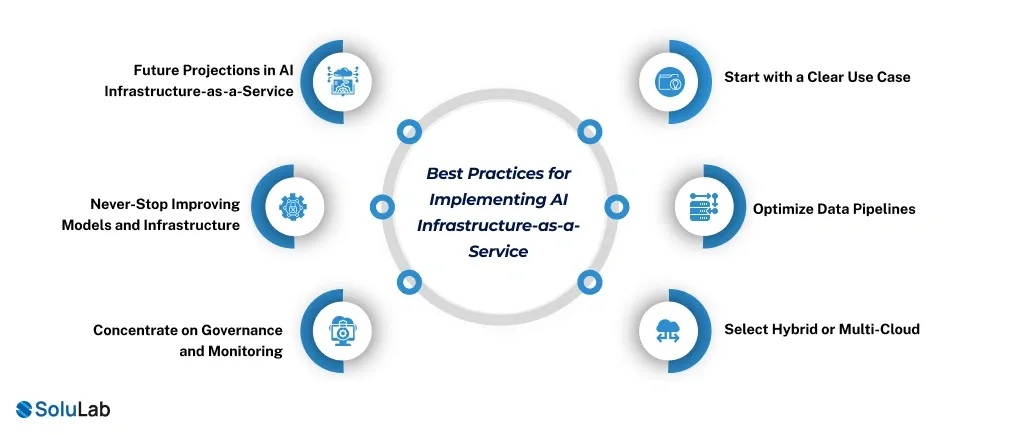
To implement AI Infrastructure-as-a-Service, cloud adoption is not enough. Businesses require an organized strategy to make sure that they are scalable, high-performing, and valuable in the long term without introducing inefficiencies and operational risks.
Start with a Clear Use Case
With expert AI consultation, identify certain business issues and quantifiable results prior to the implementation of AI infrastructure. A targeted application will make it more likely to succeed, quicker, and more profitable to use the AI investments.
Optimize Data Pipelines
It is essential to have efficient data pipelines to perform AI. Make sure that there is a clean, well-organized, and real-time flow of data to enhance the model accuracy, minimize latency, and make sound decision-making.
Select Hybrid or Multi-Cloud.
The transition to hybrid or multi-cloud environments enhances the flexibility, prevents vendor lock-in, and provides more effective workload distribution that assists enterprises in balancing the performance, cost, and compliance demands.
Concentrate on Governance and Monitoring.
Institute robust regulatory structures and accountability devices to monitor the functioning of models to ensure that they comply and that data is secure without posing too much risk to the operations of AI.
Never-Stop Improving Models and Infrastructure.
Artificial intelligence needs continuous adjustment. Periodically re-train models, optimize them, and scale up or down infrastructure resources to ensure performance, lower cost, and respond to changing business requirements.
Future Projections in AI Infrastructure-as-a-Service.
AI architecture is changing quickly, with businesses expanding smart systems in operations. Performance, automation, and smarter deployment models are what will determine the future of AI Infrastructure-as-a-Service.
Future Trends in AI Infrastructure-as-a-Service
AI architecture is changing quickly, with businesses expanding smart systems in operations. Performance, automation, and smarter deployment models are what will determine the future of AI Infrastructure-as-a-Service.
- Emergence of LLM-Native Infrastructure: The new AI infrastructure as a service (IaaS) is being re-architectured to support LLMs with optimized compute, vector databases, and memory layers, to allow faster training, inference, and real-time enterprise applications.
- Edge AI + Cloud Hybrid Models: Companies are adopting edge AI, computing and cloud computing to compute nearer to the data source, but use centralized computing to enhance latency, efficiency, and scalability in distributed systems.
- Advancement in AI-Specific Chips and Hardware: The move to specialized hardware such as GPUs, TPUs, and custom AI chips is changing the performance barriers, as it allows training models faster and consumes less energy to run large-scale AI workloads.
- Autonomous MLOps: Future AI infrastructure of enterprises will consist of automated pipelines capable of monitoring and retraining models in real time and optimizing them to ensure the continuous improvement of performance.
How SoluLab Helps with AI Infrastructure-as-a-Service?
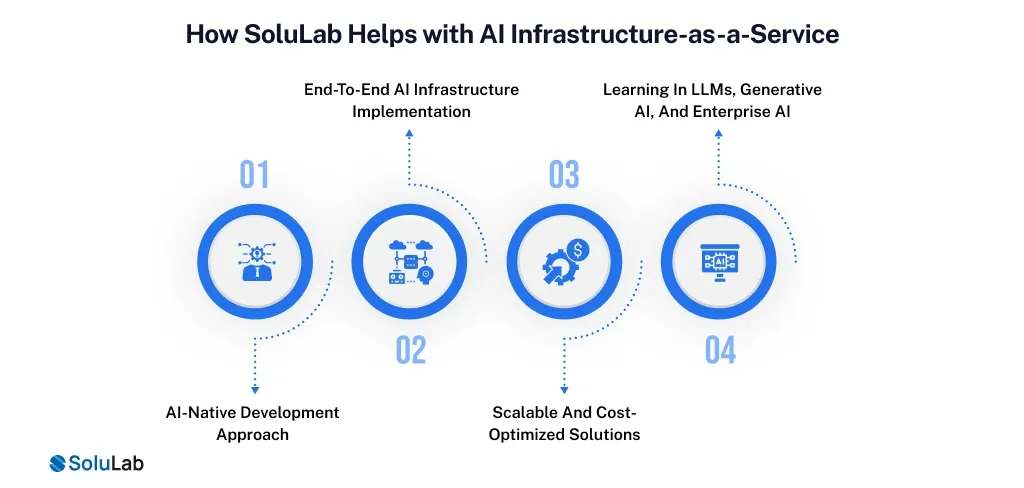
To make AI scaled effectively, enterprises require a tool, but they also require the appropriate partner. Here is how we help businesses with AI Infrastructure-as-a-Service:
- AI-Native Development Approach: SoluLab is an AI-first company and implements intelligence into the operating workflow to speed delivery, minimize manual work, and create smarter systems on an AI Infrastructure as a Service basis.
- End-to-End AI Infrastructure Implementation: SoluLab takes care of the full lifecycle of data pipelines, model training environments, cloud environment, and integration, so that AI infrastructure-as-a-service solutions are seamlessly adopted.
- Scalable and Cost-Optimized Solutions: SoluLab is an enterprise infrastructure designed to balance performance with cost, using the capabilities of a cloud to scale with demand, efficient model architectures, and resource optimization to ensure that enterprises scale without incurring unnecessary infrastructure costs.
- Learning in LLMs, Generative AI, and Enterprise AI: SoluLab is an expert in applying AI to develop custom AI-driven web3 solutions for enterprise-specific tasks, allowing sophisticated automation, insights, and intelligent decision-making on a massive scale.
Conclusion
AI Infrastructure as a Service is now the foundation of contemporary enterprise innovation and allows companies to develop, implement, and scale AI applications without making significant initial investments.
It simplifies complicated infrastructure, speeds up the time-to-market, and makes data and AI requirements flexible as they increase. Whether it is powering LLCs or making real-time analytics possible, AI infrastructure as a service can make organizations remain competitive in an increasingly AI-driven economy.
SoluLab, an AI development company, can help your business design, deploy, and scale an AI infrastructure as per your business needs.
FAQs
Neha is a curious content writer with a knack for breaking down complex technologies into meaningful, reader-friendly insights. With experience in blockchain, digital assets, and enterprise tech, she focuses on creating content that informs, connects, and supports strategic decision-making.