Key Takeaways
- The Problem: Most Middle Eastern-based businesses are exploring investments into AI, yet cannot successfully scale their efforts because of vague strategy, slow systems, and disconnected data, resulting in minimal actual business impact.
- The solution: Invest in developing an effective AI infrastructure and definition of use cases, improved data movement, and scalability to enable AI to transition experimentation into actual, quantifiable growth.
- How SoluLab helps: SoluLab is an AI-native firm that uses AI driven approach to its internal operations to provide faster and lower-cost solutions, assisting the Middle East to scale AI solutions effectively and realistically.
Businesses across the Middle East are shifting from digital adoption to true AI-driven growth. What started as small experiments is now turning into a large-scale transformation, where companies are using AI to improve decisions, reduce costs, and deliver better customer experiences.
From banking and healthcare to logistics and energy, organizations are finding practical ways to scale smarter using data and automation. This shift is driven by strong government support, rising investments, and a clear push toward innovation.
As enterprise AI development and integration in the Middle East gains momentum, companies are focusing on building systems that can grow with them. At the same time, AI integration in the Middle East is no longer optional but is becoming a key factor in staying competitive and future-ready.
Current State of Enterprise AI Adoption in the MENA Region
Enterprise AI adoption in the Middle East is accelerating rapidly, driven by strong government backing and enterprise demand, but scaling remains uneven. Around 60–62% of organizations in GCC countries have already adopted AI in some form, exceeding global averages in some cases.
The MENA artificial intelligence market size is projected to reach USD 166.33 billion by 2030, growing at a CAGR of 44.8% from 2024 to 2030.
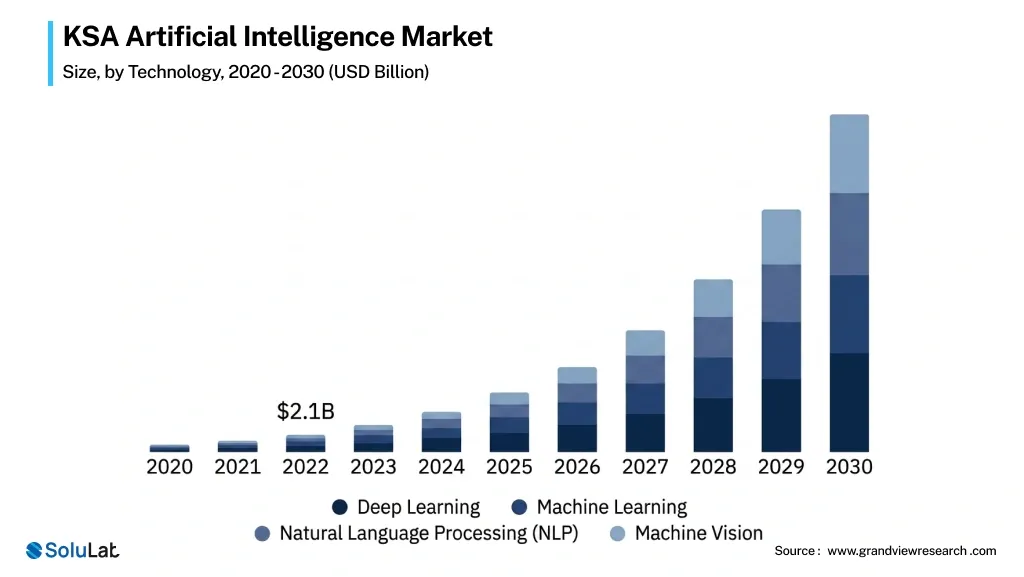
At the workforce level, 75% of employees report using AI tools in their jobs, reflecting widespread exposure and early integration into daily operations.
However, most enterprises are still transitioning from experimentation to full-scale deployment. Reports indicate that while adoption is high, only a smaller segment has successfully embedded artificial intelligence into core business functions at scale.
Overall, the region shows strong momentum, but the gap between adoption and scalable value realization remains a key challenge.
Why the Middle East Is Emerging as an AI Powerhouse?
The Middle East is positioning itself as a global AI hub, driven by government vision, strategic investments, and a strong focus on building region-specific, scalable AI capabilities.
- Government-Led Vision: Countries like the UAE and Saudi Arabia are driving AI adoption through long-term strategies such as the UAE AI Strategy 2031 and Vision 2030, aligning innovation with economic diversification goals.
- Infrastructure Investments: Massive investments in cloud computing, hyperscale data centers, and AI-ready infrastructure are enabling enterprises to deploy, train, and scale AI models efficiently across industries.
- Sovereign AI Growth: The region is focusing on building localized AI models and sovereign AI capabilities, ensuring data control, regulatory compliance, and better alignment with the Arabic language and regional use cases.
AI Integration Checklist for MENA Enterprises
With plans to increase the use of AI by enterprises in the MENA, a reasonable AI integration checklist will guarantee a less bumpy ride and minimize risks to stakeholders, besides assisting businesses in realigning their technology, data, and strategy to achieve scalable AI success.
- Effective alignment of AI strategies: Align business goals, AI use cases, and anticipated main objectives before implementation. This helps to make sure AI projects suit the organization’s priorities through the provision of measurable returns in its operations.
- Unified data infrastructure: This is required to make sure that data is centralized, clean, and available to all systems so that there is seamless training of models in real-time analytics and improved decision-making across departments and functions.
- Scalability and computeability: Invest in scalable cloud infrastructures and GPUs to scale AI workloads with the needs of the enterprise, making AI proficient and cost-effective to be deployed enterprise-wide.
- Connectivity with existing systems: AI models must be integrated easily with legacy systems, APIs, and processes so as not to disrupt operations and allow the creation of a seamless flow of automation throughout business operations.
- Compliance and data governance: Oversee regional regulations and data privacy rules in the adoption of AI, secure activities of data handling, and compliance standards in MENA markets.
- Continuous monitoring and MLOps: Deploy pipelines to support AI model deployment, monitoring, and updates to maintain steady perf, scale, and rapid response to business requirements.
- Localization and applicability: Localize AI models and regional peculiarities to enhance the quality and efficiency of AI-based solutions in the Middle East, AI in the UAE business, and AI in Saudi Arabia business.
Step-by-Step Process for Enterprise AI Integration
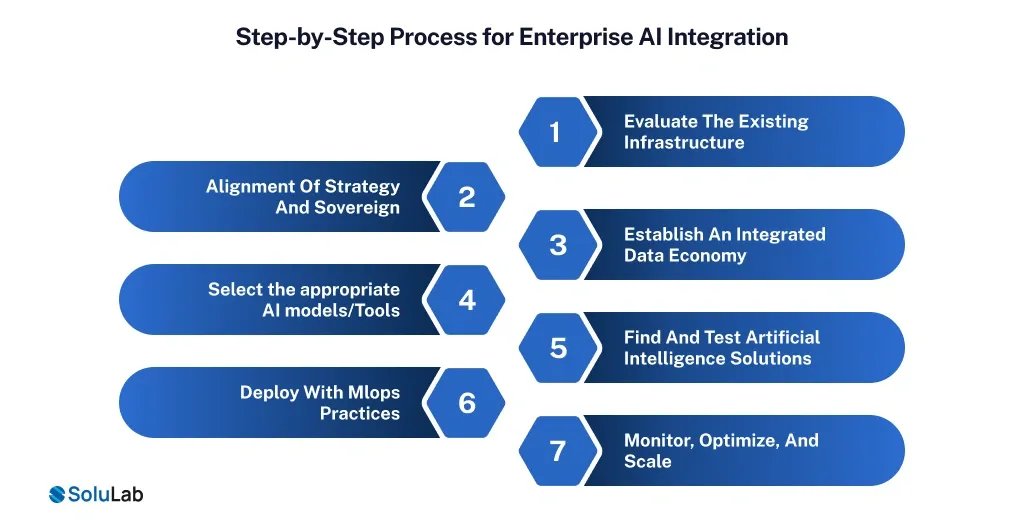
Integration of AI into the enterprise is not a case of trial and error, but it takes some organization to succeed. Adhering to a guided and systematic process will assist companies in minimizing the risks, aligning their strategy, and scaling the AI-based initiatives.
Step 1. Evaluate The Existing Infrastructure
With expert AI consultants, assess your current technical stack, data infrastructure, and processes to find vulnerabilities. This is to make sure that you have the capacity to work on the infrastructure, support AI, create scalability, and integrate without creating failures or subpar connections.
Step 2. Alignment Of Strategy And Sovereign
Establish AI objectives in accordance with business performance and local policies. In the Middle East, they encompass data sovereignty, compliance, and alignment with national AI strategies to guarantee their long-term levels of sustainable achievement and confidence.
Step 3. Establish An Integrated Data Economy
Bring together information from various sources in a single, convenient place. Accurate AI models can be trained only on clean, structured, and real-time data, and allow for a smooth and Integration between departments.
Step 4. Select the appropriate AI models/Tools
Use the right AI architectures, LLMs, or bespoke models, depending on applications. Take into account scalability, cost, and compatibility with your infrastructure in order to provide efficient deployment and long-term performance.
Step 5. Find And Test Artificial Intelligence Solutions
Develop AI models and test them using controlled test environments. This assists in accuracy and reliability, as well as favors business goals before implementing them into production systems.
Step 6. Deploy With Mlops Practices
This is done using MLOps solutions to facilitate the deployment and monitoring of AI models. This will provide consistency, quicker updates, and integration with existing enterprise working formulas.
Step 7. Monitor, Optimize, And Scale
Measure and manage performance continuously, model improvement, and expansion. Knowing that ROI is sustained and accuracy is improved with regular optimization, and that the AI systems could be modified to meet the needs of the business when they change.
Challenges in AI Integration in the Middle East and How to Overcome Them
AI adoption across the Middle East is accelerating, but many businesses struggle with practical challenges. Understanding these issues and solving them early helps ensure smoother, scalable, and successful AI integration.
1. Poor Data Quality And Access:
Data is often incomplete, outdated, or stored in different systems, making it hard for AI models to deliver accurate results and reliable business insights.
Solution: Build a centralized data system, clean existing data regularly, and ensure easy access across teams.
2. Shortage Of Skilled AI Talent:
Many organizations lack experienced AI engineers and data experts, slowing down implementation and making it difficult to manage and scale AI systems effectively.
Solution: Invest in training programs, partner with AI service providers, and use low-code or no-code AI tools where possible.
3. Legacy Systems And Outdated Infrastructure:
Older systems are not designed to support modern AI tools, causing integration issues, slow processing, and increased costs during implementation.
Solution: Gradually upgrade infrastructure, adopt cloud-based solutions, and use APIs to connect old systems with new AI technologies.
4. Data Privacy And Regulatory Concerns:
Strict data laws and regional regulations make it challenging to use and share data, especially across borders, limiting AI model training and deployment.
Solution: Follow local compliance rules, use secure data handling practices, and implement strong governance frameworks.
5. High Initial Investment And Unclear ROI:
Businesses often hesitate due to upfront costs and uncertainty about returns, especially when AI projects take time to show measurable results.
Solution: Start with small, high-impact use cases, track performance clearly, and scale gradually based on proven ROI.
How SoluLab Helps with Enterprise AI Integration in the Middle East?
Businesses in the Middle East are speeding up and moving toward the implementation of AI, though achieving success hinges on the correct implementation partner. SoluLab, with its AI native strategy, assists companies to smoothly, efficiently, and at scale integrate AI.
- AI-native development strategy: We create solutions in which the AI is a core part, rather than an augmentation. This assists businesses in applying data, automation, and smart systems on the first level, making processes smarter, quicker, and able to scale up.
- More automation develops: SoluLab allows companies to deploy AI faster and with less development time by making use of pre-made frameworks and automated processes. This enables companies to roll solutions out promptly, provide faster feedback on controversial ideas, and start yielding results promptly.
- Economical solutions of AI used in enterprises: SoluLab specializes in the AI-led development that should exclude manual labor and enhance productivity. This reduces operational expenses in the long-term perspective and aids companies in attaining improved performance without having to waste their fortunes on complex infrastructures.
Future of Enterprise AI in the Middle East
Enterprise AI in the Middle East undergoes a high-growth stage, which is fueled by government efforts, infrastructure projects, and more models of enterprise adoption in a wide range of industries seeking to undergo a scalable, AI-led transformation.
- Rapid Growth: With significant investment volumes, digital transformation initiatives, and enterprise demands on on-premises automation, predictive analytics, and smarter decision-making processes, the Middle East AI market is set to grow at a rate of greater than 41% CAGR by 2033.
- Localized Innovation: Region-specific AI and LLM solutions and usages are occasioning businesses an opportunity to provide customer experiences, language-sensitive solutions that enhance customer experiences, align regulations, and are adopted in various fields such as government, banking, and healthcare.
- AI-First Response: Business is shifting to AI-first thinking, integrating AI into business workflows and core operations and decision-making to enable the business to scale more quickly and achieve business operational efficiency and sustainable competitive advantage in the international market.

Conclusion
Businesses across the Middle East are no longer experimenting with AI; they are scaling it to drive real impact. From smarter operations to faster decision-making, enterprise AI integration is becoming a key growth driver across industries.
However, success depends on the right strategy, infrastructure, and execution approach. Companies that invest early in scalable AI systems are already seeing stronger efficiency and competitive advantage.
As the region continues its rapid digital transformation, the opportunity is only growing. If you’re planning to scale with AI, SoluLab, an AI development company, can help your business build, integrate, and grow with confidence.
FAQs
Shipra Garg is a tech-focused content strategist and copywriter specializing in Web3, blockchain, and artificial intelligence. She has worked with startups and enterprise teams to craft high-conversion content that bridges deep tech with business impact. Her work translates complex innovations into clear, credible, and engaging narratives that drive growth and build trust in emerging tech markets.