
In 2026, businesses across industries want to automate their business. While 92 % of UAE businesses now rank AI as a strategic priority, and 88 % report measurable productivity gains from initial AI investments.
Most organizations still struggle to realize full value from these technologies. Many firms face skills shortages and inadequate data infrastructure, integration challenges, and security concerns, which slow implementation and limit ROI.
In Dubai’s hyper‑competitive market, these gaps mean missed opportunities in customer experience, operational efficiency, and strategic decision‑making. Using AI integration solutions without proper planning may lead to wasted time, effort, and cost you.
This blog post will guide you through enterprise AI adoption in Dubai and more. Let’s get started!
Key Takeaways
- The Problem: Many Dubai enterprises lack clear AI strategies, data readiness, and workforce skills. Industry-specific regulations and compliance requirements add complexity.
- The Solution: Conduct AI readiness assessments to benchmark capabilities against industry standards. Identify high-impact, sector-specific AI use cases for pilots.
- How SoluLab Can Help: Evaluate your enterprise’s current AI maturity and identify gaps. Get ailored AI strategies for sectors like finance, healthcare, retail, and logistics and increase outcomes by 40%.
Current Adoption of AI Readiness in Dubai
Recent surveys show that a big majority of UAE companies view AI as a strategic priority, with around 92 % integrating AI into core strategies and already seeing productivity benefits. Many firms are building out cloud and data readiness as foundations for AI, with 67 % hosting key processes on the cloud to support future AI tools.
In practice, about 42 % of businesses are actively using AI in operations, and nearly two-thirds report that adoption has sped up over the last couple of years.
Departments like finance are often early adopters, with close to half planning AI deployments soon and a strong shift toward generative AI for analytics and reporting.
Why AI Readiness Consulting Matters in Dubai?
Dubai isn’t just embracing AI its having staked its entire economic future on becoming the world’s most AI-ready nation by 2031.
1. It’s a Government Mandate, Not a Trend: Dubai’s AI push is backed by law and leadership at the highest levels. The Dubai AI Policy now provides a unified framework for ethical, scalable, and transparent AI deployment across all government entities, showing explainability, interoperability, and human-centricity.
2. The Economic Stakes Are Enormous: From a market worth AED 12.74 billion in 2023, AI in the UAE is projected to expand at a compound annual growth rate of 44%, reaching AED 170.14 billion by 2030.
According to the Gulf News at the national level, the UAE AI Strategy projects that AI will contribute $91 billion (AED 335 billion) to the Emirati economy within six years.
3. Adoption Is Already Surging: The gap between AI-ready and AI-unready businesses is widening fast. 52% of DIFC firms are now actively using AI, a sharp increase from 33%, and generative AI usage is rising 166% year-on-year.
For example, in financial services alone, firms using AI for fraud detection, compliance, and client analytics are operating at fundamentally different cost and speed levels than those that aren’t.
4. Government Services Are Going AI-Native: Businesses that interact with Dubai’s government need to be prepared for an AI-first public sector. UAE government entities have reached 97% utilization of AI tools, with digital assistants, smart platforms, predictive analytics, automated processing, and AI-powered decision support now standard across federal departments.
In 2024, the UAE government processed 173.7 million digital transactions, with over 57 million users accessing 1,419 digital services, achieving a 91% satisfaction rate.
5. Dubai Ranks Among the World’s Top Smart Cities
Infrastructure readiness underpins AI readiness. According to the IMD Smart City Index 2025, Dubai ranked 4th globally and 1st in the Arab world, Acuma — giving businesses world-class digital infrastructure to build on.
The UAE has the highest number of data centres in the region (35), with Dubai hosting 18 of them. Public cloud spending per employee stands at $228, the highest in the region according to BCG data.
Read More: How Businesses in the Middle East Are Scaling with Enterprise AI Integration?
How to Implement AI Readiness in Dubai Enterprises?
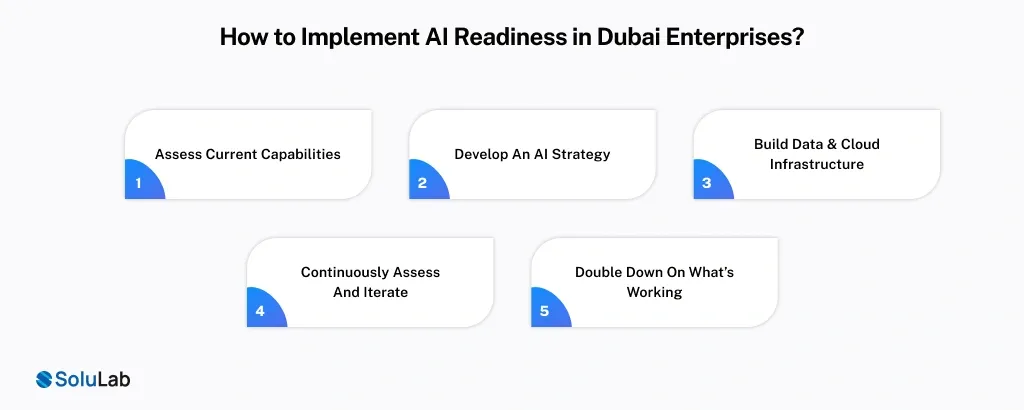
Implementing AI in Dubai businesses requires careful planning and execution. From assessing current capabilities to doubling down on successes, a structured approach ensures AI adoption delivers real business value.
1. Assess Current Capabilities
Start by evaluating your organization’s AI maturity, technology stack, and employee skill sets. Understanding strengths and gaps helps prioritize initiatives and align AI efforts with business goals.
2. Develop an AI Strategy
Craft a clear AI roadmap that targets key business challenges. Include timelines, responsible teams, and measurable KPIs to ensure AI adoption aligns with organizational objectives.
3. Build Data & Cloud Infrastructure
Invest in scalable cloud solutions and robust data management. Clean, accessible, and secure data forms the backbone of AI, enabling faster experimentation and more reliable insights.
4. Continuously Assess and Iterate
AI-led development isn’t a one-time project. Regularly review outcomes, gather feedback, and refine models or processes to improve efficiency and effectiveness over time.
5. Double Down on What’s Working
Identify AI initiatives delivering measurable results and scale them across departments. Focus resources on proven solutions to maximize ROI and drive enterprise-wide adoption.
Common AI Adoption Challenges in Dubai Enterprises
Although AI is receiving high levels of priority in the UAE, and 92% of enterprises consider AI as strategic, numerous Dubai organizations continue to encounter adoption traps such as capability overestimation, challenge underestimation, resistance to change, and lack of ROI frameworks.
1. Excessively Altered Expectations of AI: AI native approach can help solve more complex business problems on the spot, often without much preparation and integration, which is the assumption of leaders. This optimism may result in poor planning and project stalls.
Evidence & Impact:
- A survey conducted by almost 6 out of 10 UAE data leaders indicates that close to 6 out of the order that the executives overestimate the accuracy of AI, and 64% feel that implementing AI will be more difficult than they anticipated.
- Lots of businesses have difficulties in tracing the decision-making process of AI as there are inconsistencies between the expectations and the reality of operation.
How to Overcome:
- Pilot programs with metrics.
- Pay attention to practical use cases that are related to quantifiable results and not hype.
- Engage cross-functional teams (business + tech) to align expectations in the beginning.
2. Certain scaled estimates are underestimated: AI uses clean and structured data, and a lot of businesses do not sufficiently consider the time and effort needed to prepare, govern, and integrate data.
Evidence & Impact:
- Lack of sufficient data infrastructure/fragmentation is mentioned as one of the primary obstacles to scaling AI pilots by 67% of UAE organizations.
- According to surveys, most companies are confident about their data, but they can hardly access or use it regularly because it is scattered or not managed appropriately.
How to Overcome:
- Invest in information governance (quality, integration, and accessibility).
- Establish strong data engineering and pipeline groups before the deployment of AI models.
- Standardize and enhance interoperability through the use of common tools.
3. Digital Transformation Resistance: AI adoption may be impeded or derailed by organizational culture and workforce resistance- despite substantial technology investment.
Evidence & Impact:
- A recent report identified that 42 percent of the companies in the UAE are internally resistant to adopting AI despite the growth in spending across the region.
- The poor performance management and cross-departmental silos contribute to further transformation.
How to Overcome:
- Introduce change-management initiatives, training the teams on the benefits and effects of AI.
- Motivate the use of AI by providing training and performance measures based on the use of AI models.
- Form cross-functional teams to be change agents.
4. Unclear ROI Budget Allocation: Investing in AI without explicit provisions on how to quantify the return on investment may result in inefficiency and abandoned projects.
Evidence & Impact:
- Although 88% of the UAE orgs record productivity or financial returns of their early AI efforts, there are large numbers that cannot translate this to organized ROI measures.
- Enterprises across the world tend to implement AI quickly without clearly defined ROI frameworks, hence it is hard to justify investment.
How to Overcome:
- Set KPIs (e.g., time saved in the process, cost reduction, revenue impact).
- Apply staged investment based on milestone achievement (proof-of-value-pilot-scale).
- Implement governance boards in order to measure results and adjust budgets according to actual performance.
Read More: Turn AI Development into Measurable ROI
5. Skills and Talent Shortages: This is not listed in your first list, but it appears to be a consistent theme in UAE AI research, and increases the effect of the rest of the challenges.
Data Insight:
- According to the surveys, there is a critical lack of AI/ML skills that is reported by 100 percent of the UAE firms that said they were limited by workforce capabilities to use AI to its full potential.
- Three-quarters of organizations (76) confirm that there is an urgent skills gap in AI that affects its adoption.
How to Overcome:
- Invest in higher education training and higher education collaboration.
- Outsource at the initial stages, and develop in-house.
- Encourage reskilling among the current workers to assist with AI jobs.
How to Access Industry-Specific AI Readiness in Dubai
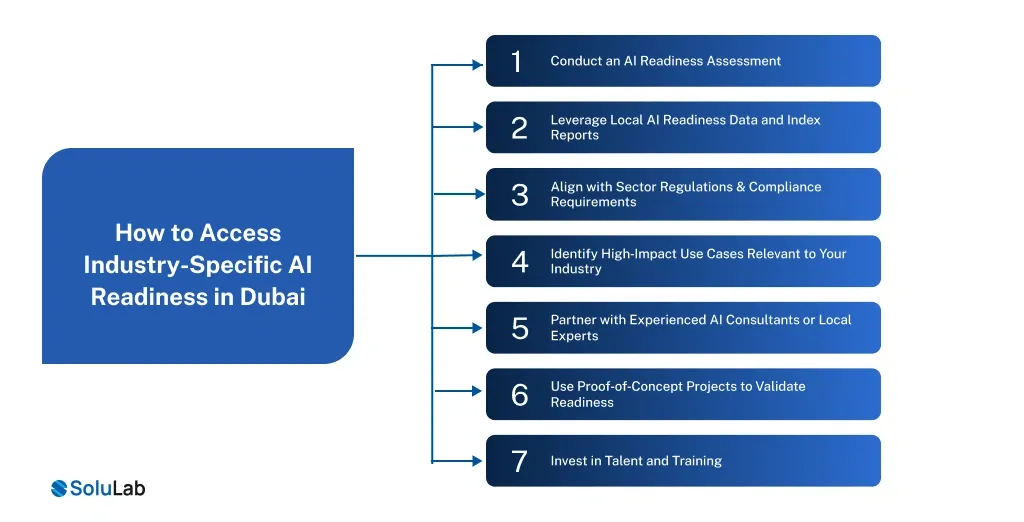
The implications of getting industry-specific AI readiness in Dubai are to analyze the current capacity of your organization, compare it with industry norms, and put custom-made frameworks in place to prepare to deploy AI, to bring about quantifiable change and competitive edge.
1. Conduct an AI Readiness Assessment: Begin with a structured evaluation of your company’s AI maturity with an expert AI consulting company—covering strategy, data quality, infrastructure, workforce skills, and governance—to identify current strengths and gaps. Tools like AI readiness frameworks help benchmark against best practices in your sector.
2. Leverage Local AI Readiness Data and Index Reports: Use recognized readiness benchmarks such as the Cisco AI Readiness Index or regional reports showing UAE firms with robust AI strategies (e.g., 73 % have defined strategies). Such insights reveal how peers in finance, retail, logistics, and healthcare are preparing for AI.
3. Align with Sector Regulations & Compliance Requirements: Various sectors need particular regulatory preparedness, including the healthcare system, which should be particularly concerned with the security of patient data in the context of the UAE legislation, whereas fintech is concerned with ensuring the safety of financial operations.
AI consulting companies in Dubai facilitate adherence to the regulations, such as the UAE Personal Data Protection Law (PDPL).
4. Identify High‑Impact Use Cases Relevant to Your Industry: Industry-specific preparation implies the prioritization of AI projects that have a clear ROI. Indicatively, predictive maintenance in the manufacturing sector, personalization in the retail industry, and fraud detection in the banking industry can be scaled using pilot frameworks. AI consultants help to choose viable and high-value use cases.
5. Partner with Experienced AI Consultants or Local Experts: Contract companies that have time-tested experience in Dubai on readiness mapping, development of AI proof-of-concept, and industry-specific strategy roadmaps.
Cases in point are consultancies that assess infrastructure and suggest AI structures that may be applied to logistics or real estate.
6. Use Proof‑of‑Concept Projects to Validate Readiness: Before a full rollout, run small pilots to test data integration, model performance, and operational impact in real scenarios. These pilots demonstrate AI’s business value and uncover readiness bottlenecks, helping fine‑tune strategies.
7. Invest in Talent and Training: The capabilities of the workforce are also related to AI readiness. AI knowledge training reduces the skill gaps and accelerates adoption in teams by training them on AI tools and workflows.
The UAE companies are putting more investment in upskilling to accommodate AI projects, which is an approach that has been mentioned to be crucial in maturity regarding readiness.
Conclusion
To make AI adoption in Dubai a reality, the process has to be systematic and include a strategic approach, talent development, and technological preparedness. The businesses have to evaluate their existing strengths, match the industry-specifics, and address the use cases of AI with the greatest impact to maintain competitiveness.
It can be expedited with the help of an established AI Consulting Company of Businesses, offering specific frameworks, pilot projects, and practical information. With Dubai still striving to establish itself as an innovation-focused city, any enterprise that actively invests in the preparedness of AI will not only optimize the effectiveness of its business.
SoluLab, an AI development company in Dubai, can help you automate your business to increase productivity and ROI over time. Book a free consultation call today!
FAQs
Neha is a curious content writer with a knack for breaking down complex technologies into meaningful, reader-friendly insights. With experience in blockchain, digital assets, and enterprise tech, she focuses on creating content that informs, connects, and supports strategic decision-making.