Key Takeaways
- AI browser agents automate complex web workflows with minimal human intervention.
- Modern frameworks combine AI reasoning, planning, and browser automation capabilities.
- Enterprise adoption is driven by productivity gains, scalability, and cost reduction.
- Security, compliance, and system integrations are critical for successful deployments. Choosing the right tools and development approach ensures long-term business value.
The internet has become the primary workspace for modern businesses, but many web-based processes still require significant manual effort.
AI browser agents are changing this by combining artificial intelligence with browser automation to perform tasks such as data extraction, form completion, research, workflow execution, and decision-making with minimal human intervention.
In 2026, advancements in large language models, agentic AI frameworks, and browser automation technologies are making these intelligent agents more capable than ever.
The Global AI Agent Market size is projected to reach USD 54.83 billion by 2032.
This guide explores the essential tools, frameworks, architecture patterns, development process, costs, and best practices required to build scalable and enterprise-ready AI browser agents.
What Is an AI Browser Agent and How Do AI Browser Agents Work?
An AI browser agent is a software system that can understand goals, navigate websites, interact with web elements, and complete tasks autonomously using artificial intelligence and browser automation technologies.
Here’s how AI browser agents work:
- Receive user instructions: The AI agent interprets goals via natural-language prompts.
- Analyze web pages: AI identifies buttons, forms, links, and relevant content.
- Create an action plan: The agent determines the steps required to complete tasks.
- Execute browser actions: It clicks, types, navigates, and submits information automatically.
- Monitor results: The agent verifies outcomes and adjusts actions when needed.
- Deliver final output: Results, insights, or completed tasks are returned to users.
Why AI Browser Agents Matter in 2026?
AI browser agents are becoming essential for organizations seeking faster workflows, smarter automation, and enhanced digital productivity. In 2026, businesses will rely on agents to improve web-based operations and decision-making.
According to Gartner, Worldwide AI spending is forecast to reach $2.59 trillion in 2026, representing a 47% year-over-year increase.
Some of the key reasons that businesses are adopting AI browser agents are:
- Increased workflow automation: AI-powered browser assistants automate repetitive web tasks, reducing manual effort.
- Faster decision-making: Real-time data access enables quicker responses to business needs.
- Enhanced employee productivity: Intelligent agents streamline workflows and boost operational efficiency.
- Improved customer experiences: Personalized interactions deliver faster, more relevant user support.
- Scalable operations: Browser agents for enterprises manage growing workloads without added complexity.
- Better data collection: Automated browsing gathers valuable insights from multiple online sources.
- Reduced operational costs: Automation minimizes repetitive tasks and optimizes resource utilization.
- Stronger competitive advantage: Intelligent agents help businesses innovate and adapt faster.
Key Technologies Behind AI Browser Agent Development
AI browser agents combine advanced artificial intelligence, automation, and web development capabilities to perform complex tasks autonomously.
Their effectiveness depends on several core technologies that enable reasoning, decision-making, learning, and browser control.
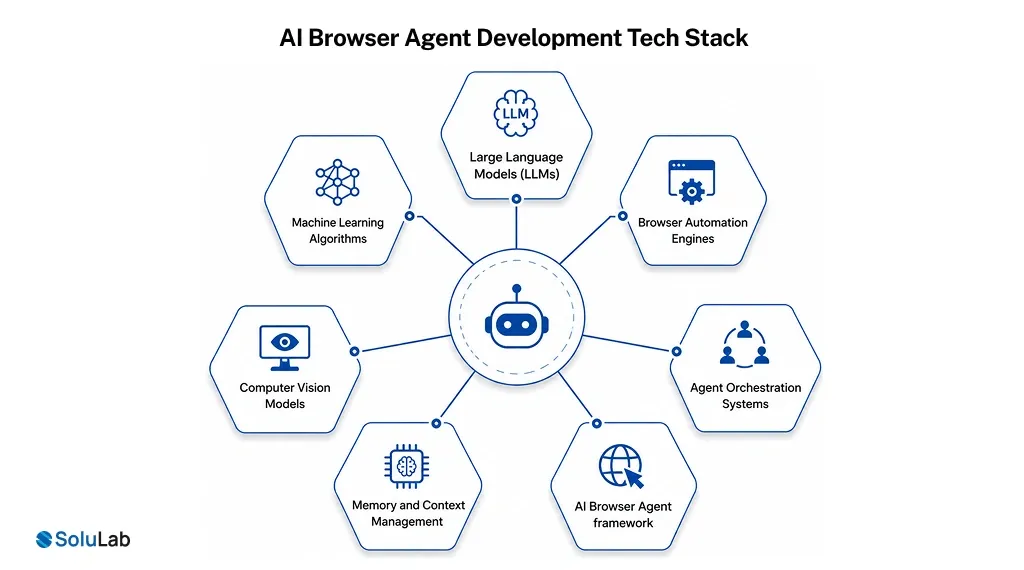
- Large Language Models (LLMs): Power natural language processing, reasoning, and decision-making, enabling AI Browser Agents to interpret instructions and execute complex web-based tasks autonomously.
- Machine Learning Algorithms: Continuously improve agent performance through pattern recognition, prediction, and adaptation, helping agents handle changing workflows and user requirements effectively.
- Browser Automation Engines: Technologies like Playwright and Selenium enable agents to navigate websites, click elements, fill forms, and complete actions automatically.
- Computer Vision Models: Enable visual understanding of web interfaces, helping agents identify buttons, forms, layouts, and dynamic webpage elements accurately.
- Agent Orchestration Systems: Coordinate planning, memory, reasoning, and execution processes, ensuring agents complete multi-step tasks efficiently and reliably.
- Memory and Context Management: Store previous interactions and task history, allowing agents to maintain context and make informed decisions throughout workflows.
- AI Browser Agent framework: Provides the infrastructure for integrating models, tools, workflows, and browser controls into scalable intelligent automation solutions.
Step-by-Step Guide to Building an AI Browser Agent?
Building an AI agent requires a structured approach that combines automation, intelligence, and seamless web interaction. Follow these essential steps to create scalable and efficient AI-powered browser automation solutions.
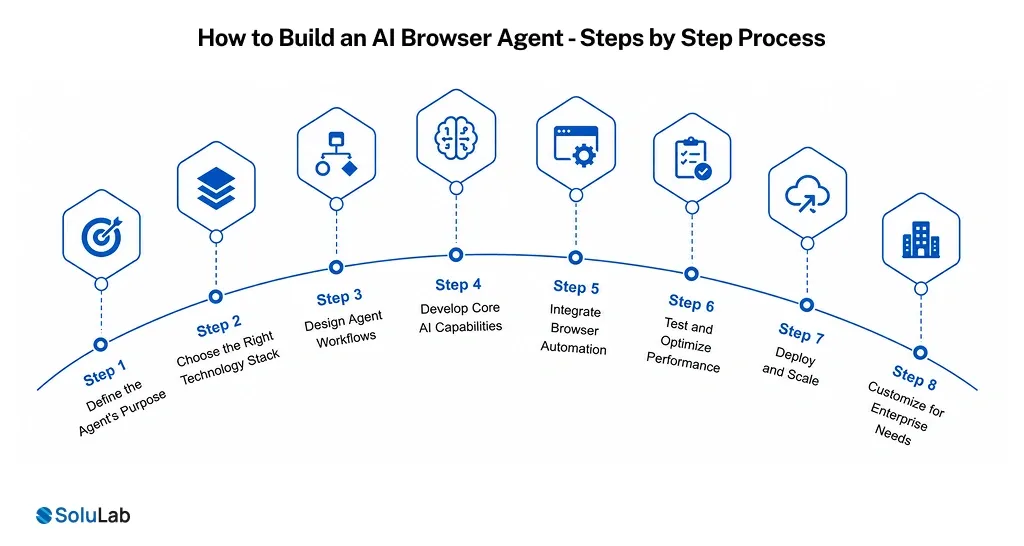
1. Define the Agent’s Purpose
Start by identifying the specific business problem your AI browser agent will solve. Clear objectives help determine features, workflows, and success metrics.
- Identify automation opportunities
- Define business goals
- Establish success metrics
2. Choose the Right Technology Stack
Select AI models, browser automation frameworks, and infrastructure based on your performance, scalability, and integration requirements.
- Select AI frameworks
- Choose browser tools
- Plan infrastructure requirements
3. Design Agent Workflows
Map out how the agent will navigate websites, process information, and complete tasks from start to finish.
- Create workflow diagrams
- Define user interactions
- Establish decision logic
4. Develop Core AI Capabilities
Build systems so the agent can understand instructions, reason through tasks, and adapt to changing environments.
- Implement language understanding
- Enable task planning
- Add contextual reasoning
5. Integrate Browser Automation
Configure AI agents for browser automation to interact with websites, forms, and digital platforms autonomously.
- Automate web navigation
- Handle content
- Execute browser actions
6. Test and Optimize Performance
Validate accuracy, reliability, and scalability through continuous testing across different use cases and websites.
- Monitor agent behavior
- Improve task accuracy
- Optimize response speed
7. Deploy and Scale
Launch the solution and continuously enhance capabilities based on business needs and user feedback through AI agent development services.
- Deploy production environment
- Track performance metrics
- Scale with demand
8. Customize for Enterprise Needs
Organizations often require custom AI-led development to align browser agents with internal workflows, compliance requirements, and business objectives.
- Integrate enterprise systems
- Ensure regulatory compliance
- Personalize business workflows

Architecture of an Enterprise AI Browser Agent
Enterprise AI browser agents combine advanced AI models, automation frameworks, and business integrations to perform complex web-based tasks autonomously. A well-designed architecture ensures scalability, security, reliability, and seamless enterprise operations.
| Architecture Component | Role in the System |
|---|---|
| User Interface Layer | Receives user requests, instructions, and workflow inputs. |
| Natural Language Processing (NLP) Engine | Interprets user intent and converts instructions into actionable tasks. |
| Task Planning Module | Breaks complex objectives into structured, executable workflows. |
| Decision-Making Engine | Evaluates context and determines the best next action. |
| Browser Automation Layer | Handles clicking, typing, navigation, scrolling, and form submissions. |
| Data Extraction Module | Collects and processes structured and unstructured web data. |
| Memory & Context Layer | Stores previous actions, session history, and workflow context. |
| AI Model Layer | Powers reasoning, content understanding, and intelligent decision-making. |
| Integration Layer | Connects with CRM, ERP, databases, APIs, and enterprise applications. |
| Security & Compliance Layer | Manages authentication, access controls, encryption, and governance. |
| Monitoring & Analytics Module | Tracks performance, logs activities, and identifies optimization opportunities. |
| Cloud Infrastructure Layer | Provides scalability, availability, and resource management across deployments. |
How AI Browser Agents Navigate Websites Like Humans?
AI browser agents navigate websites much like humans by understanding content, interpreting visual elements, making decisions, and completing actions such as clicking, typing, scrolling, and data extraction.
Unlike traditional automation tools, they adapt to changing web environments, maintain context across multiple steps, and execute complex workflows with minimal human intervention.
- Page understanding: AI agents analyze webpage layouts, content, and navigation structures to identify the information and actions required for a specific task.
- Context-aware decision-making: Instead of following fixed rules, agents evaluate user intent and page context to determine the most effective next action.
- Human-like interactions: Agents click buttons, fill forms, scroll pages, and navigate websites similarly to how a human user would.
- Dynamic adaptation: Modern enterprise AI solutions use browser agents that adjust to changing website layouts and unexpected scenarios without frequent reprogramming.
- Multi-step workflow execution: Agents maintain context across multiple pages, enabling them to complete end-to-end tasks efficiently and accurately.
- Real-time information processing: They continuously analyze new web data, helping businesses make faster and more informed decisions.
- Connected automation: Through AI integration services, browser agents can exchange data with CRM, ERP, and business applications to automate entire workflows.
How Much Does Browser Agent Development Cost?
Browser AI agent development costs vary based on complexity, AI capabilities, integrations, scalability requirements, and customization needs. Understanding cost factors helps businesses plan budgets and choose the right development approach.
| Development Level | Estimated Cost Range | Features Included |
|---|---|---|
| Basic Browser Agent | $10,000 – $25,000 | Simple browser automation, task execution, basic workflows, limited integrations. |
| Mid-Level AI Browser Agent | $25,000 – $35,000 | AI-powered decision-making, web navigation, data extraction, API integrations. |
| Advanced Browser Agent | $45,000 – $50,000 | Multi-step workflows, contextual reasoning, memory, analytics, enterprise integrations. |
| Enterprise AI Browser Agent | $50,000+ | Multi-agent system architecture, custom AI models, security, compliance, large-scale deployment. |
AI Browser Agents vs Traditional RPA
As businesses pursue smarter automation, AI browser agents are emerging as a powerful alternative to traditional RPA. Understanding their differences helps organizations choose the right custom automation solution for scalable workflows.
| Feature | AI Browser Agents | Traditional RPA |
|---|---|---|
| Functionality | Understand context and make autonomous decisions | Follow predefined rules and workflows |
| Adaptability | Adjust to website changes and environments | Break easily when interfaces change |
| Data Handling | Processes structured and unstructured data efficiently | Best suited for structured data |
| User Interaction | Understands natural language instructions | Requires explicit programming |
| Scalability | Handles complex, multi-step workflows across platforms | Limited flexibility for evolving tasks |
| Maintenance | Lower maintenance through adaptive learning capabilities | Frequent updates required for workflow changes |
| Decision-Making | Makes context-aware decisions during execution | Executes only predefined actions |
| Use Cases | Research, customer support, web automation, analytics | Data entry, form filling, repetitive tasks |
| Future Readiness | Ideal for Browser Automation AI Agent solutions and AI Browser Automation Development initiatives | Better suited for basic process automation |
Emerging Trends Shaping AI Browser Agent Development in 2026
AI browser agents are rapidly evolving from simple web automation into intelligent multi-agent systems capable of reasoning, collaborating, and executing autonomously.
As organizations invest in browser automation agents, several trends are changing how browser-based AI agents operate, creating new opportunities for businesses seeking advanced AI browser agent development services.
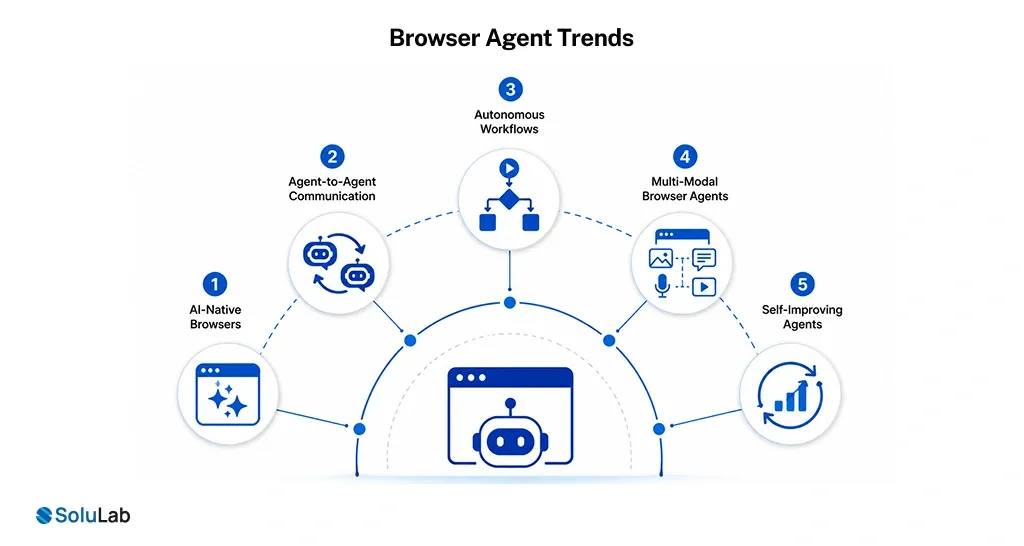
1. AI-Native Browsers
Browsers are being redesigned with AI built into the core experience, enabling intelligent navigation, automated task execution, and contextual assistance without relying on external tools.
2. Agent-to-Agent Communication
AI agents can collaborate with other specialized agents, sharing information and coordinating actions to complete complex workflows more efficiently across multiple applications and websites.
3. Autonomous Workflows
Modern AI browser agents can independently plan, execute, monitor, and optimize multi-step tasks, reducing human intervention while improving productivity and operational efficiency.
4. Multi-Modal Browser Agents
Agents combine text, voice, images, and visual understanding, enabling more natural interactions and allowing them to process diverse forms of web content.
5. Self-Improving Agents
Advanced agents learn from previous interactions and outcomes, continuously refining decision-making, improving task accuracy, and adapting to changing digital environments.
Best Practices for AI Browser Agent Development
Follow these practices for better AI browser agent development:
- Human-in-the-Loop Approvals: Require human validation for high-risk actions such as financial transactions, sensitive data updates, and compliance-related workflows to reduce errors and maintain oversight.
- Session Management: Implement secure session handling, token management, and automatic session renewal to ensure reliable and uninterrupted browser interactions.
- Credential Vault Integration: Store and manage credentials using secure vaults instead of hardcoding passwords, improving security and simplifying credential rotation.
- Audit Logging: Maintain detailed logs of agent actions, decisions, and workflow outcomes to support troubleshooting, compliance, and performance monitoring.
- Compliance Monitoring: Continuously monitor agent activities to ensure adherence to data privacy regulations, industry standards, and internal governance policies.
How can SoluLab help in building an AI browser agent?
SoluLab, as an AI native company, helps businesses design, develop, and scale AI browser agents tailored to enterprise workflows. Our expertise ensures secure, scalable, and high-performing automation solutions for modern digital operations.
- AI browser agent consulting
- Custom AI browser agent development
- Browser workflow automation solutions
- Enterprise browser automation integration
- Multi-agent workflow development
- AI agent testing and optimization
- Secure and compliant AI architectures
- Autonomous browser task automation
For example, SoluLab built UpdateIA, a multi-agent AI platform for a French startup, enabling 14+ autonomous agents coordinated by Jarvis. It unified enterprise workflows, reduced manual effort, ensured compliance, and improved real-time decision-making across HR, CRM, Finance, and Legal systems.

Conclusion
AI browser agents are changing how businesses interact with the web by combining decision-making, automation, and real-time adaptability.
From automating repetitive workflows to enabling complex multi-step tasks, browser agents are redefining enterprise productivity across industries.
By focusing on security, integration, scalability, and user experience, businesses can get significant operational value and competitive advantages.
If you’re looking to build a powerful browser agent solution, SoluLab, an AI development company, can help your business design, develop, and deploy enterprise-grade AI browser agents tailored to your needs.
FAQs
Neha is a curious content writer with a knack for breaking down complex technologies into meaningful, reader-friendly insights. With experience in blockchain, digital assets, and enterprise tech, she focuses on creating content that informs, connects, and supports strategic decision-making.