
Key Takeaways
- AI red teaming is the deliberate practice of attacking your own AI system before an outsider does, covering jailbreaks, data leaks, bias, and prompt injection.
- Standard software QA does not catch model-specific failures. A model can pass every functional test and still leak training data or agree to write malware if asked the right way.
- A working red team program has six stages: mapping the attack surface, building threat models, writing adversarial scenarios, running attacks, logging findings, and retesting after fixes.
- Red teaming is not a one-time launch gate. Models drift, prompts change, and new jailbreaks surface, so testing needs to repeat on a set cadence.
- Regulations including the EU AI Act increasingly expect documented adversarial testing for high-risk AI systems, making red teaming a compliance input as much as a security one.
A chatbot that answers customer questions correctly nine times out of ten can still be the reason a company ends up in the news for the wrong story. Maybe it hands over a discount code it was never supposed to reveal. Maybe a cleverly worded prompt convinces it to ignore its own safety instructions.
AI red teaming is how you find that failure mode on a Tuesday afternoon in a test environment, instead of discovering it on launch day through a screenshot on social media.
Traditional QA checks whether a feature works as designed. Red teaming checks whether a system can be made to misbehave by someone who is actively trying to break it. For large language models (LLMs) and AI agents, that difference matters more than most teams expect going in.
This guide walks through what AI red teaming actually involves, why it belongs in every launch checklist, and how to run a program that catches problems while there’s still time to fix them.
What Is AI Red Teaming?
AI red teaming is the structured practice of simulating adversarial attacks against an AI model or system to expose security flaws, unsafe behavior, and bias before real users or bad actors find them first. The term borrows from military and cybersecurity red teams, whose job is to think like an attacker rather than a defender.
For LLMs and generative AI specifically, red teaming looks different from a typical penetration test. A network pentester runs known exploits against a defined perimeter. An AI red teamer crafts prompts designed to manipulate a model’s behavior over a conversation, tests whether a document the model reads can hijack its instructions, and checks whether the system will hand over information or take an action it was never meant to. This is sometimes called adversarial testing AI teams run alongside standard QA, and it typically covers:
- Jailbreaks that bypass safety guidelines
- Prompt injection through user input or external content
- Training data or system prompt leakage
- Harmful, biased, or factually wrong outputs
- Misuse of tools or APIs an AI agent can call
Why Should You Red-Team an AI Model Before Launch?
Skipping this step doesn’t save time. It just moves the discovery of a serious flaw from a controlled test environment to a live product, where the cost of fixing it is much higher, and the audience watching is much bigger.
1. Detect Security Vulnerabilities
LLMs introduce attack surfaces that didn’t exist in traditional software, including prompt injection and system prompt extraction. LLM penetration testing-style red team exercises surface these before an attacker does.
Gartner’s Market Guide for AI Trust, Risk and Security Management notes that as AI systems act with more autonomy, the risks extend beyond a simple data breach to compliance exposure and stalled adoption, which is part of why runtime guardrails paired with red teaming are becoming central to enterprise AI security strategy.
2. Identify Harmful or Unsafe Outputs
A model can generate content that’s offensive, dangerous, or simply wrong under the right (or wrong) framing, even when it behaves well most of the time. Red teaming applies pressure specifically designed to surface those edge cases rather than waiting for them to show up in production feedback.
3. Prevent Sensitive Data Leakage
Models fine-tuned on proprietary data, or connected to internal knowledge bases through retrieval-augmented generation, can be coaxed into revealing information they were never meant to share. Testing this before launch is far cheaper than a disclosure after the fact.
4. Test Resistance to Prompt Injection
Prompt injection currently sits at the top of the OWASP Top 10 for LLM Applications, and it doesn’t require touching your infrastructure at all. An attacker can hide instructions inside a webpage, a PDF, or an email that your AI agent later reads and treats as a command. Red teaming is the primary way to find these paths before they’re exploited.
5. Reduce AI Compliance and Reputation Risks
Gartner has predicted that by 2027, more than 40% of AI-related data breaches will stem from the improper cross-border use of generative AI, as governance struggles to keep pace with adoption speed.
Separately, Deloitte’s 2025 Connected Consumer survey found that 82% of surveyed GenAI users believe the technology could be misused, up from 74% the year before, which shows how quickly public trust erodes when something goes wrong. A documented testing process gives you evidence of due diligence and a head start on emerging AI regulation.
How Does AI Red Teaming Work?
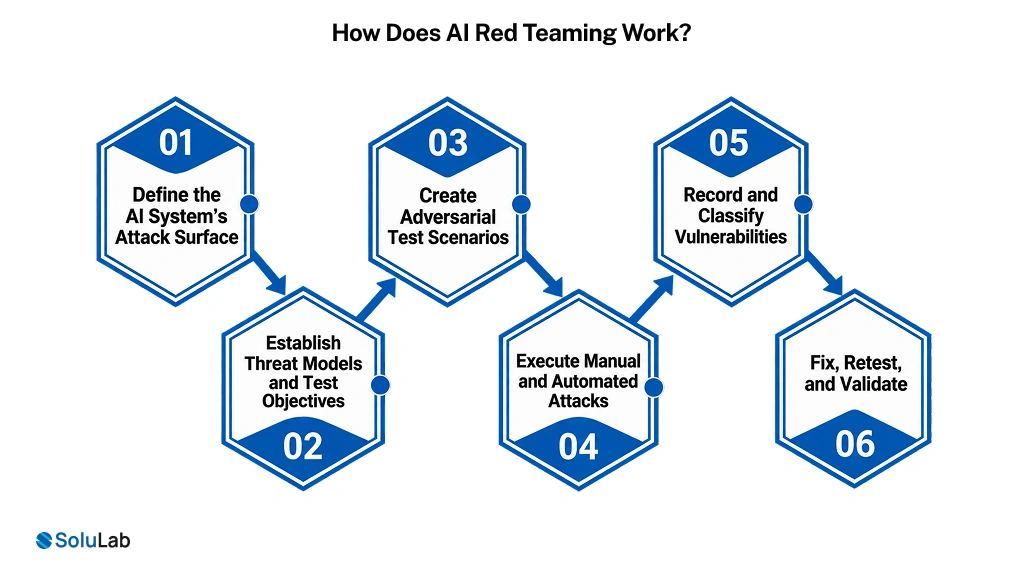
A red team engagement isn’t a single afternoon of typing tricky prompts into a chatbot. It’s a repeatable process, and skipping steps is usually where programs fall apart.
1. Define the AI System’s Attack Surface
Map every entry point: the chat interface, any APIs, documents the model can retrieve, tools an agent can call, and third-party plugins. You can’t test what you haven’t inventoried.
2. Establish Threat Models and Test Objectives
Decide what you’re actually defending against. A customer-facing support bot and an internal coding assistant have very different risk profiles, so the threat model should reflect who might attack the system and what they’d want out of it.
3. Create Adversarial Test Scenarios
Write specific prompts and scenarios tied to each threat: role-play attacks to bypass content filters, injected instructions hidden in uploaded files, multi-turn conversations that slowly erode a guardrail. This is the core of any LLM red team playbook.
4. Execute Manual and Automated Attacks
Run the scenarios using a mix of human testers, who bring creativity and context automated tools can’t replicate, and automated frameworks that can fire thousands of variations overnight. Neither approach alone is sufficient.
5. Record and Classify Vulnerabilities
Log every successful attack with severity, reproducibility, and affected component. Without structured documentation, findings tend to get fixed inconsistently or forgotten entirely once the launch deadline arrives.
6. Fix, Retest, and Validate
Patch the issue, whether that’s a system prompt change, a guardrail model, or input filtering, then retest the exact scenario that broke it. A fix that hasn’t been retested is just a hypothesis.
How to Implement AI Red Teaming Step-by-Step
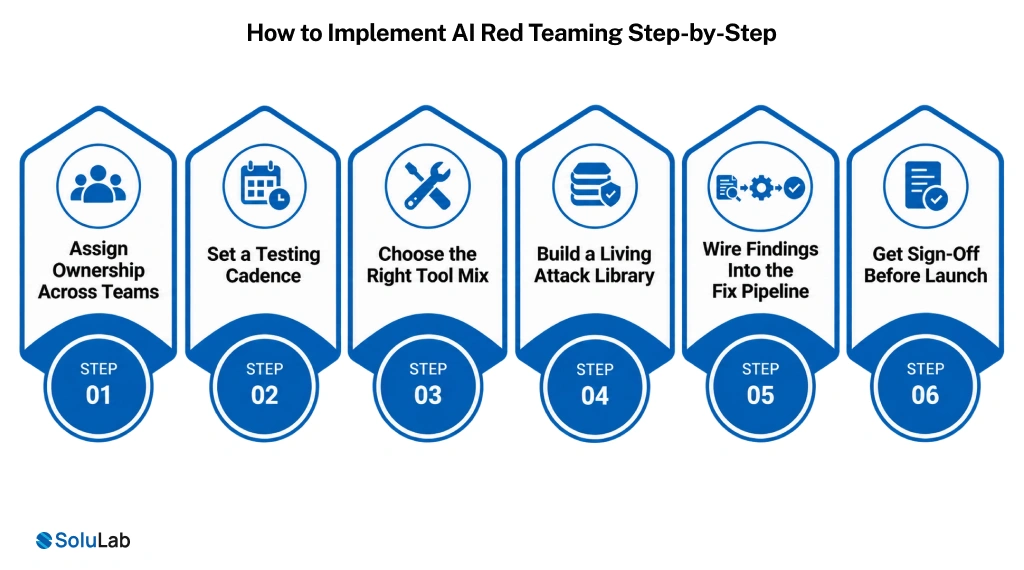
Running a red team program well comes down to a handful of operational decisions made early, before the first test case is written. Here’s a compact checklist covering the parts teams most often skip.
1. Assign Ownership Across Teams
Red teaming that lives only inside engineering tends to miss legal, brand, and policy risks that a security-only lens won’t catch.
- Name a single accountable owner
- Include legal and trust reviewers
- Loop in product early, not late
2. Set a Testing Cadence
A one-time pre-launch scan doesn’t hold up once the model, prompts, or connected data sources change.
- Test before every major release
- Re-test after model version changes
- Run lighter checks monthly
3. Choose the Right Tool Mix
No single tool covers every attack category, so pair automated coverage with human judgment.
- Use automated fuzzing frameworks
- Keep manual testers on staff
- Track new jailbreak techniques
4. Build a Living Attack Library
Reusing last year’s test cases against this year’s model wastes the exercise entirely.
- Log every successful attack
- Update scenarios each quarter
- Share findings across product lines
5. Wire Findings Into the Fix Pipeline
A vulnerability sitting in a spreadsheet nobody reads is not a fixed vulnerability.
- Route findings to engineering tickets
- Set severity-based fix deadlines
- Confirm fixes with a retest
6. Get Sign-Off Before Launch
Someone with authority to delay a launch should actually review the results.
- Require documented sign-off
- Escalate unresolved critical findings
- Archive results for compliance audits
Teams without in-house capacity for this often bring in an outside partner for an AI readiness assessment to benchmark where their current testing coverage stands before scaling further.
AI Red Teaming vs Traditional Security Testing
Is AI red teaming just penetration testing with a new name? Not quite. The two overlap at the infrastructure layer but diverge sharply once you get into the model itself.
| Aspect | Traditional Security Testing | AI Red Teaming |
| Target | Networks, APIs, code | Model behavior, prompts, agent actions |
| Attack style | Known exploits, CVEs | Novel, conversational, context-based |
| Skill set | Network and app security | Prompt engineering, ML understanding |
| Output stability | Deterministic (same exploit works reliably) | Probabilistic (same prompt may or may not work) |
| Common finding | Misconfiguration, unpatched software | Jailbreak, bias, data leakage, injection |
| Cadence driver | New CVEs, code changes | Model updates, prompt changes, new jailbreaks |
A security team that only runs traditional penetration tests against an AI product will pass the infrastructure check and still ship a model that hands out its system prompt to anyone who asks nicely. This is why AI safety evaluation increasingly sits alongside, not instead of, conventional application security testing.
What Techniques Are Used in AI Red Teaming?
Here are some techniques used in AI red teaming:
1. Manual Adversarial Prompting
Skilled testers craft prompts by hand, drawing on an intuition for how models respond to phrasing, tone, and framing that automated tools haven’t learned to replicate yet.
2. Automated Red Teaming
Purpose-built frameworks generate and run thousands of prompt variations, useful for coverage at scale, though they still need human review to catch subtle or context-dependent failures.
3. Multi-Turn Attack Testing
Some jailbreaks only work across several exchanges, where a model is gradually walked away from its guardrails one small, reasonable-seeming request at a time.
4. Role-Playing and Context Manipulation
Testers ask the model to adopt a persona or fictional scenario that removes its usual restrictions, a technique that remains one of the more reliable ways to bypass basic content filters.
5. Prompt Injection Testing
This covers both direct injection (typed straight into the chat) and indirect injection, where instructions are hidden inside a document, webpage, or tool output the model later processes as if it came from the user.
6. Adversarial Input Generation
Beyond text, this includes malformed inputs, unusual encodings, and edge-case formatting designed to confuse a model’s input parsing or trigger unexpected behavior.
7. Agent and Tool-Calling Tests
For AI agents that can browse, run code, or call APIs, testers check whether the agent can be tricked into calling a tool with harmful parameters or taking an action outside its intended scope. This category has grown fastest as agentic systems move into production, and it’s also where model stress testing overlaps most closely with traditional application security.
Read more: What is explainable AI
Common AI Red Teaming Mistakes to Avoid
Here are some mistakes to avoid in AI red teaming:
1. Testing Only the Base Model
The fine-tuning layer, system prompt, retrieval pipeline, and any connected tools all introduce their own risks. Testing the foundation model alone leaves the entire application layer unchecked.
2. Focusing Only on Jailbreaks
Jailbreaks get the headlines, but data leakage, AI bias testing gaps, and quiet factual errors cause just as much real-world damage and get far less testing attention.
3. Ignoring AI Agents and Connected Tools
An agent with API access, file system permissions, or the ability to send emails carries risk that a plain chatbot never had. Skipping agent-specific tests leaves the highest-impact attack surface untested.
4. Using Too Few Attack Scenarios
A handful of test prompts creates a false sense of security. Comprehensive coverage requires hundreds or thousands of scenarios across every threat category identified in the threat model.
5. Testing Once and Never Retesting
Models get updated, prompts get tweaked, and new jailbreak techniques circulate publicly within weeks of a model’s release. A test suite from six months ago tells you almost nothing about today’s risk.
6. Failing to Prioritize Critical Findings
Not every finding deserves the same urgency. Teams that treat a minor tone issue with the same priority as a data leak end up burning fix cycles on the wrong problems while the serious ones wait in the backlog.

Conclusion
AI red teaming isn’t a box to check before a demo. It’s the difference between finding a model’s failure modes on your own terms and finding out about them from a customer, a regulator, or a headline.
Building this capability from scratch, choosing the right mix of manual and automated testing, and keeping pace with new jailbreak techniques takes real, specialized effort.
SoluLab, an AI development company, can help your business design and run an AI red teaming program that fits your specific model, agents, and risk profile, from the first threat model through post-launch retesting.
FAQs
Neha is a curious content writer with a knack for breaking down complex technologies into meaningful, reader-friendly insights. With experience in blockchain, digital assets, and enterprise tech, she focuses on creating content that informs, connects, and supports strategic decision-making.