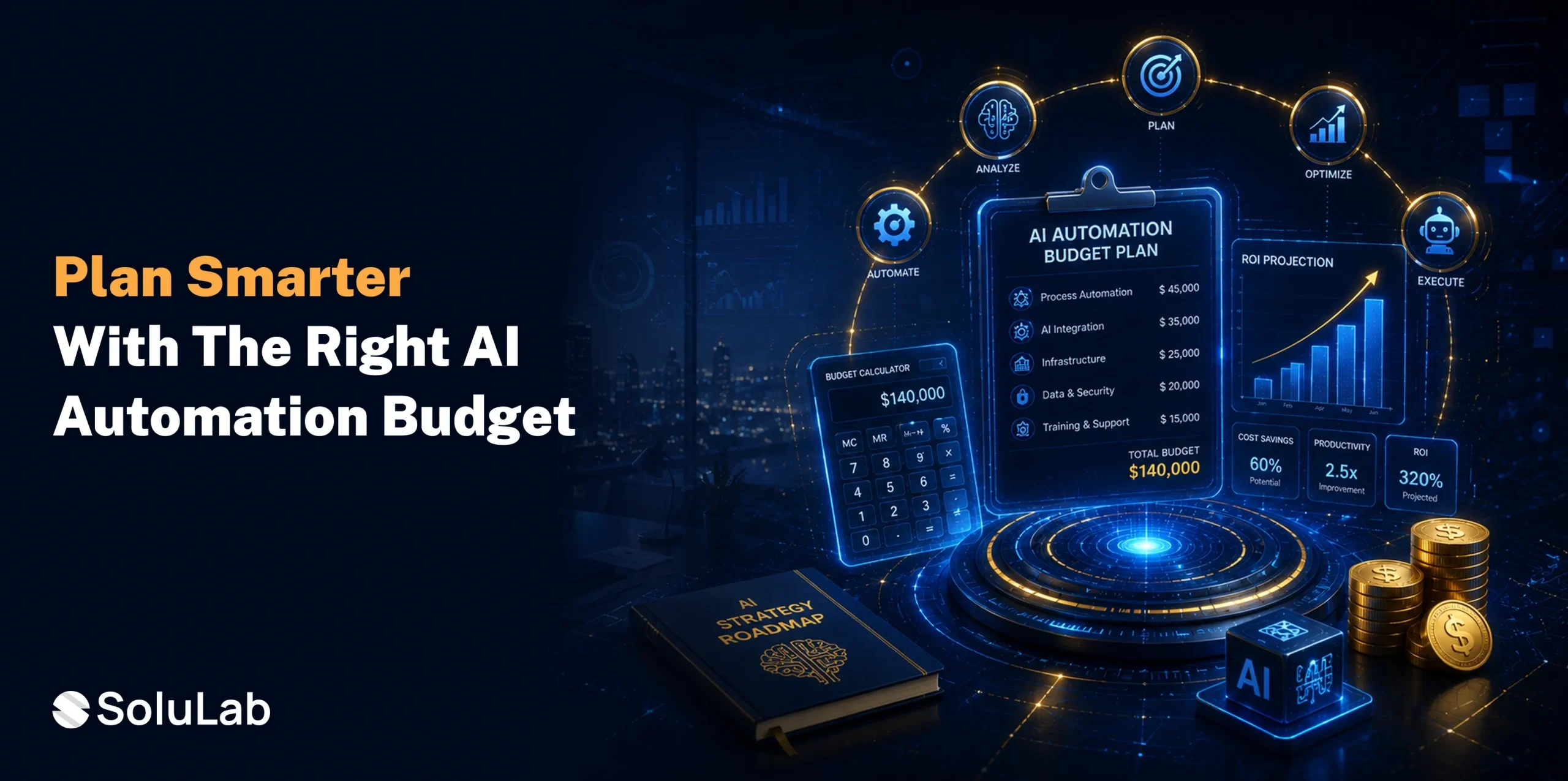
Ask ten small business owners what AI automation costs, and you’ll get two kinds of answers: a suspiciously precise number, or “it depends, book a call.” Neither is much use when you’re just trying to figure out if this is worth pursuing. So here’s the actual range: most small businesses spend $1,500 to $25,000 upfront, plus $50 to $2,000 a month ongoing, depending on how many workflows they are touching and whether they’re leaning on off-the-shelf tools or custom-built AI development solutions.
A single automated workflow, routing inbound leads, say, might run a few hundred dollars a month in software fees. Tie your CRM, invoicing, and support desk together with custom logic, and you’re looking at five figures.
The rest of this guide gets into where that money actually goes, what pushes the price up or down, and how to tell whether it’s worth spending in the first place — organized around the questions small business owners tend to search before they ever call an agency.
Key Takeaways
- Most small businesses land somewhere between $1,500 and $25,000 upfront for AI automation development, plus $50 to $2,000 a month to keep it running.
- What drives the price isn’t how big your company is, it’s how many systems you’re connecting, how messy your data is, and whether you’re in a regulated industry.
- The line item nobody budgets for is data cleanup, not software. If your records are inconsistent, tack on another 20–30%.
- Average returns hover around $3.70 back for every $1 spent, and most well-scoped projects pay for themselves in 3 to 6 months.
- Zapier and Make.com are fine for simple, linear tasks. Once the logic gets messy or the workflow can’t afford to break, that’s when custom development earns its price tag.
- Gartner is calling 2026 an “inflection year” for enterprise AI spending — and that surge is a big part of why automation tooling keeps getting cheaper even as it gets more capable.
- Pick one process, automate it well, prove it pays off, then move to the next one. Trying to automate everything at once is usually where budgets go sideways.
How Much Does AI Automation Cost For A Small Business?
Cost tracks with complexity, not company size. A five-person shop automating one workflow can end up spending less than a fifty-person company doing three or more, if that one workflow has to make sense of messy, unstructured data. In practice, the costs settle into three rough tiers.
| Tier | Setup cost | Monthly cost | Typical use case |
|---|---|---|---|
| DIY / no-code | $0–$3,000 | $50–$300 | Connecting 2–3 apps (Zapier, Make.com) with simple triggers |
| Consultant-built | $3,000–$15,000 | $200–$800 | Lead routing, client onboarding, and document processing with AI models |
| Custom development | $10,000–$25,000+ | $500–$2,000+ | Multi-system workflows, proprietary logic, compliance-heavy processes |
A handful of things reliably push a project toward the top of its tier:
- How many systems are involved? Wiring an email to your CRM is one thing. Orchestrating orders, invoicing, inventory, and shipping together is a different job entirely.
- How clean is your data? Duplicate records, inconsistent formatting, and information scattered across spreadsheets- expect to pay for cleanup before automation even starts. That alone can run $500 to $5,000.
- How much AI model usage do you need? Classification, drafting, and extraction usually add a small ongoing cost, often just $5 to $30 a month for a few hundred automated tasks. Usage-based model pricing is cheap next to the labor it’s replacing.
- Compliance. Healthcare, finance, and anything legal-adjacent means paying more for audit trails and documentation, even when the underlying workflow itself is simple.
If you’re trying to decide between a fully custom build and a pre-built platform, it helps to talk to someone who does both, from lighter-touch AI integration services up to full AI development. A good discovery call should be enough to tell you which tier your project actually belongs in, instead of defaulting to whichever one costs more.
Is AI automation worth it for small businesses?
For the right process, yes. But “AI automation” isn’t really one investment; it’s a bunch of separate bets on individual workflows, and some of those bets pay off a lot faster than others.
Industry benchmarks from IBM and Aerospike (2025) put the average return around $3.70 for every $1 spent, and small businesses automating high-volume, repetitive work tend to save 10–15 hours a week per workflow, with most reaching positive ROI in 3 to 6 months. Where it tends to fall flat is the opposite scenario: low-volume tasks, processes that keep changing month to month, or anything that genuinely needs human judgment, negotiations, vendor evaluation, that kind of thing.
Before you commit any budget, it’s worth running your own numbers through a quick gut check:
- What does the task cost right now? Hours spent × hourly rate, yours or an employee’s.
- What’s a realistic efficiency gain? 30–50% time savings is a fair assumption. If someone’s promising 10x, be skeptical.
- What’s the true first-year cost? Monthly fees times twelve, plus setup and training time.
- Divide total cost by monthly savings — that’s your payback period.
Under 6 months, the case is usually solid. Past a year, the workflow probably isn’t ready yet; either it needs more time to stabilize, or the underlying process needs fixing before automation makes sense.
What factors affect the cost of AI automation development?
Beyond the tiers above, there are three bigger forces shaping what AI automation actually costs small businesses right now, in 2026.
First, enterprise AI spending is accelerating faster than most people expected, and that’s reshaping the tools SMBs end up buying. Gartner forecasts worldwide AI spending will hit roughly $2.59 trillion in 2026 [a 47% jump year over year], and analyst John-David Lovelock has called this the “inflection year,” the moment mainstream enterprises, not just tech companies, start putting real money behind AI. That demand is part of what’s funding cheaper per-task API pricing and the wave of new no-code AI features showing up inside tools SMBs already use. It’s a big reason automation has gotten more affordable even as it’s gotten more capable.
Second, that spending isn’t staying theoretical — it’s showing up in real budget decisions. EY’s 2026 Technology Pulse Poll found that 95% of technology executives expect their AI spending to increase over the next year, up from 92% the year before, with back-office functions like IT, finance, and HR near the top of the list for new investment. For a small business, that matters practically: the vendors and consultants you’d hire are themselves scaling up how much they can deliver with AI assistance, which is part of why turnaround times have shortened even as project scope has grown.
Third, and this one gets glossed over, data preparation is usually the real cost driver, not software licensing. Estimates suggest up to 80% of the effort in an AI development project goes into gathering, cleaning, and organizing data before anything can act on it reliably. That’s why two businesses buying what looks like the “same” automation can end up with very different final bills.
What’s The Difference Between No-Code AI Automation And Custom AI Automation Development?
No-code platforms like Zapier and Make.com make sense when your workflow is linear, and your systems already have pre-built connectors — a form gets submitted, a CRM record gets updated, done. They’re quick to set up and cheap on day one, usually $10–$50 a month per platform.
Custom AI development starts to make more sense once:
- The logic isn’t linear anymore; decisions depend on multiple conditions or unstructured text
- Per-task fees on a no-code platform are creeping past what a custom build would cost at your volume
- The workflow is business-critical, and a broken integration going unnoticed isn’t an option
- You need the system to actually reason over documents, emails, or messages, not just shuffle data between fields
The rough rule of thumb: low volume and simple logic, stick with no-code. High volume or genuinely custom decision-making, go purpose-built, whether that’s an AI agent handling multi-step reasoning or a machine learning model trained on your own data.
How Do I Choose an AI Automation Development Company For My Smb?
A few questions tend to separate a scoped, fixed-price engagement from an open-ended one:
- Does the quote include data cleanup? If not, add 20–30% to whatever number they gave you.
- What’s actually included in ongoing costs? Some vendors lead with a low setup fee and quietly load the monthly retainer, or the reverse. Ask for the full first-year total, not just the headline figure.
- Who owns the workflows once they’re live? You should be able to maintain or move them yourself if you ever switch providers.
- What happens when something breaks? Get a specific response time and include fix hours in writing, not a vague promise.
- Is training part of the deal? Your team should be able to handle routine issues without calling support every time.
A partner willing to scope your actual workflow before quoting a price, instead of pitching a one-size-fits-all package, is usually the safer bet. That holds whether you’re looking at AI consulting services for a broader roadmap or a narrower generative AI build for one specific process.
Common Mistakes Small Businesses Make With AI Automation Costs
- Automating a process that isn’t stable yet. If your workflow has changed every month for the last six months, fix that first. Automating a moving target just means paying to maintain the chaos.
- Ignoring data cleanup until it becomes a crisis. Budgeting for the automation but not the data behind it is probably the single most common reason these projects run over.
- Comparing sticker price instead of total first-year cost. A cheap setup with an expensive monthly retainer can easily cost more over a year than a pricier setup with lean ongoing fees.
- Automating just because. The real question was never “should we automate”, it’s “which one process actually has the volume and stability to justify it right now.”
Conclusion
There’s no single number for what AI automation costs a small business; it’s a range shaped by how many systems you’re connecting, how clean your data already is, and whether the workflow needs simple orchestration or genuine decision-making. The businesses that get the most out of it aren’t the ones spending the most money. They’re the ones who pick one stable, high-volume process, automate it well, prove the payback, and only then move on to the next one.
If you’re trying to figure out which tier your business actually falls into and what a fixed, honest quote would look like, that’s a scoping conversation, not a guessing game.
Ready to find out what AI automation would actually cost for your business? Talk to SoluLab’s AI development team for a scoped assessment before you commit to a number.
FAQs
Shipra Garg is a tech-focused content strategist and copywriter specializing in Web3, blockchain, and artificial intelligence. She has worked with startups and enterprise teams to craft high-conversion content that bridges deep tech with business impact. Her work translates complex innovations into clear, credible, and engaging narratives that drive growth and build trust in emerging tech markets.