Key Takeaways
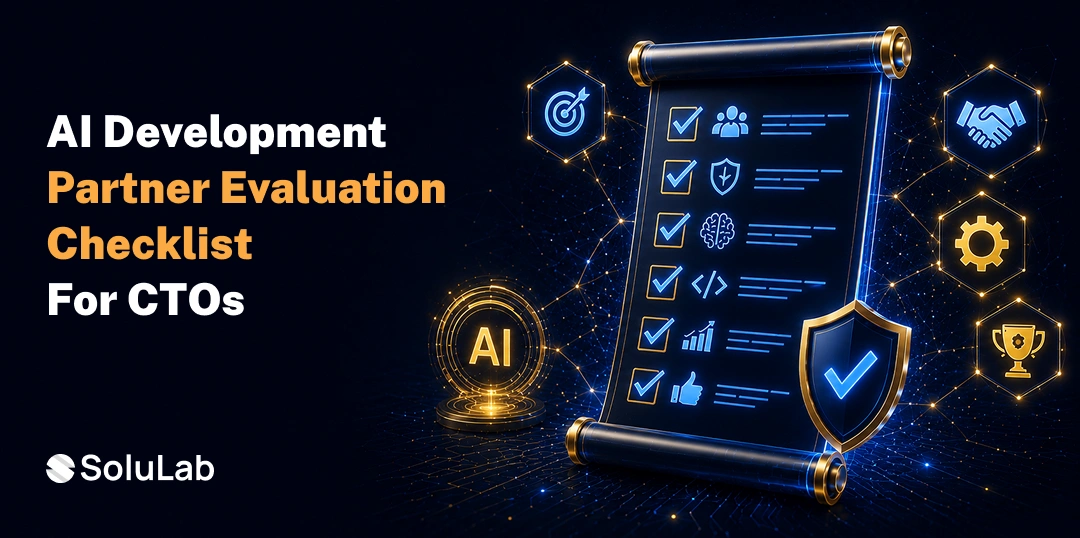
- Run eight gates in order. Lifecycle delivery, data architecture, readiness assessment, security and governance, domain depth, knowledge transfer, IP and exit terms, outcome-linked commercials.
- Ask the 24 questions in this guide verbatim. Vendors rehearse the generic ones. They don’t rehearse “walk me through your drift-detection pipeline.”
- A firm price in the first call is the loudest red flag. Nobody can quote an AI build before looking at your data.
- Knowledge transfer is the gate most CTOs skip and most regret. If your team can’t maintain the system six months after handover, you bought a dependency, not a capability.
- Get IP ownership and exit terms in writing before signing. Who owns the trained model, the fine-tuning data, and the retraining pipeline is a question that gets expensive later.
- The build is the smaller number. Model a 12-month run rate covering inference, monitoring, retraining, and compliance alongside every build quote.
- Match the partner to your stage. A seed MVP and an enterprise rollout are different jobs, and very few firms do both well.
To choose an AI development partner, run eight due-diligence gates in order: lifecycle delivery, data architecture, readiness assessment, security and governance, domain depth, knowledge transfer, IP and exit terms, and outcome-linked commercials. Stop at the first failure. Most AI budgets die at gates two and six.
Here’s the uncomfortable context. Gartner puts worldwide AI spending at $2.59 trillion in 2026, up 47%. McKinsey’s State of AI found 88% of organizations now use AI in at least one function, but only 39% can point to any enterprise-level EBIT impact. Spending isn’t the constraint. Execution is, and execution is what you’re buying when you hire an AI development company.
Why is 2026 a different kind of AI investment decision?
Because the buyer changed, and the failure mode moved.
For three years, AI spending was dominated by hyperscalers building infrastructure. Gartner now describes 2026 as the inflection year, when mainstream enterprises open their budgets for AI development and agent deployment. Worldwide IT services spending is set to surpass $1.87 trillion, and Gartner predicted in August 2025 that task-specific AI agents would reach 40% of enterprise applications by the end of 2026, up from under 5%.
So the market is crowded. Consultancies, dev agencies, and freelance platforms all claim agentic AI expertise, and nothing on a website tells you where a given vendor actually sits.
More importantly, the question you’re evaluating against has changed. In 2023, a CTO asked, “Can you build a model for this use case?” In 2026, the question is “can you deploy a system that survives data drift, integrates with our architecture, and improves after launch?” Those need completely different evidence. A vendor who can answer the first and not the second will still pass most RFPs, because most RFPs are still written for 2023.
What does choosing the wrong AI development partner actually cost?
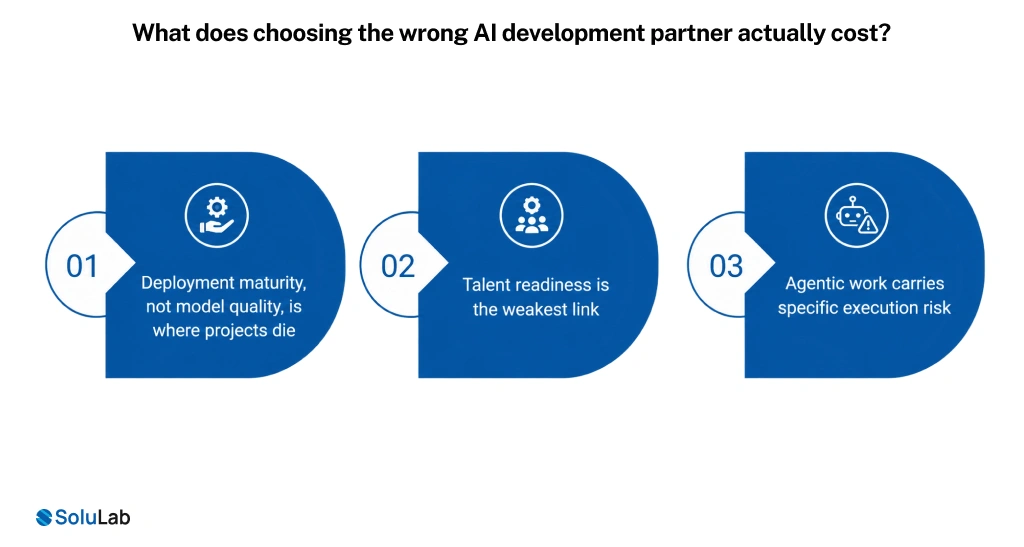
The cost isn’t a failed build. It’s a cancelled program six months later, nothing shippable, and a team that stops trusting AI projects.
Three data points frame the risk.
Deployment maturity, not model quality, is where projects die. MIT’s Project NANDA reported in 2025 that roughly 95% of enterprise generative AI pilots produced no measurable P&L return. Treat that headline with some care: the study was preliminary, wasn’t peer reviewed, used a small interview base, and defined failure narrowly as no measurable revenue or profit impact inside about six months. Plenty of pilots in that 95% were useful but never baselined. The direction still holds, and the useful part isn’t the number. It’s the diagnosis. Failure clustered around data readiness, workflow integration, and the absence of a defined outcome before the build started. All three are things your partner either forces you to fix or lets you skip.
Talent readiness is the weakest link. In Deloitte’s State of AI in the Enterprise, only 20% of organizations rate themselves highly prepared on talent, down four points year over year. Most companies can’t reliably design, ship, and operate production AI in-house. Pick a partner without genuine bench strength, and you’ve imported the same gap wearing a different logo.
Agentic work carries specific execution risk. Gartner predicted in June 2025 that over 40% of agentic AI projects will be cancelled by the end of 2027, citing escalating costs, unclear business value, and inadequate risk controls. Note the date. That window is now well underway, which makes it a live constraint rather than a forecast. Meanwhile, 85% of companies expect to customize AI agents to their own workflows, and only 21% report mature governance for autonomous agents.
Put those together, and the risk isn’t that the technology fails. It’s that the wrong partner, process, or scope turns a promising pilot into a line item someone kills at the next budget review.
The eight due-diligence gates: what should a CTO evaluate before signing?
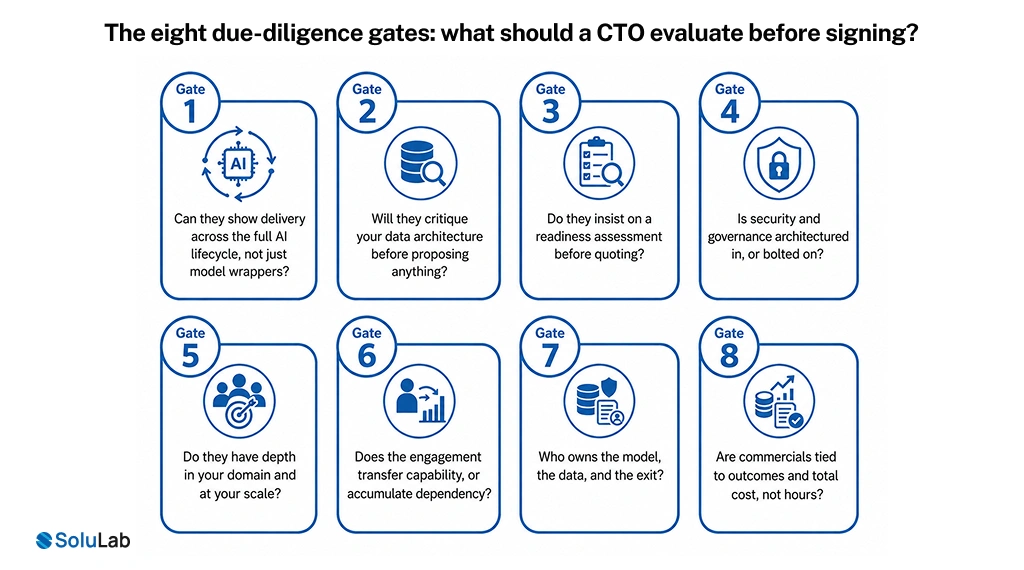
Treat this as technical due diligence, not a sales conversation. Run the gates in order. A vendor who can’t clear gate one doesn’t need to reach gate six.
Under each gate are the questions to ask verbatim, and the answer pattern that should end the conversation. Vendors rehearse the generic questions. They don’t rehearse these.
Gate 1. Can they show delivery across the full AI lifecycle, not just model wrappers?
Plenty of firms marketing themselves as AI development companies are building thin interfaces over third-party APIs. The distinction that matters is between firms that build models and firms that build systems that keep working.
Ask this:
- Walk me through your drift detection and retraining pipeline on a system you currently run in production.
- Show me an evaluation set from a live engagement. Not a slide about evaluation, the actual set.
- What percentage of your engagements reached production versus stopping at PoC?
Fails if: MLOps is “phase two.” Monitoring is manual. The word prototype appears more often than production. They pivot to how fast they can stand up a chatbot demo.
Gate 2. Will they critique your data architecture before proposing anything?
This is where more budgets die than anywhere else, and it’s the gate most CTOs run last instead of second. A partner who can’t evaluate your data honestly will build a model on a foundation that won’t hold it.
Ask this:
- Look at our current data infrastructure and tell me where the gaps are, before you propose a solution. Be specific.
- How do you handle feature engineering when training data and production data come from different systems?
- What’s your position on feature stores and data versioning for a system this size?
Fails if: answers stay at the level of “data quality matters.” Pipeline architecture isn’t discussed until after the contract. Nobody asks to see a schema.
Gate 3. Do they insist on a readiness assessment before quoting?
A credible partner refuses to commit to a build before assessing data availability, integration points, security requirements, and a realistic definition of what version one should do.
Ask this:
- What would have to be true for this project to fail? Name three things.
- What do you think we’re underestimating about this deployment, based on what you know about our sector?
- What does version one deliberately not include, and why?
Fails if: you get a firm price and timeline in the first call. That isn’t confidence, it’s a vendor who hasn’t looked at your data. It’s the single loudest red flag on this list.
Gate 4. Is security and governance architectured in, or bolted on?
For regulated or sensitive data this is binary. Certifications alone prove little, so pair them with the operational questions most vendors haven’t rehearsed.
Ask this:
- Where does inference data live, is it retained by the model provider, and who can access it during training?
- Walk me through your audit trail: model inputs, outputs, bias testing protocol, and human escalation triggers.
- What’s your data deletion policy for training data, and what contractual protection do we have?
Fails if: governance is a pre-delivery compliance step rather than an architectural requirement. SOC 2 or ISO 27001 can be named but not evidenced. Regulatory exposure is framed as your legal team’s problem.
Gate 5. Do they have depth in your domain and at your scale?
Generic competence doesn’t transfer. A fintech fraud model, a clinical triage assistant, and a retail recommender fail in completely different ways, and the failure modes are where the engineering effort goes. Scale matters just as much: a seed MVP and a Fortune 500 rollout are different jobs.
To make this concrete, here’s what depth sounds like from the inside. On a fraud-detection build for a digital bank, SoluLab’s team worked with TensorFlow, Kafka, Redis, and FastAPI against live transaction streams, landing at 92% detection accuracy with a 58% reduction in fraud losses and 67% faster investigation. The accuracy number was never the hard part. Getting false positives low enough that the compliance team would actually act on the alerts was, and that constraint shaped the architecture more than the model choice did.
Ask this:
- Show me two projects in our industry with similar data constraints and integration complexity. Walk me through the specific decisions.
- What are the failure modes in our sector, and how do you architect against them?
- Give me two references at our company size and stage, not just our industry.
Fails if: industry references are all from adjacent sectors. Regulatory or workflow constraints can’t be discussed without going away to research them. Every reference is 10× your size or 10× smaller.
Gate 6. Does the engagement transfer capability, or accumulate dependency?
This is the gate almost nobody runs, and the one CTOs most often regret skipping. If your team can’t maintain and extend the system six months after handover, you didn’t buy a capability. You bought a subscription with a build fee attached.
Ask this:
- Show me how knowledge transfer was structured in a past engagement. What was transferred, to whom, and how was it validated?
- After this ends, what exactly does our team need in order to retrain, monitor, and extend this without you?
- Which competencies will our engineers have to demonstrate before you consider the handoff complete?
Fails if: knowledge transfer is “included” with no structured programme, no validation, and no milestones. The honest tell is when the answer to “what happens if we don’t renew?” requires them to stay engaged.
Gate 7. Who owns the model, the data, and the exit?
Ask this before the SOW is drafted, not during redlines. The answers get expensive to change later.
Ask this:
- Who owns the trained model weights, the fine-tuning dataset, and the retraining pipeline when the engagement ends?
- If we leave in 18 months, what format do we get our artifacts in, and how long does migration take?
- Can we run this on our own infrastructure without your tooling? Show me what breaks if we do.
Fails if: IP is “standard, we’ll cover it in the contract.” Models run only inside proprietary tooling. There’s no documented exit path, or asking for one causes visible discomfort.
Gate 8. Are commercials tied to outcomes and total cost, not hours?
CTOs are under real pressure to show measurable ROI, so the commercial structure matters as much as the technical one. And the build quote is the smaller half of the number.
Ask this:
- For a comparable engagement, what business KPI did you track alongside model accuracy, and how was success defined with the client?
- When a model hit its technical target but the business metric didn’t move, what did you do? Give me a real example.
- Give me a 12-month run-rate estimate alongside the build quote: inference, monitoring, retraining, compliance.
Fails if: success is defined only in technical terms. ROI discussion is deferred to post-delivery. They can’t or won’t produce a run-rate number, which tells you they’ve never been on the hook for one.
What should the vendor be asking you?
Flip the evaluation. The questions a partner asks in the first two calls tell you more than the answers they give, because you can’t fake curiosity about a business you haven’t thought about.
A partner worth signing will ask about the decision the system is meant to change and who currently makes it, what the baseline is today and whether anyone measures it, what happens when the model is wrong and who absorbs that cost, which internal team will operate this after launch, and what your data actually looks like rather than what your data dictionary claims.
A partner not worth signing will ask about your budget, your timeline, and which competitor you’re also talking to. That call is qualification, not discovery. There’s nothing wrong with a vendor qualifying you, but if three calls in, nobody has asked to see a schema, you’re being sold to rather than scoped.
Which type of AI development partner fits your stage?
Most of the “in-house vs agency vs specialist” advice online assumes an enterprise buyer. That’s not the only buyer, and the right answer changes a lot by programme maturity.
| Your stage | Use case profile | Partner type that fits | Risk to avoid |
| Pre-seed / seed MVP | One use case, validating an idea, tight runway | Specialist AI firm willing to scope down, or a small senior team | Being sold enterprise-grade complexity you won’t need until Series B |
| Exploration / pilot | Single use case, low regulatory load, internal data | Boutique AI consultancy or specialist ML firm | Paying enterprise rates for pilot-stage delivery |
| Proof of value | Two or three use cases, business case established | Mid-size AI engineering firm with a real MLOps practice | A vendor who ships models but not production systems |
| Production scaling | Multiple use cases, complex integration, regulated | Full-lifecycle partner with domain depth | A partner whose ceiling is below your production requirements |
| Capability building | Internal AI team forming, knowledge transfer is the point | Hybrid: delivery plus a structured transfer programme | Dependency accumulation with no transition plan |
Building entirely in-house stays valid in one specific case: your AI capability is the product, and you have the runway to hire against a market where only 20% of organizations rate their talent ready. Even then, most teams use a partner for version one and the surrounding infrastructure, then absorb it as they hire AI developers of their own. That hybrid is the most common shape we see, and usually the right one.
What does an AI engagement actually cost over 12 months?
Most vendor comparisons stop at the build quote. That’s the smaller number, and comparing two vendors on build price alone is how teams pick the more expensive one by accident.
Here’s the cost structure to model before signing. Percentages are directional and shift with use case, but the shape holds across most production AI systems.
| Cost line | When it hits | Roughly what share of year one | Who usually forgets it |
| Build / implementation | Months 0–4 | The quoted number | Nobody |
| Inference and compute | Ongoing from launch | Often 15–40% of the build cost annually, and it scales with usage, not headcount | Almost everyone |
| Monitoring and observability | From launch onward | Small in licence terms, meaningful in engineering time | Teams without an MLOps practice |
| Retraining and evaluation refresh | Quarterly or on drift | A recurring engineering cost, not a one-off | Teams whose contract ended at deployment |
| Data pipeline maintenance | Continuous | Grows as source systems change | Teams who treated the data audit as a formality |
| Compliance and audit upkeep | Annual, plus on incident | Concentrated in regulated sectors | Teams who bolted governance on |
The practical move is simple. Ask every shortlisted vendor for a 12-month run-rate estimate alongside the build quote, and compare the totals. Their willingness to produce one is itself a signal. A partner who has operated systems past launch will have the number close to hand. A partner who hasn’t will treat the question as premature.
What mistakes do CTOs make most often when buying AI development?
Treating AI development like standard software outsourcing. AI systems need ongoing evaluation, retraining, and monitoring long after launch. A contract that ends at deployment sets the system up to degrade quietly, and nobody notices until a user complains. Budget for MLOps services from day one, not as a phase two line item.
Skipping the data audit. Teams routinely discover mid-build that the data needed to train or ground the model doesn’t exist in usable form. That belongs in gate two, not sprint three.
Chasing the newest model instead of the right one. Model choice should follow cost, latency, and accuracy for your use case, not which foundation model made headlines that month. A smaller model with good retrieval beats a frontier model with no grounding most of the time, at a fraction of the inference cost.
Meeting the sales team instead of the engineers. Ask to speak with the specific ML engineers and MLOps specialists who will be on your engagement, before signing. If the people in the pitch aren’t the people on the project, you’re evaluating a different team than the one you’ll get.
Underestimating change management. Deloitte’s research shows the talent and process side lags the technology side badly. A partner who only ships code, without helping your team operate and trust the system, leaves the hardest part of the job undone.
What should seed-stage founders do differently?
Seed-stage companies run the same decisions with far less margin, because a wasted development cycle burns a meaningful share of runway.
Three priorities change. Speed to a working MVP beats architectural elegance. The architecture still has to survive to Series A without a rewrite, which rules out the fastest shortcuts. And you need a partner willing to scope down rather than upsell complexity a two-person company won’t need for two years.
That third one is the filter, and it’s the fastest way to sort a shortlist. Send the same brief to three vendors. A vendor who responds to a seed-stage brief with an enterprise-grade proposal is telling you which client they’d rather have.
Two gates matter more than the others at this stage. Gate seven, because if you don’t own your model and data, your Series A diligence gets awkward. And gate eight, because inference costs that are trivial at 500 users are not trivial at 50,000, and that curve arrives right when you’re raising.
SoluLab works with founders through a structured discovery process to validate the idea, scope an AI MVP against actual seed-stage constraints, and build on an architecture that scales later without a rebuild.
Worth reading alongside this is the difference between a PoC, a prototype, and an MVP, which is where most seed-stage scoping arguments start.
How long until an AI development investment shows value?
For a scoped MVP or PoC, expect a working system in 8 to 12 weeks and a defensible read on business value about a quarter after launch. Enterprise AI deployments with legacy integration and governance review typically take two to three quarters to reach production value.
Be suspicious of anything faster. A two-week AI launch is a demo, and demos don’t survive the first month of real traffic.
One thing that genuinely does compress the timeline: having the baseline measured before the build starts. MIT’s diagnosis of stalled pilots keeps returning to this. Teams that couldn’t prove value often hadn’t recorded what “before” looked like. That’s a week of work at the start and it’s the difference between a renewable programme and an unprovable one.
The pre-signing checklist
You should be able to tick every box before signing. Each line maps to a documented failure mode.
Technical validation
- Reviewed a production system reference, not a PoC or demo
- Observed drift monitoring on a system the partner currently maintains
- Had them critique your data architecture with a specific, unprompted gap
- Tested domain depth with scenario questions rather than capability claims
- Confirmed stack compatibility with your existing architecture
Governance validation
- Confirmed the governance framework, audit trail, and explainability approach
- Reviewed security documentation: encryption, access control, deletion policy, SOC 2 or ISO 27001
- Confirmed compliance competence for your specific regime (HIPAA, GDPR, PCI-DSS, SOX)
- Validated bias testing protocol and human escalation triggers
Commercial validation
- Milestone-based delivery with an outcome KPI at each stage
- Knowledge transfer programme with named competency checkpoints
- IP ownership settled for model weights, training data, and pipeline
- Exit terms documented: artifact formats, migration timeline, support during transition
- 12-month run rate modelled alongside the build quote
Alignment validation
- Met the actual engineers who will do the work
- Two references at your company size and stage, called and asked what went wrong
- Post-deployment support model agreed: SLA, monitoring owner, drift response
Don’t choose an AI development partner based on a demo alone!
Partner with SoluLab for the technical expertise, engineering discipline, and AI capabilities required to take complex initiatives from PoC to production.
How to choose an AI development partner: your next three steps?
The AI development market has more capital, more vendors, and more genuine capability than at any point before it. The data keeps pointing at the same gap: spending is outpacing readiness, and most organizations still can’t tie AI to the bottom line.
So the highest-leverage decision isn’t how much to spend. It’s who to spend it with, and how hard you’re willing to press before you sign.
Run the eight gates in order. Ask the 24 questions verbatim. Get the run-rate number, the IP terms, and the exit path in writing.
Comparing partners more broadly? Start with SoluLab’s AI development company overview, or see how AI consulting differs from build work.
FAQs
Shipra Garg is a tech-focused content strategist and copywriter specializing in Web3, blockchain, and artificial intelligence. She has worked with startups and enterprise teams to craft high-conversion content that bridges deep tech with business impact. Her work translates complex innovations into clear, credible, and engaging narratives that drive growth and build trust in emerging tech markets.