Key Takeaways
- Value and benefit are different things. Value is the business number. Benefit is the mechanism underneath it. A fast model answering the wrong question adds benefit without value.
- AI risks are operational, not exotic. Bias, hallucination, leakage, drift, security and over-reliance. Each one maps to a known control.
- AI risk mitigation is continuous, not a launch checklist. Drift and data exposure surface weeks after go-live, so controls must run on a schedule.
- Name one governance framework and align to it. NIST AI RMF works as an operating model. ISO/IEC 42001 certifies. The EU AI Act is an obligation rather than a choice.
- Diffuse ownership is itself a risk. When everyone is responsible, nobody signs off. Assign a model owner, data owner, security lead, legal contact and business owner.
- Someone must accept residual risk in writing. That single step turns hoping the model behaves into a documented decision to ship.
- Deployment and monitoring fail most builds. Both need engineering wired into the release pipeline, because a policy document cannot enforce a gate.
AI creates value by doing work faster, at scale and around the clock. Its risks, namely bias, hallucination, data leakage and model drift, are real. However, they are mostly manageable through AI risk mitigation: governance, human oversight and monitoring. Handled well, the benefits persist. Therefore value, risk and benefit are decided by how you deploy AI, not whether you deploy it.
Most guides treat these four ideas separately. This one connects them, because the decision a leader actually faces is not “AI or no AI.” Instead, it is “which controls make the value worth the risk?” SoluLab builds AI systems with those controls wired in from the start, as set out on our AI development company page.
On this page: the four sources of AI value, six operational risks, the controls that work, how value and risk map together, the governance frameworks worth naming, who owns the risk, lifecycle coverage and a four-question go or no-go test.
What Value Does AI Actually Create?
AI creates value by producing a business outcome you could not get as cheaply or quickly before. For example: a decision made in seconds, a document drafted in one pass, a support queue cleared overnight.
There are four repeatable sources of AI value.
Speed. Tasks that took hours, such as summarising a contract or triaging a ticket, resolve in seconds.
Scale. One model serves thousands of concurrent requests, so output rises without matching headcount.
Availability. Systems run overnight, at weekends and across time zones without a shift schedule.
Decision support. Models surface patterns in data that a person would miss, or would take days to find.
Value shows up as a business number: revenue retained, cost avoided, cycle time cut. Meanwhile, benefit is the mechanism underneath it. When you build the case for a project, name the value in dollars or days, then trace it back to the benefit that delivers it. If you cannot draw that line, the project is a demo rather than an investment.
What Are the Real Risks of AI?
The real risks of AI are operational rather than exotic. They come from how models behave in production. Six show up on almost every enterprise build.
Bias. A model trained on skewed data reproduces that skew in hiring, lending or triage decisions.
Hallucination and inaccuracy. Generative models state wrong facts confidently, especially outside their training data.
Data privacy and leakage. Sensitive inputs can end up in logs, prompts, or a third-party provider’s systems.
Model drift. Accuracy degrades as real-world data shifts away from training data. Stanford HAI defines drift as performance degrading because the data a model encounters has changed (Stanford HAI).
Security. Prompt injection, model theft and poisoned training data are attack surfaces a traditional app does not have.
Over-reliance. Teams stop checking outputs, so a small error compounds before anyone notices.
None of these require a research lab to manage. Instead, each maps to a known control. The mistake is treating AI risk as a single fuzzy fear rather than a short list of specific, addressable failure modes.
Which AI Risk Mitigation Strategies Actually Work?
The AI risk mitigation strategies that work map one control to each risk, then run those controls continuously rather than once at launch. There is no single fix. Instead, there is a stack.
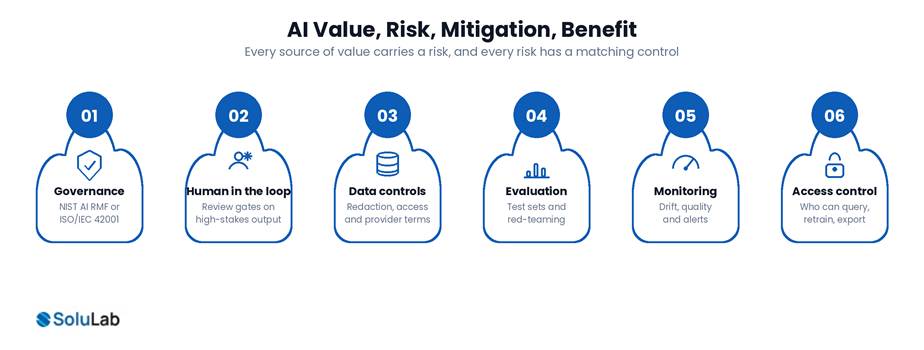
1. Governance framework. Adopt a named standard so controls are defined, assigned and auditable.
2. Human in the loop. Route high-stakes outputs to a person before they reach a customer or a system of record.
3. Data controls. Redact sensitive fields, restrict what reaches a prompt, and confirm where a provider stores data.
4. Evaluation and testing. Score models against a held-out test set, then red-team for bias and prompt injection.
5. Monitoring. Track output quality, latency and drift in production, with alerts when a metric moves.
6. Access control. Limit who can query, retrain or export the model, and log every privileged action.
Crucially, these are not launch-day checkboxes. Drift and data exposure appear weeks after go-live, so the controls have to run on a schedule. SoluLab wires evaluation and monitoring into the deployment pipeline itself, as described on our AI deployment services page.
How Do Value, Risk and Mitigation Fit Together?
They fit together as a single chain. Each source of value carries a specific risk. In turn, each risk has a matching control, and applying that control preserves the benefit instead of forcing you to give up the value.
| AI value (outcome) | Associated risk | Mitigation | Benefit retained |
| Faster customer support | Hallucinated or wrong answers | RAG grounding plus human review of edge cases | Lower cost per ticket, accuracy kept |
| Scaled document processing | Data leakage of sensitive fields | Redaction, access control, provider data terms | High throughput, confidentiality kept |
| Automated decisions | Bias against protected groups | Bias testing plus human sign-off | Consistent decisions, fairness kept |
| Always-on analysis | Model drift over time | Production monitoring plus scheduled retraining | Reliable insight, accuracy kept |
| Faster drafting | Over-reliance, unchecked errors | Review gates plus evaluation scoring | Faster cycles, quality kept |
Read any row left to right and you get the argument for a project in one line. Read the table top to bottom and you get an implementation checklist. Consequently, this is the artefact to bring to a go or no-go meeting.

Which Governance Frameworks Should Guide AI Risk Mitigation?
Three frameworks give AI risk mitigation a defined structure, so controls are named, assigned and auditable rather than improvised. You do not need all three. However, you should name at least one and align to it deliberately.
NIST AI Risk Management Framework. A voluntary US framework built on four functions: Govern, Map, Measure and Manage.
ISO/IEC 42001:2023. The first AI management system standard, specifying requirements for establishing and improving an AI management system.
EU AI Act. A risk-based regulation that classifies AI systems by risk level and imposes obligations accordingly.
The practical move is to pick a backbone, then map your controls to it. NIST AI RMF works well as an internal operating model, because its four functions translate directly into who does what. Meanwhile, ISO/IEC 42001 is the choice when you need a certifiable system an auditor will recognise. Confirm current framework versions and any enforcement dates that apply in your jurisdiction before you publish a compliance claim.
Who Owns AI Risk Inside an Organisation?
AI risk is owned by named roles, not by the AI team in general. Diffuse ownership is itself a risk, because when everyone is responsible, nobody signs off. Therefore a workable split assigns each risk category to a clear owner.
Model owner. Accountable for model performance, evaluation results and drift monitoring.
Data owner. Accountable for training and input data quality, provenance and privacy handling.
Security lead. Accountable for access control, prompt-injection defence and model integrity.
Legal and compliance. Accountable for regulatory alignment and contract terms with model providers.
Business owner. Accountable for the value case and for accepting residual risk on behalf of the business.
The business owner role matters most, yet it gets skipped most often. Someone has to accept the risk that remains after controls, in writing, so the decision to ship becomes explicit. In short, that step turns “we hope the model behaves” into “we decided the residual risk was acceptable.”
How Does AI Risk Mitigation Work Across the Lifecycle?
AI risk mitigation runs across four lifecycle stages, with a different control focus at each. Treating it as a one-time review misses the risks that only appear later.
1. Data stage. Check provenance, redact sensitive fields, and test the dataset for bias before any training.
2. Model stage. Evaluate against a held-out test set, red-team for prompt injection, and document known limitations.
3. Deployment stage. Add human-review gates for high-stakes outputs, enforce access control, then set rate limits and logging.
4. Monitoring stage. Watch output quality and drift in production, alert on metric shifts, and schedule retraining or rollback.
The stages that fail most builds are deployment and monitoring, because both need engineering wired into the release pipeline rather than a document. This is where a build-and-deploy partner earns its place. SoluLab’s enterprise AI development practice builds these gates into the pipeline, so mitigation is enforced automatically rather than remembered manually.
How Do You Weigh AI Value Against Risk?
You weigh AI value against risk with a short, repeatable framework. Estimate the value, list the risks, cost the controls, then compare residual risk to the value. Run it in four questions.
1. What is the value, in dollars or days? If you cannot quantify it, scope the project as a pilot.
2. What are the top three risks? Name them from the list above, specific to this use case.
3. What does each control cost? Human review, monitoring and testing all take time and money, so price them in.
4. Is the residual risk acceptable to the business owner? After controls, what could still go wrong?
Take a real scenario. An AI support assistant drafts replies to customer tickets. The value is faster response and lower cost per ticket. Meanwhile, the top risk is a confidently wrong answer reaching a customer. The control is RAG grounding on your own help content, plus a human-review gate for low-confidence output. The residual risk is a rare wrong answer on an unusual question, which the business owner may accept because a human catches flagged cases. That is a shippable project.
Where Does SoluLab Fit?
SoluLab builds AI systems with governance, human oversight, evaluation and monitoring wired in from the first sprint. Rather than writing a policy and hoping teams follow it, we put the gates in the pipeline, so AI risk mitigation is enforced by the system itself.
For build and strategy, see our AI development company page. For the deployment and observability side, our AI deployment services cover monitoring, drift detection and cost visibility after launch.
Frequently Asked Questions
Shipra Garg is a tech-focused content strategist and copywriter specializing in Web3, blockchain, and artificial intelligence. She has worked with startups and enterprise teams to craft high-conversion content that bridges deep tech with business impact. Her work translates complex innovations into clear, credible, and engaging narratives that drive growth and build trust in emerging tech markets.