If you talk to European bank leaders today, most will say the same thing: margins are tight, compliance is heavier, and operations are under pressure to do more with less. The European Banking Authority notes that AI adoption has moved beyond pilots, with most EU banks now using AI methods like NLP and neural networks in production.
With only 2% of financial institutions reporting no AI use. Generative AI (GenAI) adoption in banks has surged from 5% in late 2024 to a projected 80% by the end of 2026. At the same time, the EU AI Act is now fully in force, which means every AI initiative in a bank or financial institution must be designed for traceability, documentation, and auditable control from day one.
This is where AI agents for compliance, operational efficiency, and risk & compliance become strategically important, not just as chatbots but as task‑oriented agents that continuously monitor, reason, and act across your risk, compliance, and operations stack.
Key Takeaways
- The problem: European regulation is tightening fast – EU AI Act, DORA, GDPR, AMLD, ESG, while AI is already embedded in core banking, creating new model, operational, and third-party risks that most teams are not set up to manage at scale.
- The solution: Deploy focused AI agents that sit directly inside risk, compliance, and ops workflows, integrate with existing systems, and continuously handle monitoring, controls, reviews, and escalation with full explainability and auditability.
- How we help: SoluLab,as an AI agent development company, turns EU regulatory requirements into production-grade agent platforms for banking – covering KYC, risk signals, policy mapping, and human-in-the-loop governance, built for real operations, not pilots.
How European Institutions Are Actually Using AI Agents Today?
If you look under the hood at leading banks and large enterprises in Europe, the way they use artificial intelligence is far more practical than the marketing suggests. You’ll find AI agents quietly embedded in day‑to‑day workflows rather than only in flashy customer apps.
Common patterns include:
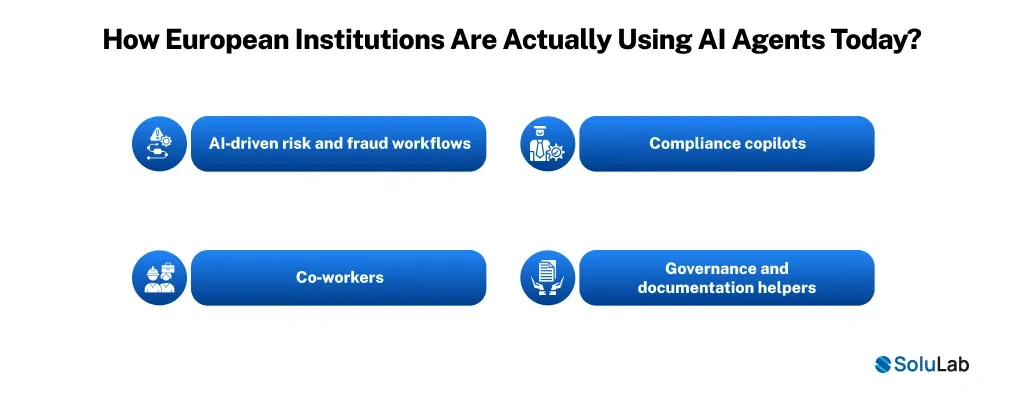
- AI‑driven risk and fraud workflows: agents that read transaction streams, behavior patterns, device information, and external signals to flag suspicious activity, often ahead of traditional rules.
- Compliance copilots: agents that digest regulatory updates, internal policies, and control libraries, helping compliance teams perform gap analysis, collect evidence, and prepare reports.
- Co‑workers: agents that verify documents, reconcile data, route tickets, and support human teams with suggested actions in customer service or back‑office operations.
- Governance and documentation helpers: agents that support EU AI Act obligations by tracking AI agent use cases, generating technical documentation, and maintaining audit trails across systems.
Research on EU banks shows that institutions that adopt AI and FinTech more aggressively tend to perform better, especially when they combine technology with disciplined risk control. This is exactly the sweet spot where AI agents in EU banking operations and risk teams create leverage – they scale capacity without losing oversight.
Why European Banks Are Deploying AI Agents Across Risk, Compliance, and Ops?
Risk, compliance, and operations might not sound glamorous, but they are where AI agents generate some of the highest, most measurable returns in Europe. There are a few reasons for that.
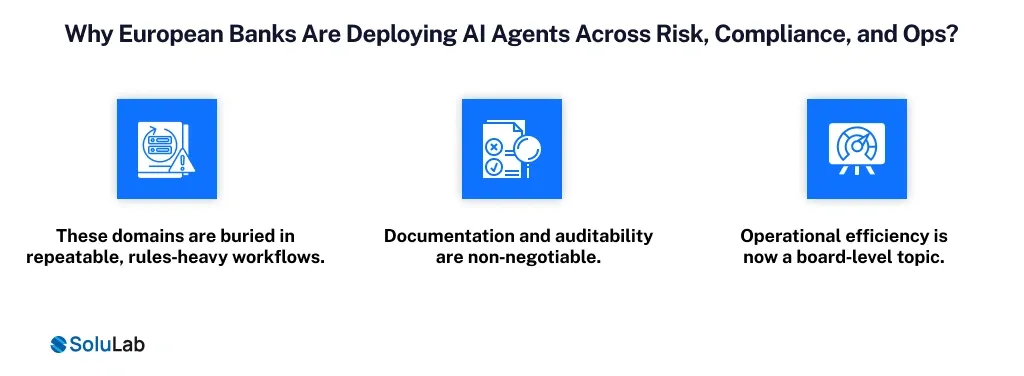
1. These domains are buried in repeatable, rules‑heavy workflows.
- Every large bank or insurer in Europe runs thousands of recurring tasks: KYC refresh, transaction monitoring reviews, regulatory filings, internal control testing, and so on.
- Many steps in these flows follow a mix of policy rules, threshold checks, and judgment calls based on documents and logs, which is a perfect fit for AI agents that can read, compare, and suggest actions at scale.
2. Documentation and auditability are non‑negotiable.
- The EU AI Act requires high‑risk systems to maintain detailed technical files, risk assessments, and post‑market monitoring plans, all of which generate heavy manual work.
- AI agents can help structure and maintain this documentation, track changes, and prepare evidence for audits, making compliance teams more productive instead of just busier.
3. Operational efficiency is now a board‑level topic.
- Consulting estimates suggest AI could reduce banking operational costs by up to 20% globally, translating into hundreds of billions in annual value, with European banks well‑positioned to benefit.
- Studies on Indian and EU banks show AI adoption improves speed, accuracy, and decision‑making in operations, while strengthening risk control mechanisms.
All of this makes AI agents for operational risk in Europe particularly attractive: they sit where the work is repetitive, regulated, and measurable.
Why AI Agent Development for EU Banking Compliance Isn’t Straightforward?
If you build AI agents in Europe, you are not just building software; you are building under some of the strictest digital regulations in the world.
A few realities every CXO in this space is grappling with:
- The EU AI Act introduces a risk‑based framework that classifies systems and imposes detailed obligations on high‑risk use cases, many of which sit in financial services and critical infrastructure.
- Compliance under this framework requires controls, documentation, datasets, logs, and oversight processes that typical “move fast” AI tooling does not provide out of the box.
- AI regulation does not exist in a vacuum; it sits alongside GDPR, banking supervision, AMLD, DORA, and national guidance, which makes AI banking solutions for EU regulations especially complex to design and operate.
Specialized platforms now exist to help automate parts of EU AI Act compliance, handling system inventory, risk classification, templates, and evidence management but they often still need to be combined with custom development and institution‑specific workflows.
That is why more institutions are looking for AI compliance software for banks in Europe that can plug into their stack and be extended via custom agents and integrations.

Core Use Cases of AI Agents for Compliance and Operations in European Banking
Let’s get concrete about how European AI agent solutions for banking and enterprises show up in daily work.
1. Use cases of AI agents for compliance
- Regulatory intelligence and mapping: agents read new regulations, guidelines, and Q&As, then highlight where internal policies or controls may be out of date.
- Policy and document drafting: agents turn templates, existing policies, and regulator feedback into updated drafts, which teams can refine and approve.
- Continuous control checks: agents scan logs, workflow data, and incidents to identify where key controls might be failing or missing, and then raise issues for human review.
These use cases of AI agents for compliance form the core of many Enterprise AI agents for compliance, keeping teams on top of obligations without endless manual work.
2. AI agent tools for fraud detection in banks
- Smarter anomaly detection: agents combine transaction data, behavioral history, and device patterns to identify unusual behavior that rules alone would miss.
- Alert enrichment: when a case is raised, an agent gathers related data, summarizes key risk indicators, and suggests next steps, so investigators can act faster.
- Learning from outcomes: agents learn from investigator decisions to refine thresholds and reduce false positives over time.
As instant payments grow, AI agent tools for fraud detection in banks are becoming essential to keep losses and investigation costs under control.
3. AI agents in EU banking operations
- Back‑office automation: agents check documents, reconcile mismatched records, and route exceptions, freeing people from repetitive tasks.
- Service co‑pilots: agents assist human service teams by surfacing relevant knowledge, suggesting responses, and triggering workflows, reducing handling times.
- Process analytics: agents watch process data and incident reports to spot bottlenecks and recurring issues, feeding into operational improvement programs.
Because impact here is easy to measure, AI agents in EU banking operations are often the first production use case, building confidence and internal know‑how.
4. AI agents for operational risk in Europe
- Risk signal monitoring: agents track KRIs, incidents, and near misses across systems to detect patterns that might signal emerging operational risks.
- Scenario and narrative support: agents help operational risk teams synthesize events, scenarios, and external data into clear narratives for reports and capital discussions.
- Third‑party and model oversight: agents follow vendor metrics, SLA breaches, and model drift indicators, connecting them back to risk appetite and controls.
These AI agents for operational risk in Europe give leadership a more dynamic view of risk rather than relying only on quarterly reports.
5. AI agents for operational efficiency
- Process optimization: agents analyze workflows and suggest ways to reduce rework, shorten cycle times, or remove unnecessary steps.
- Work routing: agents distribute tasks based on priority, skill, and capacity, so teams spend time where it matters most.
- Cost‑to‑serve insights: agents help quantify how much effort each process or customer segment consumes, giving leaders clearer levers to manage cost.
Here, AI agents for operational efficiency often pay for themselves quickly through hours saved and fewer errors.
Why European Banks Invest in Custom AI Agents for Compliance: Build vs Buy
Most institutions start with platforms and tools, then realize they also need to build custom AI agents where they want differentiation or tighter control.
Buying makes sense when you need standardized capabilities like EU AI Act system inventory, basic risk classification, or generic governance dashboards from proven AI agent platforms for EU compliance. These tools are helpful foundations.
Custom building makes sense when your advantage is in your process, data, and risk philosophy. For example, your fraud stack, your credit workflows, or your internal compliance frameworks are rarely off the shelf. In those areas, you want tailor‑made AI Agent solutions for businesses that reflect how your institution thinks and works.
This is exactly where a specialist AI Agent Development Company like SoluLab comes in: to combine platforms with bespoke agents and create Enterprise AI solutions for risk & compliance and operations that fit your institution instead of forcing you into someone else’s template.
How We Develop Enterprise AI Agents for Compliance and Operational Efficiency in Europe?
Working with regulated European institutions, you can’t just deploy a model and hope governance will catch up. The build approach needs to be structured but practical. Typically, we:
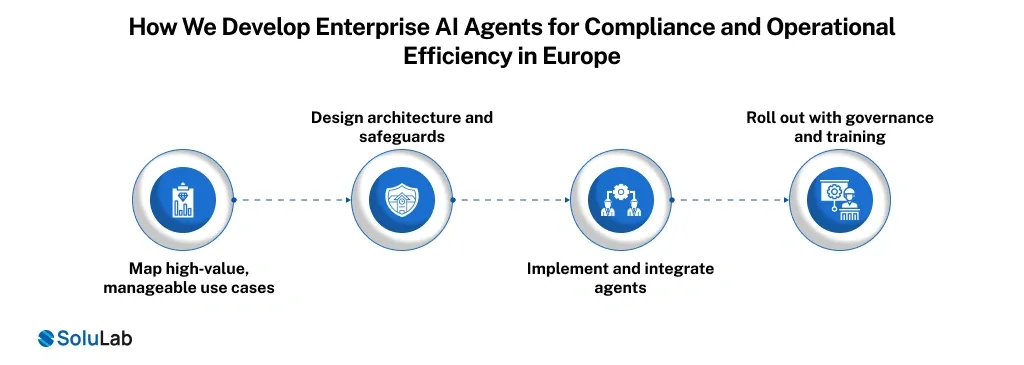
1. Map high‑value, manageable use cases
Start with use cases where agents can clearly help, such as use cases of AI agents for compliance, fraud triage, or operations support, and classify them under EU AI Act expectations.
2. Design architecture and safeguards
Choose models, data access patterns, and logging rules, then align them with your risk appetite and AI solutions for EU banking regulations.
3. Implement and integrate agents
Build agents that operate inside your systems – GRC tools, case managers, banking platforms, rather than sitting in isolation.
4. Roll out with governance and training
Put monitoring, documentation, and human‑in‑the‑loop controls in place from day one, so compliance and risk teams stay comfortable and informed.
Across all of this, an experienced AI Agent Development Company acts as both builder and guide, ensuring that the AI Agent builders and service providers in Europe and the platforms you use are configured in a way that stands up to regulators and internal audit.
How to Get Started with Enterprise AI Agents?
A simple, low‑drama way for CXOs and heads of function to get started looks like this:
1. Choose 1–2 focused use cases
Good candidates: internal compliance copilots, AI agent for compliance EU documentation helpers, or limited‑scope fraud and ops agents with clear guardrails.
2. Set governance principles early
Decide what agents can do on their own, what needs human approval, how they log actions, and how you will review performance and incidents.
3. Build on a reusable foundation
Use AI agent platforms for EU compliance and aligned tools so each new agent is cheaper and faster to roll out, with consistent documentation and controls.
That way, your first projects in AI Agent solutions for businesses become the starting point for a long‑term capability rather than isolated experiments
When Should You Work with an AI Agent Development Agency like SoluLab?
You know it’s time to call in a specialist when AI demand inside the organization is rising faster than your ability to govern and deliver.
Clear signals include:
- Multiple teams running disconnected pilots with no shared standards or architecture.
- Regulators, auditors, or internal risk functions are asking harder questions about AI system inventory, documentation, and monitoring than your current stack can answer.
- Strong interest in AI agents in EU banking operations, fraud, or compliance that has not yet turned into stable, production‑grade solutions.
- A desire to build custom AI agents that encode your specific risk and compliance approaches, instead of relying purely on generic SaaS tools.
In those moments, partnering with a focused AI Agent service provider in Europe helps you move faster while staying inside regulatory guardrails.

Conclusion
AI is already part of the core stack for European institutions, especially in risk, fraud, compliance, and operations. The winners will be the organizations that treat Enterprise AI solutions for risk & compliance and operations as long‑term capabilities, using agents that are explainable, monitored, and aligned with EU regulation.
Doing that at scale means combining strong platforms, thoughtful governance, and targeted custom builds delivered by an experienced AI Agent development company like SoluLab, that understands both technology and the regulatory reality.
FAQs
With over 3 years of experience, I specialize in breaking down complex Web3 and crypto concepts into clear, actionable content. From deep-dive technical explainers to project documentation, I help brands educate and engage their audience through well-researched, developer-friendly writing.