Key Takeaways
- You are entering the most competitive AI startup cycle ever, where funding is high but expectations are unforgiving.
- Your biggest early decisions are focus, data strategy, and picking an AI startup development partner that can ship, not just advise.
- You should treat AI startup development as a product journey: validate a pain, ship an AI MVP, then scale with real usage data.
- Your ideal AI development partner for startups must combine product thinking, MLOps, security, and domain experience—not only model skills.
- You can reduce build time by 30–50% by reusing proven AI development solutions, cloud-native stacks, and accelerators instead of starting from scratch.
- You should plan realistic costs: mid-complex AI products for funded startups often sit in the mid-six-figure range over 12–18 months.
- You gain an edge when you build an AI startup with a seasoned partner like SoluLab, which focuses on funded startups, AI-native product development, and long-term engineering support.
You probably felt that mix of fear and excitement the first time you watched an AI demo that looked almost unreal.
Maybe it was an agent that booked flights end-to-end, or a copilot that wrote production-ready code in minutes.
At that moment, your brain quietly said, “If this is real, your industry is about to change forever.”
Now it is 2026.
AI valuations still make headlines, but the easy stories are over.
Gartner and others talk about agentic AI as the next wave, yet many pilots still stall before scale.
Stanford’s 2026 AI Index shows AI adoption is now mainstream, with a large majority of organizations using AI in at least one business function.
You are not pitching “Why AI?” anymore. Your investors already know.
You are pitching “Why your AI startup?” and “Why now?”
This is where your choice of AI development partner matters more than your pitch deck design.
Why It Matters?
Your AI startup development journey is no longer about proving AI works.
It is about proving that your product, your data, and your execution can stand in a crowded, fast-moving market.
You are competing in a world where OpenAI has reached multibillion-dollar annual revenue in under three years, setting a brutal benchmark for speed and scale.
You are also building in a venture climate where artificial intelligence dominates funding headlines, but investors have become selective and allergic to slide decks.
In this landscape, the right AI development partner becomes your operational edge:
- Faster shipping of your AI MVP.
- Cleaner engineering and MLOps foundations.
- Better chance of hitting product–market fit before the runway runs out.
Why Building an AI Startup in 2026 Is Harder Than Ever?
Building an AI startup in 2026 is harder because expectations have matured, the bar for defensibility is higher, and investors now expect working products, not prototypes.
You are stepping into a market where AI has moved from experimentation to production across most industries.
Stanford’s 2026 AI Index notes that AI adoption has crossed into the mainstream, with organizations using AI in multiple business functions and investing more heavily in AI infrastructure.
CB Insights reports that private AI companies raised record-breaking funding in 2025, and early 2026 has already seen massive capital concentration into a smaller set of high-performing players.
That means you are not only up against scrappy peers; you are up against incumbents with budgets, data, and distribution.
You also face a new kind of complexity.
Agentic AI, autonomous workflows, and AI-native stacks are now hot topics, but most organizations still struggle to operationalize them safely.
McKinsey’s 2025 State of AI report shows that while many organizations experiment with AI, fewer manage to scale use cases across the enterprise due to talent gaps, data readiness issues, and unclear value capture.
Your startup must navigate exactly those same traps, but with less time and money.
At the same time, investor scrutiny is sharper.
PitchBook’s 2025 analysis shows AI deals dominate venture volume, but valuations and follow-on funding now heavily favor companies with working products and clear revenue traction.
In other words, you can no longer rely on a “vision plus slide deck” approach.
You need real shipping software, clear usage metrics, and realistic costs.
This is why your AI startup plan must be more disciplined than ever.
You need to think about:
- Data sourcing and compliance from day one.
- Model choices and future migration.
- MLOps, monitoring, and observability.
- AI safety, governance, and responsible use.
A capable AI startup development company helps you make those trade-offs early, instead of discovering them when your product is already in customers’ hands.
The Founder’s Journey: From Idea to AI-Powered Product
The founder’s journey from idea to AI-powered product is a sequence of learning loops: problem discovery, feasibility, AI MVP development, real-world usage, and scale.
You start not with models, but with a painful, specific problem.
You then validate that this problem is worth solving with AI and that you can access the right data to make your solution work.
Only then does AI startup development become an engineering problem instead of a guessing game.
Real Growth Scenario: “The Support Tickets That Wouldn’t End”
Picture this.
You are running a B2B SaaS startup in logistics.
Every Friday night, your small team dreads the spike of complicated support tickets.
Customers keep asking variations of the same questions: shipment delays, document issues, compliance clarifications.
You decide to build an AI support copilot.
Initially, you try a no-code tool with a generic model and a basic API wrapper.
The prototype impresses your team but fails with customers: hallucinated answers, inconsistent tone, and poor handling of edge cases.
At this point, you bring in an AI development partner for startups with real experience in retrieval-augmented generation, knowledge base structuring, and human-in-the-loop review flows.
Together, you refine your data sources, create a smarter retrieval pipeline, and build an AI MVP that handles the top 40% of support tickets with high accuracy.
Within three months, your team’s weekend workload drops, and your NPS climbs because responses become faster and more consistent.
That journey illustrates your reality:
Your idea is not the problem; your execution path is.
Key Stages in Your AI Founder Journey
- Problem and user clarity
You define one clear user persona and one painful use case.
You write it in a sentence that even a non-technical investor can understand. - Feasibility and data assessment
You ask: “Do you have or can you access the data needed for this?”
You evaluate data quantity, quality, labeling needs, and privacy constraints. - AI MVP scoping with a development partner
You work with an AI startup development company to define a realistic first release: just enough to prove value and learn.
You prioritize use cases with high value and low technical dependency risk. - AI product development and MLOps foundations
You build with observability, evaluation, and monitoring in mind rather than treating models as black boxes. - Pilot, feedback, and iteration
You roll out to a small set of customers and measure outcomes: time saved, error reduction, revenue uplift. - Scale and expansion
You refine the model stack, automate retraining where appropriate, and extend features to new segments.
An AI integration partner like SoluLab that understands this entire arc will treat your startup as a living system, not as a one-off app build.
How to Choose the Right AI Development Partner for Your Startup?
You choose the right AI development partner for your startup by focusing on proven product outcomes, cross-functional capabilities, and alignment with your funding stage, not just hourly rates or model buzzwords.
You are not hiring a freelance coder; you are selecting an AI technology partner for startups who will shape your product DNA.
This partner will affect your architecture, your velocity, your burn, and your fundraising narrative.
Non-Negotiable Traits to Look For
- Proven startup track record
You want a partner that has shipped AI products for funded startups, not just enterprises or labs.
Ask for case studies where MVPs led to follow-on funding or revenue. - Full-stack AI and product capability
Your ideal AI product development company should cover user research, product design, backend engineering, AI modeling, and MLOps. - Experience with modern AI stacks
You need comfort with:- Foundation models and model APIs.
- Retrieval-augmented generation and vector databases.
- Orchestration tools and agent frameworks.
- Data and security maturity
In 2026, data governance and security are not optional.
Look for strong processes around PII handling, access control, and compliance with relevant regulations. - Clear communication and founder empathy
You are juggling fundraising, sales, and product.
You need a partner that explains trade-offs in plain language and commits to predictable delivery. - Post-launch commitment
AI products age quickly.
You want a partner that supports continuous improvement, fine-tuning, and feature expansions, not just launch and exit.
SoluLab, as an AI startup development company focused on funded startups, builds exactly around these needs on its AI development for funded startups offering.
Step-by-Step: How to Build an AI Startup with a Development Partner
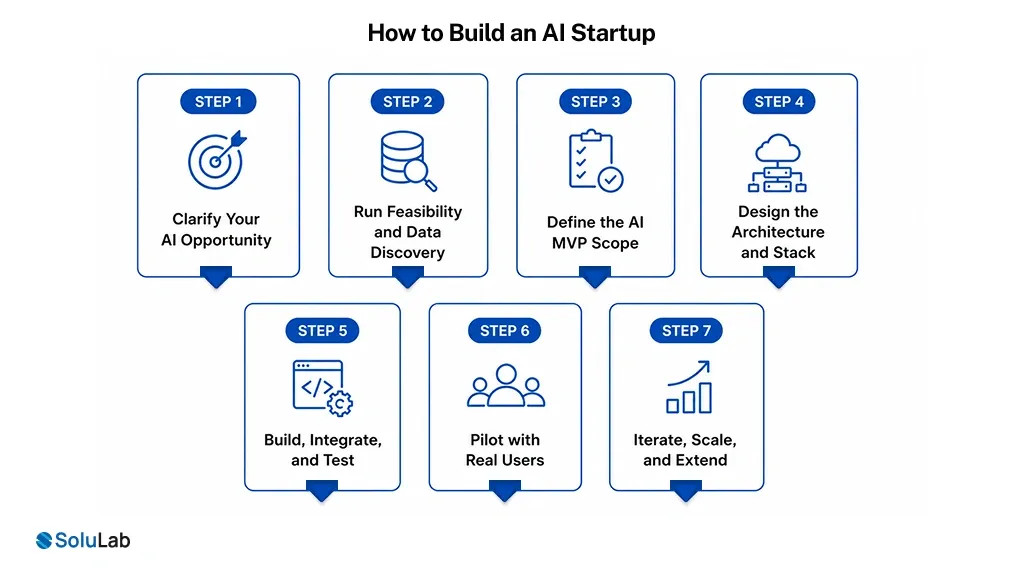
You build an AI startup with a development partner by following a structured sequence: problem definition, feasibility, scoping, AI MVP development, pilot, scale, and continuous optimization.
Think of this as your AI startup development roadmap.
Each step reduces uncertainty and converts your assumptions into measurable signals.
Step 1: Clarify Your AI Opportunity
You start by clearly answering: “What painful problem will your AI product solve, for whom, and why now?”
You define:
- Target user segment.
- Core job-to-be-done.
- Existing workaround and its pain.
At this stage, your AI-led development partner for startups should help pressure-test your assumptions and suggest AI-first approaches that match your domain.
Step 2: Run Feasibility and Data Discovery
You next examine whether AI is the right way to solve this.
You look at:
- What data you already have.
- What external data you can tap.
- What labeling or transformation is needed.
Stanford’s AI Index notes that data availability and quality remain key constraints for many AI projects that fail to scale.
Your AI consulting company partner should provide a structured feasibility assessment, including model options, infrastructure needs, and risk considerations.
Step 3: Define the AI MVP Scope
You then move into scoping an AI MVP with your development partner.
The focus is on shipping a product that:
- Solves one primary use case end-to-end.
- Has a clear success metric.
- Can be tested with real users quickly.
Here, using an AI MVP development company approach reduces wasted effort.
Your goal is to reach a version that investors can touch, not just imagine.
Step 4: Design the Architecture and Stack
You collaborate on the technical blueprint:
- Frontend, backend, and APIs.
- Model selection and orchestration.
- Data pipelines for ingestion, cleaning, and retrieval.
- Monitoring, logging, and evaluation.
CB Insights and McKinsey both highlight that scaled AI value tends to come from companies that invest early in reusable infrastructure, not one-off experiments.
Your AI development partner should help you avoid brittle architectures that cannot be extended.
Step 5: Build, Integrate, and Test
You now enter active AI app development.
The partner’s team:
- Implements frontend and backend.
- Integrates models and vector search.
- Adds evaluations and guardrails.
- Tests with synthetic and real data.
This is where a specialized AI startup development company differentiates itself from generic software vendors, because you need continuous tuning, prompt strategies, and data-driven refinements.
Step 6: Pilot with Real Users
You select a subset of users, maybe five to ten design partners.
You track:
- Usage frequency.
- Task completion time.
- Satisfaction scores.
- Error cases and edge scenarios.
McKinsey’s research stresses that real value comes when AI products change workflows, not when they simply add another screen.
Your partner should help design experiments that show measurable outcome changes.
Step 7: Iterate, Scale, and Extend
You then evolve from MVP to product.
You refine your model stack, optimize costs, and add features.
At this stage, you might explore custom models, agentic workflows, or deeper integrations into your clients’ systems.
SoluLab’s AI-powered solutions practice focuses on this kind of long-term, iterative development.
AI Development Partner Checklist Every Founder Needs
You choose your AI startup development partner using a clear checklist that covers strategy, execution, and long-term support.
Use this AI development partner checklist as a practical tool in your vendor evaluation process.
1. Strategy and Domain Understanding
- Has experience in your industry or adjacent spaces.
- Can articulate your user problem better after a discovery call.
- Brings ideas about AI-native business models, not just features.
2. Technical Depth
- Demonstrates experience with modern AI stacks, including foundation models, retrieval, and agent orchestration.
- Shows capability in MLOps: monitoring, evaluation, and continuous improvement.
- Can build both greenfield products and AI integrations into existing systems.
3. Product and UX Capability
- Offers product management support to prioritize your roadmap.
- Includes UX and design to build interfaces that users actually adopt.
- Understands behavior change, onboarding, and adoption patterns.
4. Security, Compliance, and Governance
- Has clear policies around data encryption, access control, and storage.
- Understands industry-specific regulations if you are in finance, healthcare, or similar spaces.
- Can document risk mitigation for your investors or enterprise customers.
5. Delivery Model and Communication
- Works in sprints with transparent reporting.
- Provides a single point of contact who understands your business goals.
- Shares risks early instead of hiding problems.
6. Business Model Fit
- Matches your funding stage and runway.
- Offers flexible engagement models so you can scale up or down.
- Aligns incentives with your outcomes, not just billable hours.
You can turn this checklist into a scoring sheet when evaluating AI development companies in the USA or globally.
As you evaluate partners, SoluLab’s AI for startups practice demonstrates alignment on these fronts, with clear offerings for discovery, MVP, and scale.
Real Success Stories: Startups That Scaled with the Right Partner
Startups that scale with the right AI development partner typically share patterns: clear problem focus, disciplined MVPs, strong data strategies, and structured collaboration.
While every startup’s story differs, recent research and reports reveal common threads among successful AI-first companies.
AI Copilots for Knowledge Work
The 2026 AI Index and recent McKinsey work highlight significant productivity gains in knowledge work when AI copilots handle repetitive tasks and information retrieval.
Startups building AI copilots for coding, customer support, or internal operations often partner with AI development companies to:
- Integrate foundation models with domain-specific data.
- Build interfaces that embed into existing tools.
- Set up evaluation pipelines to track output quality.
Your startup can mirror this approach: focus on a narrow workflow, make the AI assistant good at that one thing, then expand.
Vertical AI Platforms
CB Insights’ 2025 AI trends report highlights strong investor interest in vertical AI startups that focus on specific industries such as healthcare, logistics, or financial services.
These startups usually:
- Partner with AI consulting companies to navigate regulatory complexity.
- Build AI product development roadmaps that align with industry-specific workflows.
- Invest in data partnerships to deepen their moat.
AI-Native B2B Infrastructure
PitchBook and other analysts note growing investment into AI infrastructure startups—vector databases, observability tools, prompt management platforms, and agent orchestration layers.
These companies often rely on AI startup development partners early on to:
- Prototype complex features.
- Validate performance claims.
- Integrate with cloud platforms and early adopter stacks.
SoluLab’s work on AI-native solution development strategy aligns with these patterns, helping founders plan for AI-first architectures.
Cost, Timeline, and ROI of Building an AI Startup in 2026
You should expect AI startup development in 2026 to require thoughtful investment: months of iterative work, six-figure budgets, and a clear plan for ROI.
Funding for AI startups is high, but capital is concentrated in companies that can show traction.
To convince investors, your numbers and milestones must make sense.
Typical Cost Ranges
Exact numbers depend on complexity, but for funded B2B AI startups, you often see:
- Discovery and roadmap (4–6 weeks):
- Activities: problem framing, data assessment, and technical architecture.
- Typical cost: a small share of the total engagement, often in the low five-figure range.
- AI MVP development (2–3 months):
- Activities: end-to-end product build, model integration, MLOps, and pilot.
- Typical cost: mid-five to low six-figure budgets for a focused AI MVP.
- Scale-up and productization (3–6 months):
- Activities: performance optimization, feature expansion, integrations, and security hardening.
- Typical cost: cumulative mid-six-figure budgets for startups pursuing enterprise-grade products.
These ranges align with broader industry patterns, where AI projects that reach scale often require sustained investment over 12–18 months.
Timelines and Milestones
You can think in phases:
- 0–2 months: Discovery, concept refinement, technical feasibility, and prototypes.
- 2–6 months: MVP build and pilot with early adopters.
- 6–12 months: Productization, integrations, security hardening, and early revenue.
- 12–18 months: Expansion of features, verticals, and automation depth.
McKinsey notes that organizations that take a test-and-learn approach with clear milestones tend to capture more value from AI at lower risk.
ROI Levers
Your ROI case usually depends on:
- Revenue impact: New product lines or premium features.
- Cost reduction: Automation of manual tasks, reduced headcount pressure.
- Risk reduction: Fewer errors, better compliance, and improved oversight.
A development partner like SoluLab helps you quantify these benefits and communicate them to investors and customers, especially when you sell AI in business contexts where outcomes matter more than features.
Your Next Move: Partnering with an AI Development Expert
Your next move is to treat AI startup development as a serious product and company-building journey and choose an AI development partner that thinks the same way.
You do not have to navigate the entire AI-native stack alone.
You can bring in a partner that has already helped fund startups design AI-native products, build MVPs, and prepare stacks for scale.
SoluLab positions itself as exactly this kind of AI startup development company:
- Focused on funded startups that need to ship AI products.
- Offering AI development solutions from discovery to scale.
- Backed by experience across industries and AI use cases.
If you are serious about building an AI startup in 2026, you will benefit from a structured collaboration that covers:
- Strategy and product discovery.
- AI MVP design and development.
- AI-native solution architecture and ongoing optimization.
You can see how SoluLab approaches this on the AI-first enterprise tech stack
How to Get Started? (Actionable Founder Checklist)
You can get started today with a clear, practical checklist.
- Write your one-sentence problem statement.
“Your AI product helps [user] do [job] by [AI outcome], saving [time/money/risk].” - List your current data assets.
Note customer data, operational logs, documents, or external sources you can access. - Define your MVP success metric.
For example, “reduce support handling time by 40%” or “increase qualified leads by 25%.” - Decide on your AI development partner selection criteria.
Use the checklist earlier: experience, domain fit, MLOps, security, and communication. - Schedule discovery calls with two or three AI development companies.
Ask each how they would handle your problem and what they see as the main risks. - Shortlist your AI startup development partner.
Choose the team that shows the clearest thinking, not just the lowest quote. - Plan your first 90 days.
Align on a roadmap that includes discovery, MVP scope, and initial pilot milestones.
Funded startups need a different level of expertise since they strive for success in a results-oriented manner. They need to launch quickly and find the right set of metrics for their scaling up.
Dos and Don’ts When Working with an AI Development Partner
You improve your odds of success by following clear dos and don’ts in your collaboration.
Dos
- Do treat your partner as part of your product team, not a pure vendor.
- Do share your investor expectations, runway, and milestones openly.
- Do insist on measurable success metrics for your AI MVP.
- Do ask for weekly visibility into progress, blockers, and next steps.
- Do encourage your partner to challenge your assumptions on scope and timelines.
Don’ts
- Don’t outsource all thinking about your users and their workflows.
- Don’t chase every new model or framework without clear value.
- Don’t ignore data governance and security in favor of speed.
- Don’t underinvest in MLOps and monitoring; brittle AI harms trust.
- Don’t pick a partner purely on price; the hidden costs of weak engineering are far higher.
Why SoluLab Is a Strong AI Development Partner for Your Startup?

You now understand why building an AI startup in 2026 is tough, but also incredibly rewarding if you execute well.
You know that your success hinges not just on your vision but on how quickly and reliably you can turn that vision into a functioning AI solution.
SoluLab stands out as an AI development partner in USA for startups because it combines:
- Focus on funded startups.
- Experience in AI MVP development and AI-native solution design.
- Support across strategy, product, engineering, and MLOps.
When you build an AI startup with SoluLab, you gain more than a team of engineers.
You gain a partner who understands the realities of raising capital, proving traction, and preparing your AI product for real-world scale.
If you are ready to move from idea to AI-powered product, your next step is clear:
Start a focused conversation with SoluLab, align on your first 90 days, and treat this as the moment where your AI startup development journey truly begins.
FAQs
A structured AI development partner checklist helps you compare options objectively.
For many funded startups, partnering with an AI startup development company like SoluLab is faster and less risky than building everything in-house immediately.
Shipra Garg is a tech-focused content strategist and copywriter specializing in Web3, blockchain, and artificial intelligence. She has worked with startups and enterprise teams to craft high-conversion content that bridges deep tech with business impact. Her work translates complex innovations into clear, credible, and engaging narratives that drive growth and build trust in emerging tech markets.