Key Takeaways
- Build AI delivers maximum customization, ownership, and strategic differentiation but requires higher investment and longer implementation timelines.
- Buying AI reduces time-to-market and implementation complexity but may limit flexibility and create vendor dependency.
- Hybrid AI strategies are becoming increasingly common because they combine the speed of commercial platforms with the adaptability of custom solutions.
- The build-vs. buy decision should evaluate business strategy, not just technology.
- Organizations should assess total cost of ownership, governance, scalability, integration requirements, security, and long-term ROI before selecting an approach.
Artificial intelligence has moved from experimentation to enterprise strategy. Organizations across industries are investing in AI to automate operations, improve customer experiences, optimize decision-making, and unlock new revenue opportunities. As adoption accelerates, one critical question consistently arises in boardrooms and executive planning sessions:
Should we build our own AI solution or buy an existing platform?
The answer is rarely straightforward. Building AI offers greater flexibility, ownership, and competitive differentiation, but it often requires significant investment, specialized talent, and longer implementation timelines. Buying an AI solution enables faster deployment and lower upfront costs, yet organizations may face limitations around customization, vendor dependency, and long-term scalability.
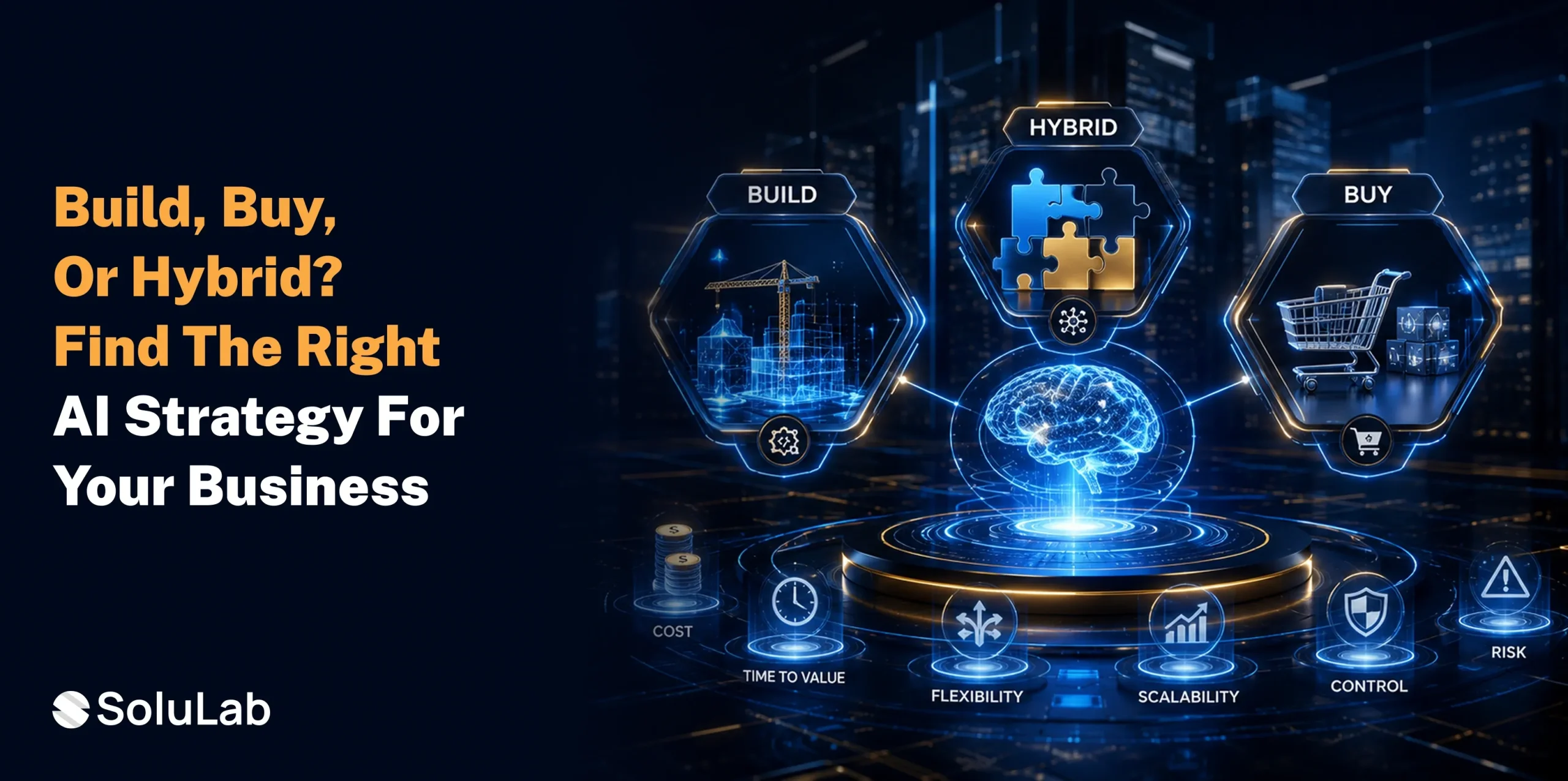
For many enterprises, the optimal strategy lies somewhere between these two extremes. A hybrid approach combining commercial AI platforms with custom AI development can balance speed, flexibility, and strategic control.
This guide provides a practical framework for evaluating Build vs Buy AI decisions. It compares costs, implementation timelines, return on investment, security considerations, governance requirements, and long-term business value. It also introduces a structured decision framework to help technology leaders determine the most suitable path based on organizational priorities, technical capabilities, and competitive objectives.
Whether you are planning your first AI initiative or scaling enterprise-wide adoption, this guide will help you make a more informed, future-ready investment decision.
Quick Answer: Should You Build or Buy AI?
For most organizations, there is no universally correct answer. The right choice depends on business goals, available expertise, budget, compliance requirements, and the strategic importance of artificial intelligence within the organization.
| If your priority is… | Recommended Approach |
| Rapid deployment | Buy AI |
| Competitive differentiation | Build AI |
| Proprietary intellectual property | Build AI |
| Lower upfront investment | Buy AI |
| Highly customized workflows | Build AI |
| Standard business automation | Buy AI |
| Balancing speed and flexibility | Hybrid AI |
Rule of thumb: Buy AI for standardized capabilities, build AI when AI becomes a core competitive advantage, and adopt a hybrid strategy when you need both rapid implementation and long-term customization.
What Does Build vs Buy AI Mean?
The Build vs Buy AI decision refers to whether an organization should develop artificial intelligence capabilities internally or purchase an existing commercial AI software solution.
Although the concept appears simple, the decision has significant implications for technology investment, operational efficiency, innovation, risk management, and long-term competitiveness.
Building AI
Building AI involves designing and developing custom AI solutions tailored to an organization’s specific business processes, data, and strategic objectives.
This typically includes:
- Developing proprietary machine learning or generative AI models
- Creating custom workflows and business logic
- Integrating AI into existing enterprise systems
- Managing infrastructure, deployment, monitoring, and continuous improvement
- Retaining ownership of intellectual property and data pipelines
Organizations pursuing this route often engage internal engineering teams or partner with a specialized AI development company to accelerate delivery while maintaining strategic control.
Buying AI
Buying AI involves licensing or subscribing to commercially available AI software or enterprise AI platforms.
These solutions generally provide:
- Pre-built AI capabilities
- Faster implementation
- Vendor-managed infrastructure
- Ongoing updates and support
- Lower initial development effort
Examples include AI copilots, intelligent document processing platforms, customer service automation tools, enterprise search solutions, and predictive analytics software.
Hybrid AI
Increasingly, enterprises are adopting a hybrid strategy that combines commercial AI platforms with custom-built components.
For example, an organization might use a foundation model from a leading provider while developing proprietary applications, workflows, and integrations tailored to its business needs. This approach can accelerate deployment while preserving flexibility and differentiation.

Why Enterprises Face the Build vs Buy AI Decision?
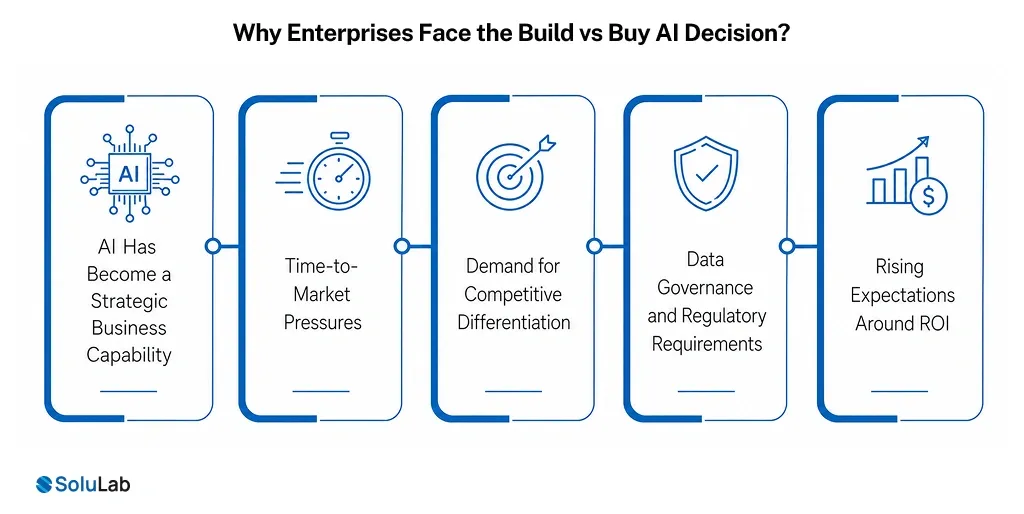
Enterprise AI adoption has accelerated as organizations seek to improve productivity, reduce operational costs, enhance customer experiences, and create new revenue streams. As AI capabilities mature, the decision is no longer whether to adopt AI but how to implement it effectively.
Several factors are driving this evaluation:
1. AI Has Become a Strategic Business Capability
AI is increasingly embedded in core business functions, from customer support and supply chain optimization to fraud detection and software development. When AI directly influences competitive advantage, organizations must determine whether standardized tools are sufficient or whether custom capabilities are required.
2. Time-to-Market Pressures
Businesses face growing pressure to deploy AI initiatives quickly. Commercial AI platforms can significantly reduce implementation timelines, making them attractive for organizations seeking immediate productivity gains. However, rapid deployment should be balanced against long-term flexibility and scalability.
3. Demand for Competitive Differentiation
Standardized AI native solutions often provide similar capabilities across multiple organizations. Enterprises seeking unique customer experiences, proprietary workflows, or industry-specific intelligence may find greater value in custom AI development that aligns with their strategic objectives.
4. Data Governance and Regulatory Requirements
Industries such as healthcare, financial services, manufacturing, and the public sector frequently operate under strict regulatory frameworks. Data residency, privacy, explainability, and compliance requirements can significantly influence whether organizations build proprietary AI systems or adopt commercial platforms with appropriate governance controls.
5. Rising Expectations Around ROI
Executive teams increasingly expect AI investments to deliver measurable business outcomes. The Build vs Buy decision must therefore consider not only implementation costs but also long-term maintenance, scalability, operational efficiency, and strategic value.
Ultimately, the decision extends beyond technology selection. It is a strategic investment choice that should align with business priorities, organizational capabilities, and long-term innovation goals.
Build vs Buy vs Hybrid AI: Enterprise Comparison
| Evaluation Criteria | Build AI | Buy AI | Hybrid AI |
| Initial Investment | High | Low to Medium | Medium |
| Time to Deployment | Longer | Faster | Moderate |
| Customization | Excellent | Limited | High |
| Ownership of IP | Full | Vendor | Shared |
| Scalability | High | Vendor Dependent | High |
| Integration Flexibility | Excellent | Moderate | Excellent |
| Security & Governance Control | High | Shared Responsibility | High |
| Ongoing Maintenance | Internal Responsibility | Vendor Managed | Shared |
| Long-Term Competitive Advantage | High | Moderate | High |
| Best Fit | Strategic differentiation | Standard business capabilities | Enterprise transformation at scale |
This comparison highlights that the Build vs Buy decision is not binary. For many enterprises, the most effective strategy is a hybrid model that combines commercially available AI capabilities with custom development to support unique business processes and long-term innovation.
Build AI: Advantages, Challenges, and Ideal Use Cases
Building an AI-powered solution means developing a system tailored to your organization’s unique business processes, proprietary data, and long-term strategic objectives. Rather than relying on pre-built software, enterprises invest in designing, training, integrating, and continuously improving AI capabilities that become part of their competitive advantage.
For organizations where AI is expected to drive innovation rather than simply improve efficiency, building custom AI can deliver significant long-term value.
Advantages of Building AI
1. Complete Customization
Every enterprise operates differently. Industry regulations, internal workflows, customer journeys, and data structures vary significantly across organizations.
Custom AI solutions are designed around these unique requirements rather than forcing the business to adapt to predefined software capabilities.
Examples include:
- AI-powered underwriting for insurance companies
- Clinical decision support systems in healthcare
- Predictive maintenance models for manufacturers
- Personalized recommendation engines for e-commerce
- Intelligent supply chain optimization for logistics providers
Instead of adapting processes to fit software, organizations create AI that aligns with their operating model.
2. Ownership of Intellectual Property
One of the biggest advantages of building AI is ownership.
Organizations retain control over:
- Models
- Training data
- Algorithms
- Business logic
- Product roadmap
- Intellectual property
This ownership creates long-term strategic value while reducing dependence on external vendors.
For businesses where AI becomes a core product capability, proprietary technology can become a significant competitive differentiator.
3. Better Integration Across Enterprise Systems
Large enterprises rarely operate using a single platform.
Instead, they manage ecosystems, including:
- ERP systems
- CRM platforms
- Legacy applications
- Data warehouses
- Industry-specific software
- Internal APIs
Custom AI development allows organizations to integrate intelligence directly into existing workflows, reducing disruption and improving adoption.
Rather than creating another isolated tool, AI becomes part of the enterprise technology landscape.
4. Greater Control Over Security and Compliance
Highly regulated industries often require strict governance over:
- Data residency
- Access controls
- Audit trails
- Explainability
- Model transparency
- Regulatory compliance
Building AI enables organizations to design governance into the solution from the outset, making it easier to align with industry-specific security and compliance requirements.
5. Long-Term Strategic Flexibility
Business priorities evolve.
Products change.
Markets shift.
Regulations emerge.
A custom AI platform evolves alongside the organization.
Rather than waiting for a vendor’s roadmap, enterprises can introduce new capabilities, improve models, and expand AI use cases as business needs change.
Challenges of Building AI
Although custom AI offers greater flexibility, it also introduces complexity.
Higher Initial Investment
Developing enterprise AI requires investment in:
- Discovery workshops
- Data engineering
- Model development
- Infrastructure
- Security
- Integration
- Testing
- Change management
While upfront costs are higher, organizations should evaluate total value over the solution’s lifecycle rather than focusing solely on implementation expenses.
Longer Time-to-Market
Unlike commercial software that can often be deployed within weeks, custom AI projects typically progress through multiple stages:
- Opportunity assessment
- Data preparation
- Proof of concept
- MVP development
- Pilot testing
- Enterprise deployment
- Continuous optimization
The timeline depends on solution complexity, data readiness, and organizational maturity.
Talent Requirements
Successful AI initiatives require multidisciplinary expertise, including:
- AI engineers
- Machine learning specialists
- Data scientists
- Solution architects
- DevOps engineers
- Security specialists
- Domain experts
Organizations lacking these capabilities frequently collaborate with a specialized AI development company to reduce delivery risk while accelerating implementation.
When Building AI Makes the Most Sense?
Building AI is typically the right choice when:
✔ AI capabilities directly influence competitive advantage.
✔ Business processes are highly specialized.
✔ Industry regulations require extensive customization.
✔ Proprietary data provides unique value.
✔ Long-term innovation outweighs short-term deployment speed.
✔ The organization plans to scale AI across multiple business functions.
Buy AI: Advantages, Challenges, and Ideal Use Cases
Buying AI involves adopting commercially available AI software, enterprise platforms, or SaaS applications that provide ready-to-use capabilities with minimal development effort.
For organizations seeking faster implementation and predictable costs, buying AI can significantly reduce project complexity.
Advantages of Buying AI
1. Faster Time-to-Value
The primary benefit of buying AI is speed.
Organizations can often deploy commercial AI platforms within weeks rather than months.
This enables faster realization of business benefits such as:
- Workflow automation
- Customer service enhancement
- Document processing
- Knowledge management
- Employee productivity
Rapid deployment is especially valuable for organizations addressing immediate operational challenges.
2. Lower Upfront Costs
Commercial AI solutions generally operate on subscription or licensing models.
This reduces initial capital expenditure while shifting investment toward predictable operational costs.
For many mid-sized enterprises, this creates a lower barrier to AI adoption.
3. Vendor Support and Continuous Updates
Commercial vendors continuously improve their products by introducing:
- Feature enhancements
- Performance improvements
- Security updates
- Compliance certifications
- Infrastructure optimization
Organizations benefit from ongoing innovation without maintaining large internal development teams.
4. Reduced Technical Complexity
Buying AI eliminates much of the engineering effort associated with:
- Infrastructure management
- Model training
- Deployment pipelines
- Performance monitoring
- Scalability planning
Internal teams can focus on business adoption rather than technical implementation.
5. Predictable Implementation
Enterprise software vendors typically provide:
- Implementation frameworks
- Documentation
- Customer success teams
- Training resources
- Service-level agreements
These structured deployment processes reduce project uncertainty.
Challenges of Buying AI
Commercial AI is not without limitations.
Limited Customization
Most AI platforms are designed for broad market needs.
Organizations with highly specialized workflows may struggle to adapt commercial software to their operational requirements.
Vendor Dependency
Buying AI often creates long-term dependence on:
- Vendor pricing
- Product roadmap
- Feature availability
- Licensing models
- Support quality
Strategic decisions may ultimately be influenced by vendor priorities rather than business objectives.
Integration Constraints
Although many platforms provide APIs, integrating commercial AI into complex enterprise ecosystems may require additional development effort.
Legacy systems, proprietary workflows, and industry-specific AI applications can increase integration complexity.
Data Governance Considerations
Organizations handling highly sensitive information must carefully evaluate:
- Data storage
- Model training practices
- Third-party access
- Regional compliance requirements
Vendor governance should align with internal security policies before deployment.
When Buying AI Makes the Most Sense?
Buying AI is often appropriate when:
✔ Speed is the highest priority.
✔ AI supports standardized business functions.
✔ Internal AI expertise is limited.
✔ Budget constraints favor subscription-based pricing.
✔ Competitive differentiation is not dependent on proprietary AI capabilities.
✔ Business requirements closely align with commercially available software.
Hybrid AI Strategy: The Best of Both Worlds?
The Build vs Buy discussion is increasingly evolving into a third option: Hybrid AI.
Rather than choosing one approach exclusively, organizations combine commercial AI platforms with custom-built capabilities.
For example:
- A financial institution may license a foundation model while developing proprietary fraud detection workflows.
- A healthcare provider may integrate commercial speech recognition with custom clinical decision support.
- A retailer may use an enterprise AI platform for demand forecasting while building personalized recommendation models using proprietary customer data.
This approach offers several advantages:
- Faster deployment than fully custom development.
- Greater flexibility than off-the-shelf software.
- Better alignment with enterprise governance.
- Lower implementation risk.
- Long-term scalability.
Hybrid AI enables organizations to accelerate adoption while preserving strategic differentiation.
For many large enterprises, this balanced approach is becoming the preferred AI implementation strategy.
Custom AI vs. Off-the-Shelf AI
Choosing between custom AI and ready-made AI solutions depends on how central AI is to your business strategy.
| Evaluation Area | Custom AI Solutions | Off-the-Shelf AI |
| Business Fit | Tailored to unique workflows | Standardized functionality |
| Deployment Speed | Longer | Faster |
| Customization | Extensive | Limited |
| Competitive Differentiation | High | Moderate |
| Data Ownership | Full control | Shared responsibility |
| Vendor Lock-in | Minimal | Higher |
| Long-Term Flexibility | Excellent | Dependent on vendor roadmap |
| Initial Cost | Higher | Lower |
| Total Cost Over Time | Potentially lower for strategic use cases | Can increase with licensing and scaling |
Organizations pursuing digital transformation often discover that while off-the-shelf AI accelerates early adoption, custom AI becomes increasingly valuable as AI capabilities mature and evolve into strategic business assets.
Build vs Buy AI Cost Comparison
AI development cost should never be evaluated solely through initial implementation expenses. A comprehensive assessment considers the Total Cost of Ownership (TCO) over the solution’s lifecycle.
| Cost Factor | Build AI | Buy AI |
| Initial Investment | High | Low to Medium |
| Infrastructure | Internal | Vendor Managed |
| Licensing Fees | None | Recurring |
| Customization | Included | Additional Charges May Apply |
| Maintenance | Internal Responsibility | Vendor Managed |
| Scaling Costs | Predictable | Can Increase with Usage |
| Long-Term Flexibility | High | Limited by Vendor |
Organizations should also consider hidden costs, including change management, user training, integration, governance, vendor switching, and ongoing optimization.
The lowest upfront investment is not always the lowest long-term cost.
Time-to-Market Comparison
Implementation speed is often the deciding factor in enterprise AI projects.
| Stage | Build AI | Buy AI |
| Discovery | ✓ | ✓ |
| Data Preparation | Extensive | Minimal |
| Solution Design | Extensive | Limited Configuration |
| Development | Required | Not Required |
| Integration | Extensive | Moderate |
| Testing | Comprehensive | Configuration Testing |
| Deployment | Longer Timeline | Faster Timeline |
| Optimization | Continuous | Vendor Driven + Internal Adoption |
Organizations facing immediate operational challenges often prioritize buying AI to accelerate deployment.
However, when AI-led development is expected to become a long-term source of competitive advantage, investing additional time in custom development can generate significantly greater strategic value over time.
Build vs Buy AI ROI Comparison: Which Delivers Better Business Value?
For most enterprise leaders, the Build vs Buy AI decision ultimately comes down to one question:
Which approach delivers the highest return on investment (ROI)?
The answer isn’t determined by implementation cost alone. A solution with the lowest upfront investment may become significantly more expensive over time due to licensing fees, limited customization, integration challenges, or vendor lock-in. Conversely, a custom AI solution may require a larger initial investment but generate greater long-term value through operational efficiency, innovation, and competitive differentiation.
The most effective way to evaluate AI investments is through Total Business Value (TBV) rather than simply Total Cost of Ownership (TCO).
Key ROI Factors
Technology leaders should evaluate AI initiatives across multiple dimensions rather than focusing on development costs alone.
| Evaluation Area | Build AI | Buy AI | Hybrid AI |
| Upfront Investment | High | Low | Medium |
| Time-to-Value | Medium | High | High |
| Operational Efficiency | High | Medium | High |
| Long-Term Cost Efficiency | High | Medium | High |
| Innovation Potential | Very High | Medium | High |
| Strategic Differentiation | Very High | Low | High |
| Business Agility | High | Medium | High |
| Vendor Dependency | Low | High | Medium |
The highest ROI depends on the organization’s strategic priorities.
For example:
- A customer support chatbot may achieve excellent ROI through a commercial AI platform.
- An AI-powered underwriting engine for an insurance provider is likely to generate greater value through custom development.
- A retailer may benefit from a hybrid strategy by purchasing a conversational AI platform while building proprietary recommendation algorithms.
The objective should not be to minimize technology spending but to maximize long-term business impact.
Measuring AI ROI Beyond Cost Savings
Many organizations mistakenly evaluate AI solely by labor cost reduction. Mature AI programs measure success across a broader set of business outcomes.
Revenue Growth
AI can create new revenue opportunities through:
- Personalized customer experiences
- Intelligent product recommendations
- Faster sales cycles
- Dynamic pricing
- New AI-enabled products and services
Productivity Improvements
Enterprise AI reduces manual work by automating repetitive processes such as:
- Document processing
- Customer support
- Knowledge retrieval
- Report generation
- Software development assistance
These improvements allow employees to focus on higher-value activities rather than routine tasks.
Better Decision-Making
AI enhances executive decision-making through:
- Predictive analytics
- Demand forecasting
- Risk modeling
- Scenario planning
- Real-time operational insights
Better decisions often generate substantially greater business value than simple automation.
Risk Reduction
Organizations also realize ROI through:
- Fraud detection
- Regulatory compliance
- Predictive maintenance
- Cybersecurity
- Quality assurance
Avoiding operational disruptions can be just as valuable as increasing revenue.
Innovation Acceleration
Custom AI frequently enables organizations to launch:
- New digital products
- AI-powered customer experiences
- Intelligent automation initiatives
- Industry-specific solutions
Innovation-driven ROI is often difficult to quantify initially, but can become one of the largest contributors to long-term enterprise value.
Security, Compliance, and Governance Comparison
Security has become one of the most influential factors in enterprise AI adoption.
Organizations operating in regulated industries must ensure that AI systems align with internal governance frameworks and external compliance requirements.
The level of control differs significantly depending on whether AI is built internally, purchased from a vendor, or implemented using a hybrid architecture.
Security Comparison
| Security Consideration | Build AI | Buy AI | Hybrid AI |
| Data Ownership | Full | Shared | Mostly Internal |
| Infrastructure Control | High | Vendor Managed | Shared |
| Identity & Access Management | Fully Customizable | Vendor Features | Flexible |
| Encryption Standards | Internal Control | Vendor Defined | Shared |
| Auditability | High | Depends on Vendor | High |
| Explainability | Fully Configurable | Platform Dependent | Flexible |
| Regulatory Alignment | High | Vendor Dependent | High |
Organizations with stringent regulatory obligations often favor custom or hybrid AI because these approaches provide greater visibility and control over data processing, model behavior, and governance policies.
Governance Considerations
Enterprise AI governance extends beyond cybersecurity.
Technology leaders should establish policies covering:
- Data quality
- Model monitoring
- Responsible AI
- Human oversight
- Bias detection
- Version management
- Regulatory reporting
- Vendor risk management
Regardless of the implementation approach, governance should be incorporated from the beginning rather than added after deployment.
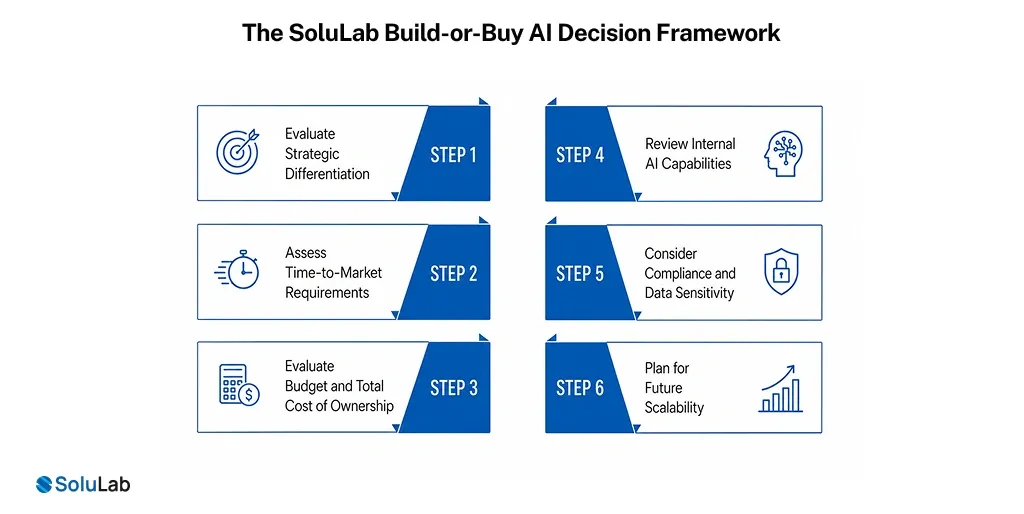
The SoluLab Build-or-Buy AI Decision Framework
Many organizations approach Build vs Buy as a technology decision.
In reality, it is a business strategy decision.
To simplify evaluation, technology leaders can assess six strategic dimensions before selecting an implementation approach.
Step 1: Evaluate Strategic Differentiation
Ask:
Will AI become part of our competitive advantage?
If AI directly influences customer experience, operational excellence, or product innovation, building custom capabilities often delivers greater long-term value.
If AI simply automates common business processes, purchasing a commercial solution may be sufficient.
Step 2: Assess Time-to-Market Requirements
Organizations facing immediate operational pressures may prioritize rapid deployment.
Commercial AI platforms typically reduce implementation time.
Organizations pursuing long-term transformation may benefit from investing additional time in custom development.
Step 3: Evaluate Budget and Total Cost of Ownership
Instead of asking:
“Which option is cheaper?”
Ask:
“Which option delivers greater business value over the next five years?”
Long-term licensing costs, customization expenses, and vendor dependency should be considered alongside development investment.
Step 4: Review Internal AI Capabilities
Successful custom AI projects require expertise in:
- AI engineering
- Data science
- Cloud architecture
- MLOps
- Security
- Product management
Organizations lacking these capabilities should consider partnering with an experienced AI app development company rather than abandoning custom development altogether.
Step 5: Consider Compliance and Data Sensitivity
Highly regulated organizations should evaluate:
- Data residency
- Privacy requirements
- Industry regulations
- Explainability
- Model governance
- Audit requirements
These factors frequently influence whether custom development becomes necessary.
Step 6: Plan for Future Scalability
AI initiatives rarely remain isolated projects.
Successful AI deployments often expand across multiple business units.
Technology leaders should ask:
- Can this solution support future AI initiatives?
- Will it integrate with our broader technology ecosystem?
- Can it evolve alongside our business?
Scalability should be evaluated before implementation rather than after deployment.
SoluLab Build-or-Buy Decision Matrix
| Strategic Factor | Build AI | Buy AI | Hybrid AI |
| Competitive Differentiation | ✓ | ✓ | |
| Rapid Deployment | ✓ | ✓ | |
| Budget Constraints | ✓ | ||
| Regulatory Compliance | ✓ | ✓ | |
| Internal AI Talent | ✓ | ||
| Long-Term Flexibility | ✓ | ✓ | |
| Standard Business Processes | ✓ | ||
| Proprietary Data Utilization | ✓ | ✓ | |
| Enterprise Innovation | ✓ | ✓ | |
| Lowest Vendor Dependency | ✓ |
Executive Insight: If your organization consistently selects options from both the “Build” and “Buy” columns, a hybrid AI strategy is likely the most appropriate path.
When Should You Build AI?
Building AI is recommended when artificial intelligence is expected to become a strategic business capability rather than simply a productivity tool.
Executive Checklist
Build AI if your organization:
✔ Views AI as a competitive differentiator.
✔ Requires highly customized workflows.
✔ Uses proprietary datasets that create unique business value.
✔ Operates in a heavily regulated industry.
✔ Needs complete ownership of intellectual property.
✔ Plans to scale AI across multiple business units.
✔ Has long-term innovation objectives.
✔ Wants maximum flexibility over future enhancements.
If most of these statements apply, investing in custom AI development is likely to produce stronger long-term returns.
When Should You Buy AI?
Buying AI is the right approach when speed, simplicity, and predictable implementation are the primary objectives.
Executive Checklist
Buy AI if your organization:
✔ Needs rapid deployment.
✔ Requires standardized AI capabilities.
✔ Has limited internal AI expertise.
✔ Prefers subscription-based pricing.
✔ Wants vendor-managed infrastructure.
✔ Needs immediate productivity improvements.
✔ Does not require proprietary AI models.
✔ Values lower implementation risk.
Commercial AI platforms are particularly effective for common enterprise functions such as document processing, customer service automation, enterprise search, and employee productivity.
When Should You Choose a Hybrid AI Strategy?
For many enterprises, the answer is neither “Build” nor “Buy.”
It is Build + Buy.
Hybrid AI combines commercial platforms for standardized capabilities with custom development for strategic differentiation.
Hybrid AI Checklist
Choose a hybrid strategy if your organization:
✔ Wants rapid implementation without sacrificing long-term flexibility.
✔ Plans to customize AI around proprietary business processes.
✔ Needs enterprise-grade governance while leveraging commercial innovation.
✔ Intends to expand AI across multiple departments over time.
✔ Wants to reduce vendor dependency while accelerating adoption.
✔ Sees AI as both an operational tool and a strategic capability.
A hybrid approach enables organizations to deploy AI quickly while preserving the ability to innovate, differentiate, and evolve as business priorities change.
For many large enterprises, it represents the most balanced path toward sustainable AI transformation.

Conclusion
Choosing between building or buying AI solutions is no longer just a technology decision—it’s a strategic business investment that can shape your organization’s competitive advantage for years to come. While off-the-shelf AI solutions offer faster deployment and lower upfront costs, custom AI development provides greater flexibility, scalability, and alignment with unique business objectives.
If your organization is planning to adopt AI in 2026, start by evaluating your current processes, identifying high-impact use cases, and defining measurable success metrics before making a build-or-buy decision.
At SoluLab, we help startups, mid-market businesses, and global enterprises navigate this decision with confidence. From AI strategy consulting and feasibility assessments to custom AI development, enterprise AI integration, and ongoing optimization, our experts deliver scalable AI solutions that generate measurable business value.
Whether you’re looking to implement AI quickly or build a differentiated AI platform from the ground up, SoluLab can help you choose and execute the right strategy.
FAQs
Tanmay is focused on building brand authority through narrative-driven marketing. With 19+ years in tech branding, he has positioned SoluLab as a thought leader in the Blockchain and AI sectors. He regularly shares insights on AI-driven brand storytelling and content strategy. He is open to connecting with startups and enterprise teams to help them overcome their challenges.