Agentic AI is changing how businesses operate, moving from assistive tools to systems that can plan, decide, and act independently.
That shift brings real opportunity, but also a new layer of risk that many organizations are not fully prepared for. Singapore’s latest governance framework offers a practical blueprint for managing this transition, showing how to balance innovation with control, accountability, and compliance.
If you are planning to invest in AI development solutions, governance can no longer be optional. It needs to be built into the foundation. In this blog, we break down how enterprises can design an agentic AI governance framework inspired by Singapore’s approach, and what it takes to implement it effectively.
Key Takeaways
- The problem: The current agentic AI systems are developing at a faster rate than governance, and enterprises are left vulnerable to risks such as those of bias, absence of accountability, compliance loopholes, and unregulated autonomous decision-making in key processes.
- The solution: Establish a well-defined governance system where accountability is clear, Risk is categorized, the system is monitored continuously, and human beings supervise it, as seen in Singapore, to provide safe, compliant, and scalable AI implementation.
- How SoluLab helps: SoluLab is an AI-native firm that applies AI to its own operations to provide enterprises with faster and cost-efficient governance frameworks with in-built security, compliance, and lifecycle control.
Singapore Launched Agentic AI Governance Framework
On 22 January 2026, Singapore introduced the Model AI Governance Framework for Agentic AI (MGF) at the World Economic Forum 2026, marking a significant step toward regulating next-generation AI systems.
This agentic AI framework is the first of its kind globally, where systems can independently reason, plan, and execute tasks with minimal human intervention.
It builds on Singapore’s earlier efforts, including the 2019 Model AI Governance Framework, the AI Verify testing framework, and the Global AI Assurance Pilot launched in 2025. However, this latest framework goes further by directly addressing the risks emerging from highly autonomous AI systems.
These risks include unauthorized actions, misuse of data, biased or opaque decision-making, and potential large-scale disruptions across business and societal systems.
By focusing on these challenges, Singapore is setting an early benchmark for how governments and enterprises can responsibly adopt and scale agentic AI.
Core Pillars of Singapore’s Agentic AI Governance
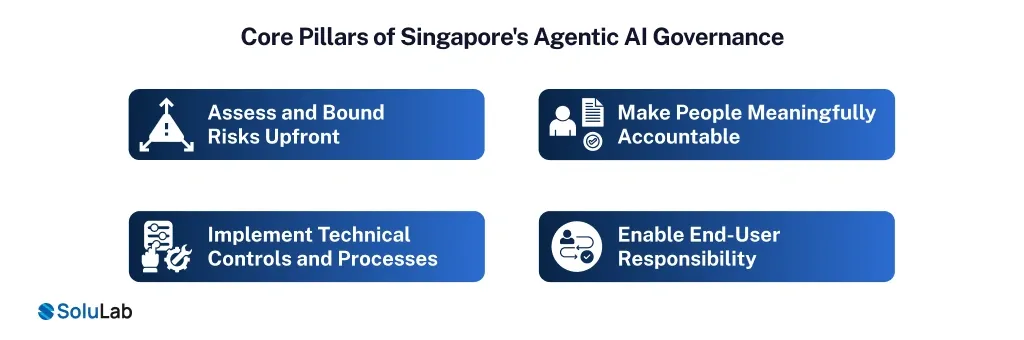
Agentic AI introduces autonomous decision-making, making governance essential. Singapore’s framework defines clear responsibility, risk controls, and operational safeguards to ensure AI systems remain reliable, accountable, and aligned with human intent.
- Assess and Bound Risks Upfront: Identify potential risks before deployment by classifying AI systems based on impact, defining clear operational boundaries, and ensuring safeguards are in place to prevent unintended or harmful outcomes.
- Make People Meaningfully Accountable: Establish clear ownership across teams by assigning responsibility for AI decisions, ensuring human oversight, and creating accountability structures that align with business, legal, and ethical requirements.
- Implement Technical Controls and Processes: Deploy monitoring systems, access controls, validation layers, and audit mechanisms that continuously track AI behavior, detect anomalies, and enforce governance policies throughout the AI lifecycle.
- Enable End-User Responsibility: Ensure users understand AI system capabilities and limitations by providing transparency, clear usage guidelines, and controls that allow human intervention when AI decisions require review or correction.

What This Means for Global Enterprises?
With increasingly autonomous and distributed AI systems implemented around the world, enterprises will need to reconsider how to govern to engage risk, enforce compliance, and exercise control over an increasingly complex and distributed AI system.
1. Compliance Expectations Will Expand Beyond Regions
The AI governance system of Singapore is indicative of a new direction where businesses would adapt to international standards, as opposed to local regulations, as AI laws would start shaping international operations and relationships.
2. Enterprises Must Prepare For Cross-Border AI Regulations
Enterprise AI solutions should be in place to transition organizations moving between conflicting regulatory mandates and ensure the compliance, auditability, and flexibility of AI systems across jurisdictions and changing legal frameworks.
3. Governance Will Become A Core Part of AI Infrastructure
AI governance will not be an option anymore; rather, it will be part and parcel of infrastructure, which will allow continuous monitoring, accountability, and control throughout the AI lifecycle, including development and deployment.
How Enterprises Can Build an Agentic AI Governance Framework like Singapore?
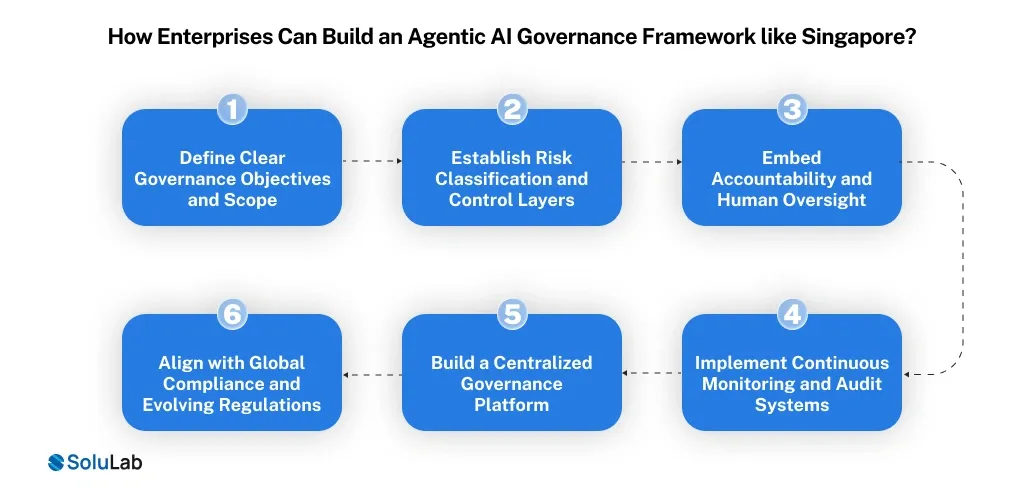
Enterprises are rapidly adopting autonomous AI systems, but without structured governance, risks scale quickly. Building a strong framework ensures control, compliance, and trust in increasingly independent AI-driven decision environments.
Step 1. Define Clear Governance Objectives and Scope
Start by identifying where AI agents operate, decision boundaries, and accountability structures to align governance with business goals, regulatory requirements, and operational risk tolerance.
Step 2. Establish Risk Classification and Control Layers
Segment AI systems based on impact and autonomy levels, then apply tiered controls, monitoring, and approval mechanisms similar to Singapore’s agentic AI governance framework for structured oversight.
Step 3. Embed Accountability and Human Oversight
Define ownership across teams and introduce human-in-the-loop checkpoints for high-risk decisions, ensuring traceability, auditability, and clear responsibility across AI-driven processes.
Step 4. Implement Continuous Monitoring and Audit Systems
Deploy real-time tracking, logging, and audit trails to monitor AI behavior, detect anomalies, and maintain compliance across the lifecycle, forming the backbone of Agentic AI Governance.
Step 5. Build a Centralized Governance Platform
Create a unified system to manage AI inventory, approvals, risk scoring, and reporting, enabling consistent governance across departments, geographies, and multiple AI models.
Step 6. Align with Global Compliance and Evolving Regulations
Design governance frameworks that adapt to changing regulatory landscapes, ensuring enterprise AI systems remain compliant, scalable, and future-ready across jurisdictions and industry standards.
Future of Agentic AI Governance
The agentic AI in businesses is transforming at an extremely fast speed, and regulators need to reconsider governance frameworks, because autonomous systems come with new risks, new accountabilities, and the necessity to organize supervision across international implementations.
- Transition to International AI Regulatory Coherence: Nations and authorities are striving to reach harmonized standards of AI regulation, cross-border compliance, less fragmentation, and giving businesses a chance to implement AI systems with a single eye on multiple jurisdictions.
- AI Agents are becoming autonomous decision-makers: Recent AI agents are leaving the support role and going directly to complex decision-making, calling into increased accountability structures and explainability systems, as well as human supervision to avoid unexpected outcomes and threats.
- Governance Becoming a Requirement: The AI governance is not a strategic decision anymore, but rather a regulatory requirement where businesses need to adopt systematic structures in order to achieve compliance responses, risk management, as well as sustaining a level of confidence in the AI-driven activities.
Read Also: Enterprise AI Security & Governance
How SoluLab Helps Build Enterprise-Ready AI Governance Frameworks?
Enterprises need more than policies to govern AI effectively; they require scalable, implementation-ready frameworks that integrate security, compliance, and accountability into every stage of AI development and deployment.
- AI-native development approach with governance embedded
- Enterprise AI governance solutions for lifecycle control
- AI security, compliance, and audit-ready systems
- Custom governance platform development
- Scalable frameworks for multi-team and global operations

Conclusion
Building an agentic AI governance system, such as that of Singapore, is not a visionary concept anymore; it is becoming a business requirement.
With the continued development of AI systems to be more autonomous, enterprises require well-organized governance that ensures control, transparency, and compliance without reducing the pace of innovation.
Agentic AI governance is not optional anymore but rather incorporates it in the AI lifecycle. Early acting organizations will minimize risk, enhance trust, and keep pace with changing regulations.
In case you want to design and deploy such a structure, SoluLab, an AI consulting company, can assist your business in developing scalable, enterprise-ready AI governance structures.
FAQs
Neha is a curious content writer with a knack for breaking down complex technologies into meaningful, reader-friendly insights. With experience in blockchain, digital assets, and enterprise tech, she focuses on creating content that informs, connects, and supports strategic decision-making.