AI Agent Development Architecture is becoming an integral part of business activities. Now, enterprises want to deploy an AI Agent framework that understands the business goals and executes tasks with minimal manual effort.
With Custom AI agent development, businesses can automate their processes such as customer support, sales, HR, logistic operations. These solutions can be deployed across a vast range of industries like finance, logistics, healthcare, and more.
A well-built AI agent requires a strong backend structure, secure data access, memory, orchestration, monitoring, and scalable deployment.
This blog helps you understand what an AI agent architecture is, its components, the right AI agent tech stack, and how to design one that works in real business environments.
Key Highlights
- AI agent architecture defines how your system thinks, connects, acts, and scales across real business workflows.
- A strong AI agent development architecture improves efficiency, security, automation, and long-term return on investment.
- Core AI agent architecture components include interface, orchestration, model layer, memory, retrieval, and integrations.
- The best AI agent tech stack depends on your goals, data, compliance, integrations, and future scalability needs.
- Solulab can help you design, develop, and scale an AI agent that fits your business goals and real workflows.
What Is AI Agent Architecture?
AI agent architecture is the technical structure that allows an AI agent to receive a goal, understand context, plan actions, use tools, access data, make decisions, and deliver a useful result.
AI agents usually work through goal initialization, planning, tool use, and learning from interactions. It is the brain, memory, workflow, and execution system behind an AI agent. The architecture decides how the agent thinks, what data it can access, which tools it can use, how it handles errors, and how safely it performs actions.
For a business, the right AI Agent Development Architecture decides whether the agent becomes a reliable digital worker or just another experimental tool.
Why AI Agent Development Architecture Matters for Businesses?
AI agent development architecture is the system design behind your AI-powered solution. It defines how the agent understands requests, retrieves data, makes decisions, uses tools, and delivers outcomes.
For your business, AI Agent architecture matters because it shapes performance, security, cost, and user trust. A weak design may look impressive in a demo but fail in production.
A strong AI agent architecture helps you:
- Reduce repetitive work across teams.
It automates repeated tasks, improves team productivity, and frees your staff to focus on higher-value business activities daily.
- Connect AI with business systems.
It links your agent with CRM, ERP, helpdesk, and internal tools, so responses become useful, and actions become real.
- Improve security and governance
It controls permissions, protects data, logs actions, and reduces risks when your agent handles sensitive workflows.
- Scale without rebuilding everything
It supports new users, departments, workflows, and integrations without forcing your business to start from scratch later.
- Measure business impact clearly.
It tracks response quality, automation rates, cost savings, and workflow outcomes so you can prove return on investment.
Core Components Of AI Agent Architecture
To choose the right solution, you need to understand the main AI agent architecture components. Each part affects business performance:
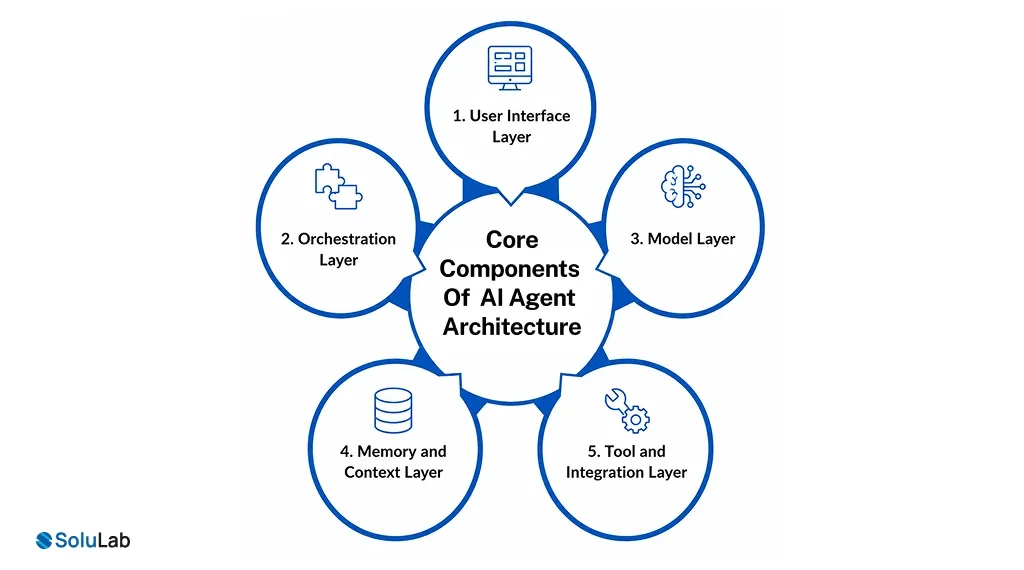
User Interface Layer
This is where people interact with the agent. It can be a website chat, internal portal, dashboard, app, or voice experience.
A simple interface improves adoption. Your users should not need technical skills to get value from the system.
Orchestration Layer
This is the decision engine that manages the workflow. It decides what the agent should do, in what order, and when.
This layer is central in modern AI agent architecture because it helps your system move from questions to actions.
Model Layer
This layer handles language understanding, content generation, summarization, and reasoning. It is often powered by one or more large language models.
Your model choice affects quality, speed, cost, and reliability.
Memory and Context Layer
This layer helps the AI agent architecture remember relevant information. It may store session context, preferences, business rules, or prior interactions.
Good memory improves continuity and makes the experience more useful for your users.
Tool and Integration Layer
This is where the agent connects with other systems. It lets the agent retrieve data, update records, trigger actions, and support workflows.
How AI Agent Workflow Work?
Step 1: The User Gives a Goal
The workflow starts when a user gives the agent a task. This may be a question, request, command, document, voice input, or business trigger.
The goal should be understood clearly before the agent takes action. If the request is incomplete, the agent may ask a follow-up question or use available context to continue safely.
Step 2: The Agent Reads Context
The agent checks conversation history, user role, business rules, documents, memory, and system instructions. This helps it understand what the user means and what constraints apply.
For example, a finance AI agent should respond differently to a CFO, an accountant, or a customer service executive because each role may have different permissions.
Step 3: The Agent Retrieves Knowledge
Next, the agent searches approved knowledge sources. This may include documents, databases, vector stores, APIs, or live business systems.
This step improves accuracy because the agent can use actual company data instead of relying only on general model knowledge.
Step 4: The Agent Creates a Plan
The agent breaks the task into smaller steps. It may decide to search data, call an API, compare results, generate content, request approval, or create a final report.
A strong planning layer keeps the agent focused and prevents unnecessary actions.
Step 5: The Agent Uses Tools
The agent calls tools to complete the task. It may open a CRM record, check inventory, retrieve analytics, send data to another system, or create a ticket.
Tool use must be controlled with permissions, logging, and validation.
Step 6: The Agent Verifies the Output
Before responding, the agent should check whether the result is complete, accurate, and aligned with the user’s request.
For sensitive workflows, the system can add human review before the agent performs final actions.
Step 7: The Agent Responds or Acts
The agent gives the answer, completes the task, or prepares the output for approval. The response should be clear, useful, and matched to the user’s business context.
Step 8: The System Logs and Learns
The workflow is logged for monitoring, debugging, analytics, and future improvement. Useful preferences or approved patterns may be saved in memory.

Best AI Agent Tech Stack for Modern Businesses
The best AI tech stack depends on the use case, budget, integrations, compliance needs, and expected traffic. A practical stack may include:
| Architecture Layer | Common Options |
|---|---|
| Frontend | React, Next.js, Vue, Flutter |
| Backend | Python, FastAPI, Node.js, Django |
| LLMs | OpenAI, Claude, Gemini, Llama, Mistral |
| Agent Frameworks | OpenAI Agents SDK, LangGraph, CrewAI, AutoGen, Semantic Kernel |
| Vector Database | Pinecone, Weaviate, Milvus, Chroma, pgvector |
| Data Layer | PostgreSQL, MongoDB, BigQuery, Snowflake |
| Tool Integration | REST APIs, GraphQL, webhooks, MCP-style connectors |
| Cloud | AWS, Azure, Google Cloud |
| Monitoring | LangSmith, OpenAI tracing, Datadog, Grafana |
| Security | IAM, OAuth, RBAC, audit logs, encryption |
How Much Does a Basic Version of an AI Agent Cost?
A basic version of an AI agent usually costs less than a full enterprise system because it has fewer integrations, simpler memory, limited tool access, and a smaller user base.
As a practical market estimate, a basic AI agent MVP may cost around $10,000 to $30,000. A mid-level business agent may range from $30,000 to $80,000. Enterprise-grade agents with multiple systems, advanced security, and custom workflows can exceed $100,000. Recent market cost breakdowns also place simple agent builds in the low five-figure range and complex systems much higher.
Main cost factors include:
- Number of workflows and user roles
- Model selection and token usage
- Data preparation and knowledge base setup
- CRM, ERP, database, or API integrations
- Security, compliance, and approval workflows
- Monitoring, testing, and maintenance
For most businesses, the best approach is to start with a focused MVP, test real usage, measure ROI, and then scale.
How to Build AI Agent Development Architecture: Step-by-Step Guide
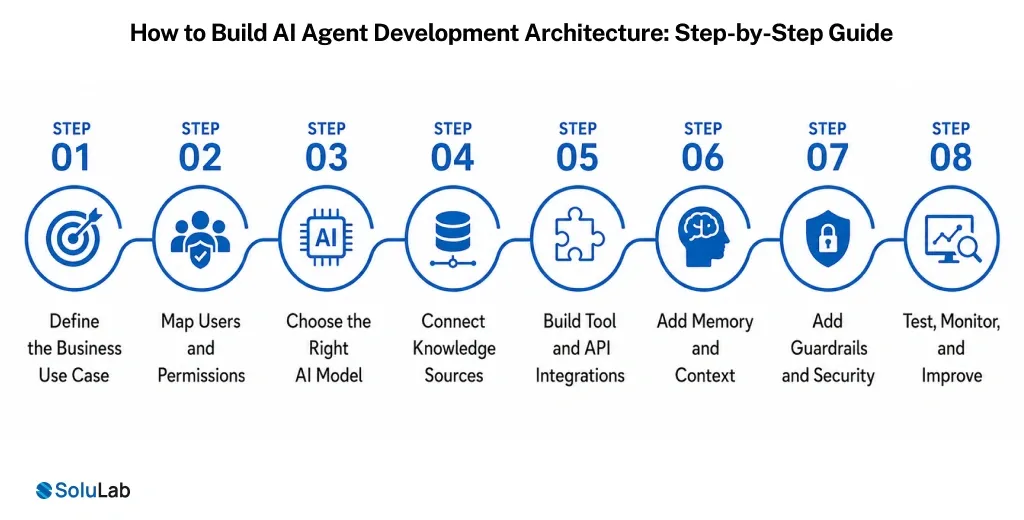
Step 1: Define the Business Use Case
Start by identifying the exact problem the AI agent will solve. Decide whether it will support sales, customer service, healthcare, finance, HR, research, or internal operations. A clear AI use case keeps the AI agent development architecture focused, practical, and cost-effective.
Step 2: Map Users and Permissions
List every user who will interact with the AI agent, including admins, employees, customers, managers, or external users. Define what each role can access or approve. This strengthens the AI agent architecture with better security, privacy, and compliance control.
Step 3: Choose the Right AI Model
Select the AI model based on accuracy, speed, cost, privacy, and reasoning needs. Some tasks need advanced reasoning, while others can use smaller models. A smart model strategy improves performance and supports a stronger AI agent tech stack.
Step 4: Connect Knowledge Sources
Add trusted business data such as documents, CRM records, product information, policies, databases, FAQs, and analytics reports. This helps the agent respond with verified information. A strong knowledge layer is one of the most important AI agent architecture components.
Step 5: Build Tool and API Integrations
Connect the AI agent with business tools such as CRM, ERP, email, calendars, ticketing systems, analytics platforms, and internal databases. These AI integrations allow the agent to take action, automate workflows, and support real Custom AI agent development needs.
Step 6: Add Memory and Context
Use memory to help the agent remember user preferences, previous conversations, task history, and business context. This makes the agent more useful over time. Memory also improves personalization and supports smarter AI agent development architecture for repeat workflows.
Step 7: Add Guardrails and Security
Set clear rules for what the AI agent can and cannot do. Add role-based access, approval flows, privacy controls, content filters, and audit logs. Guardrails are essential for safe production use, especially in enterprise AI agent architecture.
Step 8: Test, Monitor, and Improve
Test the agent with real workflows before launch. Monitor accuracy, tool calls, response quality, errors, cost, and user feedback. Continuous improvement helps businesses build a more reliable AI scalability architecture and get better long-term results from AI automation.

Final Thoughts
A successful AI agent starts with a strong architecture. The model is important, but the real value comes from orchestration, memory, tools, data access, security, monitoring, and scalability.
For businesses, AI-led development should be planned around real workflows, not trends. The right AI agent architecture helps reduce manual work, improve decision-making, support customers faster, and connect teams with trusted business data.
Whether a company needs a basic assistant or a production-grade enterprise agent, the best path is to start focused, design carefully, and scale based on measurable results.
Choose Solulab for AI Agent Development!
Deploy an AI agent that creates business value with SoluLab. We are the leading AI agent development company that will help you deploy a custom AI agent Development architecture with respect to the business use case.
Our AI consulting services include strategy, architecture, development, integration, and scale support in one place. Our AI experts can help you understand how businesses evaluate AI investments and take ideas to production with a solution designed around your workflows, systems, users, and goals.
FAQs
Shipra Garg is a tech-focused content strategist and copywriter specializing in Web3, blockchain, and artificial intelligence. She has worked with startups and enterprise teams to craft high-conversion content that bridges deep tech with business impact. Her work translates complex innovations into clear, credible, and engaging narratives that drive growth and build trust in emerging tech markets.