Key Takeaways
- Implementation is more than the model. It covers use case selection, data, integration, process change, measurement and scale.
- Readiness and a baseline decide the outcome. If the outcome was never recorded, or current performance was never measured, no model can prove its value.
- Most failures are organisational. Six of the eight common failure patterns have nothing to do with the technology.
- Data work is usually the largest cost. Running cost also scales with success, so model it at production volume, not pilot volume.
- Plan three to six months to daily use. Anything promising production in weeks is describing a pilot.
AI implementation is the process of taking an AI capability from an idea to something an organisation uses every day. In practice, it has eight stages, from use case selection through to scale. However, the stage that defeats most organisations is not building the model. It is changing the process around it and keeping it running once the project team leaves.
What is AI implementation?
AI implementation covers everything between deciding to use AI and having it used routinely: choosing the use case, checking the data, building or buying the capability, integrating it, changing the process, training people, measuring the result and scaling. Our AI implementation services cover this end to end.
However, it is distinct from two adjacent things it gets confused with:
| Term | What it means |
| AI implementation | The whole programme, idea to daily use |
| AI integration | Connecting an AI capability to your existing systems and data. A component of implementation |
| AI adoption | What happens after implementation, whether people actually use it |
Most published advice covers the model and skips the rest. Yet the rest is where projects fail. For connecting AI to the systems you already run, see our AI integration services.
The eight steps of AI implementation
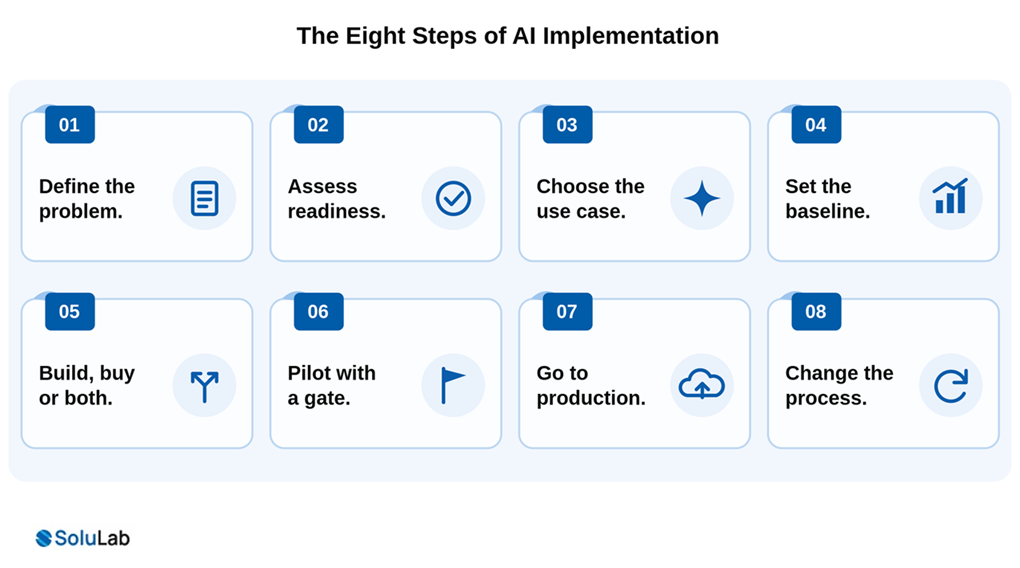
- Define the business problem, not the AI project. Instead, start with a decision or a task that costs money and takes time. If a prediction would not change what anyone does, it is not a use case regardless of how interesting the model is.
- Assess readiness. Four things, in order of how often they block: is the outcome recorded in your data at all, is the data accessible without a one-off extract, does a named person own the process, and is there a written policy the system can apply.
- Choose the first use case. High-volume, written policy, measurable cost per instance, reversible output, and a named owner. However, visibility is the wrong criterion, even though it is the most common one used.
- Establish the baseline. What does the current method achieve. A model at 85% is excellent against 65% and a failure against a 95% requirement. As a result, projects that skip this produce results nobody can judge.
- Decide build, buy or both. Buy for standard work on common systems. Build where your process is genuinely unusual, data cannot leave your environment, per-task pricing breaks at your volume, or the capability is a differentiator.
- Pilot with a decision gate. Measured on your own data against the baseline, with a stated rule in advance for what result means proceed, adjust or stop. A scoped AI proof of concept is one way to run this gate.
- Implement into production. Data pipeline, integration, access control, logging, fallbacks, monitoring, and the controls your risk function requires. In fact, this is usually the largest phase and is routinely underestimated.
- Change the process and measure. Retrain the people, redesign the workflow, name the owner, and measure the business metric you agreed in step 4. Otherwise, you end up with a working system nobody uses.
How to implement AI in business, if you only remember three things
- The data question comes before the model question. After all, if the outcome was never recorded, nothing can be predicted.
- Write down the number that would make you stop. Before the pilot, not after.
- Someone must own the process, not just the system. Monitoring lapses within a quarter otherwise.
AI readiness: what actually blocks projects
| Area | Ready | Not ready |
| Data availability | The outcome is recorded and accessible | It lives in a system nobody can query |
| Data quality | Known, measured, with owners | Unknown until someone looks |
| Process ownership | A named person can change the workflow | Three teams share it informally |
| Written policy | The rule exists in writing | Experienced staff decide case-by-case |
| Baseline measurement | Current performance is known | Nobody has measured it |
| Skills | Someone can evaluate model output | The vendor is the only judge |
| Governance | Risk classification and approval exist | Decided at deployment, which is too late |
| Executive sponsorship | A named sponsor with budget | Enthusiasm without a decision-maker |
In other words, anything in the right column is work that has to happen whether or not you use AI. That is worth saying to a board, because it reframes the cost as fixing the foundation rather than funding an experiment. Also, a structured AI readiness assessment checks each of these areas.
Why AI projects fail
In practice, the pattern is rarely a model that did not work. Instead, it is usually one of these:
- The pilot proved the model, not the business outcome. Accuracy improved, but the metric that matters did not move.
- The data access was temporary. An extract is fine for a pilot, but it is not a pipeline.
- No owner after the project team left. Monitoring stops, quality drifts, nobody notices.
- The process never changed. So output arrives, and people continue as before.
- Controls were designed too late, so risk or compliance blocked deployment after the build.
- Cost was modelled at pilot volume, understating production cost substantially.
- The use case was chosen for visibility rather than for payback and clean data.
- Success was never defined, so the programme could neither be declared finished nor stopped.
Six of those eight are organisational. That is why this ratio is the single most useful thing to know before starting.
What AI implementation costs
Cost is not one number. In fact, it has five parts, and the one organisations forget is the fifth.
| Component | What drives it |
| Readiness and data work | Usually the largest, and the least expected |
| Build or licence | Scope, integrations, accuracy bar |
| Integration | Number of systems, and whether they have APIs |
| Running cost | Per instance or per user, scaling with success |
| Change, training and ongoing ownership | Number of people affected, and it never ends |
The number that justifies the programme is cost per instance before against after at production volume, measured on a metric your organisation already reports. Not model accuracy, and not a vendor’s published benefit figure.
How long does AI implementation take?
| Phase | Typical |
| Readiness assessment | 2 to 3 weeks |
| Foundation: data, access, controls | 4 to 8 weeks |
| First use case to production | 6 to 12 weeks |
| Embedding: process, training, ownership | 4 to 8 weeks |
Three to six months to a first use case in genuine daily use is realistic. Anything promising production in weeks is describing a pilot, and a pilot is not the hard part.
Machine learning or generative AI: which problem are you solving?
| Your problem | What fits |
| Predict a number or a category from structured data | Machine learning. Forecasting, scoring, classification |
| Read and interpret unstructured documents or text | Language models, with retrieval over your own content |
| Produce language, code or images | Generative models |
| Complete a multi-step task across systems | Agents, with permissions and approval design |
| Apply a rule you can already write down | Not AI. Automate it |
In practice, the last row saves more money than the other four combined. If the rule can be written, writing it is cheaper, faster and more predictable than learning it.
Governance, which decides whether it ships
Four things your risk function will ask for, and designing them early costs a fraction of retrofitting them:
- An inventory, so somebody knows what AI is running.
- Risk classification per system, based on what it decides and who it affects.
- Controls proportional to that risk: approval thresholds, human review, audit trail, monitoring.
- A named owner per system.
Our AI consulting team can help design that framework alongside the first use case.
What good looks like at twelve months
- One or two use cases in production, used daily, with named owners.
- A measured improvement in a metric the organisation already reported before.
- A data foundation the next use case can reuse, so the second costs less than the first.
- Monitoring your own team reads, not a vendor dashboard. MLOps consulting covers how that monitoring is set up.
- A governance framework that did not slow the first project down because it was built alongside it.
So if after twelve months there are six pilots and nothing in production, the problem is almost never the technology.
How SoluLab helps
We run the implementation rather than the slide deck: readiness assessment that can conclude you are not ready, data foundation work, the build or the platform selection, integration, controls designed with your risk function, change management, and measurement against a metric you already report.
For the delivery service, see our AI implementation services. Also, for integration into existing systems, see AI integration services. Finally, for strategy and use case selection, see our AI consulting page.
AI readiness assessment
Bring the decision you want to improve and the systems involved. You will get a readiness view, the blockers in order, the first use case worth doing, and the number to measure it against.
Frequently Asked Questions
Shipra Garg is a tech-focused content strategist and copywriter specializing in Web3, blockchain, and artificial intelligence. She has worked with startups and enterprise teams to craft high-conversion content that bridges deep tech with business impact. Her work translates complex innovations into clear, credible, and engaging narratives that drive growth and build trust in emerging tech markets.