Key Takeaways
- AI coding agents go beyond autocomplete. They plan, write, test, and often fix their own code across multiple steps with minimal human input.
- Unlike traditional automation, an autonomous AI coding agent can reason about a task, decide what to do next, and adjust when something breaks.
- Tools like Claude Code, Cursor, Windsurf, and GitHub Copilot’s Agent Mode each take a different approach to how much autonomy they hand the developer.
- The real value shows up in specific situations: repetitive coding tasks, legacy modernization, and speeding up the early stages of MVP development.
- Security cannot be an afterthought. Sandboxing, least privilege access, and human approval steps matter as much as the agent’s coding ability itself.
A few years ago, “AI writing code” mostly meant autocomplete that finished your sentence for you. That’s not really what’s happening anymore.
AI coding agents can read an entire codebase, plan out a multi-step task, write the code, run the tests, and fix what breaks, often with very little hand-holding from a developer.
That shift from suggestion to action is the whole point of agentic AI development for coding. Instead of asking a model to generate a snippet and pasting it in yourself, you’re handing off an actual task and letting the agent figure out the steps to get there. It’s a meaningful difference, and it’s why engineering teams are paying attention.
According to Gartner, 75% of enterprise software engineers will use AI code assistants by 2028, up from less than 10% in early 2023. This guide walks through what an AI coding agent actually is, how it works, and more.
How AI Coding Agents Work?
Understanding the mechanics behind coding AI agents helps clarify why they can handle far more complex, multi-step engineering tasks than a simple code completion tool ever could.
- Reads and understands context: The agent scans relevant files, dependencies, and project structure before deciding how to approach the task at hand.
- Plans a sequence of actions: Rather than generating one block of code, it breaks the task into smaller steps that it can execute in order.
- Writes and edits code directly: The agent modifies files, creates new ones, and refactors existing code as part of completing its plan.
- Runs tests and checks results: Many agents execute test suites automatically, using the output to catch mistakes before a human ever looks at the diff.
- Iterates until the task is done: When something fails, the agent adjusts its approach and tries again instead of stopping and waiting for instructions.
AI Coding Agents vs. Traditional Automation
It’s worth being precise here, since a lot of what’s called “automation” in dev tooling works quite differently from what these newer agents actually do.
| Factor | AI Coding Agents | Traditional Automation |
| Decision-making | Reasons through steps dynamically | Follows fixed, pre-defined rules |
| Flexibility | Adapts when a task changes | Breaks when conditions shift |
| Scope of work | Handles multi-step coding tasks | Executes a single, narrow function |
| Error handling | Detects and corrects its own mistakes | Fails and stops without judgment |
| Setup | Works from natural language instructions | Requires explicit scripting upfront |
Popular AI Coding Agent Tools
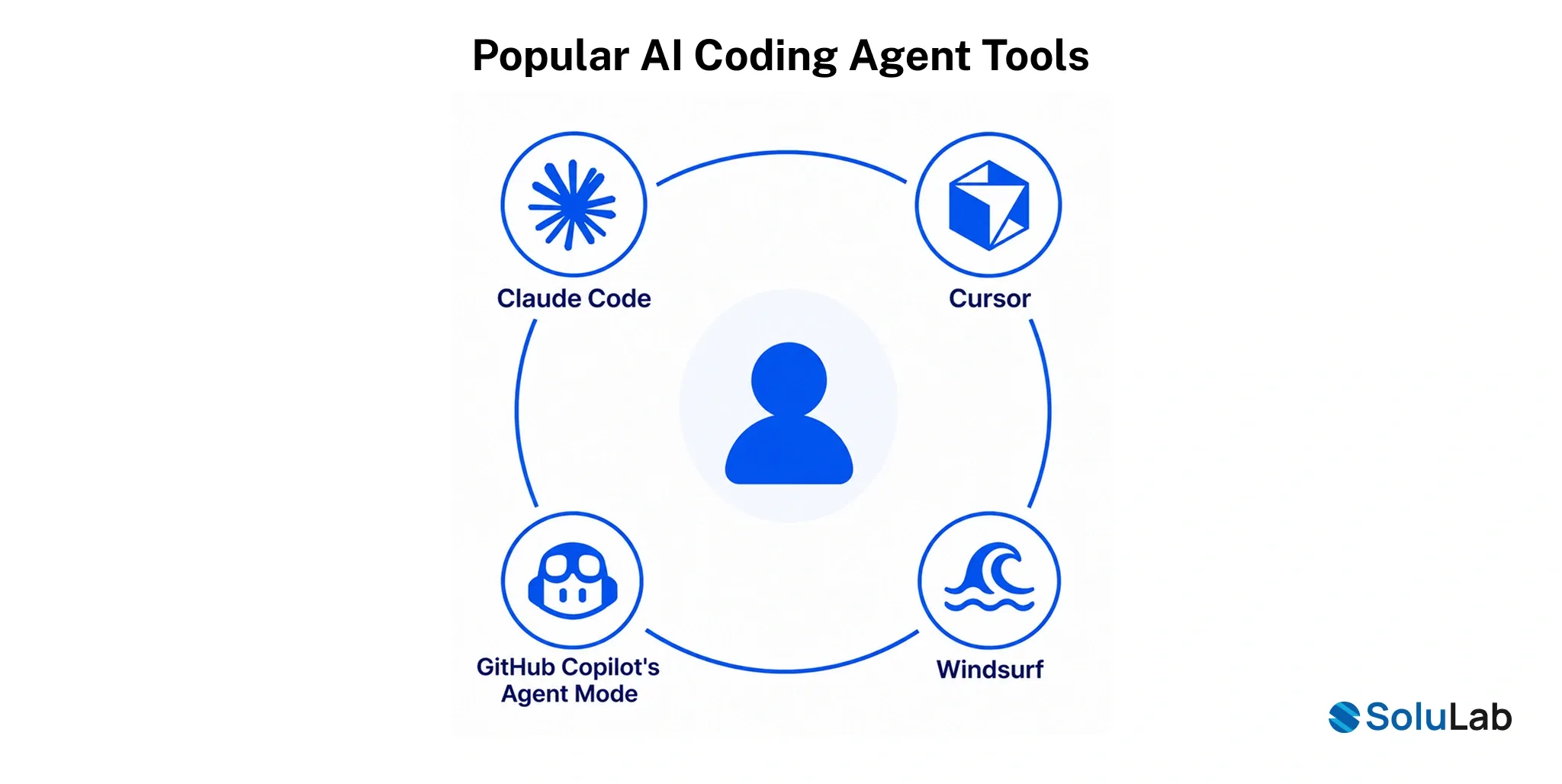
A handful of tools currently lead the way when it comes to the best AI agents available to development teams, each with a slightly different philosophy.
- Claude Code takes a terminal-first approach, letting developers hand off complex, multi-file tasks and review changes as the agent works through them step by step.
- Cursor builds agentic capability directly into a familiar IDE experience, which makes it an easy entry point for teams that don’t want to change their existing workflow.
- Windsurf leans into a more autonomous “flow” style of working, where the agent handles longer sequences of changes before checking back in with the developer.
- GitHub Copilot’s Agent Mode extends the tool most developers already know, adding task planning and multi-step execution on top of the completion features it built its reputation. More than 90% of Fortune 500 companies use GitHub Copilot in some capacity.

Benefits of AI Coding Agents for Businesses
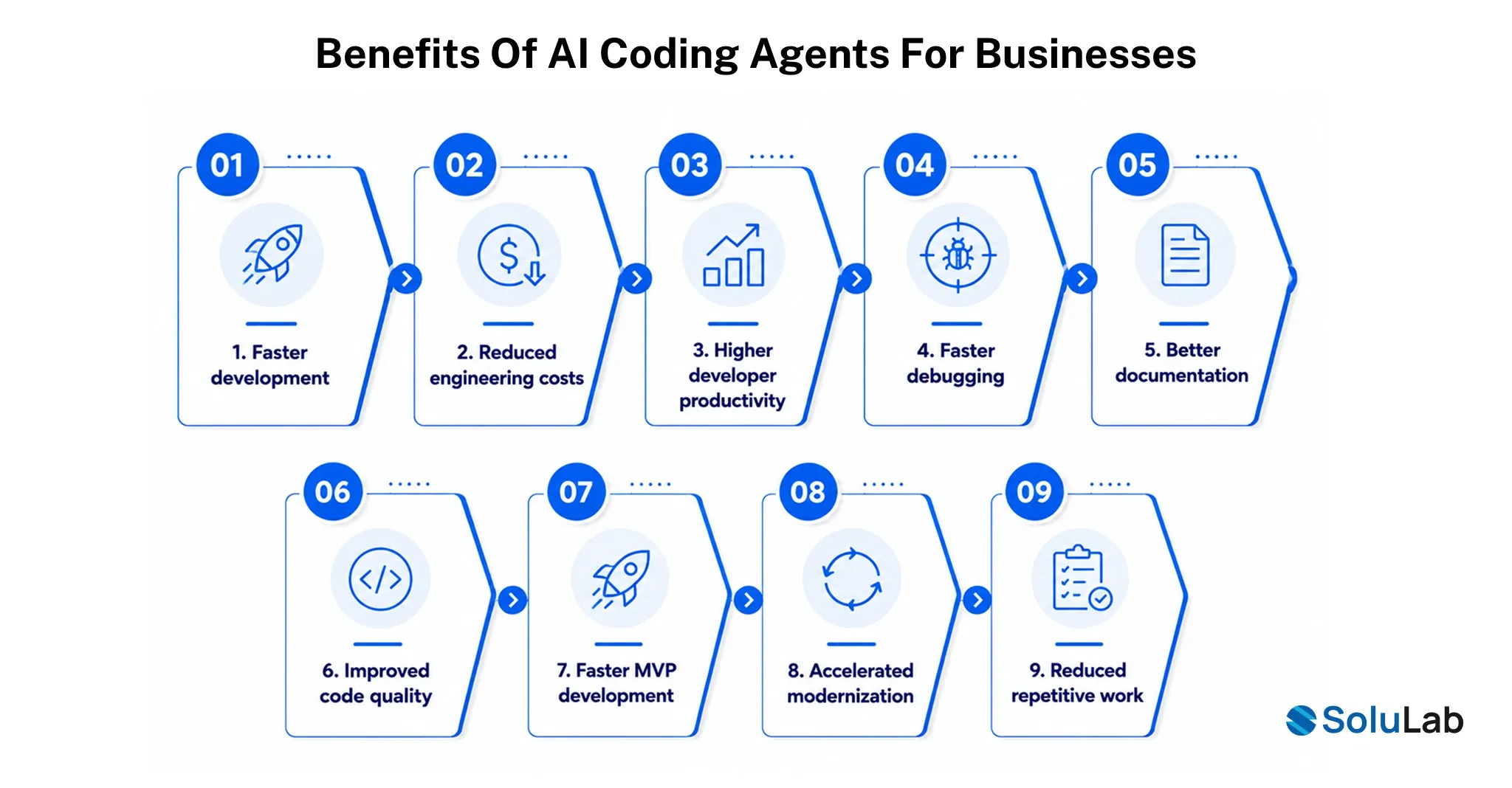
Beyond the novelty of watching an agent write and test its own code, there are concrete business reasons teams are adopting AI agents for coding right now.
- Faster development: Tasks that used to take days of manual coding and testing can often be completed in hours once an agent handles the repetitive parts.
- Reduced engineering costs: Automating routine implementation work means fewer engineering hours spent on tasks that don’t require senior-level judgment calls.
- Higher developer productivity: Developers spend more time on architecture and problem-solving while the agent handles boilerplate and repetitive implementation details.
- Faster debugging: Agents can trace through a codebase, identify likely causes of a bug, and propose or apply fixes far quicker than manual investigation.
- Better documentation: Many agents generate documentation alongside code changes, closing a gap that often gets skipped under deadline pressure.
- Improved code quality: Consistent application of coding standards and automatic test runs help catch issues before they reach a human reviewer.
- Faster MVP development: Early-stage products benefit enormously from agents that can scaffold and iterate on features quickly during validation.
- Accelerated modernization: Legacy codebase updates, a tedious task, become far more manageable with an agent handling repetitive migration work.
- Reduced repetitive work: Developers get to skip the parts of the job that drain motivation, like writing tests or updating configuration files.
What AI Coding Agents Are Good At?
Before deciding whether to bring one into your workflow, it helps to know exactly where these tools tend to perform well.
- Writing repetitive boilerplate code fast
- Refactoring large existing codebases safely
- Generating and running test suites
- Migrating code between frameworks smoothly
- Fixing well-defined, reproducible bugs quickly
- Scaffolding new features from scratch
- Writing and updating documentation automatically
When to Use an AI Coding Agent?
Knowing when an agent actually adds value, rather than just adding complexity, makes the difference between a useful tool and wasted effort.
- Prototyping an MVP under time pressure
- Modernizing a large legacy codebase
- Clearing a backlog of small bugs
- Automating repetitive test-writing tasks
- Speeding up onboarding for new developers
- Handling well-scoped, low-risk coding tasks
- Reducing time spent on documentation
How to Implement AI Coding Agents in Your Organization
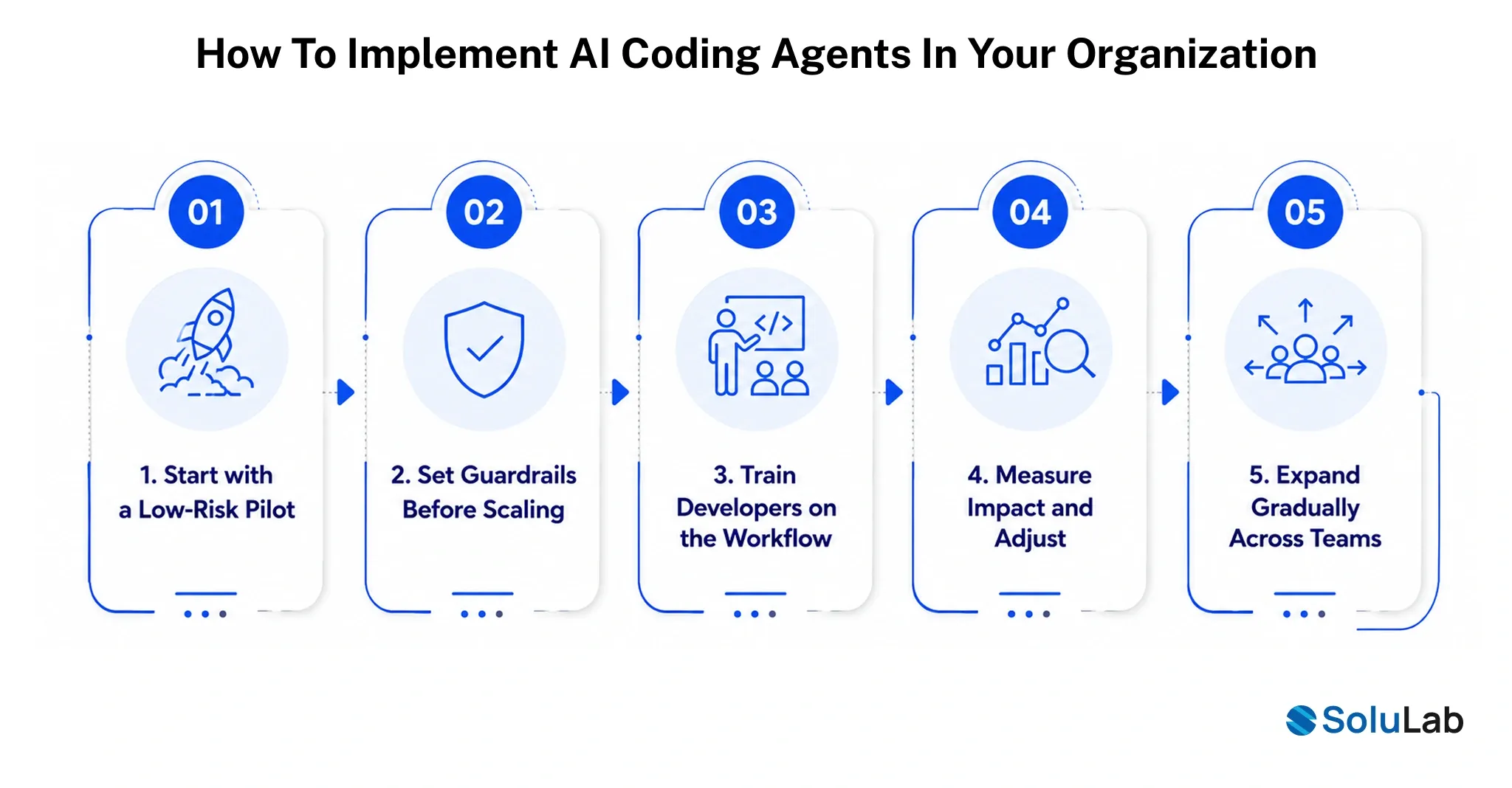
Rolling out an agentic AI coding across a team works best as a gradual process rather than something you flip on across every project at once.
1. Start with a Low-Risk Pilot
Pick a small, well-defined project where mistakes are cheap and easy to catch.
- Choose one small team
- Select low-risk coding tasks
- Define clear success metrics
2. Set Guardrails Before Scaling
Establish rules around what the agent can and cannot touch without approval.
- Restrict access to production
- Require review before merging
- Set clear permission boundaries
3. Train Developers on the Workflow
Teams need to learn how to prompt, review, and correct the agent effectively.
- Run hands-on training sessions
- Share effective prompting examples
- Encourage careful output review
4. Measure Impact and Adjust
Track real outcomes before expanding usage further across the organization.
- Track velocity and quality metrics
- Gather developer feedback regularly
- Adjust guardrails based on results
5. Expand Gradually Across Teams
Once results hold up, extend usage to additional teams and project types.
- Roll out to more teams.
- Document lessons from the pilot
- Standardize best practices org-wide
How AI Coding Agents Improve the Software Development Lifecycle (SDLC)?
AI agent development touches nearly every phase of the SDLC, not just the part where code actually gets written.
1. Planning and Requirements
Agents can help translate requirements into technical tasks faster than a manual breakdown alone.
- Draft technical task breakdowns
- Flag ambiguous requirements early
- Estimate the implementation complexity roughly
2. Development and Coding
This is where agents spend most of their time, writing and modifying actual code.
- Generate feature implementation code
- Refactor existing code structures
- Apply consistent coding standards
3. Testing and QA
Automated test generation and execution catch issues before they reach a human reviewer.
- Write comprehensive test cases
- Test suites automatically
- Flag failing tests immediately
4. Code Review and Deployment
Agents can prepare code for review and even assist with deployment readiness checks.
- Summarize changes for reviewers
- Check deployment readiness automatically
- Suggest rollback plans proactively
5. Maintenance and Monitoring
Ongoing maintenance tasks, often neglected, become far more manageable with agent support.
- Identify outdated dependencies quickly
- Propose security patch updates
- Monitor for recurring bug patterns
AI Coding Agent Security Best Practices
Handing an agent the ability to write and execute code introduces real risk, so security needs to be built in from day one, not added later.
- Prompt injection protection: Treat any external content the agent reads, including code comments and documentation, as untrusted input that could contain hidden instructions.
- Secrets management: Keep API keys, credentials, and tokens out of reach of the agent entirely, using secure vaults instead of plaintext configuration files.
- Sandbox execution: Run agent-generated code in isolated environments first, so a mistake or malicious action can’t touch production systems directly.
- Least privilege: Grant the agent only the specific permissions it needs for a given task, nothing broader than what the job actually requires.
- Code review: Require human review before any agent-generated code merges into the main branch, regardless of how routine the task seems.
- Human approval: Build in explicit approval steps for higher-risk actions, like deployments or changes touching sensitive systems.
- Model governance: Set clear policies on which models and tools are approved for use, and review them periodically as the landscape shifts.
- Audit logging: Log every action an agent takes so teams can trace back exactly what happened if something goes wrong.
Read more: Autonomous shopping AI agent
How Can SoluLab Help You Build and Deploy AI Coding Agents?
Adopting an agentic AI coding framework is one thing. Building and securing one that fits your actual engineering workflow is a different challenge entirely. SoluLab helps businesses design, integrate, and govern AI coding agents tailored to their codebase, team structure, and risk tolerance.
- Custom AI coding agent development
- Secure agent architecture and sandboxing
- Integration with existing dev workflows
- Multi-agent AI coding workflow design
- Security and governance framework setup
- Team training and rollout support
For example, SoluLab built UpdateIA, a multi-agent AI platform for a French startup, enabling 14+ autonomous agents coordinated by Jarvis. It unified enterprise workflows, reduced manual effort, ensured compliance, and improved real-time decision-making across HR, CRM, Finance, and Legal systems.

Conclusion
AI coding agents represent a real shift in how software gets built, not just a faster way to autocomplete a function. Used well, they speed up development, reduce repetitive engineering work, and free up developers to focus on the problems that actually need human judgment. Used carelessly, without guardrails or review, they introduce risk that’s easy to underestimate until something goes wrong.
Getting the balance right takes more than picking a tool off a list. SoluLab, an AI development company, can help your business design, secure, and deploy AI coding agents that fit how your team actually works.
FAQs
Neha is a curious content writer with a knack for breaking down complex technologies into meaningful, reader-friendly insights. With experience in blockchain, digital assets, and enterprise tech, she focuses on creating content that informs, connects, and supports strategic decision-making.