Key Takeaways
- The problem: Traditional customer support systems struggle with delays, repetitive workloads, and poor user experiences, making it difficult for businesses to scale voice interactions efficiently.
- The solution: Advanced AI voice agents help automate conversations, improve response quality, reduce operational costs, and deliver faster, more natural customer support at scale.
- How SoluLab helps: As an AI-native company, SoluLab uses AI across its own development workflows to build faster, reduce delivery costs, and create scalable AI voice agents tailored to your business needs.
In 2026, the most efficient companies aren’t hiring more support reps or sales callers. They’re deploying AI voice agents that work 24/7, handle multiple calls simultaneously, and never have a bad day.
But here’s the gap most business owners miss: there’s a massive difference between a basic voice bot and an advanced solution built through custom AI development services, the one that actually converts, retains, and scales.
As customer expectations continue to rise, relying on outdated voice systems instead of AI-powered automation and conversational AI development can quickly put businesses behind competitors.
This guide cuts straight to what matters: the step-by-step guide, the architecture, and the decisions that separate a voice agent that frustrates customers from one that drives real revenue.
If you’re serious about building this into your business, you’re in the right place. Let’s get into it.
What is an AI Voice Agent?
An AI-driven voice assistant is a software system that uses speech recognition, natural language processing, and voice synthesis to understand spoken requests, respond naturally, and complete tasks in real time. It can handle conversations like answering customer queries, booking appointments, processing requests, and escalating complex issues when needed.
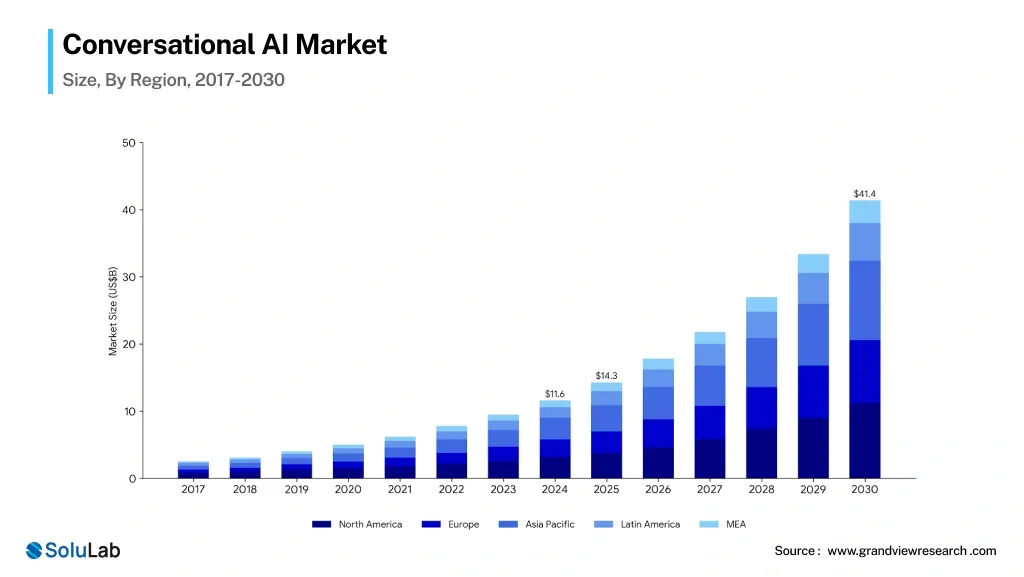
The global conversational AI market is projected to reach $41.39 billion by 2030.
Key Components Required to Build an Advanced AI Voice Agent
A high-performing AI voice agent depends on multiple interconnected technologies working together to understand speech, process intent, generate responses, and deliver smooth, human-like conversations in real time.
- Speech-to-Text (STT): Converts spoken input into accurate text in real time, enabling the system to capture user queries clearly across accents, speaking speeds, and background noise conditions.
- Natural Language Understanding (NLU): Interprets user intent, context, and meaning behind spoken queries, helping the voice agent understand requests beyond keywords and respond more intelligently.
- Large Language Models (LLMs): Power contextual reasoning, dynamic response generation, and personalised conversations, allowing AI voice agents to handle follow-up questions and complex interactions naturally.
- Automatic Speech Recognition (ASR): Processes voice signals efficiently by detecting speech patterns, pauses, and pronunciation, ensuring fast and reliable voice input recognition during live interactions.
- Text-to-Speech (TTS): Converts AI-generated responses into natural, human-like speech, making conversations smoother, more engaging, and easier for users to understand.
Why Should Businesses Invest In AI Voice Agents In 2026?
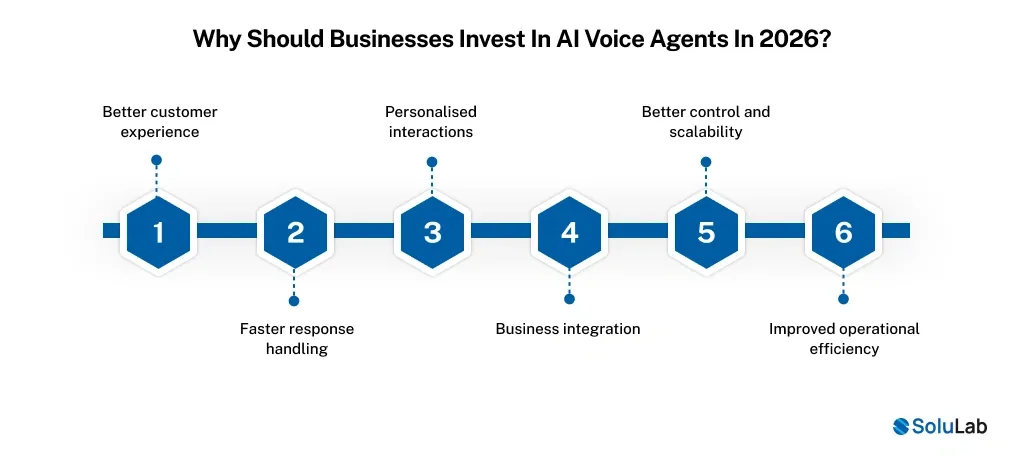
Custom AI voice agents help businesses move beyond scripted interactions by delivering faster, more natural, and context-aware conversations. They improve efficiency, customer experience, and operational flexibility at scale.
- Better customer experience: Custom AI voice agents more accurately understand user intent, context, and tone, enabling smoother, more natural conversations and reducing customer frustration during support or service interactions.
- Faster response handling: Unlike traditional systems that rely on rigid call flows, custom voice agents process requests instantly, helping businesses reduce wait times and resolve issues more efficiently.
- Personalised interactions: Custom-built voice agents can connect with CRM, order systems, and user history to deliver relevant responses, making conversations more useful and tailored to individual customer needs.
- Business integration: Custom solutions connect directly with internal tools like calendars, payment systems, helpdesks, and CRMs, enabling automated workflows without manual intervention.
- Better control and scalability: Businesses can customise tone, workflows, languages, and compliance settings, making it easier to scale operations while maintaining brand consistency and service quality.
- Improved operational efficiency: By automating repetitive calls, appointment bookings, follow-ups, and FAQs, custom AI voice agents free up teams to focus on high-value tasks and complex customer issues.
Benefits of Building AI Voice Agents for Businesses
AI voice agent development is helping businesses improve support, reduce operational friction, and deliver faster customer experiences. Beyond automation, they create measurable efficiency gains that directly impact service quality, costs, and long-term growth.
- 24/7 availability: AI voice agents ensure customers can access support at any time without depending on business hours, helping companies capture leads, resolve queries, and maintain uninterrupted service.
- Lower support cost: By automating repetitive calls, routine inquiries, and first-level support tasks, AI voice agents reduce staffing pressure and operational costs while allowing teams to focus on higher-value conversations.
- Faster resolution: AI voice agents can instantly understand intent, retrieve information, and guide users to solutions, significantly reducing wait times and helping businesses resolve customer issues more efficiently.
- Better customer satisfaction: Faster responses, natural conversations, and consistent support experiences improve customer trust and satisfaction, making interactions smoother and reducing frustration during service requests or inquiries.
- Scalability: AI voice agents can handle large volumes of simultaneous conversations without affecting response quality, allowing businesses to scale support operations efficiently during peak demand or business growth.
Step-By-Step Guide To Building An AI Voice Agent
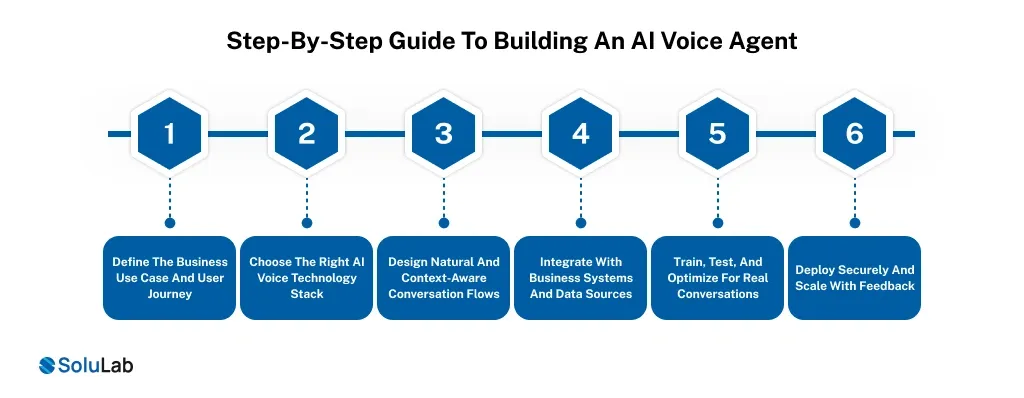
Building an AI voice agent is not a one-step process. You need to identify the requirement as per your business type. Here’s a complete step-by-step guide on building an AI voice agent:
1. Define the Business Use Case and User Journey
Building an AI voice agent starts with clarity on what business problem it needs to solve and how users will interact with it across different touchpoints.
A clearly defined AI use case helps avoid unnecessary complexity, reduces development waste, and ensures the voice agent delivers measurable business value from day one.
- Identify core user pain points
- Map call flow scenarios
- Set success KPIs early
2. Choose the Right AI Voice Technology Stack
Selecting the right AI technology stack determines how accurately, naturally, and efficiently the voice agent will perform in real-world conversations.
The technology stack should support fast speech recognition, contextual understanding, human-like responses, and seamless integration with your existing systems.
- Select a reliable speech engine
- Use low-latency AI models
- Ensure scalable infrastructure
3. Design Natural and Context-Aware Conversation Flows
AI voice agents must handle interruptions, follow-up questions, and varied user responses without making interactions feel robotic or repetitive.
Conversation design should focus on natural dialogue paths, fallback handling, and context retention to ensure smooth and intuitive user experiences.
- Build realistic dialogue paths
- Plan fallback responses
- Handle edge cases early
4. Integrate with Business Systems and Data Sources
A voice agent becomes truly useful when it connects with the systems your business already relies on for customer and operational workflows.
Integrations with CRM, scheduling tools, payment systems, and knowledge bases allow the AI voice agent to provide real-time, personalized assistance.
- Connect CRM and ERP
- Enable live data sync
- Secure API workflows
5. Train, Test, and Optimize for Real Conversations
Launching without proper testing can lead to delays, poor recognition, and frustrating user experiences that damage trust and adoption.
Training on real business scenarios and testing for accents, silence, interruptions, and latency helps improve performance before full deployment.
- Use real call samples
- Test edge-case scenarios
- Optimize latency regularly
6. Deploy Securely and Scale with Feedback
AI deployment is not the end of the process. AI voice agents need ongoing monitoring, updates, and improvements to maintain performance at scale.
A secure deployment strategy with feedback loops helps improve conversations, reduce failure points, and support growing business demands.
- Monitor call performance
- Track customer feedback
- Improve workflows continuously
Use Cases of Advanced AI Voice Agents across Industries
Generative AI-powered voice agents are changing how businesses manage customer interactions, automate workflows, and deliver faster support across industries where speed, accuracy, and availability directly impact user experience and outcomes.
- Customer Support Automation: AI voice agents handle routine inquiries, resolve common issues, and reduce wait times, helping businesses deliver faster support while lowering operational costs and improving customer satisfaction.
- Appointment Scheduling and Reminders: In healthcare, salons, and service businesses, voice agents can book appointments, send reminders, and manage rescheduling without requiring manual staff intervention.
- Lead Qualification and Sales Assistance: AI voice agents engage incoming leads, collect key details, answer basic questions, and route high-intent prospects to sales teams more efficiently.
- Order Tracking and Ecommerce Support: In ecommerce and logistics, voice agents provide shipment updates, return assistance, and delivery information, improving convenience and reducing support workload.
- Banking and Financial Assistance: AI voice agents support balance checks, payment reminders, fraud alerts, and basic service requests while maintaining secure and compliant customer communication.
- Insurance Claims and Policy Support: Voice agents improve claims intake, policy queries, and renewal reminders, helping insurers improve response times and customer experience.
- Travel and Hospitality Assistance: Hotels, airlines, and travel platforms use voice agents for bookings, itinerary updates, cancellations, and customer service during peak demand periods.
- Internal Operations and Employee Support: Businesses use AI voice agents for HR queries, IT support, attendance updates, and internal helpdesk tasks, improving efficiency across teams.
How Much Does it Cost to Build an AI Voice Agent?
Building an AI voice agent involves more than model selection. AI development cost depends on business complexity, integrations, voice quality, compliance needs, and how scalable the final solution needs to be.
| Cost Component | Cost Range | Explanation |
| Basic MVP Development | $15,000 – $30,000 | Covers simple voice workflows, basic speech recognition, limited use cases, and essential backend setup for pilot launch. |
| Mid-Level AI Voice Agent | $30,000 – $40,000 | Includes contextual conversations, CRM integrations, multilingual support, and improved voice response quality for business use. |
| Enterprise AI Voice Agent | $50,000+ | Supports advanced workflows, real-time integrations, security layers, analytics, and large-scale deployment across teams or regions. |
Future Trends in AI Voice Agent Development
AI voice agents are moving beyond scripted responses toward intelligent, adaptive conversations. In 2026, the focus will be on faster response times, deeper personalization, and more reliable real-world performance.
- Hyper-personalised conversations: AI voice agents will use customer history, preferences, and past interactions to deliver context-aware responses that feel more relevant, human, and tailored to each user.
- Real-time multilingual communication: Future voice agents will support multilingual AI language switching and regional accents, helping businesses serve diverse users without delays, misunderstandings, or language-based support limitations.
- Better human handoff systems:
Future voice agents will transfer conversations to human teams with full context, reducing repetition and ensuring smoother support for complex or sensitive issues. - Deeper enterprise integrations: A multi-agent system will connect more effectively with CRMs, ERPs, scheduling tools, and internal systems, enabling end-to-end task completion without manual intervention.
Why Choose SoluLab for Advanced AI Voice Agent Development?
As an AI-native company, SoluLab builds advanced AI voice agents that require more than basic automation. It demands expertise in conversational design, real-time voice infrastructure, enterprise integrations, and scalable deployment tailored to complex business workflows.
- Custom AI voice agent development
- Real-time speech pipeline integration
- Multilingual voice assistant deployment
- AI call automation for support teams
- Voice bot CRM and ERP integration
- Secure enterprise voice AI deployment
- AI voice agent optimisation and support
For example, SoluLab built UpdateIA, a multi-agent AI platform for a French startup, enabling 14+ autonomous agents coordinated by Jarvis.
It unified enterprise workflows, reduced manual effort, ensured compliance, and improved real-time decision-making across HR, CRM, Finance, and Legal systems.

Conclusion
Building advanced AI voice agents is no longer just a technology upgrade. It is becoming a practical way for businesses to improve customer support, automate repetitive workflows, and deliver faster, more natural interactions at scale.
Success depends on choosing the right use case, building with the right AI stack, integrating core systems, and continuously optimising performance after launch. Businesses that invest early can create better customer experiences while reducing operational friction.
If you are planning to build a scalable voice AI solution, SoluLab, an AI agent development company, can help your business design, build, and deploy advanced AI voice agents tailored to your goals.
FAQs
Neha is a curious content writer with a knack for breaking down complex technologies into meaningful, reader-friendly insights. With experience in blockchain, digital assets, and enterprise tech, she focuses on creating content that informs, connects, and supports strategic decision-making.