Key Takeaways
- Agentic AI orchestration enables multiple AI agents to collaborate, reason, and execute complex workflows autonomously with minimal human intervention.
- Unlike traditional AI systems, orchestrated agents can make decisions, delegate tasks, access tools, and continuously adapt to changing business requirements.
- Businesses use agentic orchestration to automate operations, improve efficiency, reduce manual workloads, and accelerate enterprise-wide decision-making processes.
- The orchestration layer manages agent communication, memory, workflow sequencing, governance, monitoring, and integrations across enterprise systems and applications.
- Human oversight, compliance controls, and monitoring frameworks remain essential for maintaining transparency, accountability, and responsible AI-driven automation.
Businesses are moving beyond simple AI chatbots toward systems capable of planning, coordinating, and executing tasks autonomously.
This shift has introduced the concept of Agentic AI Orchestration, where multiple AI agents work together within a connected ecosystem to complete complex workflows with minimal human intervention.
Instead of relying on isolated automation tools, organizations are now building AI-driven environments that combine decision-making, contextual memory, tool integration, and collaboration between agents.
AI orchestration plays a crucial role in enhancing operational efficiency, minimizing repetitive workloads, and facilitating faster business execution across various industries. As enterprises adopt AI-native operations, orchestration becomes the foundation. Continue reading this blog to know everything about the agentic AI orchestration solution.
What is Agentic AI Orchestration?
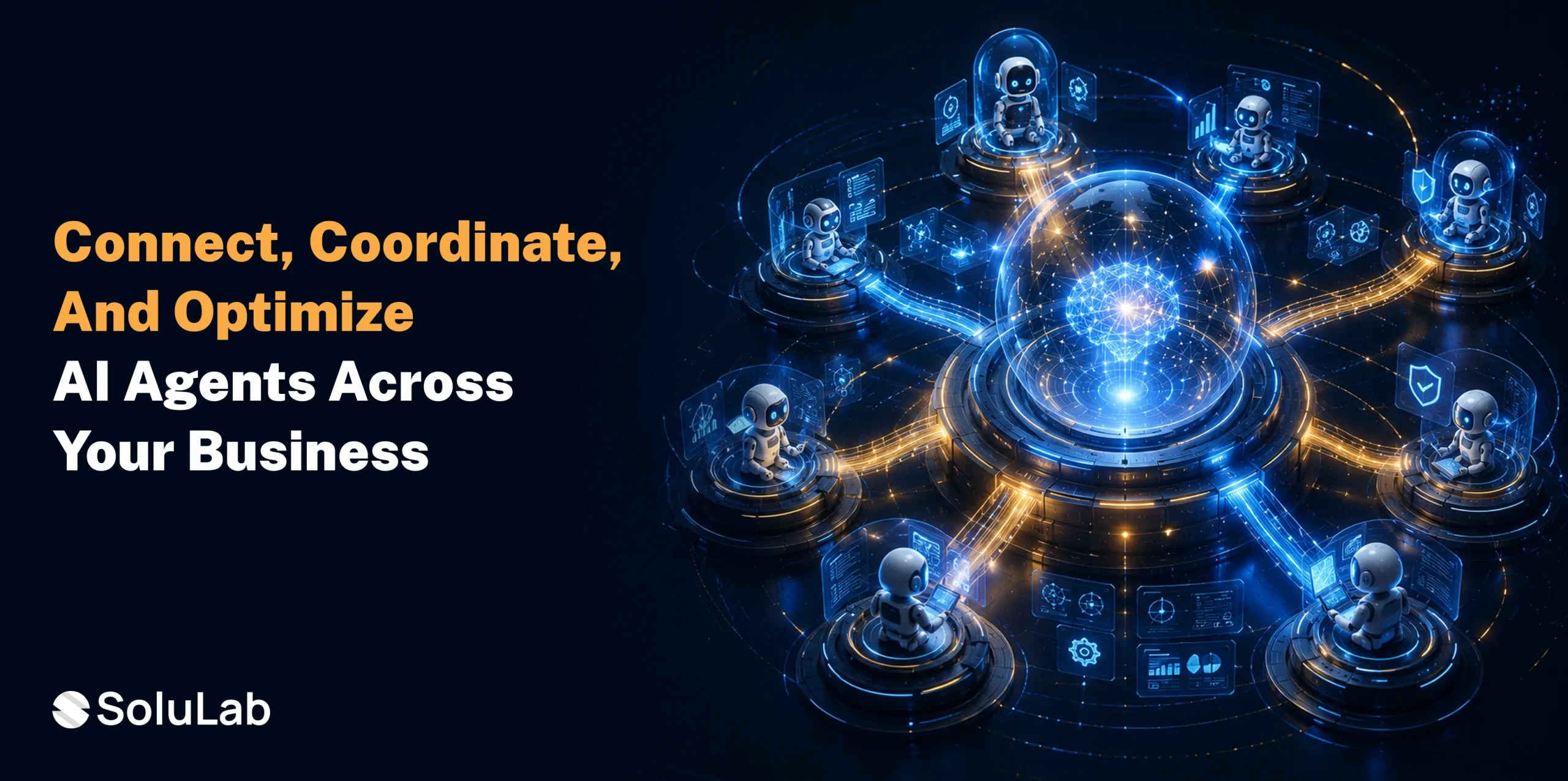
Agentic AI orchestration refers to coordinating multiple autonomous AI “agents” so they can work together to complete complex tasks with minimal human intervention.
Instead of a single model handling everything, you have a system of agents, each with its own role, tools, and goals, working in a structured workflow. Orchestration is the layer that manages how they interact, make decisions, and pass information.
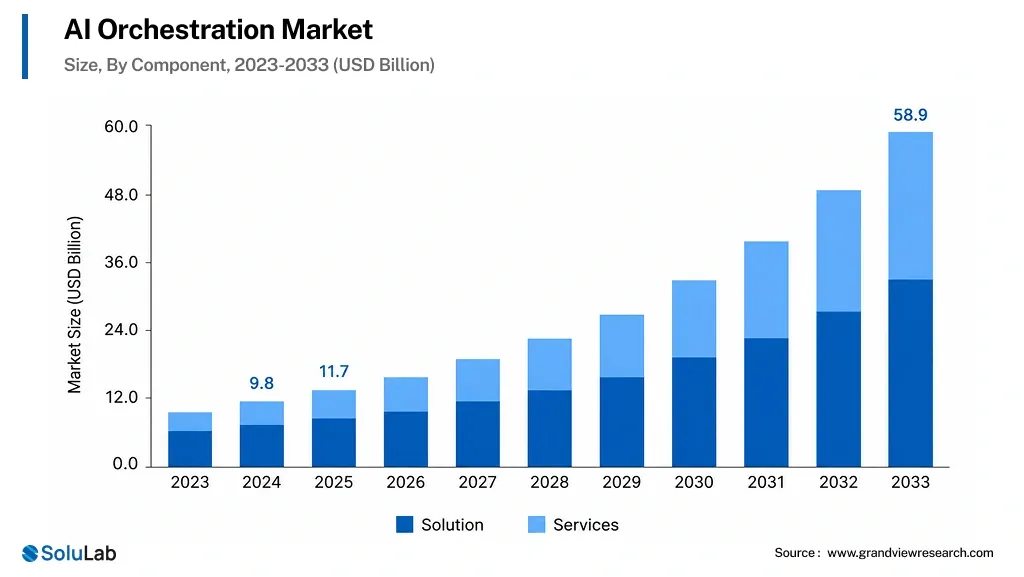
The global AI orchestration market is projected to reach USD 58.92 billion by 2033, growing at a CAGR of 22.4% from 2025 to 2033.
Why Agentic AI Orchestration is Important?
Agentic AI orchestration helps businesses coordinate multiple intelligent systems efficiently, improving automation, decision-making, operational speed, and workflow collaboration across complex enterprise environments with minimal manual intervention.
In fact, McKinsey describes agentic AI as the next phase beyond copilots, where autonomous systems combine planning, memory, reasoning, and integration to manage end-to-end enterprise workflows.
- Improved workflow coordination: Multiple AI agents collaborate intelligently, reducing operational confusion and ensuring smoother execution across interconnected business tasks and enterprise workflows.
- Reduced manual dependency: Automated agent collaboration minimizes repetitive human involvement, allowing teams to focus on strategic planning, innovation, and high-value business activities.
- Better system adaptability: Agentic orchestration dynamically adjusts workflows during unexpected disruptions, improving operational flexibility and maintaining consistent performance across business operations.
- Continuous monitoring: AI agents monitor systems constantly, identifying issues instantly and enabling proactive responses before operational problems impact overall business productivity.
- Smarter resource allocation: AI agents distribute workloads intelligently, optimizing system performance while reducing unnecessary computational costs and operational inefficiencies significantly.
- Stronger cross-system communication: Orchestration enables seamless interaction between applications, databases, APIs, and enterprise tools, improving data consistency and workflow synchronization effectively.
Types of Agentic Orchestration Frameworks
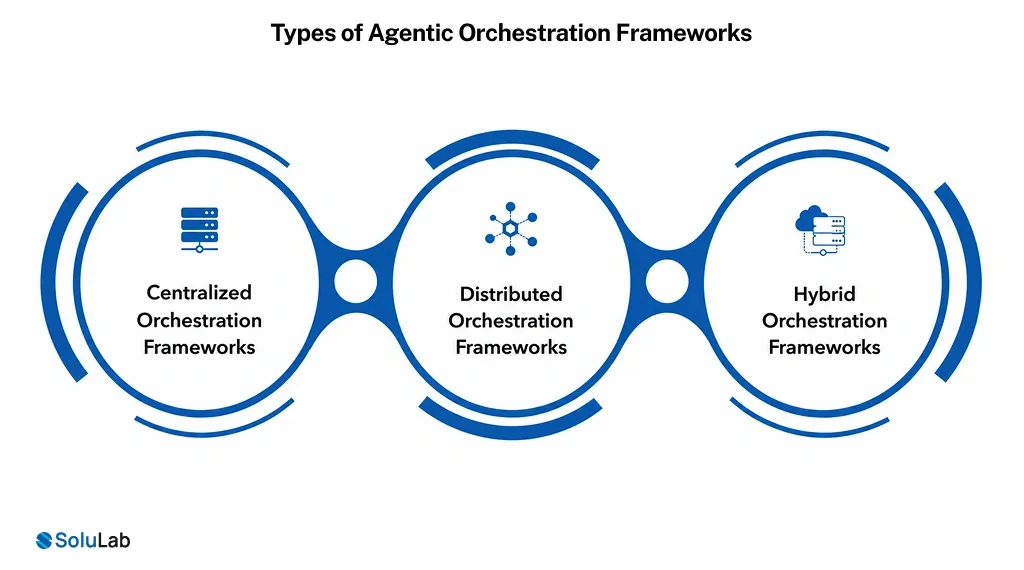
Modern enterprises need intelligent coordination systems managing autonomous workflows efficiently. Different orchestration models support varying scalability, governance, flexibility, and operational requirements across AI-driven ecosystems and evolving enterprise infrastructure environments.
- Centralized Orchestration Frameworks: A single control layer manages agents, workflows, tools, and decisions centrally. Best suited for regulated environments requiring governance, visibility, and structured Agentic AI Orchestration patterns across enterprise systems.
- Distributed Orchestration Frameworks: Multiple autonomous agents coordinate independently across decentralized environments without central dependency. These frameworks improve resilience, scalability, and fault tolerance for dynamic AI orchestration for autonomous agents implementations.
- Hybrid Orchestration Frameworks: Combines centralized governance with distributed execution capabilities for balanced operational flexibility. Organizations gain stronger control while maintaining adaptive scalability across multi-agent enterprise automation environments.
Implementation Strategy for Agentic Orchestration Platform
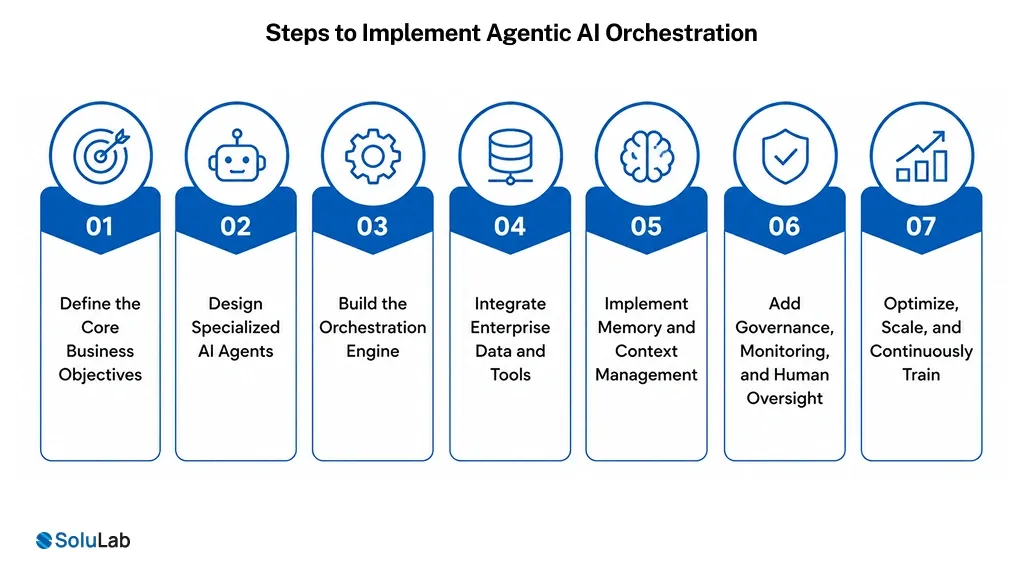
Modern enterprises are shifting toward autonomous systems where intelligent agents collaborate, make decisions, and execute workflows independently, creating faster operations, smarter automation, and highly adaptive digital ecosystems.
1. Define the Core Business Objectives
Start by identifying operational bottlenecks, workflow dependencies, and automation opportunities. Clear objectives help shape agent responsibilities, orchestration logic, scalability requirements, and measurable business outcomes.
2. Design Specialized AI Agents
Create task-specific agents for research, planning, execution, monitoring, analytics, or compliance. Strong role separation improves coordination efficiency and supports reliable multi-agent AI orchestration across enterprise systems.
3. Build the Orchestration Engine
Develop a central coordination layer that manages task routing, agent communication, workflow execution, retries, prioritization, and decision sequencing between interconnected AI services and external systems.
4. Integrate Enterprise Data and Tools
Connect APIs, CRMs, ERP platforms, databases, cloud services, and communication tools. Seamless integrations enable agents to access real-time information and perform autonomous operational tasks effectively.
5. Implement Memory and Context Management
Add short-term and persistent memory layers to maintain workflow continuity, user preferences, historical decisions, and contextual awareness across multiple interactions and long-running automated processes.
6. Add Governance, Monitoring, and Human Oversight
Introduce approval checkpoints, audit logs, observability dashboards, access controls, and fallback mechanisms. Governance ensures responsible automation while maintaining transparency, security, and operational accountability.
7. Optimize, Scale, and Continuously Train
Monitor agent performance, execution latency, failure patterns, and decision quality regularly. Advanced AI Agent development Solutions evolve continuously through feedback loops, fine-tuning, and adaptive workflow improvements.
What is the difference between workflow and agentic orchestration?
Workflow orchestration follows predefined automation rules, while agentic orchestration enables intelligent AI agents to make decisions, adapt dynamically, and execute complex tasks autonomously across evolving business environments.
| Aspect | Workflow Orchestration | Agentic Orchestration |
| Decision-making | Follows fixed rules and predefined execution paths. | Makes contextual decisions using intelligent AI agents. |
| Adaptability | Limited flexibility during unexpected operational changes. | Adjusts workflows dynamically using real-time data insights. |
| Execution style | Sequential task execution with manual dependencies involved. | Autonomous multi-agent collaboration across interconnected systems. |
| Human involvement | Requires frequent monitoring and manual intervention regularly. | Reduces human dependency through autonomous task coordination. |
| Learning capability | Does not learn from previous workflow outcomes. | Continuously improves decisions using contextual learning patterns. |
| Response handling | Handles repetitive and structured business processes efficiently. | Responds intelligently to changing business scenarios instantly. |
| System intelligence | Automation-focused with limited reasoning and contextual awareness. | AI-driven reasoning enables smarter enterprise-wide operations management. |
| Business impact | Improves operational consistency and process standardization mainly. | Enhances agility, innovation, scalability, and business responsiveness. |
What Are The Benefits Of Agentic Orchestration?
Agentic orchestration helps businesses coordinate intelligent systems efficiently, enabling faster decisions, adaptive workflows, improved governance, and streamlined operations across departments through advanced AI powered solutions and enterprise-wide automation.
- Delivers real-time adaptive responses: Agentic systems analyze live data continuously, enabling faster reactions, smarter automation, and dynamic workflow adjustments during changing operational conditions across modern AI orchestration for enterprises.
- Strengthens compliance and audit readiness: Intelligent orchestration tracks decisions automatically, maintains transparent activity records, simplifies regulatory reporting, and improves accountability across sensitive enterprise operations and governance workflows.
- Accelerates time-to-market: Automated coordination between AI agents reduces manual dependencies, speeds execution cycles, streamlines development workflows, and helps organizations launch products and services significantly faster.
- Optimizes resource utilization: Agentic orchestration distributes workloads intelligently, minimizes operational bottlenecks, improves infrastructure efficiency, and enables teams to focus on higher-value strategic business activities.
Industry Use Cases for Agentic AI Workflow Orchestration
AI workflow automation helps businesses coordinate intelligent agents, automate complex operations, improve decisions, and streamline enterprise processes through connected systems powered by AI orchestration solutions and AI orchestration for enterprises.
Financial Services
Fraud detection: Identifies suspicious transactions instantly, reducing financial risks and improving transaction monitoring across digital banking platforms.
Loan processing: Automates verification, approvals, and document validation, helping financial institutions accelerate customer onboarding and lending decisions.
Portfolio management: Coordinates analytics agents for investment tracking, market forecasting, and personalized wealth management recommendations efficiently.
Healthcare
Patient scheduling: Organizes appointments, doctor availability, and treatment workflows, improving operational efficiency across hospitals and clinics daily.
Medical documentation: Automates clinical note generation, record updates, and compliance reporting, reducing administrative burden for healthcare professionals.
Remote patient monitoring: Tracks patient health data continuously, enabling faster interventions and improving long-term care management outcomes.
Energy
Grid monitoring: Detects operational anomalies automatically, helping utility providers maintain stable energy distribution and prevent service disruptions.
Predictive maintenance: Analyzes equipment performance patterns, reducing downtime and improving infrastructure reliability across energy production facilities.
Energy optimization: Coordinates consumption insights and automation systems, helping enterprises reduce wastage and improve operational sustainability goals.
Telecom
Network operations: Automates fault detection, resolution, and monitoring processes, ensuring consistent connectivity and reduced network downtime.
Customer onboarding: Simplifies SIM activation and service setup workflows, creating faster and smoother customer onboarding experiences.
Billing management: Streamlines payment adjustments and refund processing, improving billing accuracy and overall customer satisfaction levels.
Insurance
Claims processing: Automates claim verification and assessment workflows, reducing manual processing time and improving operational efficiency.
Risk assessment: Coordinates analytics agents for policy evaluation, fraud detection, and underwriting decisions across insurance operations.
Customer support: Handles policy inquiries and renewal reminders automatically, improving response times and enhancing customer service experiences.
Future of Agentic AI orchestration
The future of Agentic AI orchestration is shifting toward autonomous enterprises where intelligent agents collaborate, reason, and execute complex workflows with minimal human intervention across industries and digital ecosystems.
- AI-Native Enterprise Infrastructure: Businesses will integrate AI Agent development Solutions into core systems, enabling departments, applications, and digital platforms to function as interconnected intelligent ecosystems.
- Human and AI Collaborative Workforces`: Workplaces will combine human expertise with specialized AI agents handling repetitive, analytical, and execution-heavy tasks while humans focus on strategy and innovation.
- Cross-Platform Automation: AI agents will coordinate across CRMs, ERPs, cloud infrastructure, APIs, blockchain systems, and IoT devices to manage end-to-end digital operations autonomously.
- Personalized Customer Experiences at Scale: Businesses will deploy AI solutions to deliver contextual recommendations, predictive support, and hyper-personalized user interactions across digital channels.
- Self-Improving Multi-Agent Ecosystems: Orchestration frameworks will allow AI agents to collaborate, evaluate performance, and refine workflows independently, improving efficiency over time without constant human supervision.
- Stronger Governance and Compliance Layers: Agentic systems will include embedded monitoring, audit trails, policy enforcement, and risk management to ensure safe, transparent, and compliant autonomous operations.
Conclusion
Agentic AI orchestration is changing how businesses operate by enabling intelligent agents to collaborate, automate workflows, and make real-time decisions with minimal human intervention.
As enterprises move toward AI-native operations, orchestration platforms will become the backbone of autonomous digital ecosystems. Businesses that adopt this approach early can gain a significant competitive advantage through smarter automation and faster execution.
SoluLab, an AI development company, can help your business buil scalable, and future-ready agentic AI orchestration solutions.
FAQs
Neha is a curious content writer with a knack for breaking down complex technologies into meaningful, reader-friendly insights. With experience in blockchain, digital assets, and enterprise tech, she focuses on creating content that informs, connects, and supports strategic decision-making.