A user in Brazil opens your app in Portuguese. Another search in Japan is in Japanese. Meanwhile, a customer in Germany expects support in German. Most digital platforms struggle with this language diversity, leading to poor user experience, lost engagement, and limited global reach.
This is where multilingual artificial intelligence becomes essential. Multilingual AI enables platforms to understand, translate, and communicate across multiple languages in real time, helping businesses serve international users without language barriers.
with Multilingual AI global customer support, localized content, and cross-border digital services at scale. Companies investing in multilingual localization can see up to 25x ROI and sales increases between 25% and 70%.
In this blog, you will learn what multilingual AI is, why it is critical for global digital platforms, key use cases, business benefits, and how companies are implementing multilingual AI to expand internationally.
Key Takeaways
- The Problem: Global digital platforms are used by users in various countries, however, users are often restricted to engage with the digital platform due to the language barrier, customer support efficiency, and market expansion. A lot of platforms are not capable of providing a localized experience at scale.
- The Solution: Multilingual Artificial Intelligence helps platforms to generate and comprehend content in more than one language as well as translate it. This assists the businesses in offering fluid communication, personalised user experiences, and quicker international expansion.
- How SoluLab can assist: SoluLab is an artificial intelligence company, which implies that AI is integrated into our development processes. This enables us to develop multilingual AI applications in a shorter time, automate operations, and provide scalable platforms at a much lower cost of development.
What is Multilingual AI?
Multilingual artificial intelligence is a form of artificial intelligence that is capable of comprehending, processing, and translating multiple human languages. It applies technologies like Natural Language Processing (NLP), machine learning, and large language models to speak to the users in other languages.
In contrast to simple translation tools, multilingual AI can read across languages in terms of context, intent, and meaning, allowing digital platforms to provide uniform experiences to a very global audience.
As an example, a worldwide e-commerce can rely on multilingual AI to automatically translate product descriptions, customer reviews, and support chats so that a shopper in another country can communicate using their native language.
Why Global Digital Platforms Need Multilingual AI?
The digital platforms have now become global, serving users in different countries, languages, and cultures. The multilingual AI chatbot is beneficial because it allows a business to eliminate language obstacles, enhance interaction with users, and provide a pleasant experience to various audiences around the world.

- Global User Bases: Contemporary digital platforms have users from other countries and languages. Multilingual AI enables companies to communicate with international users, which means that users are able to use the type of language they prefer in the provision of services and information.
- Language Obstacles to Engagement: The language barriers tend to decrease user engagement and trust. Multilingual AI assists platforms with communication with the users, thereby enhancing interaction, lessening confusion, and making it more understandable to users of the different language groups.
- Scalability in Customer Support: Multilingual support systems pose a challenge to expanding websites. Virtual assistants and multilingual AI chatbots enable companies to offer 24/7 customer care services without employing multilingual customer service workers in their employ.
- Localization of Content Requirements: Global sites should be localized to various areas with websites, applications and marketing materials. Multilingual AI will assist in automatic translation and localisation of product descriptions, blogs, and user interface of different markets.
- International Communication of Compliance: Companies that have their businesses in more than one country have to relay legal updates, policies, and notifications of compliance to various regions. Multilingual AI makes sure that the necessary regulatory information is properly provided to users based on different languages.
How to Build Multilingual AI Platforms?
Online platforms should be able to interact with all users in various languages and geographies. The development of AI systems assists companies in providing multilingual, localized experiences, scalable communication, and effective automation to global audiences.
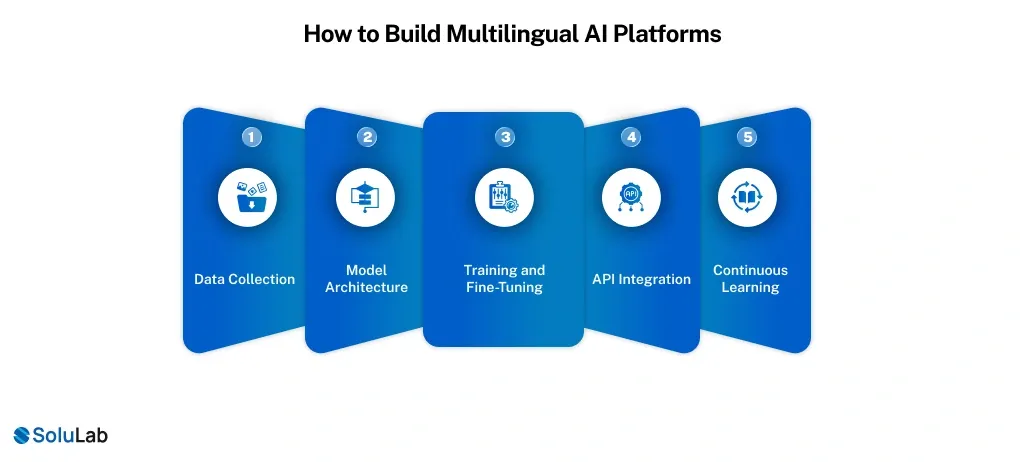
1. Data Collection
The construction of multilingual platforms begins with the gathering of multilingual datasets (text, speech, and geographic material), and so forth. Quality datasets are used to develop models that drive multilingual AI-based solutions to gain the rightful understanding and communication.
2. Model Architecture
AI architectures are developed with the capacity of processing several languages using one framework. Language models and sophisticated neural networks facilitate contextual interpretation and drive the current AI technology of language translation.
3. Training and Fine-Tuning
Multilingual datasets are used to train AI models and subsequently fine-tune to their industry-specific usage. The process enhances language correctness, comprehension of cultural context, and performance in more than one language worldwide.
4. API Integration
After creating models, the multilingual AI system is linked to applications like chatbots, websites, mobile apps, and customer support platforms via APIs to facilitate a smooth multilingual system.
5. Continuous Learning
Multilingual AI systems can be constantly enhanced through interaction with users, new data and changing language patterns, guaranteeing increased accuracy of translations, contextual interpretation and performance over time.
Real-World Use Cases of Multilingual AI in Global Platforms
Global digital platforms operate across countries where users speak different languages. Multilingual AI enables these platforms to deliver localized content, support services, and seamless digital experiences at global scale.
1. Global E-commerce Platforms
Multilingual AI automatically translates product descriptions, reviews, and search queries, helping international customers browse products, understand details, and complete purchases in their preferred language.
Example: Cross-border marketplace Shoplazza helps merchants sell globally using AI-driven multilingual storefronts and automated translation for international buyers.
2. Customer Support Automation
Multilingual AI chatbots and virtual assistants provide instant responses in multiple languages, reducing support costs while ensuring customers receive consistent help regardless of their location.
Example: Customer service automation platform Forethought uses AI models to automate multilingual support conversations for global businesses.
3. Streaming Platforms
Streaming services use multilingual AI to generate subtitles, dubbing, and content recommendations, allowing audiences from different countries to discover and enjoy media in their native language.
Example: Global streaming leader Netflix uses AI to improve subtitle generation, translation quality, and multilingual content discovery for international viewers.
4. International Fintech Platforms
Multilingual AI helps fintech platforms deliver financial information, onboarding instructions, and transaction alerts in multiple languages, improving accessibility and regulatory communication across global markets.
Example: Digital payments company Airwallex supports global businesses with multilingual interfaces and localized financial services across international markets.
5. Global SaaS Platforms
SaaS companies integrate multilingual AI to localize dashboards, documentation, and collaboration tools, enabling teams from different countries to use the same platform without language barriers.
Example: Customer communication platform Crisp provides multilingual chat and automated translation features for businesses serving international users.
Key Technologies Behind Multilingual AI
Multilingual AI allows digital platforms to interact with users in various languages through a combination of sophisticated language processing technologies to comprehend the context, translate, and provide a fluent experience in multiple languages globally.
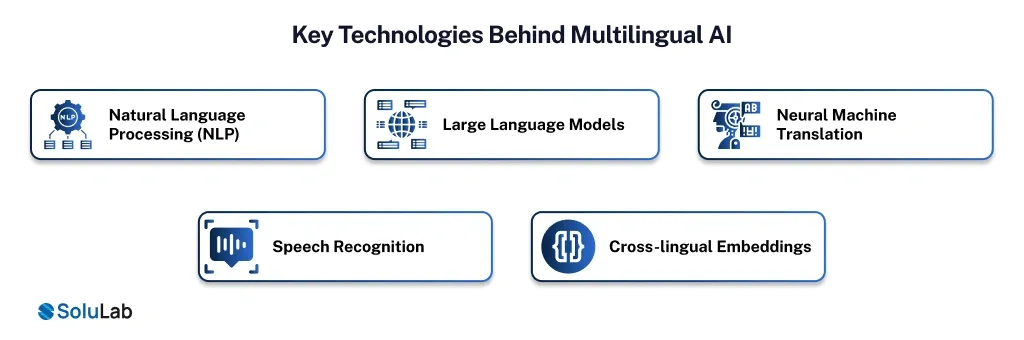
- Natural Language Processing (NLP): Natural Language Processing allows AI systems to comprehend the structure, purpose, and meaning of the human language. It aids computer programs in processing poly-lingual text and discourse in order to provide relevant and precise answers and situational insights.
- Large Language Models: Large Language Models are models whose data has been trained on huge multilingual datasets. They also acquire patterns in multiple languages and by doing this, AI systems are able to produce text and respond to questions, and can also converse naturally with users across the globe.
- Neural Machine Translation: Neural Machine Translation is a technique based on deep learning that can be used to translate text between languages with the ability to maintain context and meaning. It allows real-time multilingual interaction in websites, applications and the entire digital world.
- Speech Recognition: Speech recognition is a kind of technology that translates oral speech into text in various languages. It drives multilingual voice assistants, call center automation and voice-enabled applications that are consumed by global customers.
- Cross-lingual Embeddings: Cross-lingual embeddings represent words in dissimilar languages within mutual vector spaces. This enables AI models to learn the connection among the languages and enhance translations, search, and multilingual information search.
Future of Multilingual AI for Digital Platforms
With the growth of digital platforms worldwide, multilingual AI is changing fast to cater to various users. The next generation of AI trends and innovations will be smart language processing, natural localization, and industry and geographical-scaled communications.
- High-tech AI Language Processing: Future platforms will be based on AI language translation technology to provide an actual-time translation, contextual and culturally precise communication on websites, applications, and worldwide digital ecosystems.
- Industrial and Enterprise Applications: The emergence of Multilingual AI to industrial development will allow manufacturing, logistics, medical, and finance applications to automate multilingual documentation, communication of the workforce, and international cooperation in a more efficient way.
- Smarter Customer Support Globe: AI chatbots and virtual assistants will offer Multilingual AI customer support that is scalable, so that businesses can respond to customer requests in different languages without sacrificing their customer service.
- Conversational and Voice AI in Real-Time: The next generation of digital platforms will be multilingual voice assistants that can recognize and translate speech in real-time and allow users to communicate with the services naturally, regardless of language differences.
- AI-Driven International Content Personalization: Multilingual AI will assist sites in personalizing content, recommendations, and marketing communications according to the language choices of the user which will enhance engagement and push global digital adoption.
How can SoluLab help with Multilingual AI with Global Platforms?
SoluLab is an AI native company that assists businesses in creating AI models that can learn and produce several languages. These systems are based on Natural Language Processing (NLP) and machine learning to make multilingual interactions possible on websites, mobile applications, and enterprise systems.
- Multilingual Chatbots
- Artificial Intelligence Virtual Assistant Multilingualism
- Implementation of Cross-Language Search Engine
- Voice Recognition Systems Multilingual
- Multilingual Conversational AI Development.
- Automated Customer Support in Multiple Languages
- Multi-Language AI Model Training
- Cross-Lingual Data Processing Solutions.

Conclusion
Multilingual artificial intelligence is turning into an essential technology for online platforms that seek to engage audiences worldwide. Multilingual AI allows removing communication barriers, facilitating the business in communicating with users in various regions, and making it easier by allowing real-time language understanding, translation, and localized user experiences.
It is also effective in enhancing customer care, the availability of content, and the expansion of the market abroad. With the ongoing rise of global digital ecosystems, multilingual AI will become a necessity of platforms interested in growing with efficiency and remaining competitive.
SoluLab, an AI development company can help you build multilingual models. Book a free consultation call today!
FAQs
Neha is a curious content writer with a knack for breaking down complex technologies into meaningful, reader-friendly insights. With experience in blockchain, digital assets, and enterprise tech, she focuses on creating content that informs, connects, and supports strategic decision-making.