Key Takeaways
- AI Agents in Fashion are goal-driven, multi-step systems that understand style, inventory, and customer context, then act across channels to personalize shopping, optimize assortments, and automate workflows.
- Deloitte’s 2026 retail outlook shows 67% of retailers scaling AI for personalization and marketing execution, with “agentic AI” named as a core lever for productivity and experience.
- Gartner’s 2026 consumer survey found over 30% of shoppers willing to use AI tools that help narrow fashion choices, providing strong tailwinds for AI Shopping Agent Development and virtual stylist experiences.
- AI Agents vs Traditional Fashion Recommendation Engines: agents reason about style goals, cross-session behavior, and inventory constraints; recommenders mostly surface “similar items” based on patterns.
- Key technologies behind an AI fashion agent include LLMs, visual search and computer vision, personalization engines, knowledge graphs, and robust orchestration/guardrails.
- Major use cases: AI personal shopping agents, virtual stylist AI agents, fashion AI shopping agents, dynamic merchandising agents, size-and-fit agents, returns reduction agents, and supply-chain optimization agents.
- Fashion brands and retailers using AI Automation Services for agentic workflows report higher conversion, bigger basket sizes, lower returns, and better inventory turns. Deloitte estimates experience-led, AI-powered fashion retail will significantly outgrow generic, price-led models through 2026.
- SoluLab, as an AI Agent Development Company, delivers Custom AI Agent Development for fashion from pilot virtual stylists to full AI Agent Solutions across e-commerce, stores, and supply chains.
Walk into any fashion retailer’s ops meeting in 2026 and the conversation isn’t “should we use AI” anymore, it’s “why isn’t it doing more yet.” Most brands already have a recommendation engine, a chatbot, maybe a forecasting dashboard. What’s changed is the ambition: instead of a tool that surfaces an insight and waits for a merchandiser to act on it, retailers want a system that reorders the bestseller before it stocks out, adjusts a markdown before margin erodes, or handles a shopper’s entire “find me something like this, in my size, under $150” request start to finish.
That’s the real difference AI integration services bring to fashion and apparel, and it’s also where the risk shows up. This is an industry built on taste, timing and trust: a wrong recommendation is a returned order, a wrong reorder is dead stock, and a wrong promise to a customer is a brand problem, not just a tech glitch. The retailers pulling ahead in 2026 aren’t the ones deploying agents everywhere at once. They’re the ones being deliberate about where an agent should have the authority to act versus where a human still needs the final call, which is exactly what this playbook is built to walk through.
What Are AI Agents in Fashion?
AI Agents in Fashion are autonomous, goal-driven systems that can understand customer intent, style preferences, inventory realities, and brand rules, then take meaningful actions across channels.
Unlike single-task tools, an AI fashion agent can:
- Interpret a shopper’s style goals (“minimalist office capsule,” “vacation outfits,” “wedding guest look”).
- Search across catalog, size curves, and availability.
- Build coordinated outfits, suggest alternatives, and manage price/promotion tradeoffs.
- Trigger actions (save to wishlist, notify about restocks, schedule fitting-room experiences, or personalize follow-up emails).
Think of these agents as virtual team members: AI Agents for Fashion Brands that work as stylists, merchandisers, planners, and service reps within clear guardrails.
How Do AI Agents Work in the Fashion Industry?
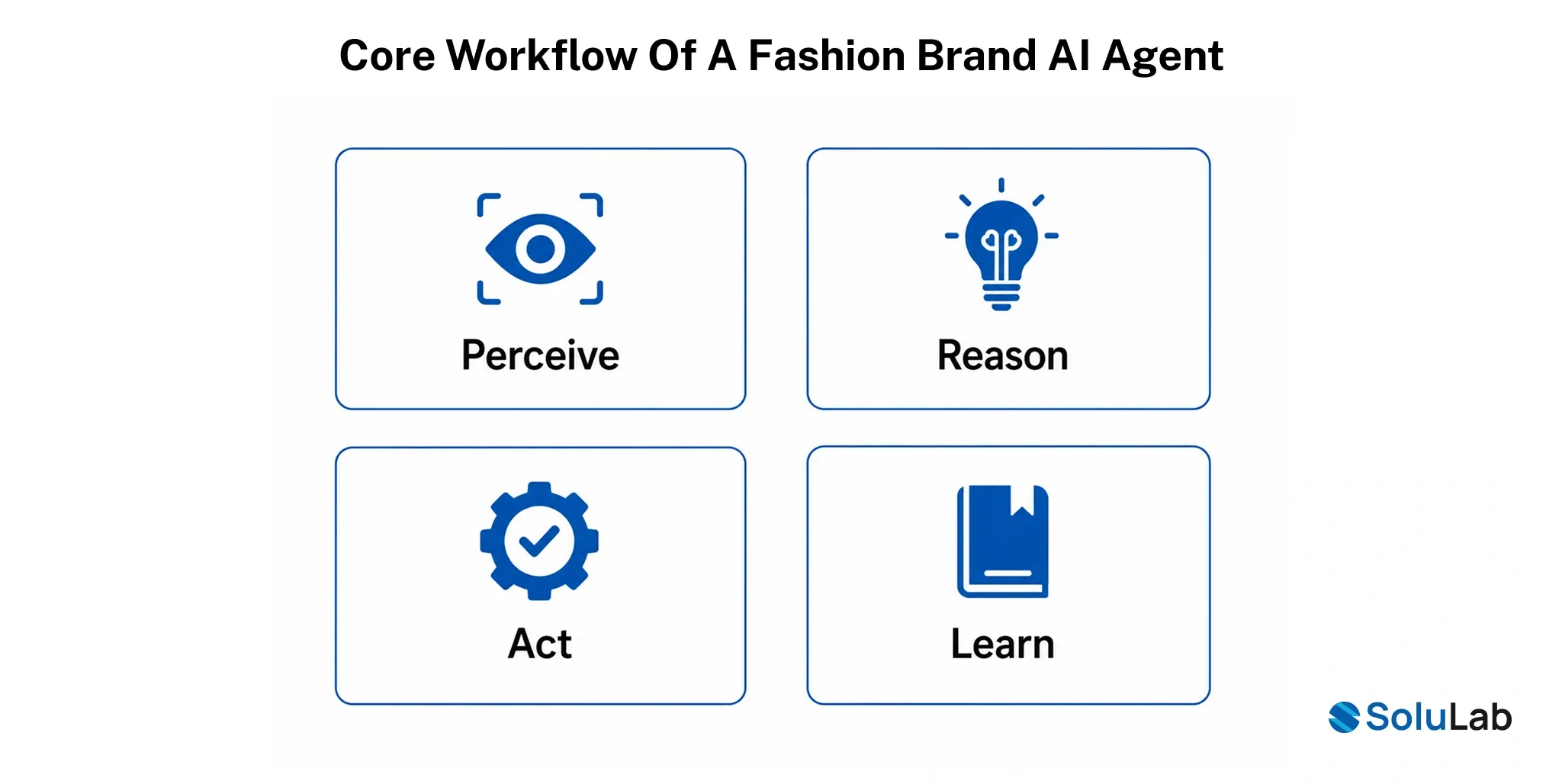
An AI agent for fashion & apparel stores typically follows a loop similar to other industries: perceive, reason, act, and learn.
- Perceive
- Collect signals: browsing behavior, past orders, returns, wishlists, engagement, and sometimes social signals or style quizzes.
- Read product data: descriptions, images, attributes, fit notes, sustainability tags.
- Reason
- Infer style preferences, fit challenges, budget sensitivity, and intent (“special occasion” vs “everyday basics”).
- Balance brand rules, current promotions, inventory constraints, and margin goals.
- Act
- Recommend outfits, capsule wardrobes, or single items.
- Coordinate colors, silhouettes, and accessories as a Virtual Stylist AI Agent or AI Stylist Agent.
- Trigger follow-ups: emails, push notifications, personalized lookbooks, or store experiences.
- Learn
- Use feedback (clicks, purchases, returns, explicit ratings) to refine future decisions.
- Adapt to seasonal trends, regional tastes, and evolving inventory.
SoluLab’s Artificial Intelligence in Fashion Industry overview dives deeper into how AI layers onto design, production, merchandising, and customer experience, forming the backbone of modern AI Agent Development for Fashion.
AI Agents vs Traditional Fashion Recommendation Engines
AI Agents vs Traditional Fashion Recommendation Engines is one of the most important distinctions to understand before investing.
Traditional recommendation engines:
- Use collaborative filtering or simple content-based similarity.
- Suggest “customers who bought X also bought Y” or “similar items” based on patterns.
- Operate mostly at a single interaction level.
AI agents for fashion:
- Understand multi-session, multi-channel context.
- Reason about style narratives, occasions, and constraints.
- Orchestrate steps across channels and systems (e.g., chat, product detail page, email, store POS).
Comparison Table: AI Agents vs Recommenders
| Dimension | Traditional Recommendation Engine | AI Agent in Fashion Examples |
| Input | Product clicks and purchases | Intent, style goals, body type, history, inventory |
| Output | Single-item suggestions | Coordinated outfits, capsules, journeys |
| Memory | Session-based | Longitudinal profile across visits and touchpoints |
| Actions | Show recommendations | Build looks, set alerts, trigger services |
| Governance | Limited rules | Policy and brand-rule aware |
| Value | Incremental uplift | End-to-end experience and operational impact |
Deloitte’s 2026 retail commentary notes that retailers moving from “static personalization” to agentic AI see significantly higher engagement and loyalty, especially when experiences feel like a trusted stylist rather than an algorithmic list.
Key Technologies Behind AI Fashion Agents
To build a robust AI for Fashion Retail, several technologies work together.
1. Large Language Models (LLMs)
- Understand natural language queries (“show me office outfits for a humid climate”).
- Generate rich, on-brand copy for style advice, product descriptions, and lookbooks.
2. Computer Vision and Visual Search
- Recognize colors, patterns, silhouettes, and details from product images.
- Power “shop the look” features and reverse image search (upload a photo → find similar items).
3. Personalization and Recommendation Engines
- Track user behavior across sessions and devices.
- Assign style segments, preference vectors, and propensity scores.
4. Knowledge Graphs and Fashion Ontologies
- Encode relationships between categories, materials, trends, fits, and occasions.
- Help an AI fashion agent reason about “smart casual,” “streetwear,” or “capsule wardrobe.”
5. Orchestration, Tools, and Guardrails
- Connect the agent to catalog APIs, pricing, promotions, CRM, and inventory.
- Enforce brand and compliance rules (discount limits, regional regulations, sustainability messaging).
6. Analytics and Feedback Loops
- Monitor performance, conversion, AOV (average order value), and returns.
- Provide merchandisers and marketers visibility into agent decisions and impact.
SoluLab’s work on AI in fashion for personalized wardrobes shows how these technologies combine into hyper-personalized wardrobe-building engines, forming the core of advanced AI Shopping Agent Development.
Major Use Cases and Examples of AI Agents in Fashion
Fashion AI Agent Development touches both front-of-house experiences and back-of-house operations.
1. AI Shopping Agent for Fashion (Consumer-facing)
- Conversational shopping agents embedded in websites, apps, and messaging.
- Help customers refine needs (“beach trip,” “formal office,” “festival look”) and build outfits.
- Serve as an AI Personal Shopping Agent—a digital stylist that remembers preferences over time.
2. Virtual Stylist AI Agent
- Curates looks from new collections based on customer profiles and style diaries.
- Suggests how to combine existing wardrobe items with new pieces.
- Drives upsell and cross-sell while enhancing brand storytelling.
SoluLab’s article on AI in Fashion for Personalized Wardrobe explains how virtual stylist experiences can leverage wardrobe history, social signals, and trend data to create truly individualized styling journeys.
3. In-store AI agent for fashion & apparel stores
- Tablet or kiosk-based fashion AI shopping agent that supports store associates.
- Suggests looks, checks inventory across sizes and locations, and prints or texts look summaries.
- Helps bridge the gap between e-commerce data and in-store experiences.
4. Merchandising and assortment agents
- Analyze sell-through rates, returns, and search behavior to recommend assortment changes.
- Support planners and merchandisers in deciding what to buy, where to place it, and when to mark down.
5. Size, fit, and returns reduction agents
- Combine historical return reasons, body-profile data, and product attributes.
- Recommend best-fit sizes and shapes, reducing costly returns and dissatisfaction.
6. Supply chain and sustainability agents
- Assist in forecasting demand, optimizing order quantities, and routing inventory.
- Support sustainable fashion initiatives (upcycling, waste reduction) by surfacing smart design and merchandising options.
Benefits for Fashion Brands, Retailers, and Customers
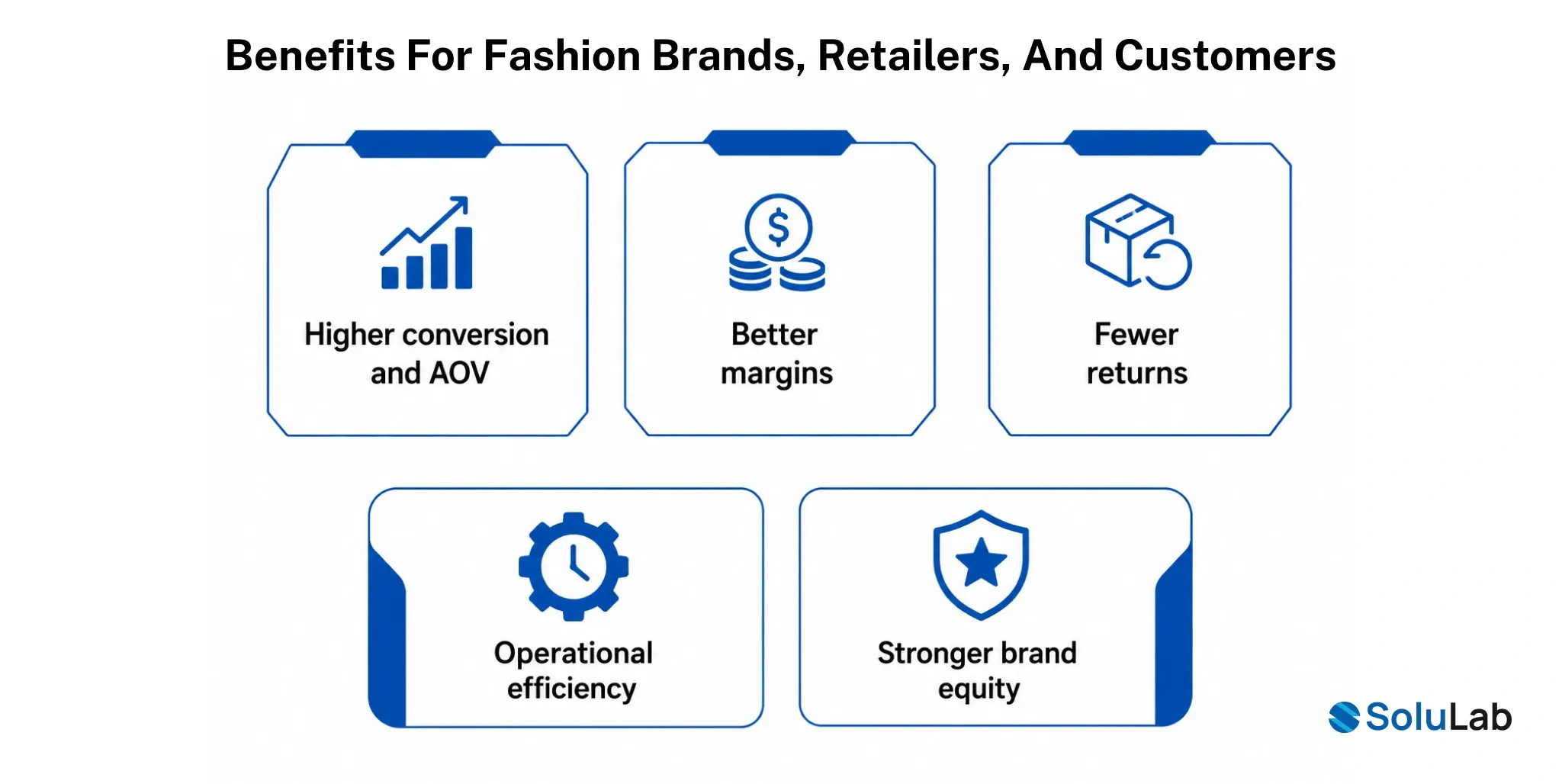
Benefits for Fashion Brands and Retailers
- Higher conversion and AOV: personalized outfit suggestions lead to more items per basket.
- Better margins: smarter promotions and assortments balance demand and profitability.
- Fewer returns: improved fit and expectation management.
- Operational efficiency: AI Automation Services free human teams from manual tagging, content creation, and repetitive merchandising tasks.
- Stronger brand equity: differentiated, experience-led journeys that align with evolving consumer expectations.
Deloitte’s retail trends note that spending is shifting from pure material goods toward experiences and emotions; fashion brands leveraging AI agents to create narrative-rich experiences are meeting this shift head-on.
Benefits for Customers
- Less decision fatigue: agents narrow choices and present curated options. Gartner’s 2026 survey confirms that shoppers welcome help in narrowing the field.
- More accurate fit and style: better alignment with tastes, occasions, and body types.
- Consistent brand voice: coherent advice and styling across channels.
- Time savings and delight: fewer hours scrolling, more time enjoying strong looks.
AI Agents for Fashion Retail and Online Stores
AI Agents for Fashion Retail and Online Fashion Stores are the most visible form of AI agent adoption in 2026.
1. AI Agent for Online Fashion Stores
- Embedded chat and guided shopping flows.
- Situation-based entry points (“Holiday shop,” “Wedding guest,” “Workwear refresh”).
- Tight integration with search, product detail pages, and checkout.
2. AI Personal Shopping Agent and AI Stylist Agent
- Like a 24/7 personal shopper who remembers your size, budget, preferences, and occasional splurge habits.
- Builds seasonal lookbooks and sends personalized drops.
- Integrates with loyalty programs and CRM to coordinate offers.
3. Fashion AI Shopping Agent in omnichannel journeys
- Begins conversations online, then hands off to stores with context (outfits shortlisted, sizing notes).
- Supports curbside pickup and appointment styling, improving omnichannel cohesion.
SoluLab’s AI agents in retail and e-commerce work extends these patterns across broader commerce, providing proven templates for robust, scalable AI deployments in fashion retail.
Building Custom AI Agents for Fashion Brands
Because style, brand voice, and operational complexity vary widely, Custom AI Agent Development is crucial for fashion.
Key design questions
- Brand identity and voice: Is your Fashion Brand AI Agent minimalist, playful, high-luxury, or streetwear edgy?
- Target segments: Are you serving value-conscious shoppers, luxury clients, or niche style tribes?
- Channel mix: How will agents appear across web, app, messaging, in-store screens, and clienteling tools?
- Autonomy boundaries: What can the agent decide alone vs what requires human oversight (pricing overrides, styling for VIPs, sustainability claims)?
- Metrics and governance: How will you monitor agent decisions for fairness, compliance, and brand consistency?
As an AI Agent Development Company, SoluLab typically runs dedicated discovery sprints for fashion brands to define the roles, guardrails, and KPIs for each AI fashion agent before any development begins.

Step-by-Step Implementation Guide for Fashion Businesses
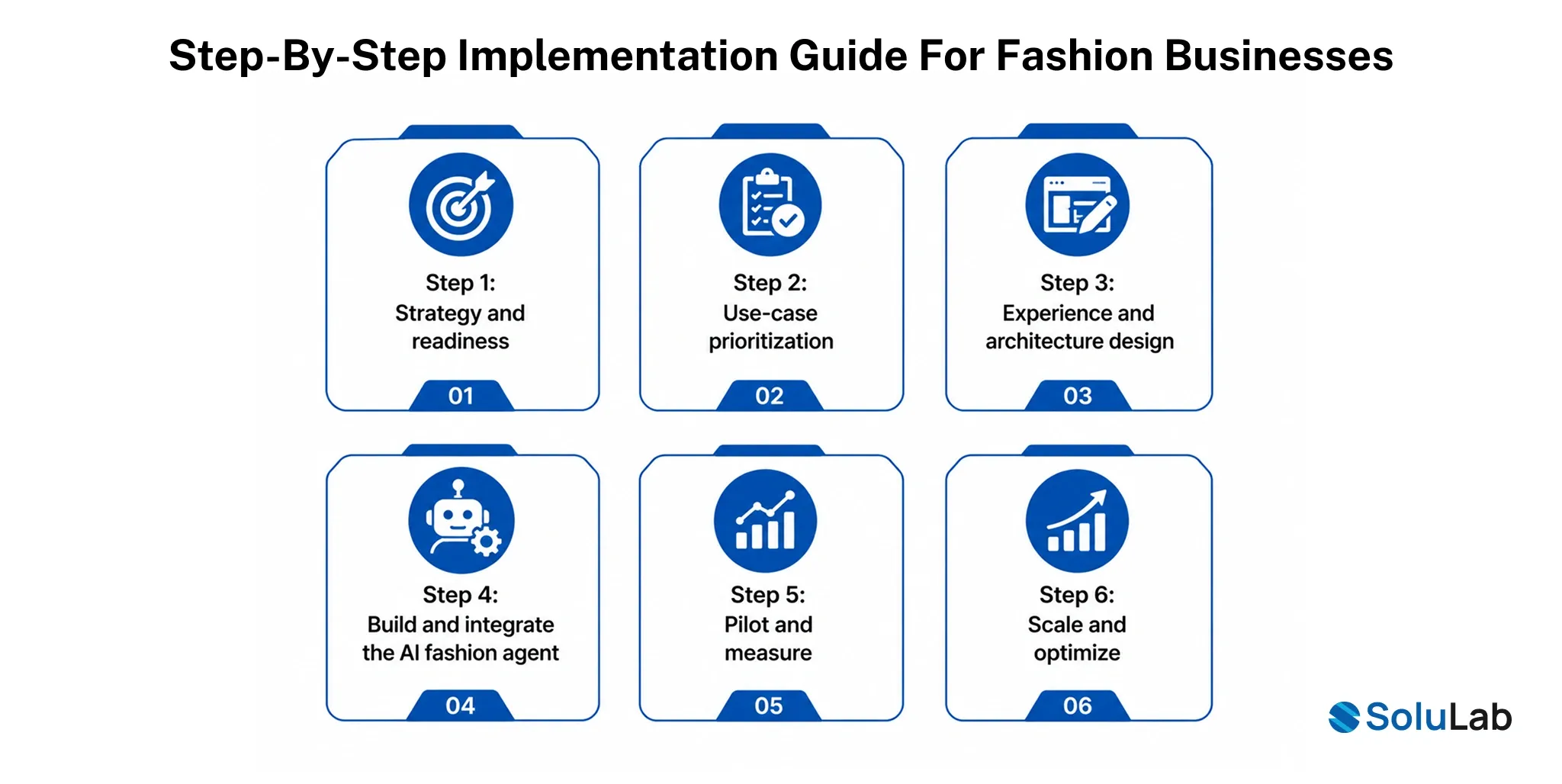
Here is a practical roadmap for AI Agent Solutions in apparel and retail.
Step 1: Strategy and readiness
- Clarify business goals (e.g., higher conversion, lower returns, stronger loyalty, omnichannel cohesion).
- Audit data quality (catalog attributes, imagery, inventory, customer profiles).
- Assess AI tech stack (e-commerce platform, OMS, CRM, POS, analytics).
- Align stakeholders (merchandising, marketing, digital, store ops, IT).
Step 2: Use-case prioritization
- Identify 3–5 high-impact AI use cases (e.g., AI Shopping Agent for Fashion, Virtual Stylist AI Agent, merch planning agent).
- Score by impact, feasibility, and risk.
- Choose one or two pilot agents that demonstrate quick value but remain governable.
Step 3: Experience and architecture design
- Map user journeys and agent touchpoints.
- Define data flows, integrations, and toolsets.
- Decide on hosting, models, and vendor stack.
- Design guardrails: brand rules, regional regulations, sustainability commitments.
You can draw on SoluLab’s Artificial Intelligence in Fashion Industry article for more detail on where AI fits from design to store operations.
Step 4: Build and integrate the AI fashion agent
- Implement catalog and profile retrieval.
- Integrate with cart, promotions, and CRM.
- Build multi-modal interfaces (text, image, maybe voice where relevant).
- Test on internal staff before exposing them to customers.
Step 5: Pilot and measure
- Launch pilots in select regions or customer segments.
- Track conversion, AOV, engagement, return rates, and customer satisfaction.
- Gather qualitative feedback from store associates and customer service.
Step 6: Scale and optimize
- Roll out to broader audiences and channels.
- Add more AI Agents in Fashion (e.g., returns agent, merch agent, procurement agent).
- Continuously refine based on metrics and trend shifts.
Challenges and Best Practices
Key challenges
- Data quality and labeling: Style attributes, fits, and occasions need consistent tagging for agents to reason well.
- Bias and inclusion: Agents may over-recommend certain styles or fits if data is skewed; inclusive modeling matters.
- Brand control: Maintaining brand integrity and sustainability messaging while agents generate content dynamically.
- Change management: Aligning merchandisers, designers, and store staff around new AI-powered workflows.
- Customer trust: Avoiding “creepy” or overly aggressive personalization.
Best practices for AI Agent Development Services in fashion
- Invest early in catalog and profile data quality; AI agents amplify whatever you give them.
- Involve brand, creative, and DEI teams in AI fashion agent design.
- Use human-in-the-loop review for high-stakes actions (VIP styling, major promotions).
- Provide transparency and controls to customers (opt-outs, preference editing, granular consent).
- Treat AI agents as living products, not one-off projects.
Gartner’s retail tech trends for 2026 stress that AI is now “operationalized” into core retail processes, requiring robust governance and ongoing optimization rather than ad hoc experiments.
The Future of AI Agents in Fashion for 2026 and Beyond
Emerging trends
- Multi-agent fashion ecosystems: Distinct agents for styling, merchandising, supply chain, and marketing collaborating behind the scenes.
- Real-time trend and demand sensing: Agents monitoring social, search, and sell-through to adjust assortments and campaigns in near real-time.
- Sustainable fashion intelligence: AI agents recommending upcycling, slow-fashion options, and more sustainable purchases.
- Hybrid human–AI styling teams: Human stylists augmented by AI Stylist Agents for ideation, coordination, and personalization at scale.
- AI as economic infrastructure: Deloitte and Gartner both signal that agentic AI is becoming foundational to profitable, experience-led retail.
From SoluLab’s vantage point, AI Agents in Fashion are set to become as standard as recommendation carousels once were—only far more powerful. The brands that win will be those that combine strong data, clear brand guidelines, and expert AI development solutions with a deep understanding of their audience.

Conclusion
AI Agents in Fashion are reshaping the industry by delivering hyper-personalized experiences, boosting operational efficiency, and reimagining how customers discover, assemble, and live with their wardrobes. From AI personal shopping agents and virtual stylists to intelligent merchandising and supply chain copilots, fashion AI agents are becoming central to how modern brands compete.
Deloitte and Gartner’s 2026 research makes it clear: retailers that operationalize agentic AI rather than just dabbling with isolated tools—will lead on both profitability and customer experience.
SoluLab stands at the forefront of this shift as a specialist AI Agent Development Company for fashion, delivering end-to-end AI Agent Development Services and AI Agent Solutions that help fashion brands and retailers move from concept to production-ready AI Shopping Agent Development with confidence.
FAQs
Shipra Garg is a tech-focused content strategist and copywriter specializing in Web3, blockchain, and artificial intelligence. She has worked with startups and enterprise teams to craft high-conversion content that bridges deep tech with business impact. Her work translates complex innovations into clear, credible, and engaging narratives that drive growth and build trust in emerging tech markets.