Key Takeaways
- Agentic AI doesn’t just execute tasks. It reasons through them, and that’s really the whole difference from older, rule-based automation.
- IDC and Microsoft measured a 3.7x average return for every dollar spent on generative AI initiatives.
- The best starting points tend to be processes with real volume, a mix of rules and judgment calls, and data that’s already sitting somewhere usable.
- Governance isn’t optional here. It’s the biggest thing separating companies stuck piloting agentic AI from companies actually running it at scale.
Every operations team eventually hits the same wall: invoices sit unmatched, onboarding drags into week two, and the only fix anyone can think of is hiring more people to keep pace.
That’s the reality for most growing businesses right now. Manual, repetitive processes are taking hours that should be going toward actual growth.
Customers notice the slow response times before leadership does, and by the time someone finally audits where all the hours are going, the cost of doing nothing is already higher than the cost of fixing it would have been.
Older rule-based bots don’t really solve this either, they just replay a fixed script and break the moment something unexpected happens.
Agentic AI is a genuinely different answer. It reasons through a task instead of just executing a script, pulling data from five different systems, weighing a decision, acting on it, then adjusting if something changes halfway through.
This blog gets into why businesses are putting real budget behind this right now, how the automation actually works under the hood, ten specific processes worth automating first, and what it takes to make this stick instead of ending up with an expensive pilot that never goes anywhere.
Why Businesses Are Investing in Agentic AI?
Honestly, it’s not really about the technology itself. It’s about what stops being a bottleneck once it’s in place. Gartner expects 40% of enterprise applications to embed task-specific AI agents by the end of 2026, up from under 5% just a year before.
- Reduce operational costs. Less time spent on repetitive, judgment-light work means lower overhead, plain and simple.
- Improve employee productivity. Teams stop babysitting routine tasks and put that time toward work that actually needs a human brain.
- Accelerate decision-making. Agents grab context from multiple systems instantly instead of someone spending an afternoon compiling a report first.
- Deliver 24/7 operations. Customer requests and approvals don’t just sit there because it’s 9pm on a Friday.
- Scale without hiring. Volume grows without headcount growing right alongside it, and that matters a lot more once budgets get tight.
How Agentic AI Automates Business Processes?
Most agentic systems run the same basic loop underneath, no matter what process they’re handling.
- An agent pulls in information, emails, databases, APIs, and a live chat, then figures out what actually needs to happen next using an underlying model.
- From there, it acts: updating a record, sending a message, triggering another system, and it logs the outcome so the next decision comes out a little sharper.
- That reasoning step is really the whole point. A traditional bot needs every scenario mapped out ahead of time. An agentic AI development company builds systems that can handle the situation nobody bothered to program for.
10 Business Processes You Can Automate with Agentic AI Services
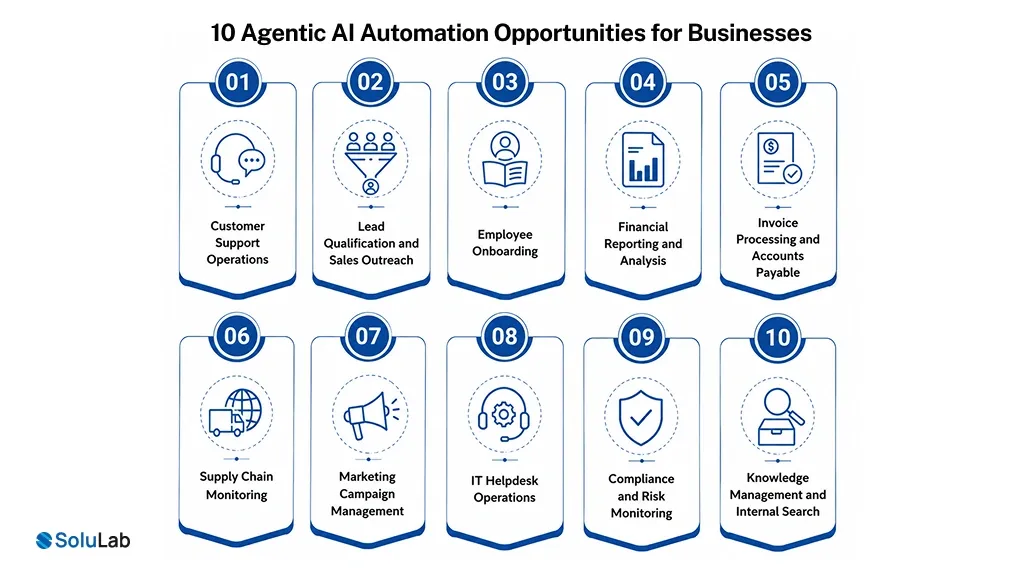
Some processes fit agentic AI a lot better than others, usually the ones with real volume, a blend of rules and judgment, and data that’s already sitting somewhere accessible.
1. Customer Support Operations
Agents resolve routine tickets start to finish and kick the genuinely tricky ones up the chain, instead of funneling everything through the same triage queue.
2. Lead Qualification and Sales Outreach
Scoring leads and personalizing follow-ups happen continuously now, not just whenever a rep finally gets a free hour.
3. Employee Onboarding
New hires get their accounts set up, paperwork processed, and questions answered without HR chasing down four other departments by email.
4. Financial Reporting and Analysis
Numbers get pulled from multiple systems and anomalies get flagged close to real time, rather than surfacing at the end of a reporting cycle when it’s too late to act on them.
5. Invoice Processing and Accounts Payable
Matching invoices against purchase orders and routing exceptions cuts the manual reconciliation grind down to just the cases that actually need a person’s eyes.
6. Supply Chain Monitoring
Agents track shipments, catch disruptions early, and adjust plans before a small delay turns into an angry customer email.
7. Marketing Campaign Management
Budget shifts, performance checks, and creative testing happen on an ongoing basis instead of waiting for Monday’s review meeting.
8. IT Helpdesk Operations
Password resets, access requests, and the usual troubleshooting steps get handled instantly, so IT staff can focus on tickets that need real diagnosis.
9. Compliance and Risk Monitoring
Agents scan transactions and communications for red flags around the clock, something a quarterly manual audit was never going to catch in time anyway.
10. Knowledge Management and Internal Search
Employees get a direct answer pulled straight from internal docs instead of digging through five different tools trying to find one policy.
How to Successfully Implement Agentic AI Services?
Getting agentic AI to actually stick inside a business takes more than picking a vendor and hoping for the best. Here’s roughly the order that tends to work.
1. Define Business Objectives
Start with a specific outcome, not a preference for a particular technology. That keeps the whole project tied to something leadership will actually care about measuring later.
- Set one clear success metric
- Align stakeholders before building
- Rule out non-AI fixes first
2. Identify High-Value Processes
Look for something with real volume and a mix of routine steps plus the occasional judgment call. That’s usually where agentic AI earns its cost fastest.
- Map current process bottlenecks
- Estimate hours currently spent
- Prioritize by impact and effort
3. Assess Data Readiness
An agent is only ever as good as what it can actually see, so this step tends to determine the real timeline more than anything else on this list.
- Audit existing data sources
- Identify gaps and access issues
- Plan cleanup before building starts
4. Build an AI Pilot
Scope the first version around one process, not the whole department, so results come back fast enough that you can actually learn something from them.
- Pick one narrow use case
- Set a defined pilot window
- Keep a human review step
5. Measure Results
Compare what actually happened against the metric you defined at the start, not against how good the demo looked in the meeting.
- Track cost and time saved
- Review accuracy and error rate
- Collect direct user feedback
6. Scale Across Departments
Once a pilot proves itself, expand on purpose instead of rolling agentic AI out everywhere overnight.
- Prioritize next-best departments
- Reuse infrastructure where possible
- Keep governance consistent throughout
Future of Agentic AI in Business Operations
1. Multi-Agent Systems
Instead of one agent trying to handle an entire process alone, specialized agents are increasingly handing tasks off to each other, each one focused on a narrow slice of the workflow.
2. Autonomous Enterprises
Some organizations are pushing toward operations that run mostly on agent-managed workflows, with people setting direction instead of executing every single step themselves.
3. AI Workforce Augmentation
Rather than replacing roles outright, agents keep getting paired with employees to soak up the repetitive parts of a job, which lines up with what Deloitte’s own research is actually finding.
4. Agent-to-Agent Collaboration
Agents built by different teams, sometimes even different vendors, are starting to coordinate directly, passing context and tasks between systems without a person relaying anything by hand.
5. Industry-Specific AI Agents
Generic assistants are slowly giving way to agents built with real domain knowledge baked in, which is exactly where a generative AI development company tends to beat an off-the-shelf tool.
Why Partner with SoluLab for Agentic AI Development Services?
SoluLab, an AI native company, helps businesses automate repetitive tasks by properly auditing their business processes.
1. Strategy Consulting
SoluLab’s AI consulting team helps figure out which processes are genuinely worth automating before any development work even starts.
2. AI Opportunity Assessment
A structured look at data, infrastructure, and process maturity shows what’s realistically doable in the first 90 days versus what still needs groundwork.
3. Custom AI Agent Development
SoluLab’s AI agent development work spans everything from a single-task assistant to coordinated, multi-agent systems built around one specific workflow.
4. Enterprise Integration
Getting an agent to actually work inside existing CRMs, ERPs, and internal tools is where a lot of projects quietly stall, and it’s a core piece of enterprise AI development done right.
5. Security and Governance
Every agent gets scoped permissions, audit trails, and human checkpoints for anything high-stakes, built in from day one instead of bolted on after a scare.
Conclusion
The businesses getting real value from agentic AI aren’t the ones trying to automate everything at once. They’re the ones picking the right process first, deciding upfront what success actually looks like, and baking governance in from day one instead of scrambling to add it after something breaks.
What separates the companies that scale this well from the ones stuck in permanent pilot mode usually comes down to exactly what’s above: start narrow, measure honestly, and only expand once the first process has actually proven itself.
SoluLab, an AI development company, can help your business identify which processes are actually ready for agentic AI and build a system that fits how your teams already work.
FAQs
Neha is a curious content writer with a knack for breaking down complex technologies into meaningful, reader-friendly insights. With experience in blockchain, digital assets, and enterprise tech, she focuses on creating content that informs, connects, and supports strategic decision-making.