Key Takeaways
- AI customer service agents can automate customer interactions, resolve common queries, and provide 24/7 support.
- They can handle tasks such as FAQ resolution, order tracking, troubleshooting, ticket creation, and personalized responses.
- Their effectiveness depends on data quality, system integration, context understanding, and human oversight.
- Key limitations include hallucinations, complex or ambiguous queries, privacy concerns, security risks, and difficulty handling emotionally sensitive situations.
- Build vs. buy depends on business needs, budget, customization requirements, technical resources, and time-to-market.
An AI customer service agent is software that resolves customer inquiries end to end rather than suggesting replies to a person. It reads the request, retrieves the answer from your knowledge bases, takes the action needed, and escalates to human agents when confidence is low. Most teams start with a platform and build custom only where their workflow is unusual.

What is an AI agent?
An AI agent is a system that pursues a goal by taking actions, not just producing text. It plans, calls tools or APIs, checks the result and continues until the goal is met or it gives up and escalates.
The distinction from a chatbot is consequence. A chatbot answers. An agent does: it issues the refund, changes the address, cancels the subscription. That is why agent projects need permissions, logging and approval thresholds that chatbot projects never needed.
What is an AI agent for customer service?
An AI customer service agent applies that pattern to support. Rather than routing a ticket to a queue, it attempts resolution: identify the customer, understand the request, look up the relevant policy and order data, perform the action, and confirm.
A real one has four parts:
- Understanding, to work out what the customer actually wants from an imprecise message.
- Retrieval, to ground answers in your knowledge base, policies and account data rather than in model training.
- Action, through tools and APIs into your systems of record.
- Escalation, with a confidence threshold and a clean handover to a human agent.
Remove retrieval and it invents policy. Remove action and it is a chatbot. Remove escalation and it will eventually give a confident wrong answer to someone who matters.
How do AI customer service agents work?
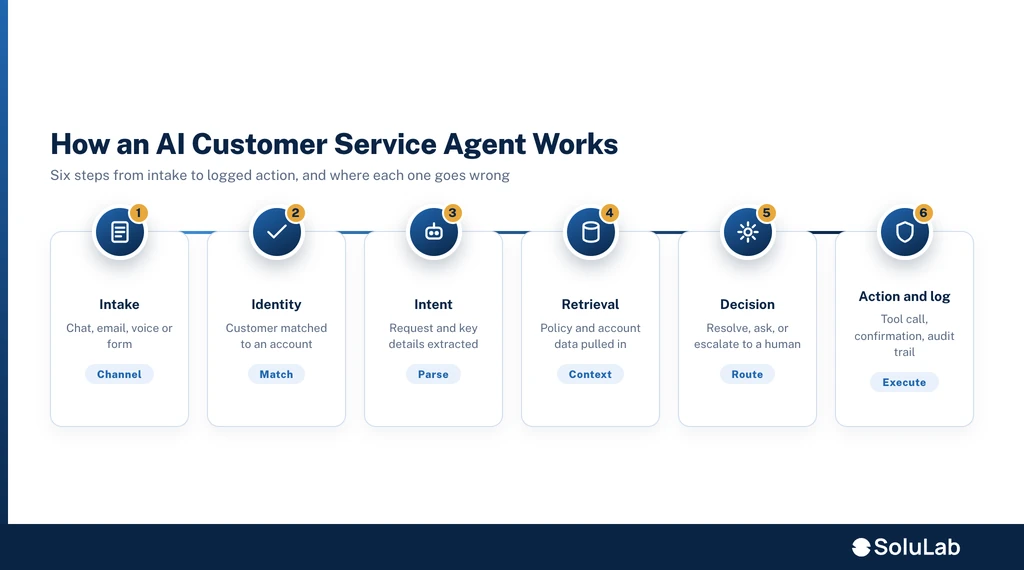
| Step | What happens | Where it goes wrong |
| Intake | Message arrives from chat, email, voice or a form | Multi intent messages get flattened to one intent |
| Identity | Customer matched to an account | Guest or multi account cases misidentified |
| Intent and entities | Request and key details extracted | Implied requests, sarcasm, mixed languages |
| Retrieval | Policy and account data pulled into context | Stale or contradictory knowledge base articles |
| Decision | Resolve, ask a question, or escalate | Confidence thresholds set too high or too low |
| Action | Tool call into your systems | Missing idempotency, so retries double charge |
| Confirmation and logging | Customer told, decision recorded | No audit trail, so disputes cannot be resolved |
The two failures that cause real damage are a wrong action taken confidently, and a knowledge base that disagrees with itself. Both are operational problems rather than model problems.
Key features and capabilities to look for
- Grounded answers with a citation to the source article, so an agent can be audited.
- Actions into systems of record, not just answers.
- Confidence scoring and a tunable escalation threshold.
- Clean human handover carrying the full conversation and what was already tried.
- Omnichannel coverage across chat, email and voice, with one policy layer.
- Multilingual handling if your customers write in more than one language.
- Analytics on resolution rate, escalation rate, cost per conversation and customer experience scores.
- Guardrails, including topics it must refuse and actions requiring approval.
What types of queries are best handled by AI agents?
Good fit: order status, returns and refunds inside policy, address and plan changes, password and access issues, appointment changes, billing explanations, and the long tail of policy questions your knowledge base already answers.
Poor fit, keep with human agents: anything involving a distressed customer, a complaint that could escalate legally, a judgement call outside written policy, high value retention conversations, and any action that cannot be reversed.
The useful rule: automate where policy is written down and the action is reversible. Escalate where judgement or goodwill decides the outcome.
How human agents work with AI agents
The pattern that works in practice is not full automation. The AI agent handles the volume, human agents handle exceptions and the conversations where relationship matters, and the AI agent assists the human on those by drafting and retrieving.
What changes for support teams:
- Volume of routine contacts falls, so the remaining work is harder and more valuable.
- Escalation quality becomes the main metric for the AI agent, not deflection rate.
- Someone has to own the knowledge base, because agent accuracy is now downstream of content accuracy.
- Quality assurance shifts from listening to calls to sampling agent decisions.
How do AI customer service agents learn and improve?
Not, in most cases, by learning continuously on their own. Improvement comes from a loop your team runs: sample resolved and escalated conversations, label what was wrong, fix the knowledge base or the prompt or the tool, then re measure against a held out set.
Treat any vendor claim of an agent that improves itself with caution and ask to see the evaluation method. Without a labelled sample and a held out set, the claim cannot be checked.
Measuring ROI
Measure these, before and after, on the same query mix:
| Metric | Why it matters |
| Full resolution rate | The only measure of real automation. Deflection is not resolution |
| Escalation rate and escalation quality | A wrong escalation costs more than a clean one |
| Cost per conversation | Model and platform cost included, not just headcount saved |
| First contact resolution | Whether customers come back for the same issue |
| Customer satisfaction on AI handled contacts | Split from human handled, or the number is meaningless |
| Containment of wrong actions | Count of actions reversed after the fact |
ROI equals contacts per month multiplied by the difference in cost per contact, minus platform and build cost. Most disappointing projects reported deflection rather than resolution, and the contacts came back.
Build vs buy: the decision that actually matters
Platforms dominate this market and for most teams buying is correct. Build custom when one of these is true:
| Situation | Why buying struggles |
| Your resolution needs many internal systems | Platform connectors cover common tools, not your ERP or in house systems |
| Your policy logic is unusual or regulated | Policy in a vendor’s rules engine becomes hard to audit |
| Data cannot leave your environment | Residency and retention terms are fixed by the vendor |
| Cost per conversation at your volume is prohibitive | Per resolution pricing scales badly above a certain volume |
| The agent is part of your product | Your customers see it, so it cannot look like someone else’s |
A practical hybrid: buy the platform for the front door and standard flows, build custom agents for the two or three high volume workflows that touch your own systems. That is where SoluLab is usually engaged.
Which platforms let you build custom AI agents for customer support?
The market divides into three groups, and the right question is which layer you want to own.
- Suite agents bundled with a support platform. Fastest to launch, least control over retrieval and actions.
- Agent platforms that let you define tools, policies and escalation. Middle ground, still the vendor’s runtime.
- Frameworks and model APIs where you build the agent, the retrieval layer and the evaluation yourself. Most control, most engineering, and the only option when data cannot leave your environment.
We deliberately do not publish a ranked list of products here. Rankings of this market go stale within a quarter, and every published list on this search is written by a vendor in it.
How to implement an AI customer service agent
- Pick one high volume workflow with written policy and a reversible action.
- Fix the knowledge base for that workflow first. Agent accuracy cannot exceed content accuracy.
- Define the escalation threshold and the refusal list before launch.
- Build the evaluation set, a few hundred real conversations with correct outcomes labelled.
- Run shadow mode. The agent proposes, humans decide, and you measure agreement.
- Launch to a traffic slice with human review on every action for the first week.
- Measure resolution, not deflection, and expand only when it holds.
- Give someone ownership of the knowledge base and the evaluation loop, permanently.
Common challenges
- Knowledge base contradictions, the most common cause of wrong answers.
- Actions without idempotency, causing duplicate refunds on retry.
- Escalation set too conservatively, so nothing is automated and the project looks like a failure.
- No evaluation set, so nobody can tell whether a change helped.
- Cost surprise from long contexts and retries at real volume.
How SoluLab helps
We build custom agents for the workflows platforms cannot reach: retrieval over your own content, actions into your own systems, evaluation you own, and audit logging suitable for regulated environments. We start with a feasibility assessment that can conclude you should buy a platform instead, which happens often enough that we say it up front.
Proof
- Updateia, autonomous enterprise workflows. Agents taking multi step action in production.
- Health insurance with AI solutions. Regulated customer workflows.
- Transforming retail with generative AI. Customer facing generative features.
Get an AI agent feasibility assessment
Bring one workflow and its monthly volume. You will get an assessment of whether an agent can resolve it, what would have to be fixed first, and whether to build or buy.
FAQs
Shipra Garg is a tech-focused content strategist and copywriter specializing in Web3, blockchain, and artificial intelligence. She has worked with startups and enterprise teams to craft high-conversion content that bridges deep tech with business impact. Her work translates complex innovations into clear, credible, and engaging narratives that drive growth and build trust in emerging tech markets.