![White Label AI Agent Platforms: Features, Costs, and Implementation Guide [2026]](https://www.solulab.com/wp-content/uploads/2026/06/White-Label-AI-Agent-Platforms-Development.webp)
Key Takeaways
- White-label AI agents accelerate enterprise automation without requiring extensive in-house AI development.
- Businesses can customize branding, workflows, integrations, and conversational experiences with greater flexibility.
- AI agent development costs vary based on complexity, integrations, scalability, and deployment requirements.
- Enterprise AI agents significantly improve operational efficiency, customer engagement, and cross-functional workflow automation.
- Modern AI agent platforms support faster deployment, continuous optimization, and scalable business growth.
AI adoption is increasing fast, and businesses across industries are now automating operations, improving customer experiences, and scaling efficiently.
But building AI agents from scratch can become expensive, time-consuming, and technically overwhelming, especially for companies trying to launch branded AI solutions without expanding internal development teams.
That’s exactly why white-label AI agent development is gaining momentum. Instead of spending months building complex AI infrastructure, businesses can launch fully customizable AI agents under their own brand with faster deployment and lower operational costs.
In fact, studies from Harvard Business School show AI-assisted agents respond approximately 20% faster, especially in enterprise support environments.
To help you understand the opportunity better, we created this guide covering the key features, business benefits, and development costs of white-label AI agents.
Let’s get started!
What are White-Label AI Agents?
White label AI agents are pre-built, fully functional AI-powered software solutions developed by a third-party AI development company and licensed to businesses, which then rebrand and deploy them as their own.
Unlike generic chatbots, white label AI agents are context-aware, task-capable systems that can reason, retrieve information, use tools, and take actions autonomously across workflows. They are built on large language models (LLMs) and are often described in AI overviews as agentic systems, meaning they can plan, execute multi-step tasks, and adapt based on feedback without human intervention at each step.
Core Features of Modern White Label AI Agent Platforms
Today’s enterprise-grade platforms go far beyond simple chatbots; they deliver autonomous, multi-modal, deeply integrated AI capabilities. Here are the core features of the white-label AI agent platforms:
- Multi-Agent Orchestration: The ability to coordinate multiple specialized agents, one handling customer queries, another processing orders, another escalating compliance issues within a single workflow. This allows complex enterprise processes to be automated end-to-end without human interruption.
- Retrieval-Augmented Generation (RAG): Agents pull real-time information from your internal knowledge bases, documentation, and databases before generating responses. This eliminates hallucinations on domain-specific topics and keeps answers grounded in your actual business data.
- Omnichannel Deployment: Deploy the same agent across web chat, mobile apps, voice interfaces, WhatsApp, Slack, email, and SMS from a single configuration. White label AI solutions with omnichannel capability ensure a consistent brand experience across every customer touchpoint.
- Tool Use and API Integration: Modern agents don’t just answer questions; they take actions. They can query databases, submit forms, trigger workflows in third-party systems, send notifications, and create tickets. This changes them from information tools into genuine automation engines.
- Real-time visibility into agent performance: Conversation volumes, resolution rates, escalation triggers, sentiment trends, and cost-per-interaction metrics. These dashboards allow continuous optimization without engineering intervention.
- Customizable AI Persona and Guardrails: Define how the agent speaks, what topics it avoids, how it handles sensitive requests, and when it escalates to a human. Brand-consistent personas are central to white-label AI assistant development; the agent should feel like a natural extension of your product, not a third-party bolt-on.
How to Build White Label AI Agents? Step by Step Guide
Deploying white-label AI agents successfully requires a phased approach that aligns technical setup with business objectives and change management.
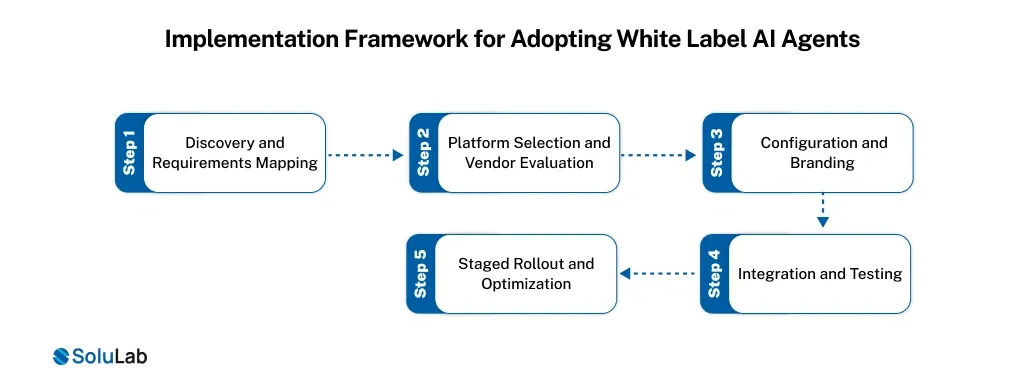
Step 1: Discovery and Requirements Mapping
Identify the exact workflows, user personas, and integration touchpoints the AI agent will handle. Define success metrics: upfront resolution rate, CSAT improvement, and hours saved. This phase prevents scope creep and ensures that the platform configuration aligns with real-world needs rather than theoretical ones.
Step 2: Platform Selection and Vendor Evaluation
Evaluate white label AI agent solutions against five criteria: LLM flexibility (can you swap models?), integration depth (APIs, CRM, ERP connectors), customization scope (branding, persona, tone), SLA terms, and data residency options. Request sandbox access before committing.
Step 3: Configuration and Branding
This is where the “white label” work happens. Apply your brand identity logo, color scheme, and voice guidelines, and configure the agent’s persona, knowledge base, escalation rules, and tool integrations. Most modern white-label AI agent platforms provide no-code configuration dashboards for this step.
Step 4: Integration and Testing
Connect the agent to your live data systems: CRM, inventory, or ERP. Run structured QA across edge cases, adversarial inputs, and peak-load scenarios. Test multilingual behavior if your customer base requires it.
Step 5: Staged Rollout and Optimization
Launch to a pilot user group, typically 10–20% of the target audience. Collect feedback, monitor hallucination rates, track containment metrics, and iterate on the knowledge base. Full rollout follows once KPIs stabilize. Post-launch, schedule monthly review cycles to retrain and refine.
Top Use Cases for White Label AI Agents in 2026
White-label AI agent solutions are being deployed across virtually every industry vertical. Here are the highest-impact applications:
1. Customer Support Automation
AI-powered assistants resolve password resets, order tracking, account queries, and troubleshooting guides with containment rates above 70% reported by enterprise deployments. Human agents focus exclusively on complex, high-value interactions.
2. Sales and Lead Qualification
Conversational AI agents engage website visitors, qualify leads through structured dialogues, score intent, and route high-value prospects directly to sales reps. Integration with CRM systems means every conversation automatically updates the pipeline.
3. HR and Employee Onboarding
Internal AI agents handle employee FAQs, guide new hires through onboarding documents, and process leave requests. Ultimately, reducing HR team workload by 40–60% in documented enterprise rollouts.
4. Healthcare Patient Engagement
HIPAA-compliant AI solutions handle appointment scheduling, medication reminders, pre-visit triage, and post-discharge follow-up. It improves patient adherence and reduces administrative burden on clinical staff.
5. Financial Services and Banking
AI agents handle account queries, transaction disputes, loan application status updates, and regulatory FAQs. With strict guardrails and audit trails, they meet compliance requirements while dramatically cutting call center volume.
6. E-commerce and Retail
Product recommendation agents, order management assistants, and AI-powered virtual try-on to deliver personalized shopping experiences at scale without proportional increases in customer service staffing.
7. Legal and Compliance
White label AI agents assist with contract review, regulatory query handling, and document retrieval. It lets people focus on high-priority tasks.
Benefits of White Label AI Agent Development
Adopting white-label AI agent solutions delivers measurable advantages across cost, speed, and competitive positioning.
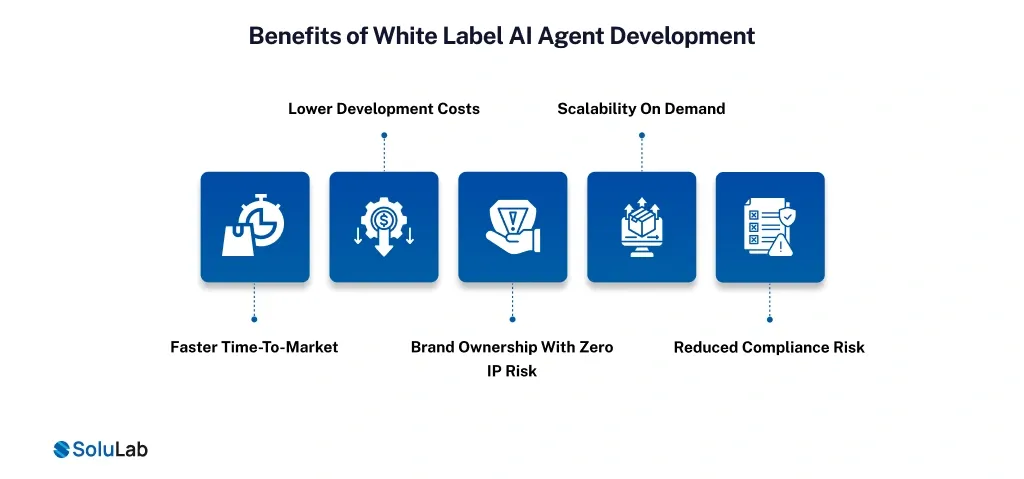
- Faster Time-to-Market: Building conversational AI agents from scratch typically takes 12–24 months of engineering work. White-label AI agent development compresses this to weeks. Businesses launch branded AI experiences while competitors are still writing RFPs.
- Lower Development Costs: Custom AI agent development from the ground up demands machine learning engineers, LLM specialists, DevOps infrastructure, and ongoing model maintenance, all expensive. White label solutions eliminate most of that overhead, making enterprise AI accessible to mid-market businesses, not just Fortune 500s.
- Brand Ownership With Zero IP Risk: You get full brand control of your name, your interface, and your workflows, while the underlying technology risk stays with the development partner. This is particularly valuable for SaaS companies that want to offer AI features without building an AI team.
- Scalability on Demand: White-label AI agent platforms are engineered for scale. Whether you’re serving 100 users or 10 million, the infrastructure scales without requiring you to re-architect.
- Reduced Compliance Risk: Enterprise-grade white label platforms come pre-built with security standards, data handling protocols, and compliance frameworks (SOC 2, HIPAA, GDPR).
Cost of White Label AI Agent Development
The cost of white-label AI agent development depends on customization depth, integrations, AI model complexity, deployment scale, and ongoing maintenance requirements across enterprise automation environments and customer-facing operations.
| Development Component | Estimated Cost Range | Description |
|---|---|---|
| Basic AI Agent Setup | $5,000 – $15,000 | Includes standard workflows, branding, and limited integrations for small-scale automation requirements. |
| Custom AI Agent Development | $15,000 – $40,000 | Covers advanced workflow customization, enterprise integrations, and tailored conversational behavior. |
| Multi-Platform Integration | $25,000 – $50,000+ | Integration with CRM, ERP, ticketing systems, APIs, and third-party enterprise software tools. |
How White Label AI Agents Improve Enterprise Automation?
White label AI agents are transforming enterprise automation by reducing operational delays, improving decision-making, and enabling scalable workflows through intelligent, branded AI-native systems across business functions.
Modern enterprises use agentic AI frameworks to automate repetitive workflows, improve response accuracy, and improve customer and operational processes. These systems integrate with existing enterprise tools while adapting to evolving business requirements in real time.
- Faster enterprise workflow execution
- Reduced manual operational dependency
- Cross-platform task automation
- Improved customer interaction efficiency
- Real-time data-driven decision support
- Scalable automation across departments
Future Trends in White Label AI Agents
The next 24 months will see white-label AI agents evolve from reactive to proactive enterprise systems.
- Proactive and Predictive Agents: Agents will flag renewal risks, surface upsell opportunities, and initiate outreach. From reactive tools to proactive business drivers that act on signals before customers even reach out.
- Multimodal Capabilities: Text-only agents are giving way to systems that process images, audio, video, and documents simultaneously. A white-label AI agent for insurance, for example, will soon accept a photo of damage and process the claim entirely autonomously, combining visual understanding with workflow execution.
- Deeper Personalization Through Memory: Next-generation platforms will maintain persistent memory across conversations, building user-specific context over time. This enables genuinely personalized AI experiences that improve with every interaction, increasing engagement and satisfaction metrics.
- Agentic Marketplace Ecosystems: White-label AI agent platforms will evolve into marketplaces where enterprises mix and match specialized agents, a billing agent, a compliance agent, and a scheduling agent that collaborate on complex tasks. This modular approach will make AI development solutions faster to compose and easier to maintain.
- Embedded AI in SaaS Products: Every B2B SaaS company will be expected to offer AI agent capabilities natively within its product. White-label AI assistant development will become the default go-to-market path for software companies that want to ship AI features without building AI infrastructure.
Conclusion
White label AI agents represent the most practical path for businesses seeking to compete in an AI-native market without the risks and costs of ground-up development.
The combination of speed-to-market, brand ownership, enterprise-grade capability, and ongoing innovation from specialized vendors makes white-label AI agent development an overwhelmingly compelling choice for 2026 and beyond.
Whether you are a SaaS company looking to embed conversational AI agents into your product, or an enterprise aiming to automate customer operations. The white label model gives you a legitimate, scalable foundation to build on.
SoluLab, an AI development company in USA, can help you build white-label AI agent solutions across industries. Book a free consultation today.
FAQs
Neha is a curious content writer with a knack for breaking down complex technologies into meaningful, reader-friendly insights. With experience in blockchain, digital assets, and enterprise tech, she focuses on creating content that informs, connects, and supports strategic decision-making.