


Key Takeaways
- The problem : The challenge in the healthcare system is the high volume of patients, the increasing cost of operation, a limited number of staff, and fragmented digital services, which make it hard to provide timely, personalized, and scalable patient care.
- The solution : AI assistants in healthcare simplify communication with the patient, automate processes, have 24/7 support, and can offer personalized healthcare with the help of AI, which enhances efficiency, cost reduction, and the patient experience overall.
- How SoluLab helps : SoluLab is an AI native company that uses AI as an integral part of its processes, which is why it can develop healthcare AI assistants more quickly and at a lower cost, and offer scalable, secure, and high-performance solutions that meet its clients’ needs.
Amazon’s latest move into digital health underscores a clear shift toward AI-driven patient engagement and more intelligent healthcare delivery. Businesses across hospitals, clinics, and health tech startups are now exploring how to replicate this model using custom healthcare AI solutions tailored to their specific workflows.
From virtual triage to automated patient support, an AI healthcare assistant can streamline operations, improve accessibility, and reduce costs. Moreover, the global healthcare AI market is projected to grow to over $613 billion by 2034,
With the increase in AI healthcare app development, organizations can now build intelligent systems that integrate with existing platforms and deliver real-time, personalized care experiences.
This blog explores how to create a healthcare AI assistant like Amazon’s, covering key features, technologies, costs, and the strategic steps required to launch a scalable, enterprise-ready solution.
What does Amazon Health AI actually do?
The Healthcare AI assistant (also known as the Health AI) is, in fact, a customized, AI-based virtual healthcare agent that aims to assist users in managing daily healthcare requirements through conversational interactions on the website and the mobile app of Amazon.
At its core, it acts as a digital front door to healthcare, allowing users to ask health-related questions, understand medical information, and take action without needing immediate human intervention. For example, it can explain complex medical records, lab results, and diagnoses in simple language, making healthcare information more accessible to non-experts.
The assistant is designed to handle actual healthcare workflows. Users can book appointments, manage prescription renewals, and even connect directly with licensed healthcare providers through Amazon’s One Medical network.
This turns the assistant from a passive information tool into an action-oriented healthcare interface that completes tasks end-to-end within a single experience.
Why AI Is Pushing Deeper Into Healthcare?
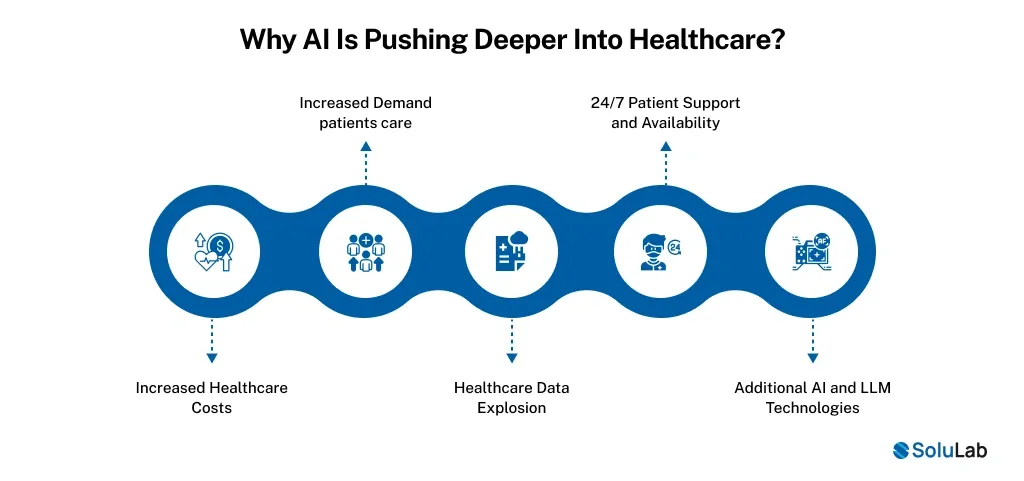
Artificial Intelligence is also changing the healthcare sector rapidly by increasing efficiency, cutting costs, and facilitating smarter patient care, compelling organizations to implement smarter systems that improve outcomes, access, and the scale of operations.
- Increased Healthcare Costs: Healthcare organizations are experiencing soaring costs and workforce shortages, forcing organizations to consider AI solutions that can automate their workflows, decrease administrative workload, and open opportunities to use their resources effectively.
- Increased Demand patients care: The patients require individualised healthcare services. With the help of AI, tailored recommendations, care plans, and real-time support are possible, which enhances interaction, satisfaction, and overall care outcomes on the digital health platforms.
- Healthcare Data Explosion: Large amounts of healthcare data demand sophisticated analysis. AI assists in processing both structured and unstructured data, allowing faster diagnosis, improved decision-making, and actionable insights to healthcare providers.
- 24/7 Patient Support and Availability: AI-powered assistants are 24/7 available to support and assist patients by helping access information, schedule appointments, and giving advice; therefore, increasing accessibility and patient experience significantly.
- Additional AI and LLM Technologies: Innovations in AI and large language models, in particular, are enabling more precise, human-like, and context-sensitive healthcare assistants, accelerating their implementation in hospitals, startups, and enterprise healthcare systems.
How Amazon Health AI uses your medical History?
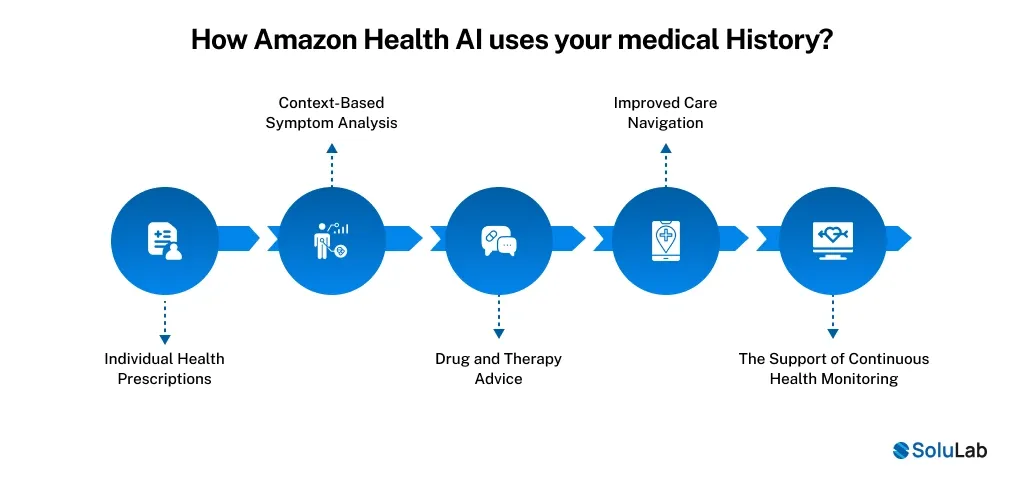
Amazon Health AI uses patients’ medical history to provide more accurate, personalized, and context-sensitive healthcare advice to help users make informed decisions and reduce the complexity of medical information and care processes.
- Individual Health Prescriptions: Amazon Health AI uses the analysis of the previous diagnoses, medications, and treatments to provide specific recommendations, enhancing relevance and assisting the users in better interpreting their current health status and further actions.
- Context-Based Symptom Analysis: Rather than generic outputs, the assistant takes into account medical history to make better judgments of the symptoms, to minimize false proposals, and to match the answers with the current conditions or treatments of the user.
- Drug and Therapy Advice: It is much safer in terms of recommendations, indicates possible problems, and makes the users have a better idea of dosage, side effects, and plans of the treatment, by referring to prescription history and current treatment.
- Improved Care Navigation: The AI utilizes past health information to refer users to suitable care service options, including virtual consultation and physical visits, among others, to make decisions that correspond to medical requirements in the past.
- The Support of Continuous Health Monitoring: By viewing changing medical histories, the assistant can observe health trends over time and assist users in managing chronic diseases and being proactive in their health journey.

What This Means for Healthcare Providers and Startups?
The healthcare sector is quickly turning to AI-based systems, with automation, personalization, and real-time assistance becoming not a choice but a necessity for providers and startups that want to remain relevant and scalable.
- The necessity of AI is becoming competitive: The use of AI in healthcare organizations is becoming more and more of a standard practice to optimize the processes, cut on expenses, and enhance results, and therefore, the capabilities of AI are becoming a necessary condition instead of a competitive advantage.
- Chance to develop niche healthcare AI assistants: Startups can focus on specific segments, such as mental health, chronic care, or diagnostics, by developing tailored solutions to meet patient- and provider-specific requirements.
- Greater demand for custom AI solutions: Healthcare providers are abandoning generic tools, which has generated strong demand for customized platforms and healthcare AI assistants that fit well into current systems and workflows.
- Move towards patient-centric digital experiences: With AI assistants, patients can access personalized, round-the-clock care, receive guidance, reserve services, and track their health journeys online, enhancing engagement and satisfaction rates
How Businesses Can Build a Healthcare AI Assistant?
Developing a healthcare AI assistant needs to align the business objectives with compliant technology, proper patient interaction, integrations, and scalable AI systems that enhance efficiency, engagement, and healthcare delivery outcomes.
Step 1. Define Use Case
Begin by defining some business goals like patient triage, virtual support, or engagement. A dedicated application can make sure that your healthcare AI assistant can provide a tangible value and enhance operational performance.
Step 2. Select AI Models
Use the right technologies such as LLMs to converse, NLP to comprehend, and RAG to respond accurately. The models are used to develop AI medical assistant solutions that have dependable context-sensitive healthcare insights.
Step 3. Behave Compliance and Data Security
Healthcare AI should comply with such regulations as HIPAA and GDPR. Enforce encryption, safe data storage and access controls to ensure protection of patient data as well as provide safe and reliable custom healthcare AI solutions.
Step 4. Integrate with Healthcare Systems
The integration in EHR systems, mobile applications, and APIs to exchange data in real-time. This guarantees that your solution has the capability of developing AI assistant healthcare platforms that are able to assist end-to-end patient experiences effectively.
Step 5. Ongoing learning and streamlining
Train AI models with real-world data and feedback on a regular basis to enhance accuracy. Long-term performance, scalability, and improved patient outcomes are all guaranteed by ongoing optimization in the changing healthcare settings.
Read more – How to Build HIPAA-Compliant AI Health Platforms
Cost to Build a Healthcare AI Assistant Like Amazon
A healthcare AI assistant like the one developed by Amazon needs to be strategically invested over features, integrations, and scalability, and the costs have a big range based on complexity, compliance needs, and the level of AI sophistication.
| Development Level | Estimated Cost | Description |
| MVP Development | $15,000 | Ideal for startups, includes basic chatbot functionality, limited AI capabilities |
| Mid-Level AI Assistant | $20,000 | Offers improved NLP, better UI/UX, integration with healthcare systems, and more accurate responses suitable for growing healthcare platforms and clinics. |
| Enterprise-Grade Solution | $50,000+ | Advanced AI with RAG, full system integrations, compliance layers, multi-platform deployment, and scalability similar to Amazon-level healthcare assistant solutions. |
Future of AI in Healthcare After Amazon’s Move
The move of Amazon into AI in the healthcare setting is an indicator of a significant change that will increase innovation, competition, and the uptake of intelligent systems that will transform healthcare delivery, access, and experiences around the world.
- Increasing numbers of tech giants: The actions of Amazon are driving Google and Microsoft to invest more in AI in healthcare, further increasing the competition and accelerating the pace of innovation in the diagnostics, patient engagement, and digital care ecosystems.
- Emergence of AI-first healthcare systems: Healthcare platforms are becoming AI-first systems with automation, decision support, and virtual assistants becoming fundamental infrastructure instead of peripheral features, enhancing efficiency and eliminating reliance on manual processes.
- Efforts to hyper-personalize patient experiences: AI systems are becoming more and more utilizing patient data, history, and behavior to give personalized care advice, treatment plans, and communication that enhance the outcome and patient satisfaction of various digital health platforms.
- Voice + multimodal AI assistants: Voice is replacing text in healthcare AI, and visuals and real-time input can also be added to facilitate increased natural interaction between a patient and a computer and serve more possible uses, such as symptom analysis, remote visits, and accessibility enhancements.
- Predictive and preventive care systems: AI is transforming healthcare into a proactive care system, where risks are predicted, early symptoms are identified, and preventive measures are enforced in real-time, based on the collected data and sophisticated analytics tools.

Conclusion
The healthcare AI assistant of Amazon emphasizes the speed with which digital healthcare is changing into intelligent and always-available care experiences. To businesses, it is not yet a future trend but a current opportunity to enhance patient engagement, streamline operations and scale services in an efficient fashion.
To create a healthcare AI assistant, it is necessary to have an appropriate combination of AI models, secure architecture, and domain knowledge. Those businesses that are early movers will have an obvious competitive advantage in this fast-changing space.
If you’re planning to build a similar solution, SoluLab, an AI development company,can help your business design, develop, and deploy a scalable healthcare AI assistant tailored to your needs.
FAQs
Neha is a curious content writer with a knack for breaking down complex technologies into meaningful, reader-friendly insights. With experience in blockchain, digital assets, and enterprise tech, she focuses on creating content that informs, connects, and supports strategic decision-making.

![Top 10 Examples of AI Being Integrated in the Real World [2026 Edition]](https://www.solulab.com/wp-content/uploads/2026/09/Examples-of-AI-Being-Integrated-in-the-Real-World.webp)